admin
admin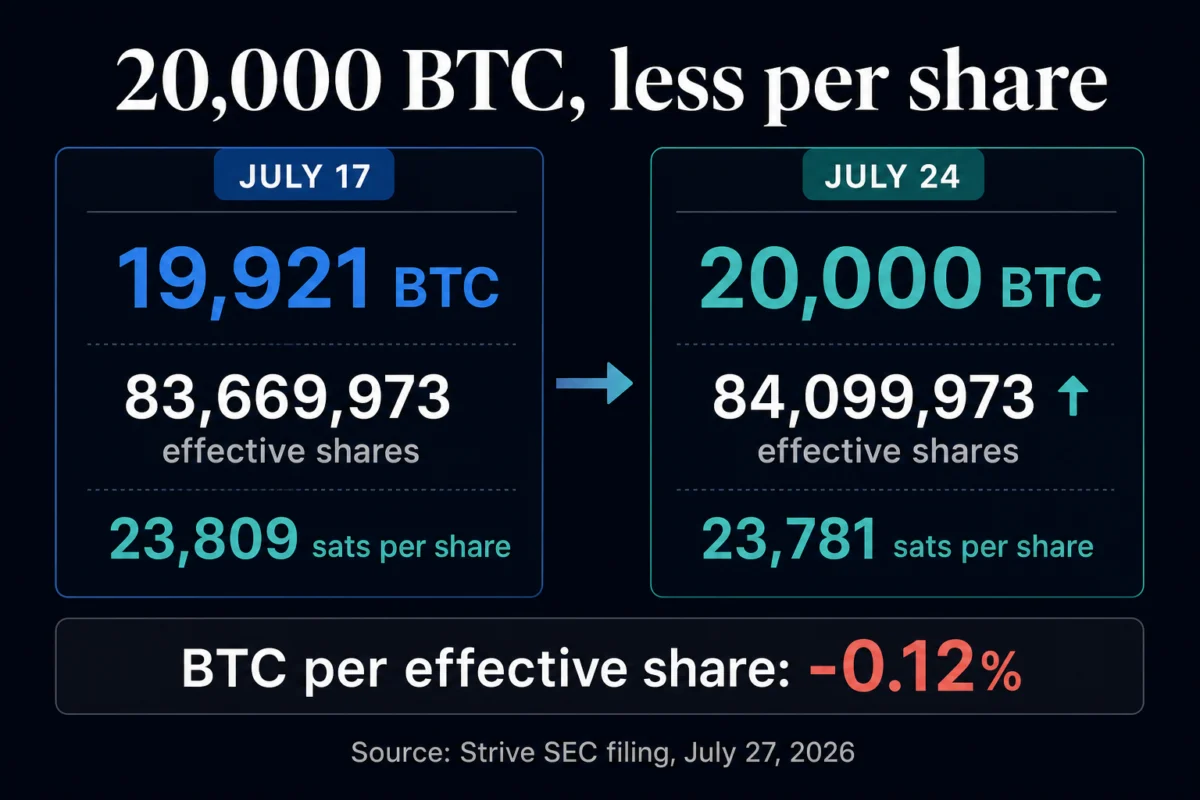
Strive, a prominent Bitcoin treasury company, has successfully expanded its digital asset holdings to surpass the significant milestone of 20,000 Bitcoin. However, this achievement in absolute terms is juxtaposed with a concerning trend for its investors: a reduction in the amount of Bitcoin held per effective common share. This development, detailed in a recent U.S. Securities and Exchange Commission (SEC) filing, highlights the complex interplay between asset accumulation and equity dilution, raising questions about the financing mechanisms behind Strive’s recent Bitcoin acquisitions.
The latest SEC filing, dated July 27, 2026, reveals that Strive acquired an additional 79 Bitcoin between July 20 and July 24. This strategic purchase, executed at an average price of approximately $65,723 per coin, including associated fees and expenses, was instrumental in pushing the company’s total Bitcoin reserves from 19,921 BTC to the coveted 20,000 BTC mark. This expansion of its core asset base is a testament to Strive’s ongoing commitment to accumulating Bitcoin as a foundational treasury asset.
However, the narrative surrounding this accumulation is complicated by a simultaneous increase in Strive’s outstanding common shares. Over the same period, the company’s Effective Common Shares Outstanding surged by 430,000, rising from 83,669,973 to 84,099,973. Strive defines this metric as the combined total of its Class A and Class B common shares. The filing indicates a net increase driven by a rise of 437,477 Class A shares, partially offset by a decrease of 7,477 Class B shares. This increase in the total number of shares directly impacts the proportion of Bitcoin attributable to each individual shareholder.
The Dilution Effect: Bitcoin Per Share Declines
The critical metric for investors is not just the total Bitcoin held, but the amount of Bitcoin each share represents. In this regard, Strive’s recent activity presents a less optimistic picture. Analysis of the provided figures shows that Strive’s Bitcoin holdings per effective common share declined from approximately 23,809 satoshis on July 17 to 23,781 satoshis on July 24. A satoshi, being the smallest indivisible unit of Bitcoin, serves as a granular measure of ownership. This represents a fractional decrease of roughly 0.12% in Bitcoin ownership per share.
This dilutionary trend is further observed when examining Strive’s reported Assumed Fully Diluted Shares Outstanding. Using this broader denominator, which aims to capture all potential equity, the company’s Bitcoin per assumed fully diluted share also experienced a decline, albeit a slightly smaller one of approximately 0.10%.

Discrepancies in Diluted Share Calculation
The calculation of Assumed Fully Diluted Shares Outstanding, as reported by Strive, has drawn attention due to an apparent arithmetic inconsistency. The company states that this figure includes effective common shares, outstanding options, and unvested restricted stock units (RSUs), while notably excluding shares underlying traditional warrants. However, for the July 17 reporting period, the reported total for Assumed Fully Diluted Shares Outstanding was 16,163 shares short of the sum of the individual components listed by Strive. The company has not provided an explanation for this discrepancy. In contrast, the calculation for Effective Common Shares Outstanding directly reconciles with the combined totals of the Class A and Class B common stock classes.
Unresolved Funding Questions
Further compounding the narrative is the lack of clarity surrounding the financing of Strive’s recent Bitcoin acquisition. The company did not disclose the specific reasons for the net increase of 430,000 in Effective Common Shares Outstanding, nor did it explicitly link the proceeds generated from the issuance of these additional shares to the purchase of the 79 BTC.
An examination of Strive’s reported cash movements during the week of the acquisition does not provide a clear answer to this funding question. The implied cost of the 79 BTC, based on the average purchase price, amounts to approximately $5.192 million. However, the company’s cash and cash equivalents decreased by $3.4 million over the same week. This indicates that the cash balance alone was insufficient to cover the entire cost of the Bitcoin purchase, leaving the source of the remaining funds a subject of speculation.
Broader Implications for Bitcoin Treasuries
Strive’s situation underscores a critical challenge faced by companies aiming to build significant Bitcoin treasuries: balancing the desire for asset growth with the need to manage equity dilution. While reaching a headline-grabbing figure like 20,000 BTC is a positive development in absolute terms, its real value to shareholders is contingent on the per-share ownership of those assets.
The rapid increase in common shares, coupled with an opaque funding mechanism for asset purchases, can lead to a scenario where investors, despite the company’s growing Bitcoin holdings, effectively own a smaller slice of the pie. This can impact investor sentiment and the company’s valuation, especially in a market where transparency and clear value accrual are highly prized.
Historical Context and Market Dynamics
The strategy of companies holding significant Bitcoin reserves as a treasury asset gained considerable traction following the public adoption of Bitcoin by companies like MicroStrategy. These firms often issue equity or debt to finance Bitcoin acquisitions, viewing it as a long-term store of value and a hedge against inflation. However, the success of such strategies is often measured not just by the quantity of Bitcoin held, but by the growth of Bitcoin per share outstanding.

Strive’s recent filing highlights that the execution of this strategy is not always straightforward. The company’s decision to increase its share count while simultaneously acquiring Bitcoin suggests a complex financial maneuver. The lack of a clear connection between the share issuance and the Bitcoin purchase raises concerns about the potential for shareholder value to be diluted without a commensurate increase in underlying asset value on a per-share basis.
The Importance of Transparency and Communication
In the competitive landscape of digital asset investment, transparency and clear communication are paramount. Investors rely on accurate and comprehensive reporting to make informed decisions. The inconsistencies and unanswered questions surrounding Strive’s recent filing could lead to increased scrutiny from investors and financial analysts.
Moving forward, it will be crucial for Strive to provide greater clarity on its share issuance policies, the specific purposes of such issuances, and the financial mechanisms employed to fund its Bitcoin acquisitions. This will not only help to rebuild investor confidence but also reinforce the company’s commitment to sustainable value creation for its shareholders.
The achievement of holding 20,000 BTC is a significant operational milestone for Strive. However, the accompanying share dilution and the unresolved funding questions cast a shadow over this achievement, emphasizing the delicate balance required to grow a Bitcoin treasury effectively while safeguarding and enhancing shareholder value. The company’s future trajectory will likely depend on its ability to address these concerns with transparency and strategic financial management.
The market reaction to such developments can be varied. While the absolute increase in Bitcoin reserves might attract attention, the dilutionary aspect can deter potential investors or lead to a reassessment of existing holdings. The ultimate impact will depend on Strive’s subsequent actions and its ability to articulate a clear and compelling strategy for long-term value creation in the evolving digital asset space.