admin
admin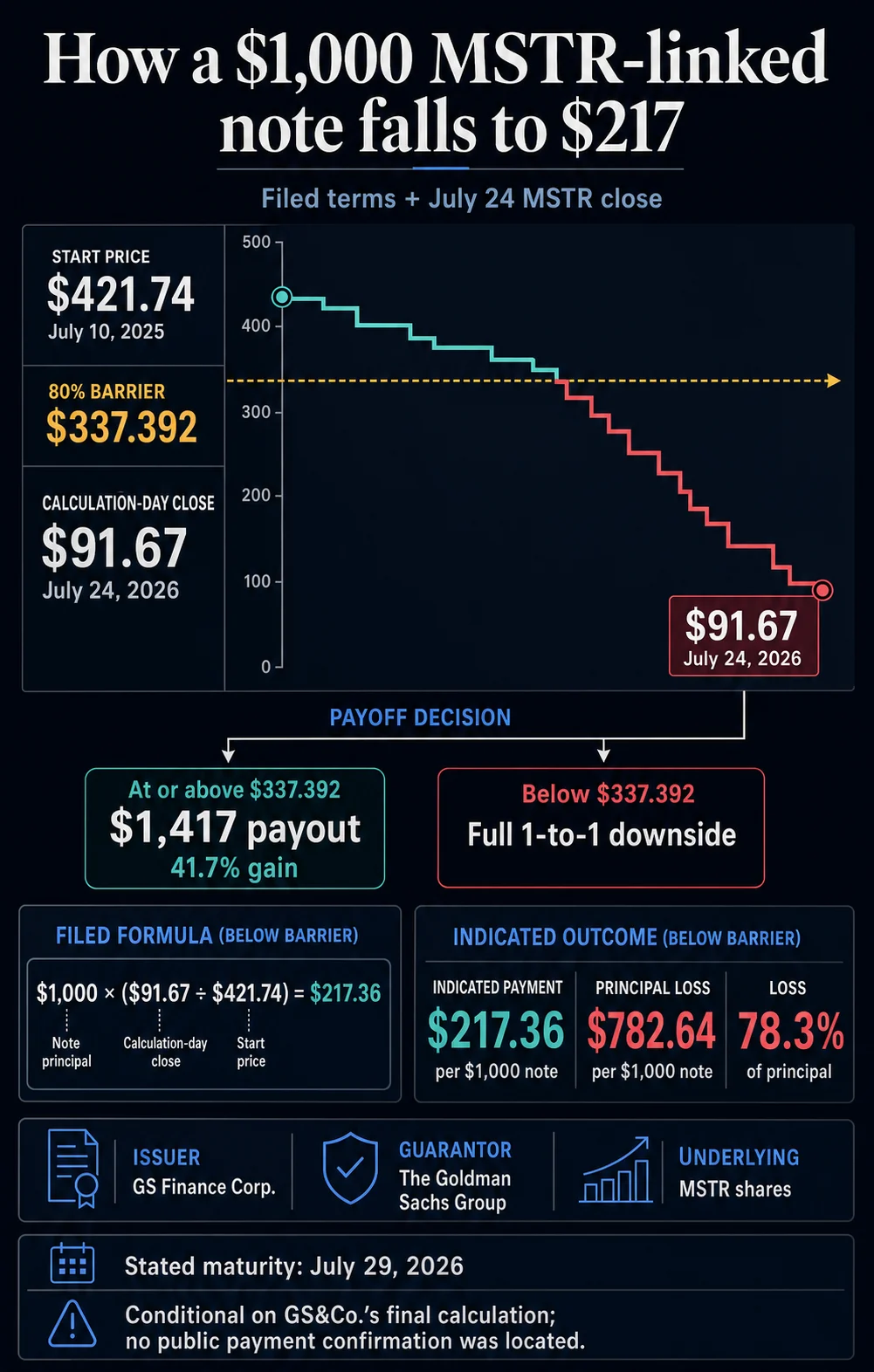
Investors who purchased $1,000 notes issued by GS Finance, and underwritten by The Goldman Sachs Group, Inc., that were linked to the stock performance of MicroStrategy Incorporated (MSTR) are poised to receive a substantially diminished return of approximately $217.36 per note upon their maturity on July 29, 2026. This projection, based on MSTR’s closing price of $91.67 on July 24, 2026, indicates a potential loss of roughly $783, or 78.3%, of the initial principal investment. While Goldman Sachs & Co. LLC retains the authority to finalize the calculation and potentially adjust terms or postpone the maturity date, current data strongly suggests a significant shortfall for these structured notes.
The financial instrument, detailed in a SEC-filed pricing supplement, was designed to offer investors a return based on the performance of MSTR shares. However, the note’s payoff structure included a critical "barrier" level that, if breached, triggered a downside formula significantly impacting the investor’s principal. MSTR’s starting price for the note was established at $421.74, with a barrier set at 80% of this value, equating to $337.392. Had MSTR’s closing price remained at or above this barrier on the calculation date, investors would have been entitled to $1,417 per $1,000 note, representing a 41.7% contingent gain. The precipitous decline in MSTR’s stock price has, however, pushed the note deep into this downside protection mechanism.
A Steep Decline Triggered by Market Volatility
The critical factor determining the payout for these GS Finance notes is the closing price of MicroStrategy’s MSTR shares on the specified calculation date. According to historical data aggregated by financial information providers such as Investing.com and Twelve Data, MSTR closed at $91.67 on July 24, 2026. This price point represents a dramatic fall from the initial price of $421.74 and, crucially, lies far below the $337.392 barrier.
The payoff structure of these notes creates a pronounced "cliff effect." A closing price precisely at the barrier level of $337.392 would have secured the full enhanced payout of $1,417. However, any closing price even infinitesimally below this threshold irrevocably shifts the investor’s return to a downside formula. This formula is calculated based on MSTR’s full decline from the initial $421.74 price, with no cap on potential losses once the barrier is breached.

The downside calculation for the note is structured as follows: the maturity payment equals $1,000 plus the product of $1,000 and MSTR’s percentage return from its starting price. With MSTR closing at $91.67, its return from the $421.74 starting price is a negative 78.17% ($91.67 / $421.74 – 1). Applying this to the downside formula, the indicated payment per $1,000 note is approximately $217.36 ($1,000 + $1,000 (-0.7817)). This can also be expressed as $1,000 multiplied by the ratio of the current price to the starting price: ($1,000 $91.67) / $421.74 = $217.36. This means investors are on track to recover just over 22 cents for every dollar invested.
The Role of Goldman Sachs and Distribution Channels
GS Finance, a subsidiary of The Goldman Sachs Group, Inc., issued these notes, with the parent company providing the ultimate guarantee for any payouts. This financial backing from a major institution like Goldman Sachs typically instills confidence in investors regarding the security of their principal, contingent on the performance of the underlying asset. However, in cases of extreme underperformance of the linked asset, as seen with MSTR, the note’s structure dictates the final return, even with a robust issuer.
Wells Fargo Securities played a role in the distribution of these notes, and Wells Fargo Advisors was identified as a potential channel for resale. This multi-faceted distribution network ensured broad accessibility to the structured product for a diverse range of investors. The SEC filing for the pricing supplement, dated July 14, 2025, meticulously outlines the terms and conditions, including the initial pricing, barrier levels, and the contingency formulas governing the payout.
Chronology of Events and Key Dates
The pricing supplement was filed on July 14, 2025, establishing the parameters for the structured notes. The starting price for MSTR was set at $421.74, and the crucial barrier was defined at $337.392. The calculation date, which determines the final payout, was July 24, 2026. The maturity date for these notes is July 29, 2026, when the final payments are scheduled to be made.

The period between the pricing supplement filing and the calculation date saw significant volatility in the cryptocurrency and technology sectors, impacting the price of MSTR shares, which are closely tied to the performance of Bitcoin due to MicroStrategy’s substantial holdings. MSTR’s trading range on July 24, 2026, as reported by financial data services, was between $89.76 and $93.68, with the closing price settling at $91.67. This price action occurred without any apparent trading halts or unusual regulatory actions logged on Nasdaq Trader’s halt log for that date, suggesting the decline was a function of market forces rather than immediate trading disruptions.
Analysis of Implications and Broader Impact
The significant underperformance of these MSTR-linked notes highlights the inherent risks associated with structured financial products, particularly those tied to volatile assets. While offering the potential for amplified returns in favorable market conditions, they also expose investors to substantial losses when the underlying asset experiences sharp declines. The "cliff effect" in this particular note’s structure means that even a minor dip below the barrier can lead to a drastically reduced payout, turning a potentially moderate gain into a significant capital loss.
For investors who held these notes, the outcome represents a harsh lesson in risk management and the importance of thoroughly understanding the payoff mechanisms of any investment. The projected return of approximately 22 cents on the dollar means that a $1,000 investment is effectively worth only $217.36 at maturity. The total aggregate face amount of the offering was $660,000, as recorded in the final supplement. However, the filing does not specify the total principal amount outstanding at maturity, making it challenging to estimate the aggregate losses across all investors in this specific offering without further clarification from the issuer.
Goldman Sachs & Co. LLC’s role as the final arbiter of the calculation means that while the $217.36 figure is strongly supported by the available data and filed terms, any contractual determination by the firm remains the ultimate determinant of the payout. Public records reviewed did not indicate any CUSIP-specific postponements, corporate-action adjustments, or formal final payment notices that would alter the projected outcome based on the current MSTR price. Therefore, assuming the scheduled dates and filed terms remain unchanged, the indicated payout of approximately 22 cents on the dollar is the most probable scenario. This situation underscores the critical need for investors to scrutinize the terms of structured products and to consult with financial advisors who can provide a comprehensive understanding of the associated risks and potential outcomes. The performance of MSTR, often seen as a proxy for institutional adoption of Bitcoin, has been subject to significant market sentiment and regulatory scrutiny, factors that have undoubtedly contributed to the price action leading to this outcome for noteholders.