James Watt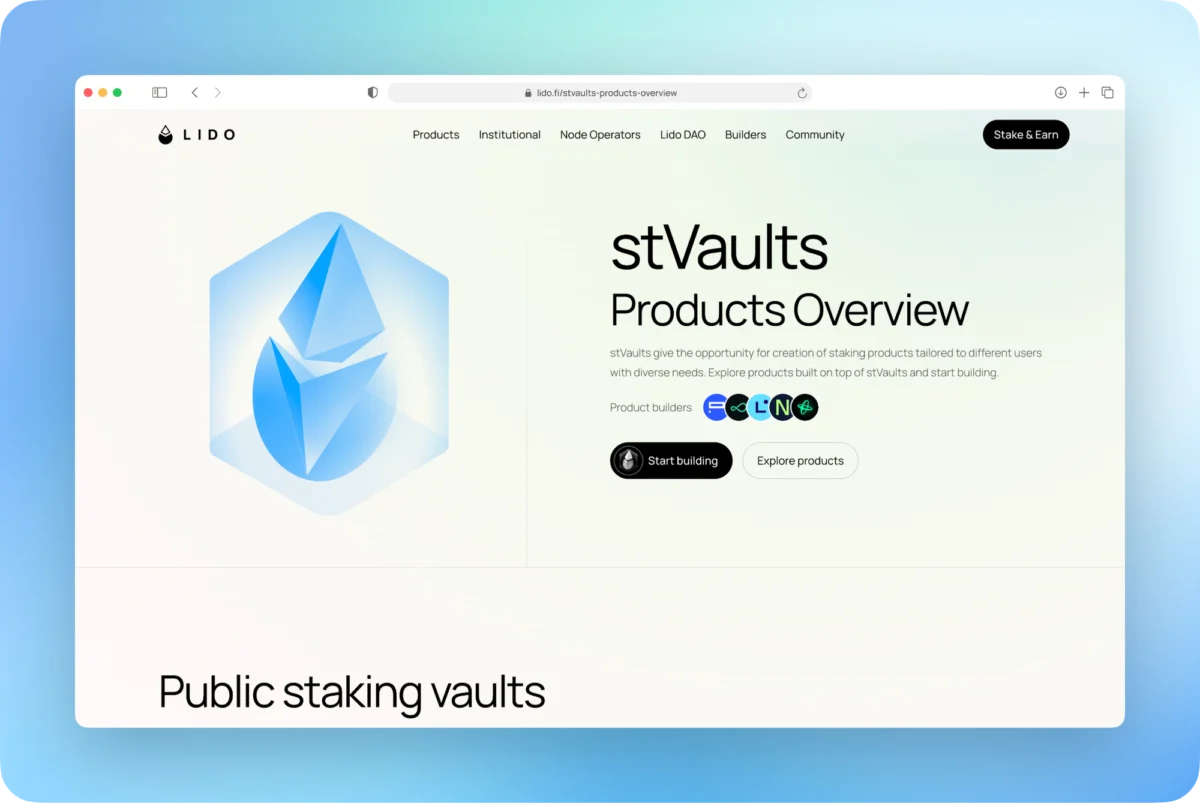
The evolving landscape of Ethereum staking witnessed a pivotal advancement with the introduction of stVaults, a new primitive within Lido V3 designed to bridge the historical divide between native staking and pooled staking models. This innovative solution empowers Node Operators with unprecedented control over validator operations while simultaneously offering clients the robust liquidity of stETH and seamless integration with decentralized finance (DeFi) protocols. April 2026 marked a period of significant development and refinement for stVaults, with a suite of new features and improvements aimed at enhancing usability, operational efficiency, and institutional accessibility. These updates underscore Lido’s commitment to fostering a more flexible, secure, and user-centric staking ecosystem, particularly as the Ethereum network continues to mature and attract a broader spectrum of participants, from individual stakers to large-scale institutional players.
Navigating the Ethereum Staking Landscape: A Deeper Dive into stVaults
Before the advent of liquid staking, participation in Ethereum’s Proof-of-Stake consensus mechanism typically required locking up a minimum of 32 ETH to run a validator, a process known as native staking. While offering direct control and rewards, this method came with significant capital requirements, technical expertise demands, and a lack of liquidity for the staked assets. Pooled staking, pioneered by protocols like Lido, emerged to address these challenges by allowing users to stake any amount of ETH and receive liquid staking tokens (LSTs) like stETH in return, providing liquidity and composability within DeFi. However, traditional pooled staking models often meant Node Operators ceded some control over their individual validator operations to the pooling protocol. stVaults represent a third way, offering the best of both worlds: Node Operators retain full, granular control over their validators, similar to native staking, but can still leverage Lido’s infrastructure to offer stETH liquidity and integrated DeFi opportunities to their clients. This hybrid approach is particularly attractive to institutional stakers and professional node operators seeking robust operational autonomy alongside the benefits of liquid staking.
Ethereum’s Validator Entry Queue: A Growing Bottleneck and stVaults’ Role
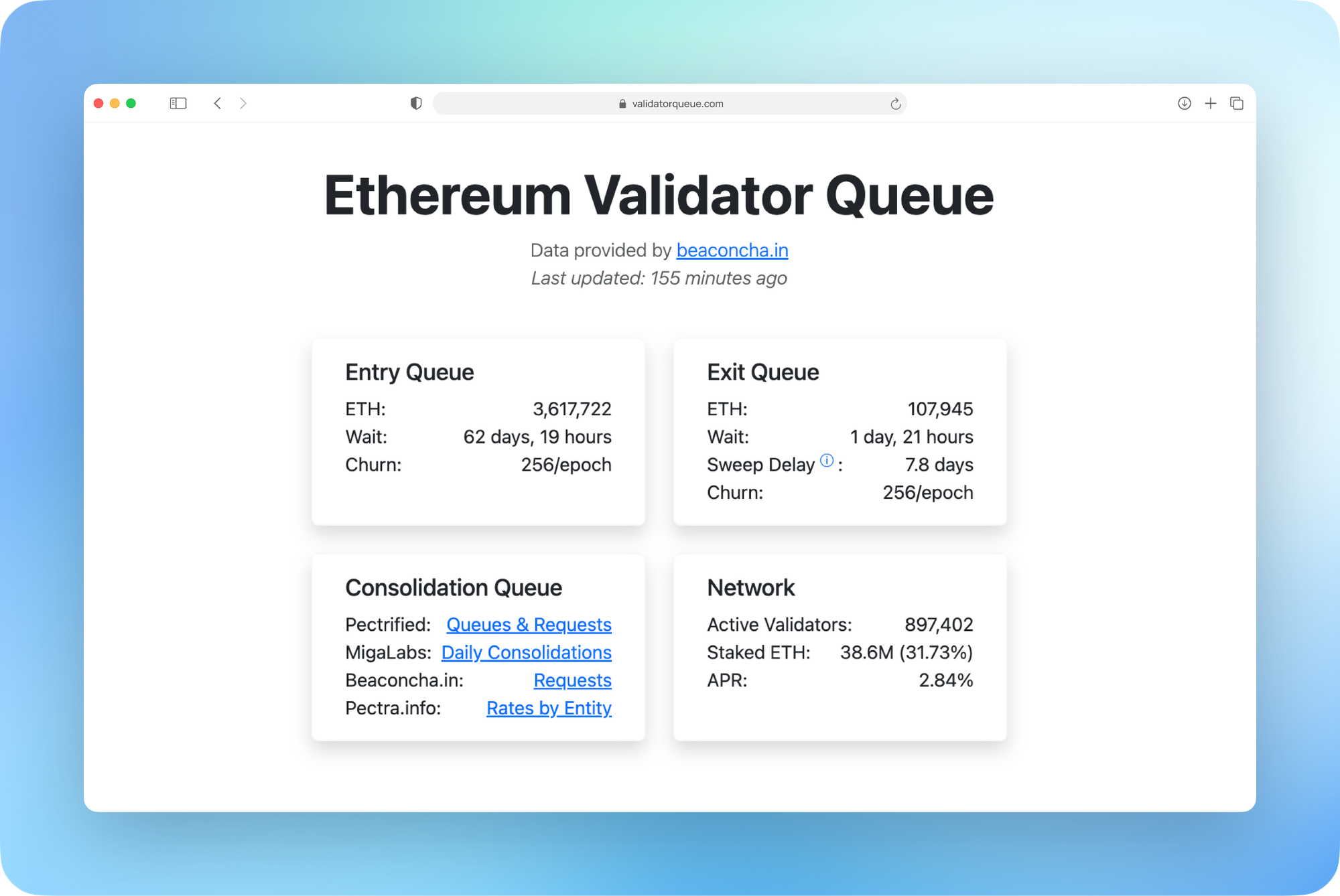
Throughout April, the Ethereum validator entry queue experienced a notable surge, extending activation times to approximately 54 days by the month’s end. This prolonged queue, which represents the waiting period for new validators to become active on the Beacon Chain, is a direct consequence of the network’s increasing popularity and the continuous influx of ETH being staked. While a healthy queue indicates robust participation and network security, an extended waiting time can pose challenges for stakers, leading to opportunity costs and delayed yield generation. The delay means that capital committed to staking remains unproductive for nearly two months before it can begin earning rewards.
In response to this growing bottleneck, Lido contributors have actively explored and surfaced two strategic options designed to assist stakers in initiating their migration to stVaults and maximizing their benefits even amidst the extended queue. While specific details of these options were not fully elaborated, they are understood to focus on mechanisms that allow stakers to prepare their assets and configurations for stVaults activation more efficiently, potentially mitigating the impact of the long wait. This proactive approach highlights stVaults’ utility not just as a flexible staking primitive but also as a tool to navigate current network challenges, enabling stakers to plan and execute their staking strategies with greater foresight and reduced friction. The ability to pre-position assets and configurations is critical for institutional clients who require precise planning and operational certainty.
Expanding the stVaults Ecosystem: Products and DeFi Integrations
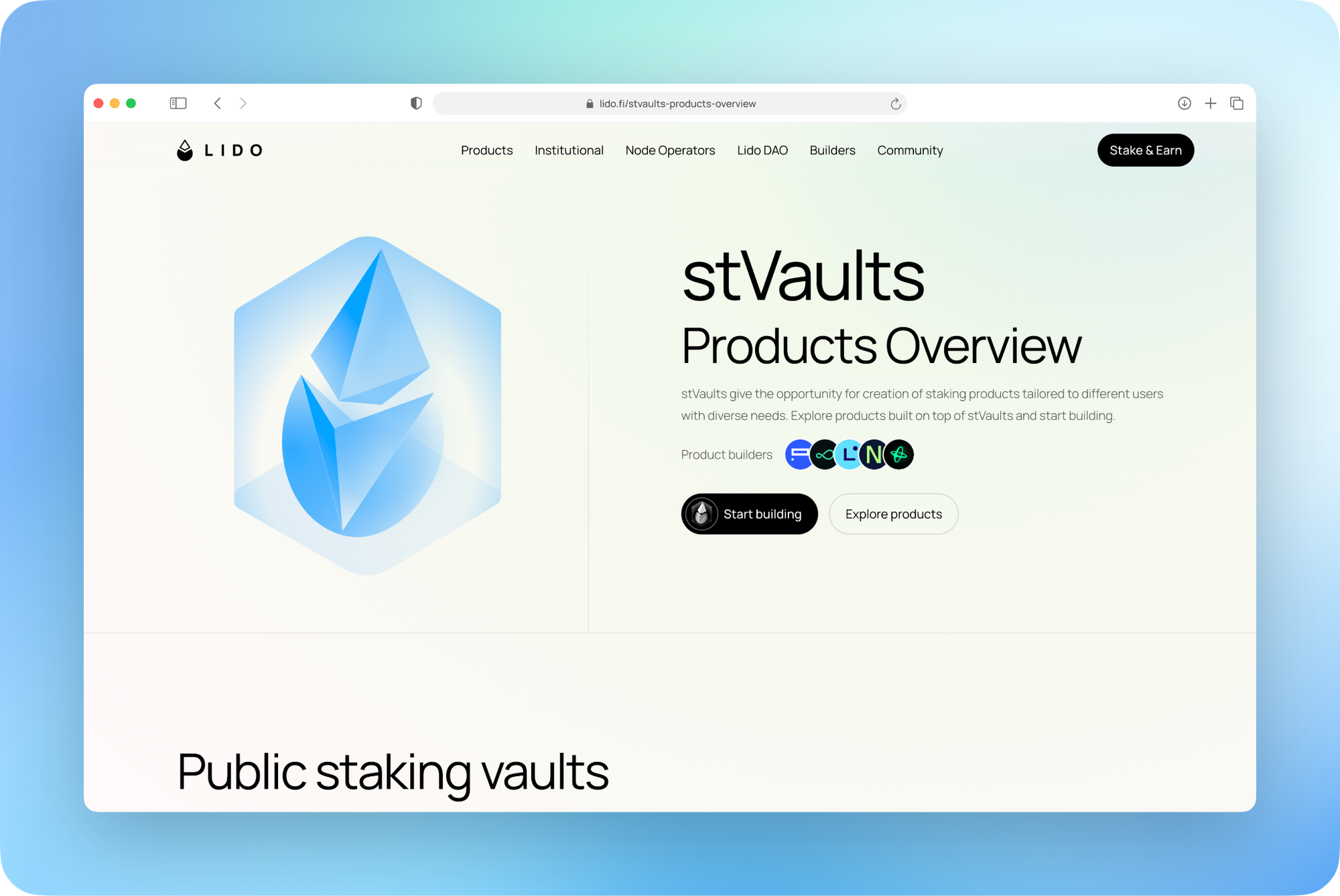
A significant development in April was the launch of a dedicated Products Overview Hub for stVaults, accessible via lido.fi/stvaults/stvaults-products-overview. This centralized discovery hub serves as a showcase for leading vault-based products built on the Lido platform, providing a clear entry point for potential users to explore various solutions tailored to their specific needs. At its initial launch, three distinct products were featured, signaling the nascent but rapidly growing ecosystem forming around stVaults. The hub is not merely a directory but a strategic initiative to foster innovation and collaboration within the stVaults framework. To encourage broader participation and development, Lido has also established a clear process for vault builders to submit their products for consideration and potential feature on the overview page, demonstrating a commitment to nurturing a diverse and competitive environment.
Further enhancing the utility and composability of stVaults, the DeFi Wrapper integrated a direct connector to Lido Earn, a platform designed to unlock various yield-generating opportunities for stETH holders. This integration creates a streamlined pathway for vault-issued stETH to flow seamlessly into a wide array of composable DeFi applications. For builders leveraging the DeFi Wrapper, this means they can now incorporate Lido Earn strategies directly into their vault designs without the need for additional, complex plumbing or custom integrations. This reduces technical overhead and accelerates the development of sophisticated, yield-optimized staking products. The ability to easily route stake to Earn strategies significantly enhances the value proposition of stVaults, offering clients not only staking rewards but also access to diversified DeFi yields, thereby maximizing the capital efficiency of their staked ETH.
Operational Excellence: Innovations in stVaults Web UI and CLI
April brought a wave of significant enhancements to both the stVaults Web User Interface (UI) and the Command Line Interface (CLI), focusing on improving monitoring, control, and overall user experience. These updates are particularly crucial for institutional stakers and professional node operators who demand robust tools for managing complex staking operations.
StVaults Web UI: Granular Control at Your Fingertips
The stVaults Web UI received several key upgrades, transforming it into a more powerful and intuitive platform for vault builders and owners to oversee performance and execute critical operations:
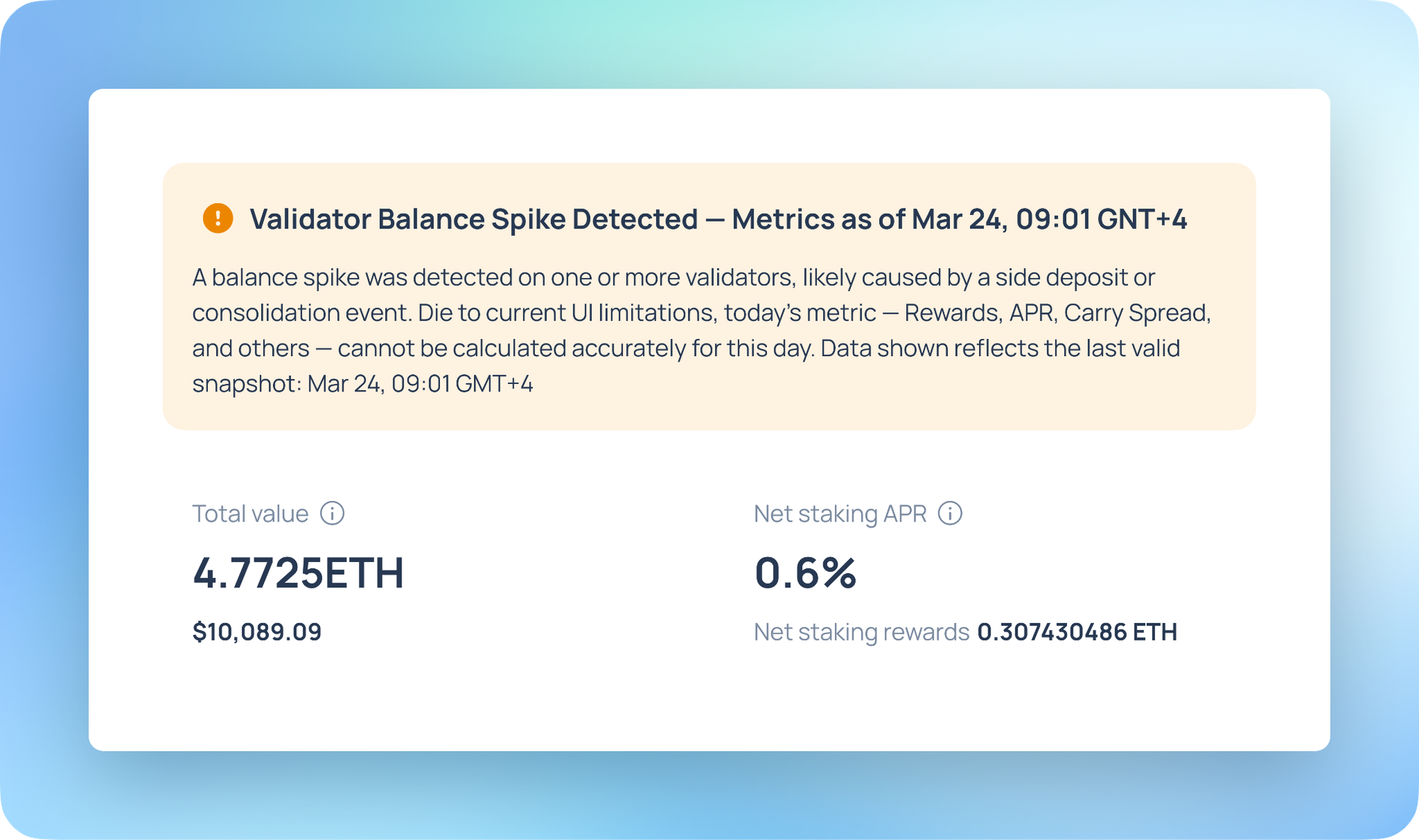
- Handling Large Deposits and Consolidations in Key Metrics: A common challenge in validator management, especially with a fluctuating entry queue, involves large, unguaranteed deposits and validator consolidations. These events can often cause anomalous spikes in performance metrics like Annual Percentage Rate (APR) and CarrySpread, distorting the true underlying performance. The updated Web UI and CLI now intelligently detect these as statistical outliers and automatically exclude them from rolling calculations. This provides users with a more accurate and representative view of their vault’s sustained performance. Furthermore, users are now presented with a clear warning on the stVault details page when such exclusions occur, maintaining transparency and informing them of any data adjustments. This feature is vital for accurate financial reporting and performance analysis, preventing misleading data points from influencing strategic decisions.
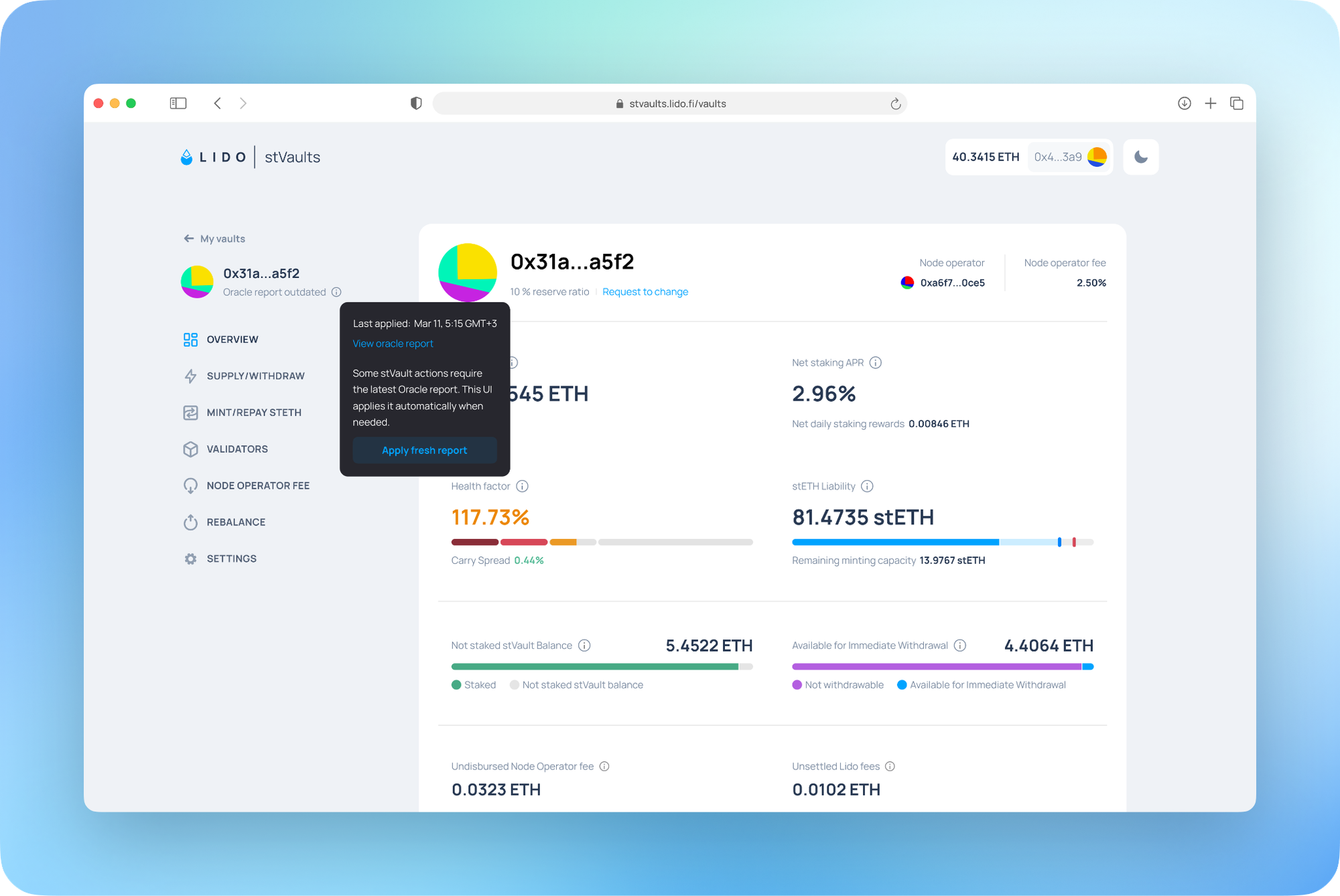
- Oracle Report Status Indicator: Transparency regarding data freshness is paramount in a dynamic blockchain environment. The Overview page now prominently displays the date and status of the latest oracle report. This allows users to quickly ascertain the recency of the data informing their vault’s metrics. For immediate updates, users can manually request a fresh report by clicking the "Apply fresh report" button, or the system automatically applies the latest report before any action requiring up-to-date data is executed. This ensures that all operational decisions are based on the most current information available, enhancing operational integrity.
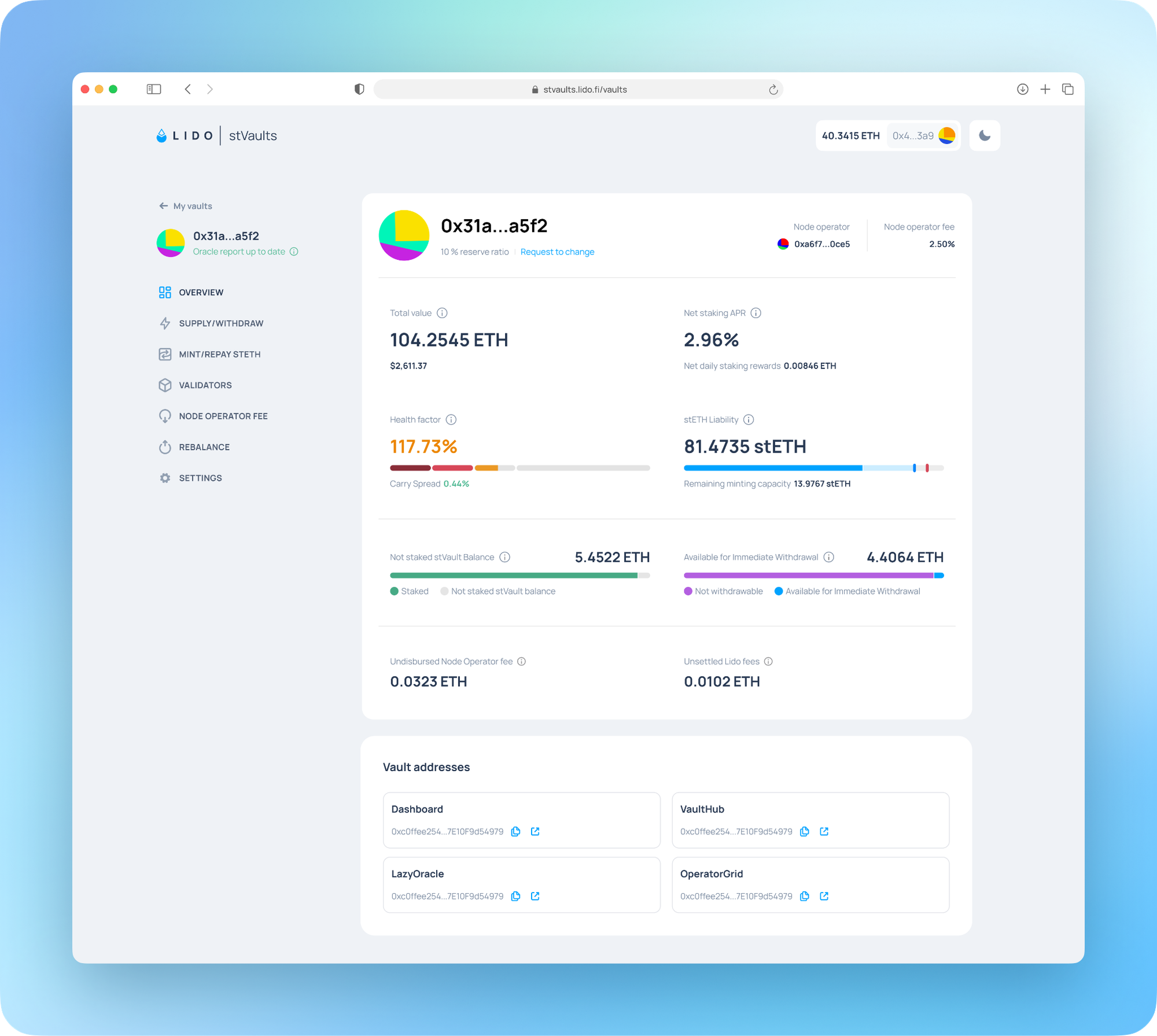
- stVault Address Overview: Navigating the multitude of smart contract addresses associated with a stVault can be complex. To simplify this, the stVaults Web UI now provides a comprehensive list of important associated addresses, including the Dashboard, VaultHub, OperatorGrid, and LazyOracle. This centralized display on the stVault details page allows users to easily locate specific addresses for interactions with Etherscan, for use in the CLI, or for auditing purposes. This improvement significantly reduces friction for users needing to interact directly with the underlying blockchain infrastructure.
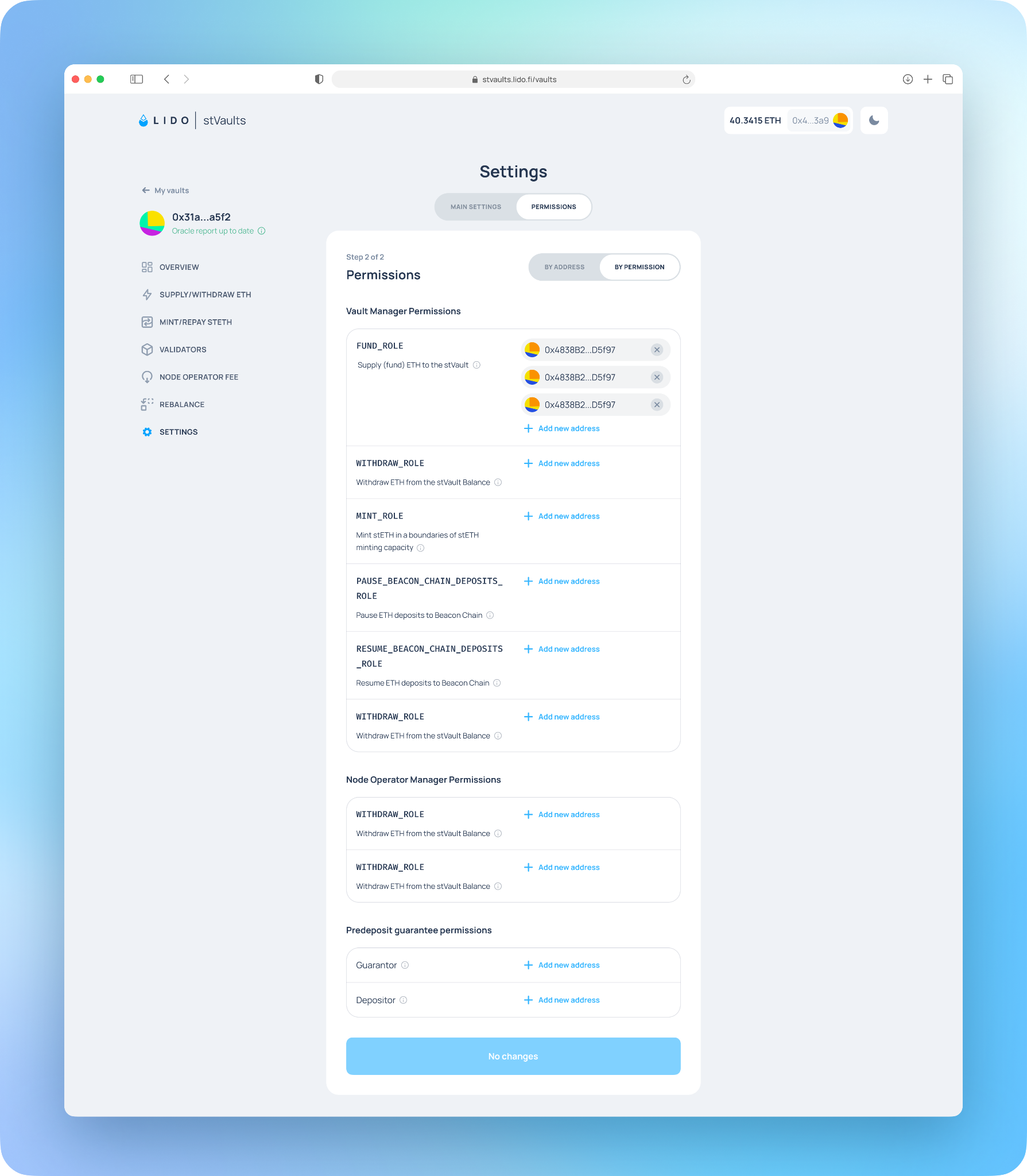
- Permissions Page Improvement: For multi-user environments, especially those involving institutional teams, clear role definition and access control are critical. The Permissions settings page has been enhanced to display technical names for various roles and permissions, ensuring consistency across both the Web UI and CLI. This standardization aids users who frequently switch between interfaces. Moreover, full descriptions of each role are now directly accessible within the UI, providing comprehensive context and facilitating more informed management of access rights. This upgrade enhances security and operational clarity for teams managing stVaults.
- Validators Page: Status, Top-ups & Withdrawals: Perhaps one of the most significant UI enhancements is the expanded functionality on the Validators page. Users can now directly monitor the real-time status of their validators on the Beacon Chain. Crucially, depending on their assigned role and permissions, they can also initiate top-ups from the stVault balance or perform partial or full withdrawals directly through the Web UI. This eliminates the previous dependency on the CLI for these core validator management actions, marking a substantial step towards enabling institutional stakers to exercise truly granular control over their funds and validator operations entirely through a user-friendly web interface. This move drastically lowers the barrier to entry for institutions and simplifies day-to-day management.
StVaults CLI v1.6 – 1.8: Power and Precision for Developers
The stVaults Command Line Interface also underwent several robust updates, catering to developers and advanced operators who require powerful scripting and detailed control:
- New Capabilities: The CLI now offers full support for strategy contracts connected to StvStrategyPool, including dedicated read/write commands and comprehensive timelock governance flows (propose/execute) at the same level as standard pools. Etherscan contract verification is seamlessly handled directly by Factory commands, streamlining deployment and auditing processes. A new
statistic-by-reports-fullcommand provides operators with a granular, report-by-report breakdown of performance. The Distributor component now supports both claim-based and snapshot-based distribution modes, offering greater flexibility. Operators can also pause and resume minting for thestv-steth-pool, enabling more dynamic management. Crucially, the entire metrics methodology has been fully documented, providing clarity and transparency for all users. - Metric Accuracy: Calculations for
netAPR,CarrySpread, andaccrued-feehave been meticulously refined to maintain accuracy even when fee withdrawals or stETH minting events occur mid-period. The accrued fee is now computed off-chain from IPFS data, ensuring that figures remain correct even if the latest oracle report has not yet been applied on-chain. This off-chain computation significantly enhances the reliability of financial reporting. - Reliability & Security: A dedicated security pass was conducted, hardening input validation, URL handling, and cache processing across the CLI, bolstering the tool’s overall robustness against potential vulnerabilities. Gas estimation now correctly handles transactions from low-balance accounts, preventing unexpected failures. JSON output has been cleaned up, making it more pipe-friendly for scripting and automation. Addresses displayed in tables are now clickable links to block explorers, improving traceability and convenience. Lastly, IPFS support has been upgraded to include CIDv1, enhancing compatibility and future-proofing. The full changelog details these extensive updates, showcasing a commitment to continuous improvement.
Knowledge Base and Institutional Readiness: The Doc Center and Lido Poolside
To support the growing complexity and user base of stVaults, the stVaults Doc Center has been launched as a centralized repository for guides, references, and how-tos. This single home for all stVaults-related documentation aims to empower users with comprehensive information and facilitate self-service.
A landmark addition to the Doc Center is the section on Qualified Custodians, featuring two in-depth user guides. These guides meticulously detail the workflows that institutional stakers and their appointed custodians can utilize when interacting with stVaults. This focus on qualified custodians is a critical step towards onboarding traditional financial institutions into the liquid staking space. Qualified custodians play an essential role in traditional finance by safeguarding assets and ensuring regulatory compliance, and their integration into the stVaults framework addresses key concerns around security, accountability, and regulatory adherence for institutional participants. More guides covering various facets of stVaults are slated for release throughout May, further solidifying the platform’s knowledge infrastructure.
Complementing these technical advancements and documentation efforts, Lido hosted its Lido Poolside: Institutional call in April 2026. This dedicated event brought together prominent figures from the institutional crypto space, including Adam Levine, CEO of Fireblocks Trust Company; representatives from Credora; and FalconX. Discussions centered on crucial topics such as facilitating DeFi access from qualified custody solutions, Credora’s groundbreaking achievement of issuing the first public asset-level rating on a liquid staking token (stETH receiving an impressive A+), and the future trajectory of institutional Ethereum staking. The A+ rating for stETH from Credora is a significant validation, signaling increasing maturity and acceptance of liquid staking tokens as legitimate, high-quality digital assets within institutional frameworks. The insights shared by Fireblocks and FalconX further highlighted the growing demand for secure, compliant, and integrated solutions for institutional participation in Ethereum staking, underscoring the strategic importance of stVaults in meeting these evolving requirements.
Broader Implications and The Road Ahead
The comprehensive updates to Lido’s stVaults in April 2026 represent more than just incremental improvements; they signify a strategic push towards solidifying stVaults as the premier solution for flexible, controlled, and institutionally-ready Ethereum staking. By addressing critical operational needs, enhancing user experience through intuitive UIs, bolstering developer tools, and building robust documentation and institutional support, Lido is actively shaping the future of decentralized finance.
The prolonged Ethereum validator entry queue, while a challenge, also underscores the network’s vitality and growing demand for staking. stVaults, with its ability to offer a hybrid model that blends control with liquidity and DeFi access, is uniquely positioned to help alleviate some of the pressures associated with this queue, allowing for more efficient capital deployment and management for professional operators. The emphasis on institutional-grade features, such as enhanced permissions, reliable metrics, and support for qualified custodians, is particularly timely. As more traditional financial entities explore the digital asset space, solutions that offer familiar levels of control, security, and compliance will be crucial for accelerating mainstream adoption of liquid staking.
Looking ahead, the commitment to "exciting stVaults developments planned for May" suggests a continued trajectory of innovation. This might include further integrations with DeFi protocols, advanced reporting functionalities, or even more streamlined onboarding processes for various types of stakers. The ongoing evolution of stVaults reinforces Lido’s position as a leader in the liquid staking domain, continuously adapting to market demands and technological advancements to provide a robust, secure, and highly functional platform for all participants in the Ethereum ecosystem.
For those interested in exploring the capabilities of stVaults for their specific vault, product development, or strategic roadmap, Lido encourages direct engagement to discuss potential integrations and benefits.