Lina Irawan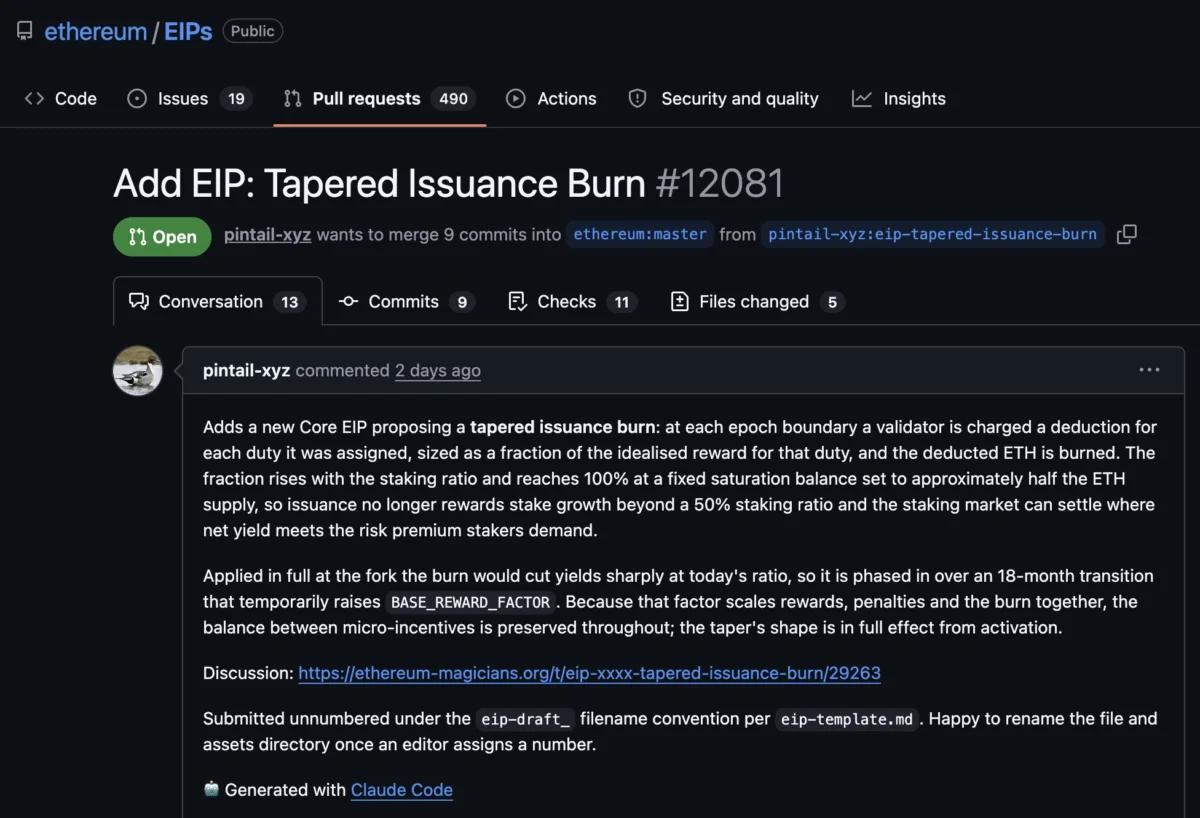
Ethereum is currently navigating a significant debate surrounding its core economic policy, specifically the issuance of new ETH to reward network validators. This discussion has been ignited by the submission of Ethereum Improvement Proposal (EIP) 8363, titled "Tapered Issuance Burn," to the Ethereum EIPs repository on August 4, 2026. The proposal seeks to recalibrate how Ethereum rewards its validators in a landscape where over one-third of the total ETH supply is already committed to staking. With a persistent and substantial validator queue, the community is increasingly questioning whether the current issuance mechanism is inadvertently over-incentivizing staking, potentially leading to unintended consequences for the network’s long-term economic security and decentralization. If adopted, EIP-8363 would introduce a mechanism where staking rewards gradually decline as the proportion of staked ETH increases, aiming to disincentivize further staking once approximately 50% of the total ETH supply is staked.
Unpacking EIP-8363: A Proposed Shift in Issuance Dynamics
EIP-8363, officially designated as "Tapered Issuance Burn," introduces a nuanced approach to managing ETH issuance by proposing the burning of a portion of validator rewards rather than a direct reduction in the overall issuance rate. This innovative strategy, categorized as a Core EIP, aims to dynamically adjust rewards based on the network’s staking ratio. At each epoch, the proposal dictates a calculation of a deduction from an "ideal" validator reward, with the deducted ETH subsequently being burned.
The central tenet of EIP-8363 is its "taper" mechanism. This taper is designed to progressively increase the deduction percentage as the staking ratio – the proportion of staked ETH relative to the total ETH supply – climbs. As this ratio approaches the proposed threshold of approximately 50%, the burn rate on consensus-layer rewards escalates, ultimately reaching 100%. This means that once the 50% staking threshold is met, net consensus-layer issuance would cease to provide any additional economic incentive for further staking, effectively capping the growth of staked ETH from an incentive perspective.
Jerome de Tychey, President of Ethereum France and a prominent proponent of the proposal, has outlined a phased implementation strategy. He indicates that the yield reduction mechanism would be gradually introduced over an 18-month period. During this transition, the effective base reward factor for validators would linearly decrease from its current level of 128 to 64. Factoring in an estimated six months required for hard fork preparation and network upgrades, validators and staking service providers would have approximately two years to adapt to the proposed changes. This extended timeline is intended to facilitate a smooth transition and minimize disruption for network participants.
The Genesis of the Debate: Rapid Staking Growth and its Implications
The current debate surrounding ETH issuance is a direct consequence of Ethereum’s burgeoning staking participation. With more than one-third of its total supply already staked, any adjustments to validator rewards have become a highly sensitive topic with potentially far-reaching implications. As of recent data, the Ethereum network has approximately 41.6 million ETH staked, representing a significant 34.1% of the total supply. This substantial amount is secured by around 895,774 active validators. Furthermore, an additional roughly 2.5 million ETH remains in the validator entry queue, a clear indicator that the demand for staking has not diminished.

Considering the total ETH supply stands at approximately 121.9 million ETH, the 50% staking milestone would translate to roughly 61 million ETH staked. While the network has not yet reached this specific threshold based on active stake, the sustained growth rate of staking and the persistent length of the validator queue have elevated the issuance discussion from a theoretical academic exercise to a pressing policy issue requiring practical solutions.
Proponents of EIP-8363, including de Tychey, argue that the current staking dynamics could lead to a scenario where the validator queue remains saturated, potentially driving the amount of staked ETH to increase by as much as 1.75 million ETH per month. In a more conservative projection presented by the proposal’s supporters, if this trend were to continue, over 70 million ETH could be staked by January 1, 2028, representing over 55% of the total supply. While this is a scenario presented to illustrate the potential trajectory and not a guaranteed forecast, it underscores the urgency perceived by EIP-8363 advocates in addressing the issuance policy before the staking ratio approaches the 50% mark. This proactive approach aims to preemptively manage the economic incentives driving staking behavior.
The Rationale Behind Burning Issuance
The core argument presented by proponents of EIP-8363 is not solely about the volume of ETH that Ethereum issues, but rather the absence of a clear endpoint or disincentive within the current staking reward structure. Jerome de Tychey elaborates that under the existing reward curve, the annual yield for staking does not drop below approximately 1.5%, even in theoretical scenarios where 100% of ETH is staked. He posits that if staking continues to be perceived as a low-risk, high-yield investment, the current mechanism could indefinitely draw more ETH into staking, even when the network has already achieved a robust level of economic security.
The proposal to burn a portion of issuance is designed to mitigate two primary risks. Firstly, it aims to prevent excessive dilution for non-stakers, ensuring that the value of their ETH holdings is not disproportionately eroded by continuous inflation driven by staking rewards. Secondly, it addresses concerns about the diminishing role of native ETH within the broader ecosystem, particularly as liquid staking tokens (LSTs) gain traction and increasingly substitute for direct ETH holdings in various decentralized finance (DeFi) applications.
Furthermore, supporters of EIP-8363 contend that a higher staking ratio does not automatically translate to a more secure Ethereum network, especially if new stake becomes heavily concentrated within a few large custodians, staking providers, or institutional ETF issuers. The proposal’s model projects that under the tapered issuance system, the annual issuance would peak at around 0.5% of the total supply when the staking ratio is near 20%. Subsequently, it would gradually taper down to zero as the staking ratio approaches 50%. For its proponents, this controlled issuance mechanism, when combined with the existing EIP-1559 fee burn, offers greater predictability and stability to the ETH supply dynamics.
Opposition and Concerns from Stakers and DeFi
Despite the compelling arguments from proponents, EIP-8363 has encountered significant pushback from various segments of the Ethereum community, particularly from active stakers and participants in the DeFi ecosystem. On the Ethereum Magicians forum, a platform dedicated to technical discussions and proposals, several voices have raised concerns that such a fundamental shift in monetary policy should not be rushed into a hard fork process. This sentiment is amplified by the proposal’s submission timing, which occurred close to critical discussion deadlines for the upcoming Bogota hard fork.

A key concern articulated by critics is the potential impact on solo stakers. These individuals, often operating with higher operational costs, facing risks of downtime, and subject to tax obligations, might find themselves exiting the market if net rewards are significantly reduced. This could inadvertently favor large institutions and professional staking providers, who possess greater economies of scale and more robust infrastructure, thereby potentially undermining the network’s decentralization goals. The argument is that a substantial reduction in yield could disproportionately impact smaller, independent validators.
For the DeFi sector, the staking yield currently serves as a crucial benchmark or reference rate for a wide array of ETH-denominated yield markets. This includes strategies involving LSTs, lending protocols, and fixed-yield products. A sharp decline in staking yield could have cascading effects, impacting the profitability and viability of these strategies. For instance, those relying on the spread between staking yield and borrowing costs, or using LSTs as collateral in leveraged positions, could face significant disruptions.
Additionally, the specific design choice of a "mint-then-burn" mechanism over a simpler "minting less" approach has been questioned. Critics argue that this method could introduce additional tax uncertainty for stakers and other participants, as it involves the creation of new ETH which is then subsequently destroyed, potentially creating complex accounting and reporting requirements.
The Path Forward for EIP-8363
Currently, EIP-8363 remains an active proposal undergoing rigorous review and discussion. The Pull Request on the GitHub repository is still in the evaluation phase, and the Ethereum Magicians forum continues to be the primary hub for feedback from a diverse range of stakeholders, including stakers, researchers, and DeFi protocol developers.
The immediate next steps for EIP-8363 involve its potential inclusion in core developer calls, where its technical feasibility and strategic alignment with the Ethereum roadmap will be debated. Subsequently, it will need to be integrated into a specific hard fork proposal for adoption by the network. Should EIP-8363 progress through these stages, the focus of the debate will likely shift from the fundamental question of whether issuance should be reduced to more granular implementation details. These will include the precise methodology for reduction, the duration of the phase-in period, the appropriateness of the 50% staking threshold, and a comparative analysis of whether burning validator rewards offers a superior outcome compared to directly adjusting the issuance rate.
At present, while Ethereum has successfully staked over one-third of its total supply, it has not yet approached the 50% mark. Therefore, EIP-8363 should be understood as a proactive measure by its proponents to preemptively address a trajectory they perceive as potentially risky, rather than a direct response to a threshold that has already been crossed. The ongoing debate surrounding this proposal is expected to intensify as the dynamics of the staking queue, the evolving economics of validation, and the broader impact on LSTs and DeFi continue to be scrutinized by the Ethereum community. The outcome of this discussion will undoubtedly shape the future economic model of the Ethereum network.