
 admin
admin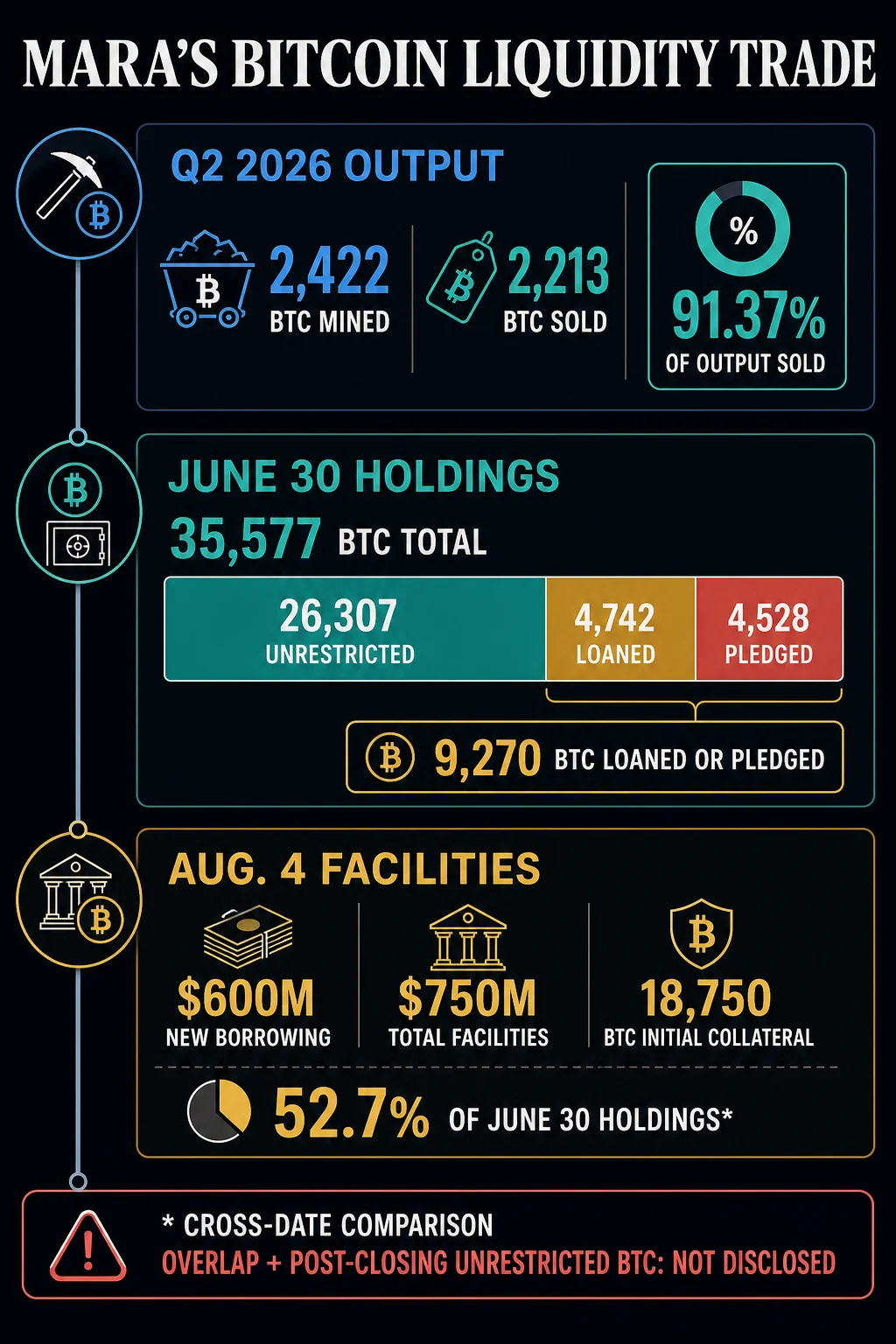
MARA Holdings, a prominent Bitcoin mining company, has executed a significant financial maneuver, selling 91.37% of its mined Bitcoin in the second quarter while simultaneously securing $600 million in new debt collateralized by Bitcoin. This strategic move appears designed to fund its ambitious acquisition of Long Ridge, a power-generation site slated for development into a hub for artificial intelligence (AI) and high-performance computing (HPC). The intricate financial arrangements, detailed in the company’s latest regulatory filings, raise questions about MARA’s financial resilience and its ability to navigate the volatile cryptocurrency market.
The company’s second-quarter report reveals that MARA sold 2,213 Bitcoin out of the 2,422 BTC it mined during that period. This aggressive liquidation of mined assets preceded the establishment of two new financing facilities totaling $750 million, which were fully drawn on August 4. These facilities include a $450 million arrangement with Coinbase, comprising $300 million in new borrowing and the refinancing of a $150 million existing loan, and a separate $300 million loan from Two Prime. The proceeds from these loans are earmarked for general corporate purposes, crucially including a portion of the cash consideration required for the Long Ridge acquisition.
The Bitcoin Collateralization Conundrum
The core of MARA’s financial strategy now rests on a substantial Bitcoin collateral pool. Initially, the company pledged 18,750 BTC across the two new facilities. This figure represents a significant portion of MARA’s total holdings, equating to 52.7% of the 35,577 BTC it reported holding as of June 30. However, a direct comparison between these two dates is complicated by the distinct timeframes and the lack of transparency regarding how much Bitcoin remained unrestricted after the loans were finalized.
MARA’s quarterly filing provides a snapshot of its Bitcoin holdings as of June 30, categorizing 26,307 BTC as unrestricted. Another 4,742 BTC were classified as loaned, and 4,528 BTC were designated as pledged collateral. These two latter categories combined accounted for 9,270 BTC. The critical ambiguity arises from the company’s failure to disclose any overlap between this existing pledged collateral pool and the 18,750 BTC committed to the new facilities on August 4. This omission means that simply adding these figures would result in a double-counting of an unknown quantity of Bitcoin, making it impossible to ascertain the true extent of MARA’s unencumbered Bitcoin reserves.
Unclear Margin Call Thresholds and Financial Risk
A key concern stemming from these new financing agreements is the lack of clarity surrounding the terms that trigger margin calls and potential liquidation of collateral. Both the Coinbase and Two Prime facilities mandate that MARA maintain sufficient Bitcoin collateral. A failure to adequately replenish this collateral can be construed as an event of default, granting the lenders the right to liquidate the pledged Bitcoin to recover their funds.
However, MARA’s filing omits crucial details necessary for assessing this risk. The company has not disclosed the specific numerical maintenance ratios, the precise margin-call thresholds, the stipulated cure periods for addressing shortfalls, or the formulas employed for liquidations. Furthermore, the division of the collateral between the two lenders remains unspecified. This information gap renders it impossible for external analysts or investors to calculate the Bitcoin price at which MARA would face a margin call or a forced sale of its assets.

The financial terms of the loans themselves offer some insight into their structure. The Coinbase facility, secured by Bitcoin, carries an interest rate benchmarked against the federal funds target range plus a spread of 3.875%. This loan is set to mature in August 2028, with an automatic one-year extension unless actively canceled. The Two Prime loan, on the other hand, features a fixed interest rate of 7.65% and shares the same August 2028 maturity date.
Financial Performance and the Long Ridge Acquisition
The financial backdrop against which these transactions are taking place reveals a company navigating a challenging economic landscape. In the second quarter, MARA reported $174.9 million in revenue, but this was overshadowed by a substantial net loss of $611.3 million. A significant component of this loss, $342.7 million, was attributed to a fair-value loss on Bitcoin, a mark-to-market accounting adjustment distinct from actual cash outflows. Looking at the first half of 2026, MARA’s net cash used in operating activities amounted to $471.3 million, a figure that does not directly reconcile with the quarterly net loss.
The acquisition of Long Ridge itself remains contingent on regulatory approvals. While the Federal Trade Commission (FTC) granted early termination of the antitrust waiting period on June 16, approval from the Federal Energy Regulatory Commission (FERC) was still pending as of MARA’s August 6 announcement. The acquisition agreement has an initial outside date of November 30, which could be extended to June 30, 2027, if certain regulatory conditions remain unresolved. In specific scenarios, MARA could be liable for a $75 million termination fee. Despite management’s stated goal of securing at least one AI or HPC lease across its portfolio before the end of the year, no tenant has yet been formally announced for the Long Ridge facility.
Implications for MARA’s Future
The recent financing provides MARA with approximately $600 million in new liquidity, crucial for the Long Ridge acquisition and other operational needs. However, it also places a substantial portion of its Bitcoin reserves, 18,750 BTC, into financial arrangements that are highly sensitive to Bitcoin’s price fluctuations. The lack of transparency regarding the post-closing unrestricted Bitcoin balance means that the company’s remaining financial flexibility, or "headroom," cannot be accurately assessed with the currently available data.
This strategy highlights a delicate balancing act for MARA. On one hand, the company is pursuing a forward-looking vision centered on the burgeoning AI and HPC sectors, requiring significant capital investment. On the other hand, it is leveraging its core asset, Bitcoin, as collateral in a manner that exposes it to considerable market risk. The successful execution of this strategy will depend not only on the timely regulatory approvals for Long Ridge and the securing of tenants but also on MARA’s ability to manage its Bitcoin collateral effectively in a potentially volatile market. The absence of clearly defined margin call triggers and liquidation parameters leaves investors and observers in the dark about the precise level of risk the company is undertaking.
Chronology of Key Events
Second Quarter 2026:
- MARA Holdings mines 2,422 Bitcoin.
- The company sells 2,213 Bitcoin, representing 91.37% of its mined Bitcoin for the quarter.
- As of June 30, MARA reports holding 35,577 BTC, with 26,307 classified as unrestricted, 4,742 as loaned, and 4,528 as pledged collateral.
Early to Mid-June 2026:

- Federal Trade Commission (FTC) grants early termination of the antitrust waiting period for the Long Ridge acquisition.
August 4, 2026:
- MARA draws fully on two new financing facilities totaling $750 million.
- Coinbase provides a $450 million facility, including $300 million in new borrowing and refinancing of a $150 million loan.
- Two Prime provides a separate $300 million loan.
- MARA pledges an initial 18,750 BTC as collateral for these facilities.
August 6, 2026:
- MARA announces that approval from the Federal Energy Regulatory Commission (FERC) for the Long Ridge acquisition is still pending.
August 7, 2026:
- CryptoSlate publishes this report detailing MARA’s financial maneuvers and associated risks.
Broader Market Context and Potential Implications
The move by MARA Holdings to aggressively leverage its Bitcoin holdings for strategic expansion into AI infrastructure reflects a broader trend within the cryptocurrency mining sector. As the industry matures, miners are increasingly seeking to diversify their revenue streams and invest in high-growth areas beyond simply mining digital assets. The demand for computing power for AI and HPC applications is soaring, presenting an attractive opportunity for companies with existing energy infrastructure and capital.
However, this diversification strategy comes with inherent risks. The reliance on Bitcoin as collateral for significant debt obligations ties the company’s financial health directly to the price volatility of the cryptocurrency. A sharp downturn in Bitcoin’s price could trigger margin calls, forcing MARA to sell assets at unfavorable prices or potentially face default. The lack of transparency in the loan covenants, particularly regarding margin call thresholds, amplifies this risk, leaving stakeholders uncertain about the company’s true financial resilience.
For investors, MARA’s actions present a complex risk-reward profile. The potential upside from the Long Ridge acquisition and its integration into the AI ecosystem could be substantial. Conversely, the financial leverage employed and the opacity of the collateralization terms create a significant downside risk. The coming months will be critical for MARA as it navigates regulatory hurdles, secures tenants for its new AI infrastructure, and manages its substantial Bitcoin-backed debt. The market will be watching closely to see if MARA can successfully execute its ambitious vision without succumbing to the inherent volatility of the digital asset market.








