James Watt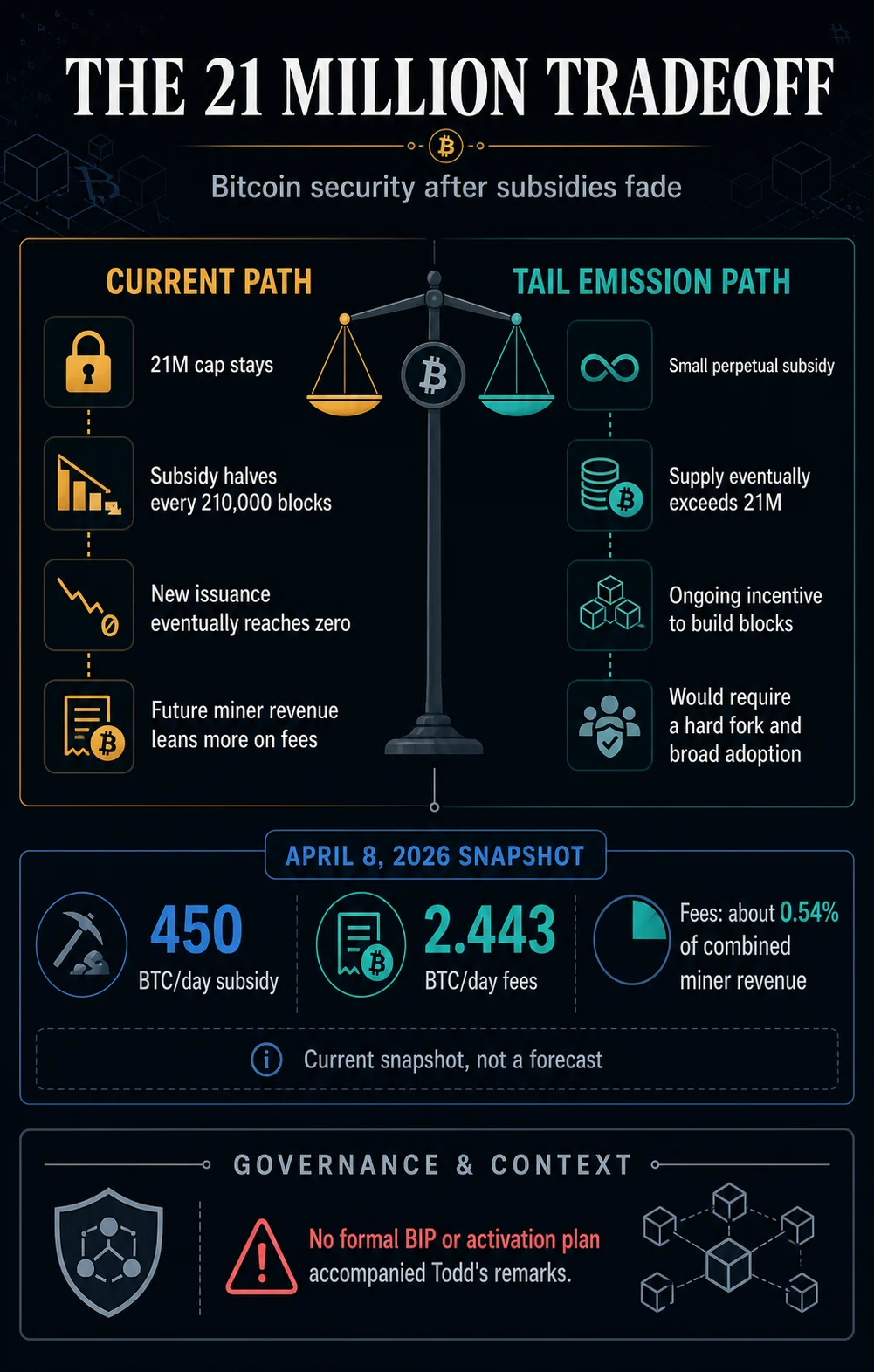
The Genesis of the Renewed Debate
The current controversy stems from a presentation delivered by Peter Todd on July 23, 2024, at the Bitcoin++ Toronto event. While Todd has discussed the concept of tail emissions for years, a clip of his talk gained significant traction on social media platforms in mid-August, reigniting fears among "Bitcoin maximalists" that the 21 million supply cap—widely considered Bitcoin’s "holy grail"—could be under threat.
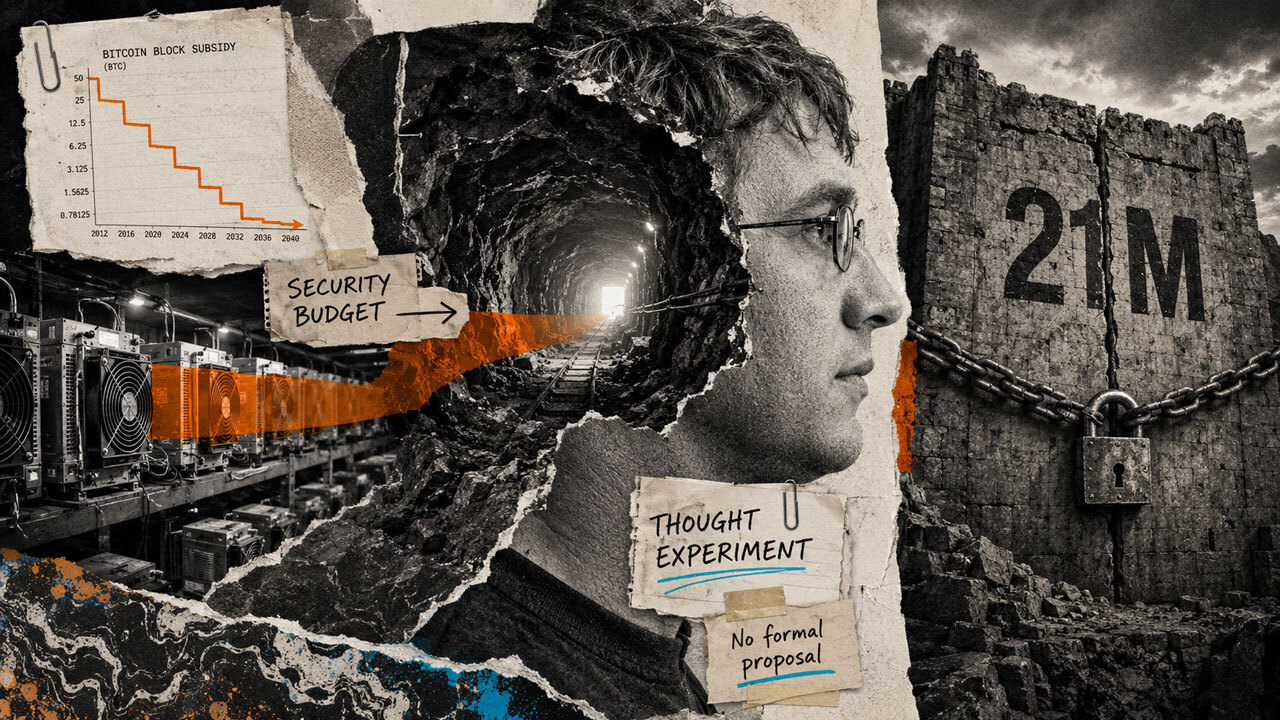
Todd’s argument is rooted in the "security budget" problem. Bitcoin’s security is provided by proof-of-work (PoW) mining, where miners expend vast amounts of electricity to secure the ledger. In return, they receive a block reward consisting of two parts: the block subsidy (currently 3.125 BTC) and transaction fees paid by users. According to the protocol’s design, the subsidy is cut in half every 210,000 blocks, roughly every four years. By approximately the year 2140, the subsidy will reach zero, leaving transaction fees as the sole incentive for miners.
Todd argues that there is no empirical evidence to prove that a fee-only market can sustain the massive hashrate required to protect a multi-trillion-dollar asset. He suggests that a nominal annual inflation rate, perhaps as low as 0.5% or 1%, could provide a stable "floor" for miner revenue, ensuring that the cost to attack the network remains prohibitively high regardless of transaction volume.
A Chronology of Bitcoin’s Diminishing Subsidy
To understand the weight of Todd’s concerns, one must look at the historical trajectory of Bitcoin’s issuance. Since its inception in 2009, Bitcoin has undergone four "halving" events, each reducing the rate of new supply:
- 2009–2012: The block subsidy was 50 BTC. Transaction fees were negligible.
- 2012–2016: The first halving reduced the subsidy to 25 BTC.
- 2016–2020: The second halving reduced the subsidy to 12.5 BTC.
- 2020–2024: The third halving reduced the subsidy to 6.25 BTC.
- 2024–Present: The fourth halving, which occurred in April 2024, reduced the subsidy to 3.125 BTC.
As of late 2024, the network is in its fifth epoch. Data from early 2026—projected based on current difficulty and hash rates—suggests a growing disparity between the subsidy and fee revenue. On April 8, 2026, for instance, miners are expected to collect approximately 2.443 BTC in daily transaction fees against a daily subsidy of roughly 450 BTC. This means fees represent only about 0.54% of total miner compensation. If the price of Bitcoin does not increase exponentially or if transaction density does not surge, the total "security budget" in dollar terms could shrink significantly in future decades, potentially making the network vulnerable to 51% attacks.
Supporting Data: The Security Budget Gap
The concern expressed by Todd and other technical skeptics is quantifiable. For Bitcoin to maintain its current level of security in a post-subsidy world, transaction fees would need to rise to levels that might drive users toward cheaper, less secure alternatives or Layer-2 solutions like the Lightning Network. However, if transactions move to Layer-2, the Layer-1 (base layer) fees might remain too low to support the miners.
Current network statistics highlight the scale of the challenge:
- Total Circulating Supply: Approximately 20.07 million BTC.
- Market Capitalization: Approximately $1.47 trillion.
- Daily Miner Revenue: Predominantly derived from the 3.125 BTC subsidy per block.
- Fee Contribution: Historically fluctuates between 0.5% and 5% of total revenue, spiking only during periods of extreme network congestion or the popularity of protocols like Ordinals and Runes.
Todd’s proposal of a tail emission would mean that the 21 million cap is never strictly reached. Instead, the supply would grow at a constant, predictable, and very low rate. This model is already utilized by other proof-of-work cryptocurrencies, most notably Monero (XMR), which implemented a tail emission of 0.6 XMR per block to ensure permanent mining incentives.
Official Responses and Community Reaction
The reaction from the Bitcoin community has been largely defensive, emphasizing the "social contract" of the 21 million supply cap. Prominent figures in the space were quick to distance themselves from Todd’s suggestions, fearing that even discussing the removal of the cap could damage Bitcoin’s reputation as "digital gold."
Dan Held, a well-known Bitcoin educator and marketing executive, described the idea of tail emissions as fundamentally flawed. Held referenced his 2019 essays on Bitcoin’s monetary policy, arguing that the predictability of the rules is more important than the rules themselves. In Held’s view, changing the 21 million cap would signal that Bitcoin’s "immutable" laws are actually subject to human whim, destroying the trust that gives the asset value.
Giacomo Zucco, a prominent Bitcoin researcher, offered a more nuanced take. He acknowledged that a very low tail emission might not technically "break" Bitcoin’s economics, but he warned that the act of changing the protocol’s most famous rule would be an existential threat to its culture. Zucco argued that if the community agrees to change the supply cap once, there is nothing to stop them from changing it again, leading to the same inflationary pressures that Bitcoin was designed to escape.
Meanwhile, the pseudonymous Bitcoiner "Hodlonaut" warned that the "gradual erosion" of Bitcoin’s ethos is a greater threat than any technical vulnerability. He argued that the culture of "no changes to the supply" is the ultimate firewall protecting the network.
Technical Hurdles: The Hard Fork Reality
Beyond the philosophical debate lies a massive technical barrier. Implementing a tail emission would require a "hard fork"—a non-backward-compatible change to the Bitcoin software. In the history of Bitcoin, hard forks have been notoriously difficult to achieve and often result in the creation of a separate, competing coin (such as the 2017 split that created Bitcoin Cash).

For a tail emission to become part of the "real" Bitcoin, every node operator, exchange, miner, and wallet provider would have to voluntarily upgrade to the new code. If a significant portion of the community refused to upgrade—which is almost certain given the current sentiment—the network would split. The market would then decide which version carries the "BTC" ticker. Given the current market’s obsession with the 21 million cap, it is highly likely that the "fixed supply" version would retain the majority of the value, leaving the "tail emission" version as a minority altcoin.
Todd himself acknowledged this in a 2022 AMA, noting that the disruption caused by a hard fork might do more damage to Bitcoin than the security budget problem it aims to solve. He framed his current comments not as an immediate call to action, but as a "long-term design question" that the community must eventually face.
Broader Impact and Future Implications
The reopening of this debate highlights a critical tension in Bitcoin’s long-term roadmap. On one side are the "Monetarists" who believe the 21 million cap is the essential feature of Bitcoin. On the other are the "Security Pragmatists" like Todd who worry that a fixed supply is useless if the network becomes too cheap to attack.
If Todd’s concerns prove correct and transaction fees fail to bridge the gap as subsidies vanish, the Bitcoin community may eventually face three difficult choices:
- Accept Lower Security: Allow the hashrate to drop, making the network more susceptible to state-level actors or wealthy attackers.
- Drive Up Fees: Artificially limit block space further to force transaction fees higher, potentially pricing out all but the largest institutional users.
- Implement Tail Emission: Abandon the 21 million cap in favor of a permanent, low-inflation subsidy to guarantee miner participation.
For now, the market remains unfazed. Bitcoin’s price has shown resilience, currently sitting at rank #1 by market cap with a valuation of $1.47 trillion and a 24-hour volume of over $54 billion. The 5.65% gain over the last 24 hours suggests that investors are more focused on current liquidity and adoption than on a technical debate regarding the year 2140.
However, the "Peter Todd debate" serves as a reminder that Bitcoin is an ongoing experiment. While its current security is undisputed—protected by a hashrate that makes it the most powerful computer network on earth—the transition from a subsidy-based economy to a fee-based economy remains an uncharted territory in the history of monetary systems. As the 2028 halving approaches, and those that follow, the "0.5% fee revenue" statistic will likely become a central metric for analysts monitoring the health and longevity of the world’s premier cryptocurrency.