admin
admin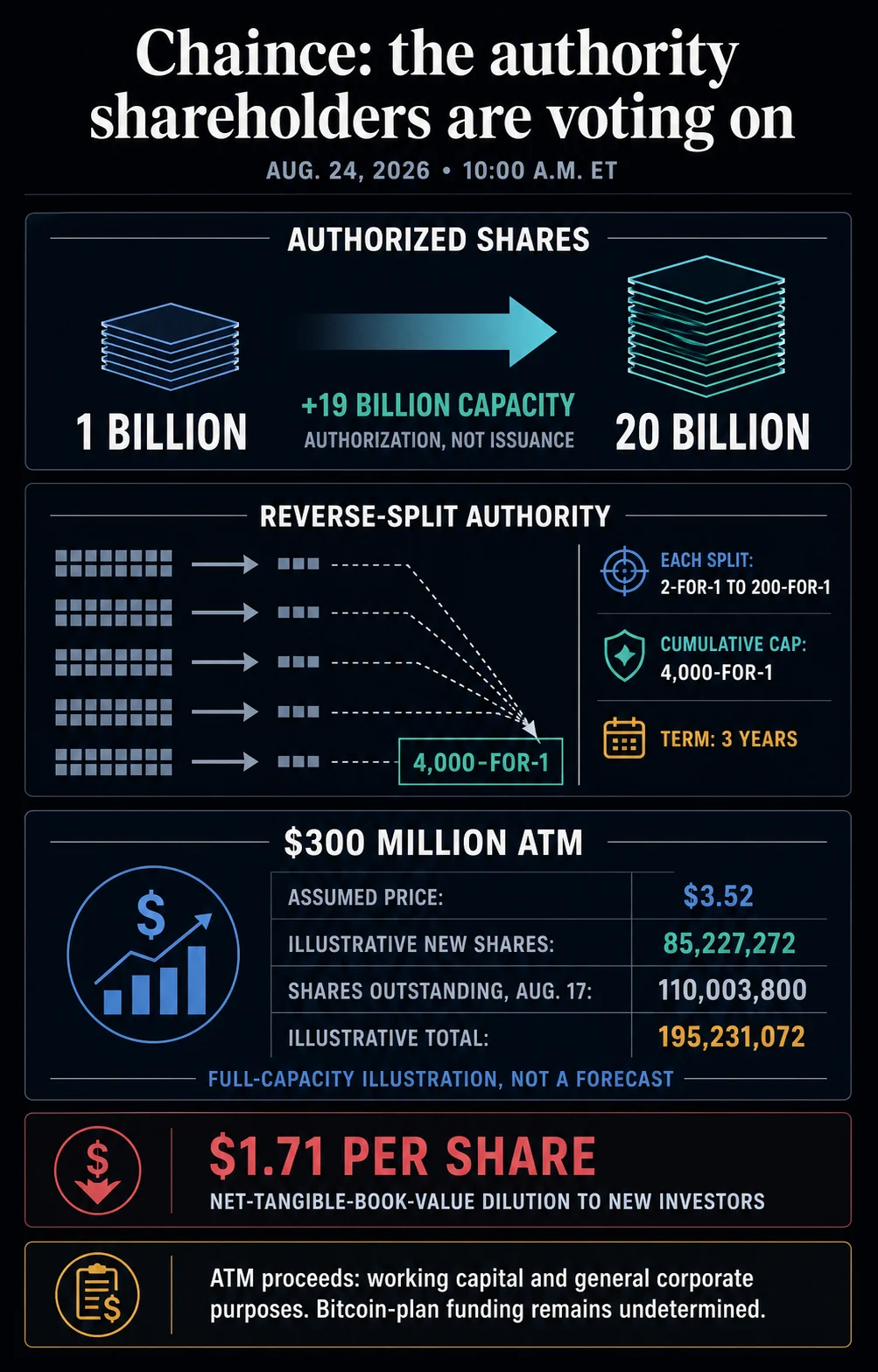
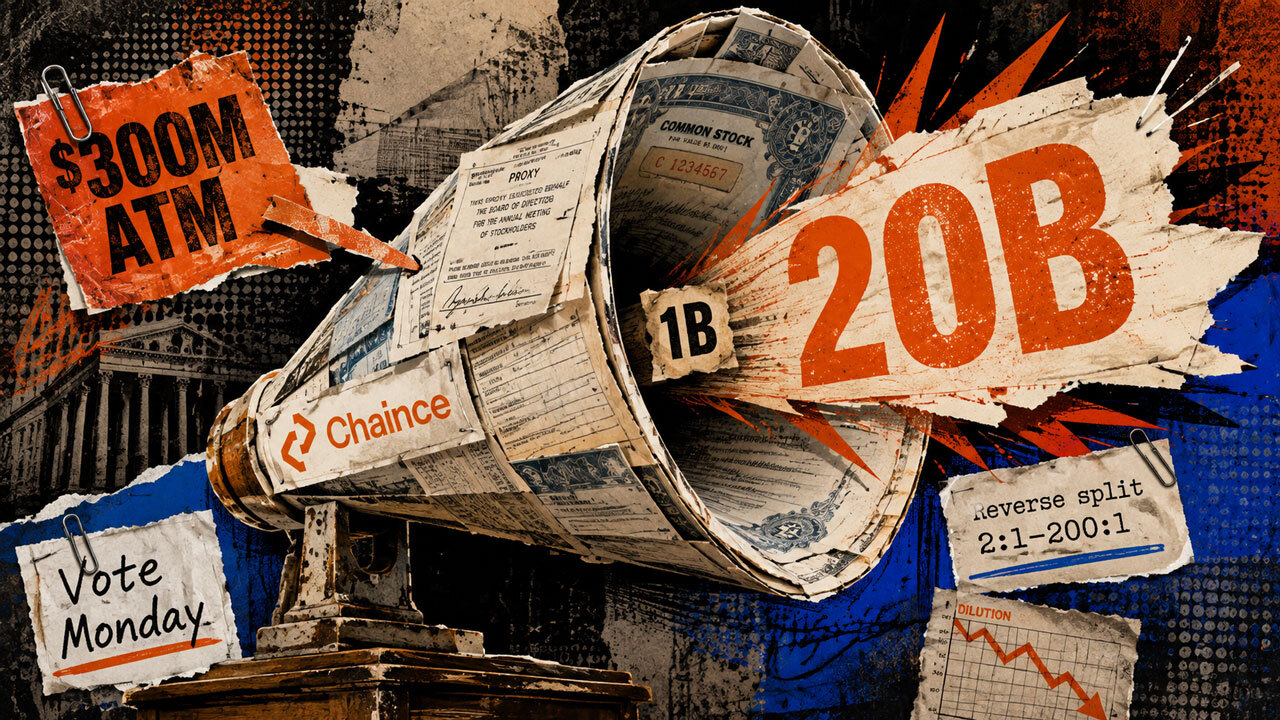
Shareholders of Chaince Digital Holdings are poised to cast critical votes on Monday that could dramatically reshape the company’s financial structure, granting its board of directors extensive authority to manage its share capital. The pivotal shareholder meeting, scheduled to commence at 10:00 a.m. Eastern Time in New York and virtually, will determine whether Chaince will increase its authorized ordinary shares from a current ceiling of 1 billion to a substantial 20 billion. Concurrently, shareholders will deliberate on granting the board broad authority to implement reverse stock splits over a three-year period. This significant decision-making moment arrives in the immediate wake of Chaince’s announcement of an "at-the-market" (ATM) equity offering, which allows the company to sell up to $300 million worth of its ordinary shares.
The implications of these proposals are far-reaching, potentially equipping Chaince with enhanced flexibility for future capital raising endeavors and strategic financial management. While the actual issuance of new shares or the execution of any reverse splits would necessitate subsequent board actions, Monday’s vote is fundamentally a referendum on the scope of power shareholders are willing to entrust to the company’s leadership.
Deep Dive into Shareholder Proposals
At the heart of the shareholder meeting are two key proposals that require an affirmative simple majority of votes cast by eligible ordinary shares represented either in person or by proxy.
Proposal Three: The Authorized Share Ceiling Expansion
This proposal seeks to amend the company’s charter to increase the number of authorized ordinary shares from 1 billion to 20 billion. This would effectively create an additional 19 billion authorized shares available for potential issuance. It is crucial to distinguish between authorized shares and outstanding shares. Authorized shares represent the maximum number of shares a company is legally permitted to issue as stipulated in its governing documents. Outstanding shares, conversely, are those that have been issued and are currently held by investors. An increase in authorized shares does not automatically translate into an increase in outstanding shares; rather, it provides the company with the headroom to issue more shares if and when deemed necessary for strategic objectives.
Proposal Four: Broad Reverse-Split Authority
This proposal aims to empower the board of directors to enact one or more reverse stock splits. This authority would be valid for a period extending up to the third anniversary of the August 24th meeting. The specifics of the reverse splits are defined with considerable latitude: each individual split could range from a 2-for-1 ratio to a substantial 200-for-1 ratio. However, the cumulative effect of all reverse splits undertaken under this authority would be capped at a 4,000-for-1 ratio. The board would retain the discretion to determine the timing, necessity, and specific ratios of any reverse splits.
It is important to note the voting mechanics for these proposals. Abstentions and broker non-votes, where a broker holding shares in "street name" does not receive voting instructions from the beneficial owner, are explicitly excluded from the calculation of "votes cast." Consequently, brokers are prohibited from voting uninstructed street-name shares on these particular proposals, which are classified as non-routine matters requiring shareholder direction.
The timeline for shareholder participation has been subject to clarification. An amendment filed with the Securities and Exchange Commission (SEC) on July 28th adjusted the proxy deadline to August 20th at 11:59 p.m. Eastern Time, correcting an earlier stated date of August 21st in the initial documentation. While the formal proxy deadline has passed, registered shareholders retain the ability to cast their votes at the meeting itself. Individuals whose shares are held through a brokerage account would have needed to obtain a legal proxy and complete their voting documentation in advance to ensure their vote was counted.
The Strategic Context: A $300 Million ATM Offering
The impending shareholder vote on capital structure is inextricably linked to Chaince’s recent launch of a significant "at-the-market" (ATM) equity offering. Filed via a prospectus supplement on August 19th, this offering allows Chaince to sell up to $300 million worth of its ordinary shares. The agreement designates H.C. Wainwright & Co. as the agent or principal for these sales. Crucially, the terms of the ATM program do not obligate H.C. Wainwright to sell a specific number or dollar amount of shares. The actual volume of shares issued will be contingent upon market conditions and the company’s strategic utilization of the program.
To illustrate the potential scale of this offering, the prospectus supplement provides an example. Assuming a sale of 85,227,272 shares at a price of $3.52 per share, this would represent a significant increase from the 110,003,800 shares outstanding as of August 17th. If the program were fully utilized under these hypothetical conditions, the total number of outstanding shares could rise to as many as 195,231,072. The actual number of shares issued will, of course, fluctuate based on the prevailing sale prices and the extent to which the company taps into this facility.
Dilution and Financial Implications
The potential dilution to existing shareholders is a key consideration arising from the ATM offering. The same example scenario estimates a net-tangible-book-value dilution of $1.71 per share for new investors. It is important to note that these share-count assumptions in the prospectus do not include shares available under Chaince’s 2025 equity plan, which has 6,164,000 shares still available for issuance. Furthermore, up to 42,755,344 additional shares could be issuable upon the exercise of outstanding warrants.
Chaince has indicated that the proceeds generated from the ATM offering may be allocated towards working capital and general corporate purposes. This strategic flexibility allows the company to respond to evolving business needs and market opportunities.
Broader Strategic Initiatives and Future Outlook
Beyond the immediate ATM offering and the shareholder votes, the company has also alluded to a preliminary plan involving an $800 million Bitcoin reserve. However, the specific funding sources and financing instruments for this ambitious reserve remain undetermined at this juncture.
The confluence of these events—the proposed massive increase in authorized shares, the grant of extensive reverse-split authority, and the active ATM offering—paints a picture of a company strategically positioning itself for substantial growth and financial maneuvering. Shareholders are being asked to provide the board with a broad toolkit for future capital management, a decision that carries both potential opportunities for expansion and the inherent risks associated with increased share issuance and potential dilution. The ultimate impact of these decisions will unfold over time, dependent on Chaince’s strategic execution and the prevailing economic and market landscapes.
Historical Context of Shareholder Votes and Capital Management
Shareholder meetings like the one convened by Chaince are standard practice for publicly traded companies seeking to adjust their capital structures or obtain approval for significant corporate actions. The ability to increase authorized shares is a common requirement as companies grow and their initial authorized share counts become insufficient for future needs. This can be driven by a variety of factors, including potential mergers and acquisitions, employee stock option plans, and indeed, the ability to engage in secondary offerings like an ATM program.
Reverse stock splits, on the other hand, are often employed when a company’s share price has fallen to a very low level. This can make the stock appear less attractive to institutional investors and may even lead to delisting from major stock exchanges if the price falls below a certain threshold. By consolidating a larger number of shares into a smaller number, a reverse split artificially inflates the per-share price, potentially improving market perception and meeting exchange listing requirements. However, reverse splits do not inherently change the company’s market capitalization or the value of an investor’s holdings; they merely adjust the number of shares and the price per share proportionally.
Chaince’s decision to seek broad authority for reverse splits, coupled with the massive increase in authorized shares, suggests a proactive approach to managing its financial future. The company is likely anticipating scenarios where either an increase in share price is desirable, or where significant capital infusions necessitate a larger share base.

Regulatory Scrutiny and Investor Considerations
The filings with the SEC are a testament to the regulatory framework governing public companies. Documents such as the annual meeting proxy and prospectus supplements are designed to provide shareholders with comprehensive information to make informed decisions. Investors are encouraged to carefully review these materials, understanding the potential risks and rewards associated with each proposal.
For Chaince, the ATM offering, while providing a flexible source of capital, also presents the risk of dilution to existing shareholders. The value of each share can decrease as more shares are issued. The company’s stated use of proceeds for "working capital and general corporate purposes" is standard but leaves room for interpretation regarding specific future investments.
The proposed 20 billion share ceiling is a substantial increase from the current 1 billion. This magnitude of increase provides the company with significant flexibility for a prolonged period. Similarly, the 4,000-for-1 cumulative reverse split authority is a very broad mandate, allowing for significant adjustments to the share price.
Analyst and Market Perspectives (Inferred)
While direct statements from external analysts were not provided in the original article, the actions taken by Chaince would typically draw attention from market observers. Financial analysts would likely be scrutinizing the company’s financial health, its strategic rationale for these moves, and the potential impact on its stock valuation.
Questions would arise regarding the specific triggers for utilizing the ATM program and the reverse-split authority. Is Chaince anticipating a period of significant investment or expansion? Is it concerned about its current stock price and its perception in the market? The company’s communication with its investors leading up to and following this shareholder meeting will be critical in shaping market sentiment.
The fact that Chaince is a "crypto treasury firm" adds another layer of complexity. The digital asset space is known for its volatility and rapid evolution. Companies operating in this sector often require substantial capital to navigate market shifts, invest in new technologies, and maintain competitive advantages. The proposed capital management tools are therefore likely intended to provide the agility needed to thrive in this dynamic environment.
Conclusion
The upcoming shareholder meeting for Chaince Digital Holdings represents a pivotal moment in the company’s financial trajectory. The proposals to increase authorized shares to 20 billion and grant broad reverse-split authority, combined with the active $300 million ATM offering, signal a strategic intent to bolster its financial flexibility and prepare for potential future growth or capital needs. Shareholders face a critical decision that will empower the board with significant control over the company’s capital structure. The implications for dilution, stock valuation, and overall corporate strategy are substantial, and investors will be closely watching the outcomes of Monday’s vote and Chaince’s subsequent actions. The company’s ability to effectively leverage these newly acquired authorities will be key to its long-term success in the complex and rapidly evolving crypto treasury landscape.