admin
admin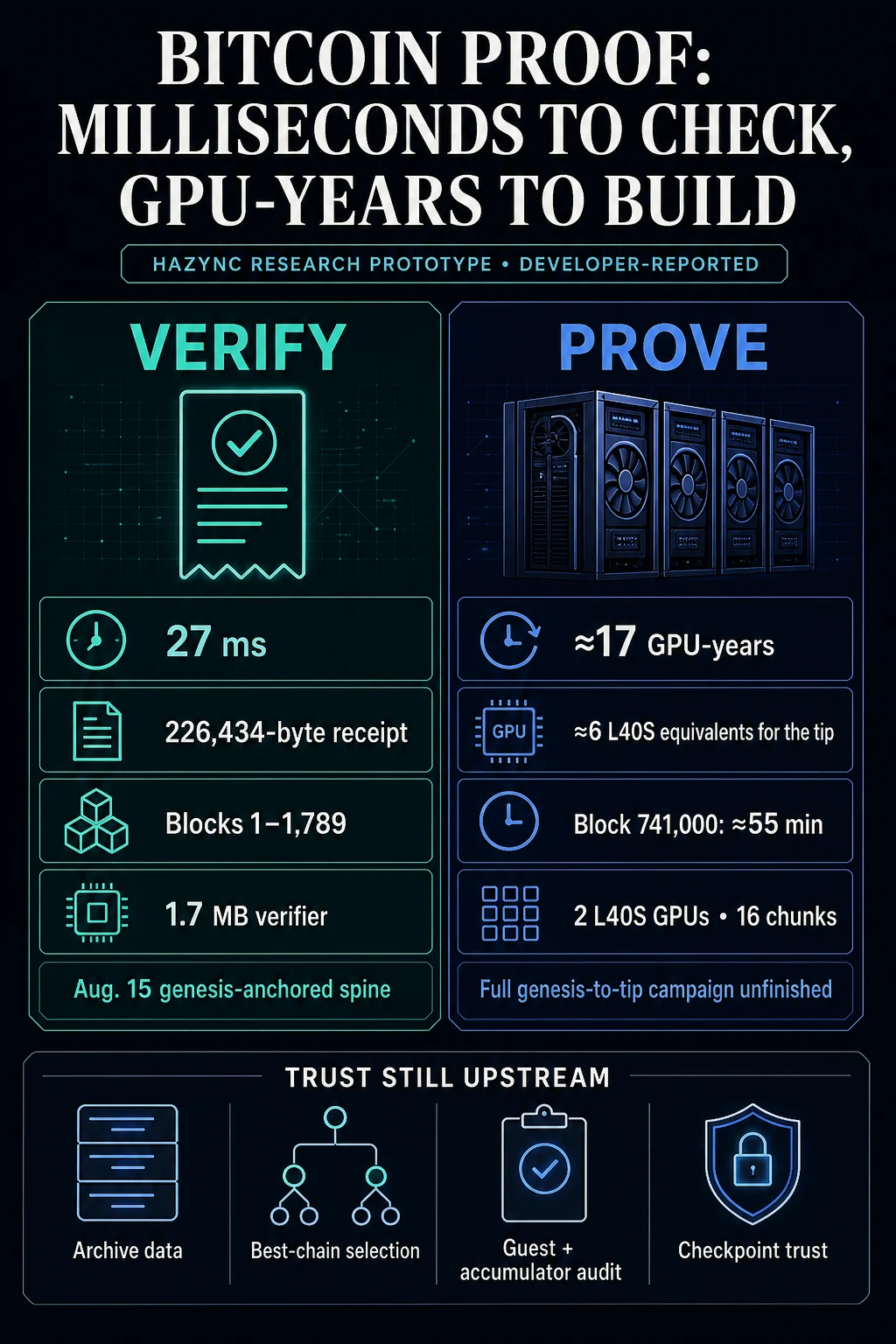
A groundbreaking development in the realm of blockchain technology has emerged, with researchers announcing that Hazync, a novel research prototype, has successfully verified a significant portion of the Bitcoin blockchain’s history in a mere 27 milliseconds. This remarkable feat, achieved using a compact 1.7 MB standalone verifier, processed a cryptographic receipt encompassing the first 1,789 blocks of Bitcoin, a testament to the potential of zero-knowledge proofs in revolutionizing blockchain consensus mechanisms. While this initial success covers an early segment of Bitcoin’s extensive history, the ambitious project aims to extend this capability to the entire genesis-to-tip chain, a comprehensive undertaking that remains under active development.
The Hazync project leverages the power of RISC Zero’s zero-knowledge virtual machine (zkVM) to enable reusable Bitcoin validation. In this innovative approach, the zkVM executes a sophisticated validation program, and the resulting cryptographic receipt serves as a highly compressed and verifiable artifact for other users. This architectural design strategically offloads the computationally intensive task of proof generation to specialized "provers," while delegating the relatively less demanding task of receipt verification to a much broader population of users. This division of labor is central to Hazync’s proposed scalability solution, recognizing the vastly different resource requirements for these two critical functions.
The Economics of Verification: Proving is Costly, Verifying is Cheap
The developer behind Hazync has provided crucial insights into the economic realities of this new paradigm. The initial phase of backfilling historical Bitcoin data is estimated to require approximately 17 GPU-years of processing power. This monumental effort will then be followed by a sustained computational capacity equivalent to about six high-performance Nvidia L40S GPUs to maintain real-time validation of newly generated blocks. The core proposition of Hazync is that the significant upfront investment in computation by provers, auditors, and archive operators ultimately translates into remarkably inexpensive and rapid receipt verification for the end-user.
This stark contrast between proving and verification costs is a departure from traditional blockchain node operation. Currently, a standard Bitcoin node independently replays the entire blockchain to verify its integrity. Hazync, however, circumvents this by running Bitcoin’s established consensus rules within the zkVM. The zkVM then generates a proof that these rules were adhered to for each block within the verified segment. These individual block proofs are then recursively folded into a single, compact receipt, drastically reducing the verification burden.
Technical Underpinnings: Reusing Core Code and RISC-V Architecture
The public repository for Hazync reveals a sophisticated guest program built upon substantial components of Bitcoin Core v28’s consensus code, along with the libsecp256k1 cryptographic library. This program has been compiled for the 32-bit RISC-V architecture, a modern instruction set architecture known for its efficiency and open-source nature. By directly reusing large portions of Bitcoin Core’s existing codebase, Hazync significantly minimizes the amount of consensus logic that needs to be independently reimplemented within a specialized zero-knowledge circuit. This approach not only accelerates development but also enhances confidence in the correctness of the validation logic.
A recent benchmark conducted around Bitcoin block 741,000 provides a tangible measure of proof-generation costs on contemporary Bitcoin data. According to the developer’s report, this specific block contained 670 transaction inputs and involved 394 unspent transaction output (UTXO) leaves. The process of generating a proof for this block, divided into 16 chunks and executed across two Nvidia L40S GPUs, took approximately 55 minutes, with 27 minutes dedicated to aggregating the individual proofs.
This specific measurement serves as a foundational data point for the developer’s broader estimate of 17 GPU-years required for a complete genesis-to-tip historical backfill. It is important to note that the currently available data comprises representative benchmarks rather than a fully audited measurement across every historical era of the Bitcoin network. Consequently, the projected full-chain performance of Hazync remains an estimate until the exhaustive backfill campaign is successfully completed.
The Ephemeral Nature of Proofs and the Importance of Stability
The dynamic nature of software development introduces an inherent challenge: changes to the underlying code can invalidate previously generated proofs. Each Hazync receipt is cryptographically bound to a unique METHOD_ID, which essentially acts as a fingerprint of the compiled guest program. Consequently, any recompilation of the guest program, even for minor updates, will result in a new METHOD_ID, rendering all previously issued receipts obsolete for that specific version.
This sensitivity to code changes has necessitated a restart of the project’s genesis block computation. On August 4th, the project initiated a fresh genesis block calculation following an internal audit that mandated a new baseline for the code. Further soundness fixes or significant code refactors in the future could trigger similar resets, even after substantial GPU time has been invested. This reality underscores the need for a robust proving budget that encompasses not only the historical backfill but also the ongoing capacity to process new blocks and the imperative for code stability to avoid costly recomputations.

The speed of receipt verification, measured in milliseconds, represents the aspect of Hazync that is directly experienced by the end-user. The substantial 17 GPU-year estimate, therefore, quantifies the concentrated, industrial-scale computational effort required to deliver this streamlined verification experience.
What the Receipt Does and Does Not Replace
The Hazync receipt serves as a powerful tool for compressing the complexity of validity checking. However, it does not eliminate the need for traditional blockchain infrastructure. Archive operators remain essential for ensuring the availability of transaction data and for storing the historical witness and signature bytes. These bytes are crucial for future re-proving of the chain, even with compressed receipts. Thus, the efficiency of succinct verification preserves a vital long-term storage role for archive operators.
Furthermore, the fundamental mechanism of best-chain selection, governed by Bitcoin’s established "most-work" rule, remains intact. Hazync strategically incorporates the cumulative proof-of-work into the public output of its receipts. This allows verifiers to access the necessary information to compare competing chain tips and make informed decisions about which chain to follow. The receipt, therefore, confirms rule compliance for its specific segment of the chain, but the ultimate choice of the valid chain rests with the individual node.
The integrity of the overall system is also contingent on the honest operation of an "archive bridge." A compromised or malicious bridge could potentially disrupt the process by serving unusable inputs to provers, thereby consuming valuable GPU time and creating an economic denial-of-service risk. The project’s stated composition rules are designed to mitigate such risks by linking every state boundary to the genesis block. Any attempt to introduce forged state would be detected when a receipt is integrated into the main chain.
The developer characterizes a proof generated from the genesis block as "unconditional" within the defined software and cryptographic assumptions of Hazync. However, any subsequent checkpoints incorporated into the system are treated as explicit trust inputs, necessitating a degree of reliance on the source of those checkpoints.
Security and Auditability: Layers of Trust and Scrutiny
The guest program itself represents a critical review boundary. It encompasses a significant portion of Bitcoin Core’s consensus code, alongside project-maintained logic for the subsidy schedule and script activation heights. The project asserts that its script-flag schedule has undergone differential testing and is designed to be a sound superset of Bitcoin Core’s rules, intentionally allowing for additional rejections to preserve network integrity.
To facilitate the zkVM environment, a C++ portability layer has been developed to adapt Bitcoin Core’s code. Additionally, a non-Core Utreexo accumulator is employed to manage changes to Bitcoin’s unspent transaction output (UTXO) set. The project’s disclosed assumptions also extend to the RISC Zero proof system itself, along with fundamental cryptographic primitives like SHA-256 and secp256k1. The developer has identified the portability shims and the Utreexo accumulator as the highest-priority areas for residual review.
In August, two AI-assisted external reviews were conducted, which reportedly failed to identify any vulnerabilities allowing the guest program to accept an invalid blockchain. Nevertheless, a commissioned professional audit is still pending. The project’s commitment to public code fosters external scrutiny, and the ultimate assurance of production-readiness will rely on adversarial examination of the exact guest program and all components within its proof boundary.
Broader Implications and the Future of Blockchain Consensus
Hazync’s innovative approach fundamentally restructures the trustless synchronization process by dividing it into several distinct roles, each with its own associated operators and budgets. The rapid millisecond verification of receipts, coupled with the significant but concentrated computational cost of proof generation, represents a potential paradigm shift. The long-term viability of this model hinges on the sustained availability of computational resources for provers, the ongoing data management by archive operators, the critical best-chain selection performed by nodes, and the rigorous assessment of the guest program by auditors.
A stable and robust implementation, supported by adequate compute resources and thorough external review, could significantly reduce the redundant validation efforts typically undertaken by new nodes joining the network. While the developer-reported 27-millisecond verification time for a limited historical segment is a promising indicator, the estimated 17 GPU-years required to reach the current tip of the Bitcoin blockchain highlights the scale of the challenge and the ongoing journey towards realizing Hazync’s full potential. This research initiative offers a compelling glimpse into a future where blockchain scalability and efficiency are dramatically enhanced through the intelligent application of advanced cryptographic techniques. The implications for decentralization, transaction throughput, and the overall accessibility of blockchain technology are profound, potentially paving the way for a new era of innovation.