James Watt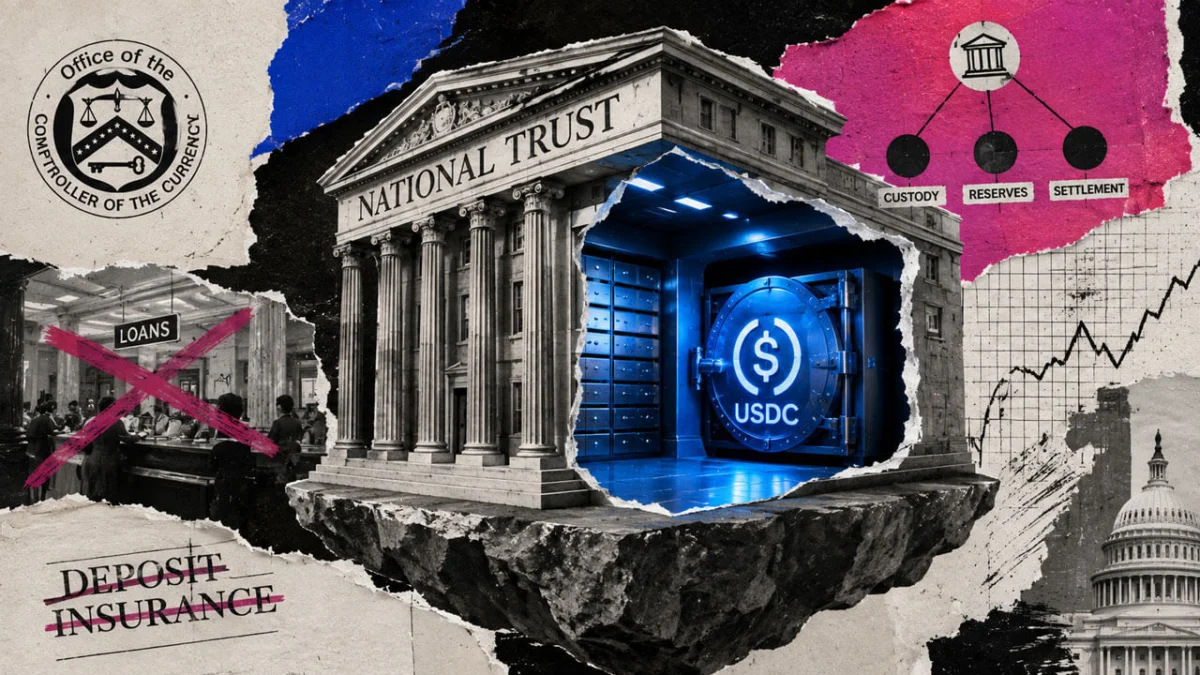
The landscape of American finance is undergoing a structural transformation as the Office of the Comptroller of the Currency (OCC) facilitates the entry of digital asset firms into the federal banking system. Circle, the issuer of the USDC stablecoin, recently secured a federal bank charter, marking a pivotal moment in the integration of blockchain technology with national oversight. However, this charter does not transform Circle into a conventional bank. Operating as Circle National Trust, the entity is part of a specialized cohort of "national trust banks"—narrowly defined institutions that supervise assets and facilitate transactions without offering the traditional suite of retail services such as checking accounts, mortgages, or FDIC-insured savings products.
This regulatory evolution signifies a deliberate move by Washington to provide cryptocurrency companies with a federal "regulatory shell." By separating the technological and administrative functions of digital assets from the traditional fractional-reserve banking model, regulators are creating a distinct lane for fiduciary administration, stablecoin reserves, and institutional custody. The result is a specialized financial tier that prioritizes the movement and safekeeping of assets over the lending and deposit-gathering activities that have historically defined the American banking experience.
The Architecture of the National Trust Bank
To understand the significance of Circle’s new charter, it is necessary to distinguish between a commercial bank and a national trust bank. A traditional commercial bank operates as a bundled service provider; it collects deposits, provides payment rails, and uses its funding base to extend credit to consumers and businesses. This model relies heavily on deposit insurance to maintain public confidence and generates the majority of its revenue through the net interest margin—the difference between the interest paid to depositors and the interest earned on loans.
In contrast, a national trust bank focuses on fiduciary responsibilities. Its core functions involve holding property for third parties, administering assets, executing complex financial instructions, and maintaining meticulous records. According to the OCC’s trust-bank guidance, these institutions typically do not accept deposits or engage in lending. Because they do not take public deposits, they generally do not carry insurance from the Federal Deposit Insurance Corporation (FDIC).
This "non-bank bank" model actually predates the rise of cryptocurrency. When the OCC approved a wave of digital-asset applications in late 2025, it already supervised approximately 60 national trust banks. A notable decision regarding Morgan Stanley Digital Trust revealed the massive scale of this sector, noting that assets under administration at uninsured national trust banks reached $7.2 trillion as of March 31, 2026. Of that total, $1.7 trillion was held in custody and safekeeping accounts. Crypto-native firms have identified this established legal form as the ideal vehicle for tokenized finance, as it allows for federal supervision of private keys and reserves without the overhead and regulatory complexity of a retail branch network.
A Chronology of Federal Integration
The integration of crypto firms into the OCC’s framework has accelerated significantly over the past year. What began as a series of isolated applications has evolved into a clear federal strategy to bring the digital asset industry under a unified supervisory umbrella.
The momentum shifted decisively on December 12, 2025, when the OCC issued a multi-part announcement granting conditional approvals to five major players: BitGo, Fidelity Digital Assets, Paxos, Ripple, and an entity that would eventually become Circle’s trust bank. This "December Cohort" utilized different pathways to federal status. BitGo, Fidelity, and Paxos sought to convert existing state-level trust charters into federal ones, while Ripple and Circle proposed entirely new national trust banks.
Following this initial wave, the OCC continued to expand the pipeline:
- February 12, 2026: Bridge National Trust Bank received preliminary conditional approval to focus on stablecoin issuance and reserve management.
- February 20, 2026: Foris DAX National Trust Bank (Crypto.com) was granted preliminary approval for custody, trade settlement, and staking services.
- April 2, 2026: Coinbase National Trust Company received its preliminary conditional approval, targeting institutional custody and transactional services.
- June 18, 2026: Morgan Stanley Digital Trust received preliminary approval, signaling the entry of traditional Wall Street giants into the specialized crypto trust space.
- July 10, 2026: Circle received its final approval for First National Digital Currency Bank, operating as Circle National Trust.
- August 14, 2026: World Liberty Trust Company, a firm linked to USD1 issuance, received preliminary conditional approval for reserve custody and administration.
As of late August 2026, the OCC confirmed that the digital asset sector has become a dominant force in its licensing queue. Comptroller Jonathan Gould stated that 23 of the 40 "de novo" (new) charter applications received by the agency over the previous 18 months included digital-asset activity in their business plans. This surge suggests that the federal lane is no longer an experimental path but the preferred destination for firms seeking to institutionalize tokenized assets.
The Strategic Value of a National Charter
For companies like Circle and Coinbase, the appeal of a national trust charter is rooted in operational efficiency and market credibility. Currently, many digital asset firms must navigate a fragmented map of state-by-state money transmitter licenses and trust charters. A national charter replaces this patchwork with a single federal supervisor, streamlining compliance and reporting.
Furthermore, a national trust bank allows an issuer to bring critical operations "in-house." In the case of Circle, the trust bank is authorized to provide fiduciary digital-asset custody for Circle and its affiliates. Future capabilities are expected to include the management of USDC reserves and custody for external institutional clients. By controlling the entity that holds the reserves and manages the ledger, the issuer reduces its reliance on third-party commercial banks, which have historically been a source of counterparty risk and operational friction.
The federal charter also provides a significant marketing advantage. Institutional clients—such as pension funds, insurance companies, and sovereign wealth funds—require high levels of regulatory certainty. Being supervised as a "national bank," even in a limited trust capacity, offers a level of prestige and a familiar examination regime that offshore licenses or state permissions cannot match. It signals that the entity holding the keys and the assets is subject to the same rigorous federal standards as the nation’s largest financial institutions.
Economic Implications and the "Deposit Drain"
While the rise of crypto trust banks offers clear benefits for the digital asset industry, it presents a challenge to the traditional commercial banking model. The primary concern among economists and traditional lenders is the potential migration of capital from bank deposits into stablecoins and tokenized assets.
Commercial banks rely on low-cost deposits to fund long-term credit, such as 30-year mortgages and small-business loans. If consumers and institutions move their cash into stablecoins issued by trust banks, that capital is effectively removed from the lending ecosystem. Because trust banks do not make loans—instead holding their reserves in high-quality liquid assets like U.S. Treasury bills—the credit capacity of the broader economy could be diminished.
Recent estimates examined by industry analysts suggest that stablecoins could eventually pull hundreds of billions of dollars out of the traditional deposit system. Some projections indicate a potential drain of up to $500 billion as tokenized dollars become a more attractive medium for settlement and savings. This creates a policy trade-off: while federal supervision makes stablecoin operations safer and more transparent, it may simultaneously increase the cost of credit for the average American by depriving commercial lenders of their cheapest source of funding.
The Future of the Unbundled Bank
The emergence of Circle National Trust and its peers confirms that the "banking bundle" is being pulled apart. In the old system, the bank was the central intermediary for everything: holding money, moving money, and lending money. In the new system, these functions are being assigned to specialized entities.
Traditional commercial banks are likely to retain their dominance in credit underwriting and local deposit gathering, as these functions require deep expertise in risk assessment and a physical presence in communities. However, they risk losing control over the "asset layer"—the custody, settlement, and administration of tokenized property. Crypto-native trust banks are positioning themselves to capture this profitable control layer, leveraging software and blockchain distribution to move assets faster and more efficiently than traditional payment messages.
As the OCC prepares to issue its final GENIUS Act rule by November 2026, the regulatory framework for these narrow institutions will become even more defined. The agency’s goal appears to be the creation of a "supervised perimeter" that allows for innovation while containing risk. For consumers and investors, the message is one of cautious optimism: federal oversight provides a higher degree of safety, but the "bank" label must be read with precision. These new institutions may carry the prestige of a national charter, but their power comes from the digital ledger and the vault, not from the mortgage desk or the local branch. The future of finance is increasingly divided between those who lend the money and those who control the assets.