James Watt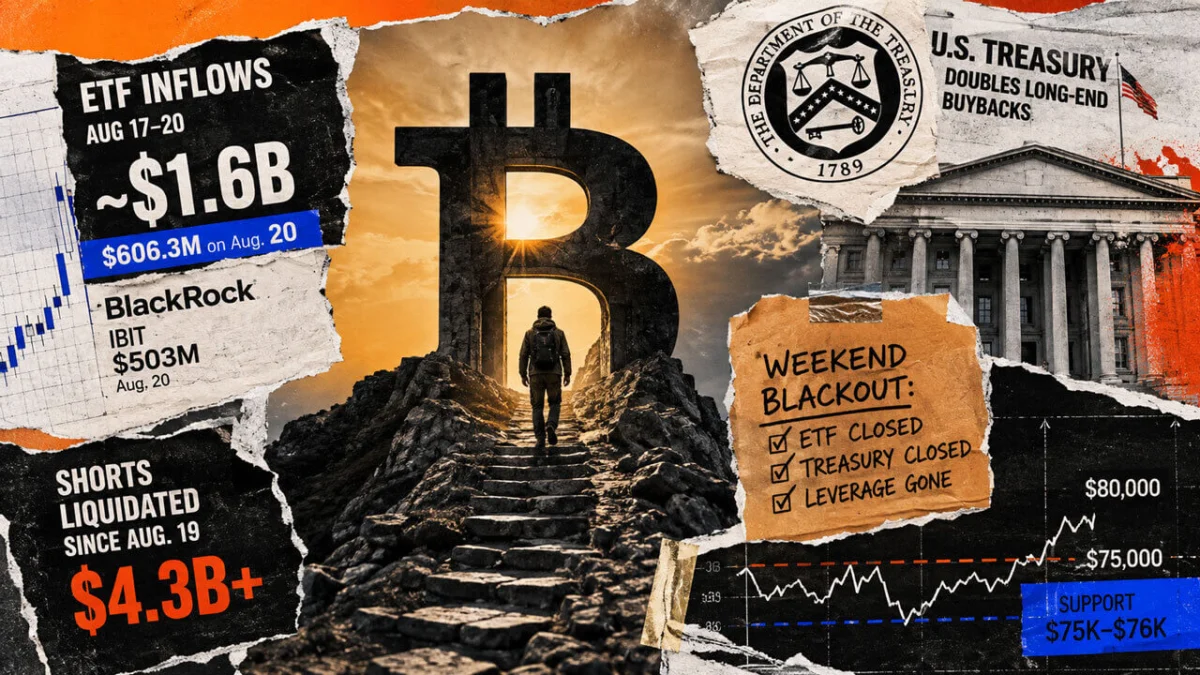
Bitcoin entered the final weekend of August within striking distance of the psychological $80,000 threshold, having reached an intraday peak of $79,500 on August 21. This price action represents the culmination of the most significant weekly rally observed in the cryptocurrency markets over the past two years. The surge was not the result of a single catalyst but rather a rare convergence of three distinct market forces: a strategic intervention by the United States Treasury, substantial capital inflows into spot Bitcoin Exchange-Traded Funds (ETFs), and a massive wave of forced liquidations affecting short-positioned traders.
As the weekend progresses, the market faces a critical juncture. The mechanical supports that propelled Bitcoin upward—specifically Wall Street trading hours and Treasury market operations—have paused until Monday. This leaves Bitcoin’s native 24/7 market structure to navigate the current price levels independently, providing a pure test of organic spot demand and investor conviction.
The Convergence of Three Market Pillars
The rally observed during the third week of August was built upon a foundation of institutional demand and macroeconomic repositioning. Market analysts have identified three "legs" that supported the price ascent. First, the spot Bitcoin ETF sector saw roughly $1.6 billion in net inflows between August 17 and August 20. This influx of capital signaled a return of high-conviction buying from U.S.-based institutional and retail investors.
Second, the price movement triggered a historic "short squeeze." Data indicates that over $4.3 billion in crypto short positions have been liquidated since August 19. Of that total, more than $3.1 billion was concentrated in a 48-hour window between August 19 and August 20. This forced buying—where traders betting against the asset are required to buy back Bitcoin to cover their losses—accelerated the upward momentum, clearing technical resistance levels with unusual speed.
The third pillar was a significant shift in the macroeconomic landscape. The U.S. Treasury Department announced a decision to double its long-end buybacks of government debt. This intervention occurred shortly after the 30-year Treasury yield touched approximately 5.33%, a 19-year high. While this action does not constitute "money printing" in the sense of Federal Reserve quantitative easing, it signaled to markets that the government is actively managing debt costs to prevent a broader bond market collapse. For Bitcoin investors, this move reinforced the narrative of currency debasement and the necessity of scarce, non-sovereign assets.
Institutional Demand and the ETF Channel
The role of U.S.-traded spot Bitcoin ETFs cannot be overstated in the current market cycle. Between August 17 and August 20, these products absorbed $1.6 billion, with August 20 alone accounting for $606.3 million in net inflows. This represented the largest single-day inflow since May, marking a definitive end to the period of stagnation seen earlier in the summer.
BlackRock’s iShares Bitcoin Trust (IBIT) emerged as the primary driver of this demand. On August 20, IBIT captured approximately $503 million in inflows, representing roughly 83% of the day’s total net demand across all U.S. Bitcoin ETFs. This concentration of flow highlights BlackRock’s growing dominance in the digital asset space and suggests that institutional "smart money" is leading the current charge toward $80,000.
However, the closure of traditional markets for the weekend creates a temporary vacuum. The ETF channel, which has acted as the primary conduit for Wall Street capital, is unavailable until Monday morning. Consequently, Bitcoin must now rely on its native market participants to maintain its gains. If the price holds steady or continues to climb without ETF support, it would validate the thesis that a genuine supply shortage exists in the spot market.
Analyzing Market Structure: Spot Buying vs. Leverage
One of the most encouraging aspects of the recent rally, according to analysts at Bitfinex, is the relatively low reliance on leverage. Typically, aggressive price surges are accompanied by a sharp rise in "open interest"—the total number of outstanding derivative contracts. When open interest rises in tandem with price, it often suggests the rally is "top-heavy" and prone to a sudden reversal if leveraged long positions are liquidated.
During this week’s 11% climb, however, open interest rose by only approximately 4%. Funding rates, which represent the cost of holding a leveraged position, remained remarkably neutral. This discrepancy suggests that the price appreciation was driven primarily by spot buying and the closing of short positions rather than the entry of new, highly leveraged long bets.
"Price climbed 10% to 11% while open interest rose only around 4%, which points to spot buying and short covering doing the work, with leverage playing a minor role," Bitfinex analysts noted in a recent report. This structural health provides a more stable base for Bitcoin as it attempts to establish $80,000 as a new floor rather than a temporary ceiling.
Macroeconomic Context and the "Debasement" Narrative
The broader financial world provided a tailwind for Bitcoin this week as capital rotated into "hard assets." Gold reached a three-month high, gaining over 5% on the week, while silver also posted significant gains. This synchronized move suggests a broader market concern regarding sovereign debt and inflation.
Fabian Dori, Chief Investment Officer at Sygnum, highlighted the importance of the Treasury’s debt management strategy. By doubling buybacks of long-dated government debt, the Treasury is effectively acting to suppress borrowing costs that had become unsustainably high. Dori argues that while this is a fiscal maneuver rather than a monetary one, the signal remains the same: the management of U.S. debt is now an active policy priority. This often leads investors to seek refuge in assets with fixed supplies, such as Bitcoin and gold, to hedge against the potential for future currency devaluation.
Furthermore, the "marginal buyer" theory, as explained by Twenty One Capital CEO Raphael Zagury, suggests that Bitcoin does not need to replace traditional asset classes to see significant price appreciation. Zagury noted that Bitcoin’s $1.6 trillion market cap is still less than 5% of gold’s total value. "Market capitalization is not liquidity. Price is set at the margin," Zagury stated. He argued that even a small fraction of the capital currently held in real estate, bonds, or gold rotating into Bitcoin can cause dramatic price shifts because the available supply of Bitcoin for sale is often much lower than the total market cap would suggest.
Critical Technical Levels to Watch
As Bitcoin trades through the weekend, several key technical levels will determine the validity of the current breakout. The $74,000 to $75,000 zone, which previously acted as a formidable resistance level, has now been reclaimed. For the bull case to remain intact, analysts suggest that Bitcoin must hold the $75,000 to $75,800 range as support.
- The Bull Scenario: If Bitcoin sustains its position above $76,000 throughout the weekend while the Coinbase Premium (the difference between Bitcoin’s price on Coinbase versus global exchanges) turns positive, it would indicate continued demand from U.S. spot buyers. A confirmed break and acceptance above $80,000 would then open the door for a move toward $82,000.
- The Bear Scenario: Conversely, if Bitcoin rejects the $80,000 level while open interest begins to spike, it would signal that late-arriving leveraged traders are chasing the move. A drop below $75,000 would suggest that the recent rally was a "liquidity-induced squeeze" rather than a fundamental repricing, potentially leading to a retreat toward the $68,000 short-term holder cost basis.
Future Catalysts: September Milestones
Looking beyond the immediate weekend price action, two dates in September are poised to influence Bitcoin’s trajectory. On September 9, the expanded U.S. Treasury buyback program is scheduled to officially begin, which could provide further stability to the bond market and maintain the "debasement" narrative.
Following this, on September 15, the U.S. Senate is expected to hold a procedural vote on the CLARITY Act. While this vote is only a step toward opening a floor debate and not the final passage of the bill, it is viewed as a critical barometer for the regulatory climate in the United States. Positive movement on the legislative front could provide the regulatory certainty that institutional investors require to further increase their exposure to digital assets.
External Risks and Geopolitical Tensions
While the internal metrics for Bitcoin appear strong, external risks remain a factor. Traditional markets closed on Friday with Brent crude oil prices settling above $94 per barrel. This rise was driven by renewed tensions in the Middle East, specifically involving Iran and the Strait of Hormuz.
Because Bitcoin trades 24/7, it often acts as a "live macro outlet" for geopolitical shocks that occur when traditional stock and bond markets are closed. Any significant escalation in global tensions over the weekend would likely manifest in Bitcoin’s price action before reflecting in other asset classes on Monday morning.
Conclusion: The Significance of the Weekend Test
The current weekend represents more than just a pause in trading; it is a diagnostic period for the world’s largest cryptocurrency. By removing the "artificial" supports of ETF inflows and Treasury market activity, the market will reveal whether the recent shortage of sellers was a genuine structural shift or a temporary byproduct of the short squeeze.
If Bitcoin can consolidate near its current highs and survive the weekend without a significant retracement, the case for a sustained run above $80,000 in September becomes increasingly compelling. Investors and analysts alike will be watching the $75,800 support level closely, as it represents the line between a historic breakout and a temporary overextension.