Nila Kartika Wati
Better Mortgage, a leading digital mortgage lender, and cryptocurrency exchange giant Coinbase announced Wednesday the general availability of their innovative Bitcoin-backed mortgage product across the United States. This groundbreaking offering allows American homebuyers to leverage their Bitcoin holdings as collateral for a down payment without the need to sell their digital assets, a move that significantly bridges the gap between the burgeoning cryptocurrency market and traditional real estate finance. The initiative, first unveiled through an early-access program in March, represents a pivotal moment in the integration of digital assets into mainstream financial products, particularly within the historically conservative mortgage industry.
The core mechanism of this unique financial instrument is a dual-loan structure designed to provide both security for the lender and flexibility for the borrower. According to details outlined in Coinbase’s Help Center, the product seamlessly combines a standard Fannie Mae-backed home loan with a distinct down payment loan. Crucially, this down payment loan is exclusively secured by Bitcoin (BTC). To qualify, borrowers are required to pledge BTC equivalent to at least 250% of the down payment loan’s value. This pledged Bitcoin is then securely transferred to Better’s custodial account, managed through Coinbase Prime, Coinbase’s institutional platform known for its robust security and operational protocols. This substantial collateralization ratio is a key risk-mitigation strategy, designed to absorb potential price volatility in Bitcoin.
A significant feature for borrowers is the streamlined repayment process: both the Fannie Mae-backed home loan and the Bitcoin-secured down payment loan carry the same interest rate and amortization term. Borrowers manage their obligations through a single, convenient monthly payment. This simplifies the financial commitment and integrates the crypto-backed component into a familiar mortgage framework. Upon the full repayment or refinancing of the mortgage, the pledged Bitcoin is returned to the borrower, subject to the specific terms and conditions of the loan agreement.
One of the most noteworthy aspects, and a potential differentiator in the evolving crypto lending space, is the explicit provision that Bitcoin price declines alone do not trigger margin calls or alter the terms of the mortgage. This safeguard aims to alleviate a primary concern for crypto holders – the risk of forced liquidation due to market fluctuations, which is common in other crypto-backed lending products. However, a critical condition remains: Better reserves the right to liquidate the pledged BTC if a borrower becomes delinquent on their payments for 60 days. This clause underscores that while the product insulates against market volatility, it still enforces traditional mortgage payment discipline.
Eligibility for this innovative product extends to US residents who possess a verified Coinbase account. Prospective borrowers must also meet Better Mortgage’s established credit, income, and other rigorous underwriting requirements, ensuring that the fundamental principles of responsible lending are maintained. As an added incentive, Coinbase One members are eligible for a 1% rebate from Better, capped at $10,000, which can be applied towards closing costs and other associated fees, further sweetening the deal for engaged Coinbase users.
A Chronology of Crypto’s Ascendance in US Mortgages
The journey towards widely available Bitcoin-backed mortgages has been incremental, punctuated by significant regulatory shifts and pioneering efforts from financial institutions. The initial announcement of the token-backed mortgage product by Better and Coinbase in March 2026, followed by an early-access program, laid the groundwork for its broader release. This development, however, is not an isolated event but rather the culmination of a series of advancements in how digital assets are perceived and integrated within the US financial system.
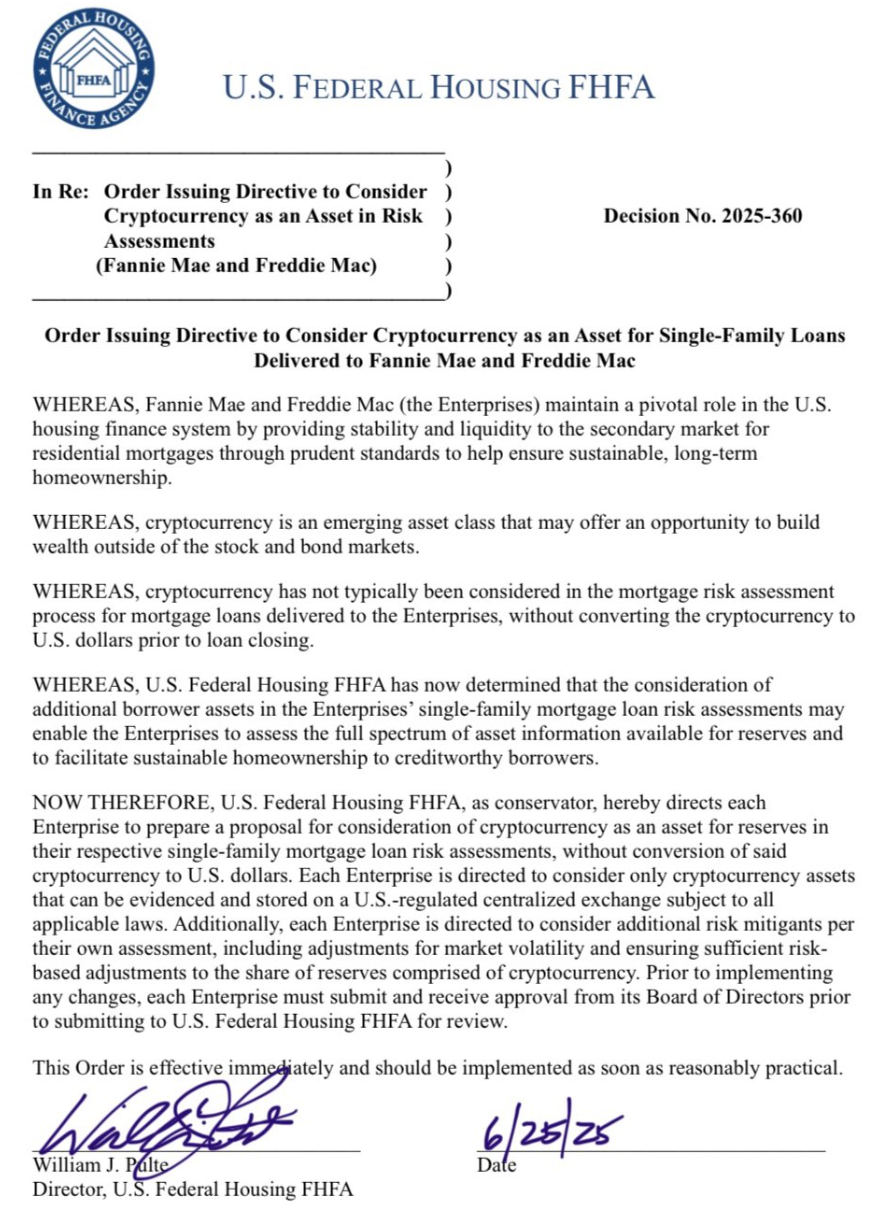
A pivotal moment preceding this launch occurred in June 2025, when the Federal Housing Finance Agency (FHFA) issued a directive to government-sponsored enterprises (GSEs) Fannie Mae and Freddie Mac. This landmark instruction mandated that these mortgage giants develop proposals for considering cryptocurrency holdings on US-regulated centralized exchanges as legitimate assets in single-family mortgage risk assessments. Crucially, this directive specified that such consideration should not require the conversion of crypto assets into US dollars, a fundamental shift from previous practices. The FHFA’s move signaled a clear intent from federal regulators to explore and formalize the role of digital assets in home financing, acknowledging their growing economic significance.
The FHFA directive also included a mandate for Fannie Mae and Freddie Mac to propose robust risk-mitigation measures specifically addressing cryptocurrency’s inherent volatility. These proposals would require approval from their respective boards before final review by the FHFA, highlighting a cautious yet progressive approach to integrating novel asset classes into the traditional mortgage ecosystem.

In parallel with these regulatory developments, other private lenders have also begun to embrace digital assets. Mortgage lender and servicer Newrez made headlines in January 2026 by announcing its intention to recognize certain cryptocurrency holdings when evaluating mortgage applications, effective from February of that year. This included applications for both new home purchases and refinancing. Such moves by established players like Newrez underscore a broader industry trend towards acknowledging and valuing crypto wealth within traditional financial frameworks. These collective actions paint a picture of an evolving landscape where digital assets are steadily gaining ground, moving from speculative investments to recognized components of an individual’s financial portfolio.
Navigating the High-Stakes US Housing Market with Digital Assets
The expansion of Bitcoin-backed home financing arrives at a particularly opportune moment, set against the backdrop of a challenging US housing market. For several years, housing prices have remained near historic highs, creating significant barriers to entry for many prospective homebuyers. According to data compiled by the Federal Reserve Bank of St. Louis from the US Census Bureau and the Department of Housing and Urban Development, the median sales price of a new US home hovered around $400,000 in 2026. While showing a slight decline from peak levels observed in 2022, these prices remain historically elevated, making the accumulation of a traditional down payment a formidable task for many households.
This persistent affordability crisis, coupled with fluctuating interest rates and competitive market conditions, has intensified the search for alternative financing solutions. The Bitcoin-backed mortgage product directly addresses this challenge by providing a pathway for individuals who have accumulated significant wealth in digital assets but wish to avoid the capital gains taxes that would typically be incurred by selling their Bitcoin to fund a down payment. This tax efficiency, combined with the ability to maintain exposure to potential future appreciation of their BTC holdings, presents a compelling value proposition for crypto-rich but cash-poor individuals.
Unlocking Digital Wealth: Benefits and Strategic Advantages for Borrowers
The Better-Coinbase product offers several distinct advantages, particularly for the growing demographic of individuals whose wealth is predominantly held in cryptocurrencies. The primary benefit is the ability to unlock the value of their Bitcoin holdings for a substantial real-world asset – a home – without triggering a taxable event. Selling Bitcoin to fund a down payment would typically incur capital gains taxes, which can significantly reduce the effective amount available for the down payment. By pledging BTC as collateral instead of selling it, borrowers defer or potentially avoid these taxes, preserving more of their digital wealth.
Furthermore, this product allows borrowers to maintain their long-term investment strategy in Bitcoin. For many crypto holders, Bitcoin is not merely a short-term trade but a conviction play in the future of decentralized finance. By using it as collateral, they retain ownership and remain exposed to any future appreciation of BTC while simultaneously acquiring a tangible asset. This dual benefit—accessing traditional finance without divesting from digital assets—is a powerful draw.
The 250% collateralization ratio serves as a significant buffer against Bitcoin’s notorious price volatility. While requiring a substantial overcollateralization, it offers a layer of protection that aims to prevent immediate margin calls in response to typical market dips. This design choice reflects a pragmatic understanding of crypto market dynamics and an attempt to mitigate the most common fears associated with using volatile assets as collateral.
Addressing the Risks: A Balanced View of Crypto-Backed Mortgages
While the benefits are clear, it is equally important to critically examine the inherent risks associated with such a novel financial product. The most prominent concern, despite the safeguards, remains the volatility of Bitcoin. Although price declines alone do not trigger margin calls, a sustained and significant downturn could erode the collateral’s value, potentially making it more challenging for borrowers to meet their obligations if they also face financial distress. The 250% collateral requirement is a robust buffer, but extreme market events are always a possibility.
The clause allowing liquidation of pledged BTC after 60 days of payment delinquency is a critical risk point. While this is standard practice in traditional lending for secured assets, the unique nature of Bitcoin as collateral adds a layer of complexity. Borrowers must be acutely aware that failure to meet mortgage payments could result in the loss of a significant portion of their Bitcoin holdings, potentially at an unfavorable market price if liquidation occurs during a downturn. This underscores the importance of thorough financial planning and stability on the borrower’s part.
Another consideration is the custodial risk associated with holding pledged Bitcoin on Coinbase Prime. While Coinbase Prime is renowned for its security infrastructure, the inherent risks of centralized custody—such as potential hacks, regulatory actions, or operational failures—cannot be entirely discounted, however remote. Borrowers must place a high degree of trust in the custodial platform.
Finally, the evolving regulatory landscape for cryptocurrencies presents an ongoing, albeit diminishing, area of uncertainty. While the FHFA directive and other regulatory movements suggest increasing acceptance, future regulations could impact the terms, tax implications, or operational aspects of such products. Both lenders and borrowers must remain vigilant to these potential shifts.
Broader Implications for the Future of Finance
The general availability of Bitcoin-backed mortgages by Better and Coinbase signifies a monumental step towards the mainstreaming of digital assets within the traditional financial system. This development is poised to have several far-reaching implications:
Firstly, it validates cryptocurrencies, particularly Bitcoin, as a legitimate form of collateral for significant financial undertakings. This moves Bitcoin beyond being solely a speculative investment or a medium of exchange, positioning it as a verifiable asset class that can underpin real-world economic activity.
Secondly, it could catalyze further innovation in the mortgage and broader lending markets. As this product gains traction, other traditional financial institutions may be compelled to explore similar offerings, leading to a diversified ecosystem of crypto-backed financial products. This competition could drive down costs, improve terms, and expand access for a wider range of borrowers.
Thirdly, it broadens the scope of financial inclusion, albeit for a specific demographic. Individuals who have accumulated substantial wealth in crypto but struggle to convert it efficiently or affordably into traditional fiat for major purchases now have a viable pathway to homeownership. This taps into a segment of the population that might otherwise be underserved by conventional lending models.
Fourthly, this move could set a precedent for how regulators view and integrate digital assets. The FHFA’s proactive stance, combined with the successful launch of products like this, may encourage a more structured and comprehensive regulatory framework that supports innovation while mitigating systemic risks.
The partnership between Better Mortgage and Coinbase represents more than just a new product; it is a testament to the increasing maturity and integration of the digital asset economy with established financial markets. As the housing market continues to present challenges and digital wealth continues to grow, such innovative solutions will likely play an increasingly crucial role in shaping the future of homeownership and personal finance. The coming years will undoubtedly reveal the full impact of this significant bridge between Bitcoin and the American dream of homeownership.