Lina Irawan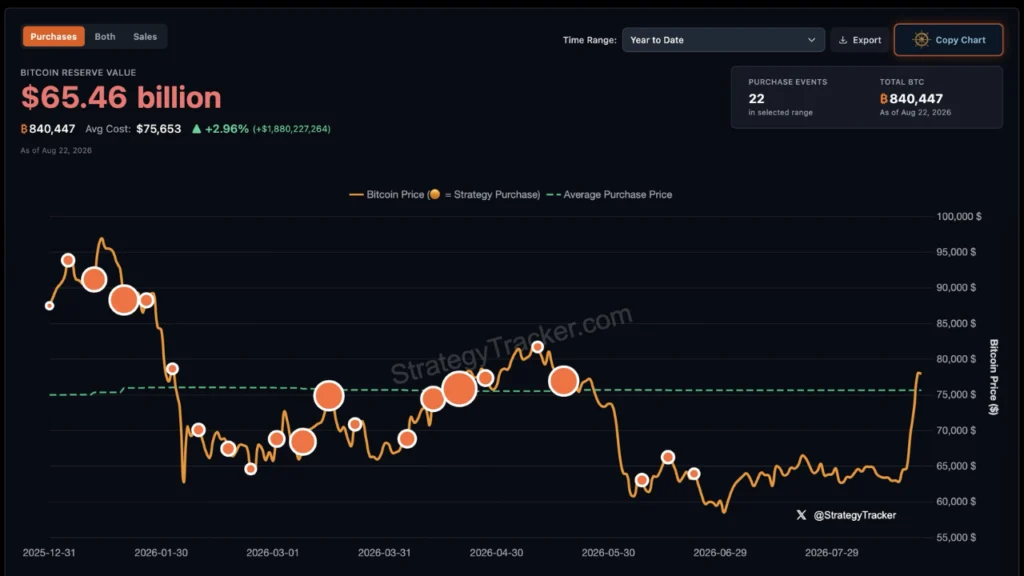
Strategy has moved back into the black on its massive Bitcoin treasury after a sharp five-day rally pushed BTC above the company’s average acquisition price, marking a significant turnaround from months of substantial unrealized losses and bolstering the company’s financial resilience. Bitcoin climbed to approximately $77,300 on August 21st, representing a robust increase of roughly 23% from its opening price of about $62,800 at the start of the week. This surge erased months of paper losses for Strategy, transforming its substantial holdings of 840,447 Bitcoin (BTC) into an estimated paper gain of approximately $1.4 billion, or about 2.4% of its total cost basis.
This financial recovery is particularly noteworthy given that Strategy spent a considerable portion of the preceding year underwater on its substantial Bitcoin investment. The company’s average acquisition price for its extensive Bitcoin holdings was $75,385 per BTC, resulting in a total cost basis of approximately $63.36 billion. With the recent price surge to $77,300, the market value of its Bitcoin treasury has climbed to nearly $65 billion, officially moving the company out of its prior deficit.
From a $13 Billion Deficit to Profitability: A Dramatic Reversal
The latest gains represent a dramatic reversal of fortune for Strategy, which had faced significant pressure from a prolonged Bitcoin downturn earlier in the year. Bitcoin had spent months trading well below its previous all-time highs, having peaked at over $126,000 in October 2025. By the close of June, BTC had plummeted to lows of around $58,000. At these depressed levels, Strategy’s Bitcoin position was estimated to be approximately $13 billion underwater, a deficit exceeding 20% of its total cost basis.
This significant unrealized loss was not merely a theoretical concern. During the market downturn, Strategy had strategically begun selling portions of its Bitcoin holdings to bolster its liquidity position and to meet its financial obligations, particularly those tied to its preferred securities. The company offloaded thousands of BTC during periods when the cryptocurrency was trading in the $60,000 range.

One of the more significant developments in this strategy occurred in June, when Strategy executed its first Bitcoin sale in nearly four years. While this initial sale involved a relatively modest 32 BTC, it signaled a notable departure from the company’s long-standing policy of primarily accumulating Bitcoin rather than divesting it. Subsequently, by early August, Strategy had sold an additional 1,690 BTC, generating approximately $108.6 million in proceeds and bringing its total holdings down to the current 840,447 BTC. Despite these sales, the company emphasized that its overall Bitcoin strategy remained intact, with the amount sold being relatively small in proportion to its vast treasury, and management continuing to focus on strengthening its balance sheet.
Strengthening Financial Foundations: A Robust Dollar Reserve
In parallel with navigating the volatility of its Bitcoin holdings, Strategy has been actively building a considerably larger U.S. dollar reserve. By August 17th, the company’s dollar reserve had expanded to approximately $4.8 billion. According to company statements, this substantial reserve provided roughly 2.8 years of coverage for preferred dividends and other ongoing financial obligations, offering a significant buffer against market fluctuations.
This expansion of its cash reserves was achieved through a multi-pronged approach. A key component involved the sale of Strategy’s own MSTR shares, rather than relying solely on Bitcoin sales. For the week ending August 16th, Strategy successfully raised $333.7 million through the sale of 3.46 million Class A shares. The proceeds from this share offering were strategically allocated across several critical areas: $52.4 million was designated for preferred dividends, $132.2 million was used to repurchase STRC preferred shares, and the remaining $149.1 million was added to the company’s dollar reserve. Notably, Strategy did not engage in any Bitcoin purchases or sales during that specific week.
This strategic allocation of capital is significant. While Strategy’s financial health remains intrinsically linked to the price performance of Bitcoin, its recent financing activities have provided the company with greater flexibility to absorb market volatility without being compelled to immediately liquidate its core Bitcoin assets.
STRC Buybacks and Market Sentiment
Beyond its primary focus on Bitcoin, Strategy has increasingly directed its attention towards its preferred stock, with a particular emphasis on STRC. The company has been actively engaged in repurchasing STRC shares in an effort to drive the security back towards its par value of $100. Over the past four weeks, Strategy has repurchased approximately $347 million of STRC, representing more than one-third of its authorized $1 billion buyback program. At the time of this reporting, STRC was trading around $95.62, a notable recovery from its June low of nearly $71.

The recent upward momentum in Bitcoin’s price could indirectly benefit this preferred stock buyback initiative. An improved Bitcoin market generally translates to enhanced investor sentiment surrounding Strategy’s balance sheet, potentially alleviating concerns about the company’s capacity to service its preferred securities.
However, it is crucial to distinguish between an unrealized gain and a realized profit. Strategy has not yet locked in the approximately $1.4 billion paper gain on its Bitcoin holdings. This represents an unrealized mark-to-market increase in value, which could diminish or disappear rapidly if Bitcoin’s price were to fall back below the company’s average acquisition price.
Future Trajectory: Resuming Bitcoin Accumulation?
A central question for investors and market observers is whether Strategy will revert to its historically aggressive Bitcoin accumulation strategy now that BTC has surpassed its average purchase price. The company has consistently viewed periods of Bitcoin weakness as opportune moments to increase its holdings. However, more recently, liquidity pressures have necessitated a delicate balancing act between Bitcoin accumulation, dividend payments, preferred stock obligations, and the imperative to maintain a substantial cash reserve.
Despite these pressures, Strategy’s CEO, Phong Le, has indicated the company’s expectation to resume Bitcoin accumulation. Furthermore, available data suggests that Strategy’s purchases for the year still significantly outweigh its sales, reinforcing a long-term commitment to the asset.
For the present moment, the Bitcoin rally has provided Strategy with much-needed breathing room. Its vast Bitcoin treasury has transitioned from a substantial $13 billion paper loss during the summer downturn to a roughly $1.4 billion unrealized profit within a matter of weeks. This swift recovery underscores the immense volatility inherent in the cryptocurrency market.

However, this dramatic reversal also serves as a potent reminder of the core risk embedded in Strategy’s business model: its financial health remains inextricably linked to the price fluctuations of Bitcoin. While the company is currently comfortably above its average acquisition price at around $77,000 per BTC, a renewed decline below $75,385 would swiftly plunge its Bitcoin treasury back into underwater territory.
Therefore, for Strategy shareholders, the recent rally is more than just a headline profit figure. It is a compelling illustration of both the significant potential upside and the inherent risks associated with the company’s Bitcoin-centric balance sheet. The company’s ability to navigate future market cycles while managing its diverse financial obligations will be a key determinant of its long-term success. The strategic balance between its digital asset holdings and its traditional financial commitments will continue to be closely scrutinized by the market.