James Watt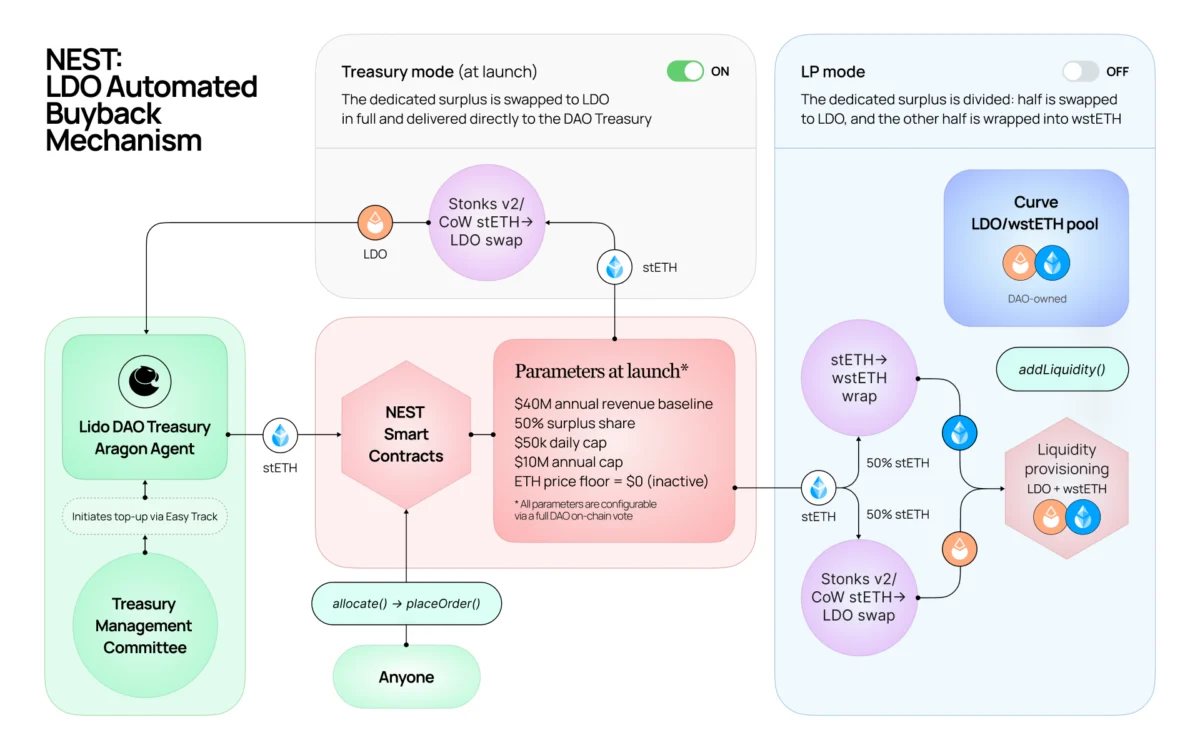
The Lido DAO has officially launched NEST (Network Economic Support Tokenomics), an innovative on-chain mechanism designed to fundamentally realign the LDO token with the Lido protocol’s operational success. This programmatic system is poised to redefine LDO’s utility by directly linking protocol revenue to LDO acquisition, utilizing surpluses from the DAO treasury in a transparent, permissionless, and fully decentralized manner. This strategic initiative, a culmination of extensive community deliberation and technical development, marks a significant milestone in Lido’s long-term vision for sustainable growth and enhanced tokenomics, fulfilling key goals established for 2025 and reiterated for 2026.
The Strategic Imperative: LDO Alignment and Lido’s Vision
Lido DAO stands as a foundational pillar in the decentralized finance (DeFi) landscape, particularly as the leading liquid staking solution for Ethereum and other proof-of-stake networks. By allowing users to stake their cryptocurrencies while retaining liquidity through tokenized representations like stETH, Lido has facilitated broader participation in network security and generated substantial yields for its users. At the heart of its governance and operational framework lies the LDO token, primarily designed to empower holders with voting rights over critical protocol parameters, treasury management, and upgrades.
However, a recurring challenge for many decentralized autonomous organizations (DAOs) has been to forge a more direct economic link between their governance tokens and the underlying protocol’s financial performance. While governance tokens are essential for decentralization, their value proposition can often be perceived as abstract if not directly tied to the protocol’s revenue generation or value accrual mechanisms. Recognizing this, the Lido DAO publicly set a strategic goal for 2025, further reinforced for 2026, to enhance LDO alignment – a mandate to more directly intertwine the LDO token’s economic fate with the Lido protocol’s prosperity. This objective was not merely about price appreciation, but about creating a robust, self-sustaining economic model that rewards active participation and aligns incentives across all stakeholders, from stakers to LDO holders and the broader ecosystem.
NEST emerges as the direct and sophisticated answer to this strategic imperative. It moves LDO beyond a purely governance-centric role, embedding it within the protocol’s economic engine. By systematically converting a portion of the protocol’s surplus revenue into LDO, NEST aims to create a positive feedback loop, enhancing the token’s utility and strengthening its position as an integral component of Lido’s flourishing ecosystem. This mechanism underscores Lido’s commitment to evolving its tokenomics to reflect a more mature and economically integrated decentralized future.
Decoding NEST: Mechanism and Design Philosophy
At its core, NEST operates as a sophisticated, programmatic system meticulously engineered to acquire LDO tokens using a defined share of Lido protocol revenue. This process is triggered when staking revenue surpasses a pre-established operating baseline, with a bounded share of the resultant surplus being converted into LDO via CoW Swap. The inherent logic is elegantly simple: as the protocol’s earnings grow, so too does the volume of LDO acquired through NEST, directly linking LDO’s economic activity to the protocol’s success. The detailed specifications governing this mechanism are publicly documented in Lido Improvement Proposal (LIP-36), reflecting the DAO’s commitment to transparent development.
The design rationale behind NEST is deeply rooted in Lido DAO’s foundational principles: transparency, security, and decentralization. Unlike more rudimentary buyback approaches that might rely on manual execution or centralized decision-making, NEST is built to operate autonomously on-chain, subject to parameters set and adjusted exclusively through full DAO votes. This ensures that every aspect of the LDO acquisition process is auditable, immutable, and under the direct control of the community. Simpler, more centralized alternatives for buybacks were consciously evaluated and rejected by the DAO, prioritizing the integrity and trustlessness inherent to decentralized systems. This rigorous approach extends to all Lido governance mechanisms, from on-chain protocol upgrades to the Dual Governance framework empowering stETH holders with oversight, and the optimistic Easy Track motions for routine treasury allocations. NEST stands as a testament to this commitment, having received explicit DAO approval for its technical infrastructure and mechanism design via Snapshot votes, ensuring it is permissionless and fully transparent.
Operational Modes and Adaptability
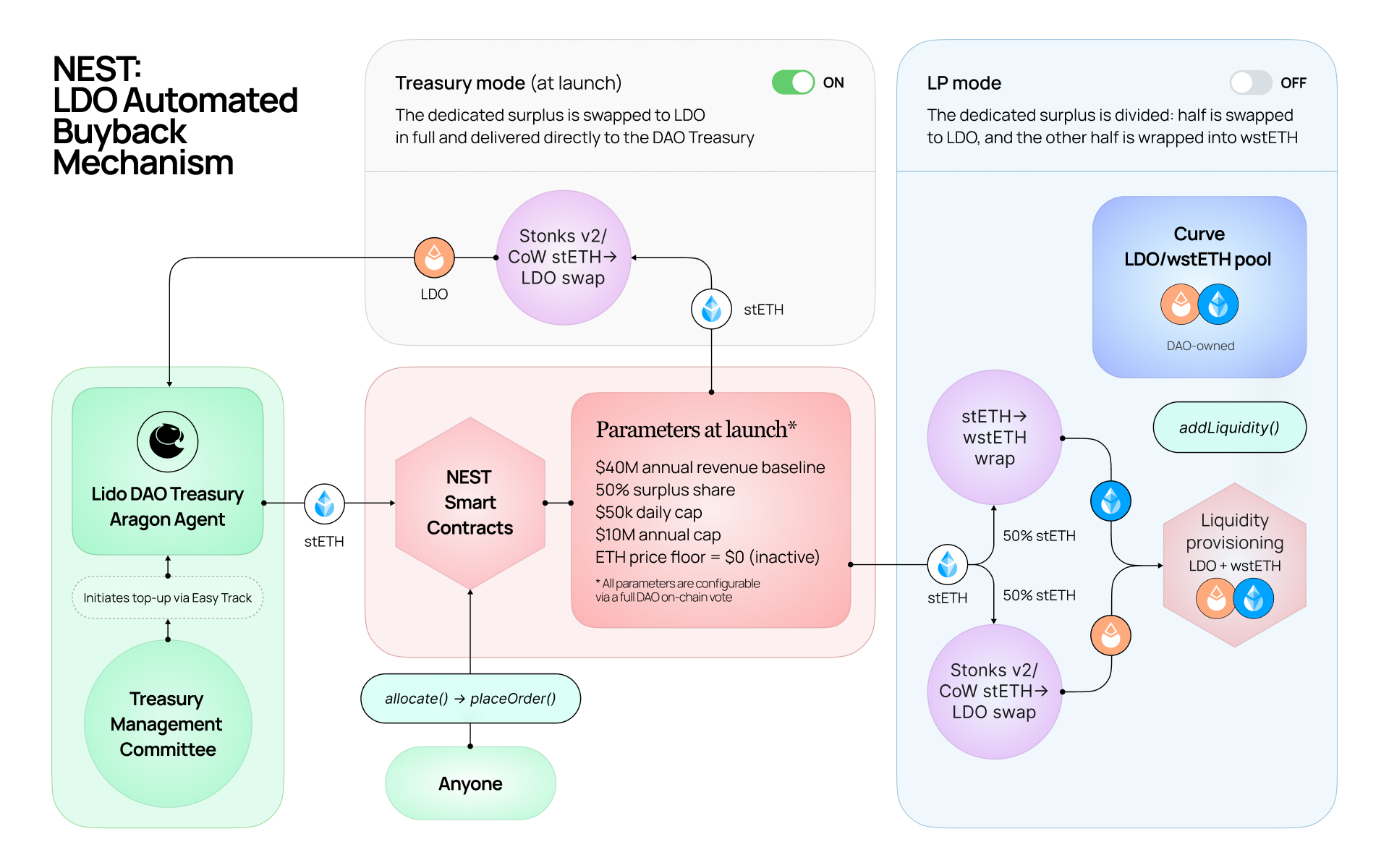
To optimize performance within the dynamic landscape of on-chain LDO liquidity, NEST is designed with two distinct operational modes:
-
Treasury-only Mode: In this default and initial mode, the daily allocation of surplus revenue is fully converted into LDO. These acquired LDO tokens are then channeled directly into the DAO treasury via an Aragon Agent contract. This mode is straightforward, efficient, and ensures a direct accumulation of LDO by the DAO.
-
LP Mode (Liquidity Provider Mode): This mode introduces an additional layer of sophistication. When activated, the daily allocation is split: half is used to purchase LDO, while the other half is wrapped into wstETH (wrapped stETH). Both components are then deposited as DAO-owned liquidity into a dedicated Curve v2 NG pool. The LP tokens generated from this deposit remain under the full ownership and control of the DAO. This mode is designed to enhance LDO liquidity and improve market depth, delivering its full benefits under specific market conditions that warrant active liquidity provision.
NEST has been launched in Treasury-only mode, acknowledging that LP mode’s advantages are contingent on particular market dynamics. However, the foresight in its design ensures seamless future transitions; the necessary Curve pool infrastructure is already deployed, meaning a shift to LP mode would merely require a subsequent on-chain DAO vote, highlighting the mechanism’s inherent flexibility.
Beyond its current scope, NEST’s architecture is built for future expansion. While its initial configuration focuses solely on Lido protocol staking revenue, the system is designed to accommodate additional revenue streams from Lido’s expanding product lines. Future governance votes can integrate these new sources, ensuring NEST remains a dynamic and comprehensive tool for LDO alignment as the Lido ecosystem continues to evolve and diversify its offerings.
NEST Parameters and Economic Safeguards
The operational parameters of NEST, as approved by the DAO at launch, are critical for its stability and effectiveness. While the article does not explicitly list the exact values for parameters such as revenue baseline or the specific caps, it outlines their function: each day, NEST evaluates the DAO’s share of staking revenue against a predefined revenue baseline. A set percentage (at launch, 50%) of the surplus difference is then added to a running NEST balance. As long as this balance remains positive, NEST proceeds with daily LDO acquisitions, adhering strictly to specified daily caps. Should the balance dip into negative territory, purchases are automatically paused until new protocol surplus restores the balance.
A critical safety feature is the $50,000 daily cap on LDO purchases. This serves as a primary guardrail, effectively limiting the DAO’s exposure over a typical six-day governance response window to approximately $300,000. This conservative approach is vital in mitigating potential risks associated with automated treasury spending, ensuring financial prudence and stability.
The adoption of a cumulative model, rather than a simple daily-spend approach, was a deliberate design choice to circumvent two common failure modes: the risk of overspending during periods of consecutive high revenue, and the inefficiency of being unable to carry forward unused purchasing capacity from days with lower surpluses. This cumulative design ensures a more consistent and strategic acquisition process over time.
To validate the model’s efficacy, extensive backtesting was conducted using historical revenue data from 2024–2025. The results were compelling: the model would have successfully delivered approximately $7.09 million in LDO acquisitions, precisely meeting its target spend, from a total of $94.18 million in protocol rewards during that period. These comprehensive calculations, along with detailed comparisons against alternative design proposals, are openly documented in LIP-36 and discussed extensively within the Lido Research forum, providing full transparency for community review.
Crucially, all NEST parameters are fully adjustable through a complete DAO vote. This empowers the Lido community to dynamically fine-tune the mechanism in response to evolving protocol economics, market conditions, or strategic shifts, reinforcing the DAO’s ultimate control and adaptability.
Mitigating Risks and Ensuring Robustness
Implementing a programmatic mechanism that automatically expends treasury assets daily inherently introduces a unique set of risks. The design of NEST has been meticulously engineered to proactively address these potential vulnerabilities, ensuring the system’s robustness and the security of DAO assets.
One primary concern for any automated market interaction is market manipulation or front-running. NEST mitigates this by utilizing CoW Swap, which is designed to provide MEV (Maximal Extractable Value) protection and fair execution prices by batching orders and using a solver network, reducing the ability for individual transactions to be exploited. The daily spending caps also limit the impact of any single day’s activity.
Smart contract vulnerabilities are a perpetual risk in DeFi. NEST’s smart contracts have undergone rigorous auditing processes, a standard practice for Lido DAO, ensuring their integrity and security. Furthermore, the permissionless and immutable nature of the deployed contracts means that once parameters are set by the DAO, the mechanism operates without human intervention, reducing human error.
Illiquidity of LDO on-chain is another consideration, which the two-mode design (Treasury-only and LP mode) addresses. Starting in Treasury-only mode minimizes market impact, while the option to switch to LP mode provides a strategic tool to enhance liquidity if needed, directly countering potential slippage or price volatility during large acquisitions.
Oracle reliance and data integrity are often points of failure. While the article doesn’t explicitly detail oracle use for revenue calculation, any such component would be subject to Lido’s high standards for decentralized oracle solutions or direct on-chain data retrieval, minimizing single points of failure.
Finally, the risk of uncontrolled treasury drain is directly addressed by the strict daily spending caps and the cumulative balance model. These mechanisms ensure that spending is always bounded and directly tied to surplus revenue, preventing the system from depleting core treasury funds. Furthermore, the fundamental principle that all NEST-purchased assets remain DAO-owned is paramount. Any movement or utilization of these assets outside the mechanism’s precisely defined operational paths requires explicit and separate DAO authorization, providing an ultimate layer of security and control. This multi-faceted approach to risk mitigation underscores Lido’s commitment to building secure and resilient decentralized infrastructure.
Broader Implications for Lido and the DeFi Ecosystem
The introduction of NEST carries profound implications, not just for the Lido DAO but for the broader decentralized finance ecosystem.
Firstly, NEST represents a significant evolution in tokenomics design. By directly linking LDO acquisition to the protocol’s revenue, it transitions LDO from a purely governance-focused token to one with tangible economic utility derived from the protocol’s success. This creates a more robust value proposition for LDO holders, as their token’s long-term value becomes more intrinsically aligned with the growth and profitability of the Lido protocol. This model could serve as a blueprint for other DAOs grappling with how to imbue their governance tokens with deeper economic relevance.
Secondly, NEST solidifies Lido’s position as a leader in decentralized treasury management. The mechanism demonstrates a sophisticated and proactive approach to utilizing surplus revenue not just for operational expenses or grants, but for strategic token alignment. This prudent and programmatic management of treasury assets, governed entirely on-chain, sets a high bar for transparency and efficiency in DAO operations. It showcases how a DAO can responsibly manage its finances while simultaneously strengthening its core token’s economic foundations.
Thirdly, the mechanism’s potential market impact on LDO is noteworthy. Consistent, programmatic buying pressure, even if capped, can contribute to increased demand and potentially stabilize or support the token’s price over time. Furthermore, the future option to activate LP mode could significantly enhance LDO’s on-chain liquidity, benefiting traders and reducing slippage, thereby fostering a healthier and more liquid market for the token. This creates a positive feedback loop: as the protocol generates more revenue, more LDO is acquired, potentially increasing its value, which in turn can attract more participants to the Lido ecosystem.
Lastly, NEST reinforces Lido’s commitment to sustainable growth and decentralization. By ensuring that LDO’s economic incentives are aligned with the protocol’s performance, it fosters a community more deeply invested in Lido’s long-term success. The adaptability of NEST to integrate future revenue sources also positions it as a foundational piece for Lido’s expanding product line, ensuring that new ventures contribute to the overall LDO ecosystem. It serves as a powerful statement about the maturity of decentralized governance and the potential for DAOs to build complex, self-regulating economic systems.
Chronology and Community Engagement
The journey to NEST’s launch is a testament to Lido DAO’s iterative and community-driven development process. The concept of LDO alignment was first articulated as a key strategic goal for 2025, with continued emphasis through 2026, stemming from extensive discussions within the Lido Research forum regarding the evolution of LDO tokenomics.
The groundwork for NEST involved several critical milestones. The DAO first approved the "technical rails" required for such an automated system through an on-chain vote on April 13, 2026. This was swiftly followed by the approval of the comprehensive "mechanism design" itself, also via an on-chain Snapshot vote, which solidified the parameters and operational logic of NEST. These approvals were the culmination of months of detailed research, proposal drafting (such as LIP-36), and vigorous debate among community members, core contributors, and the Lido Foundation.
Throughout this period, the Lido Research forum served as the central hub for intellectual exchange, allowing for rigorous backtesting of various models and a thorough comparison against alternative designs. This collaborative environment ensured that NEST was not only technically sound but also reflected the collective wisdom and priorities of the Lido community. The Lido Foundation, responsible for delivering on the DAO’s strategic goals, played a pivotal role in translating these community-driven decisions into robust, executable on-chain infrastructure. The widespread support and active participation in these governance processes underscore the community’s belief in NEST as a pivotal step for Lido’s future.
Distinguishing NEST from Other Initiatives
It is crucial to differentiate NEST from other ongoing Lido initiatives, particularly the LDO Accumulation Program. While both involve LDO acquisition, their design, governance, and purpose are distinct. The LDO Accumulation Program, approved by the Lido DAO on April 13, 2026, is a separate, one-time treasury operation. It functions as a discretionary, committee-executed initiative, designed to capitalize on specific market opportunities to accumulate LDO for the DAO’s treasury. Batch parameters, execution updates, and further details for this program are published on the Research forum. In contrast, NEST is a structural, programmatic, and fully automated on-chain mechanism, designed for continuous operation based on protocol revenue. Its governance is entirely decentralized, driven by pre-set parameters adjustable only through DAO votes, making it fundamentally different from a discretionary, committee-led program. This distinction highlights Lido’s multi-faceted approach to treasury management and tokenomics, employing both strategic, opportunistic programs and foundational, automated mechanisms.
In conclusion, the launch of NEST represents a pivotal advancement for the Lido DAO, solidifying the LDO token’s role as a directly aligned economic engine within the protocol. By establishing a transparent, permissionless, and revenue-driven LDO acquisition mechanism, Lido is not only enhancing its tokenomics but also setting a new standard for decentralized treasury management and sustainable growth in the DeFi space. NEST is a testament to Lido’s commitment to innovation, decentralization, and a future where token utility is intrinsically woven into the fabric of protocol success.