admin
admin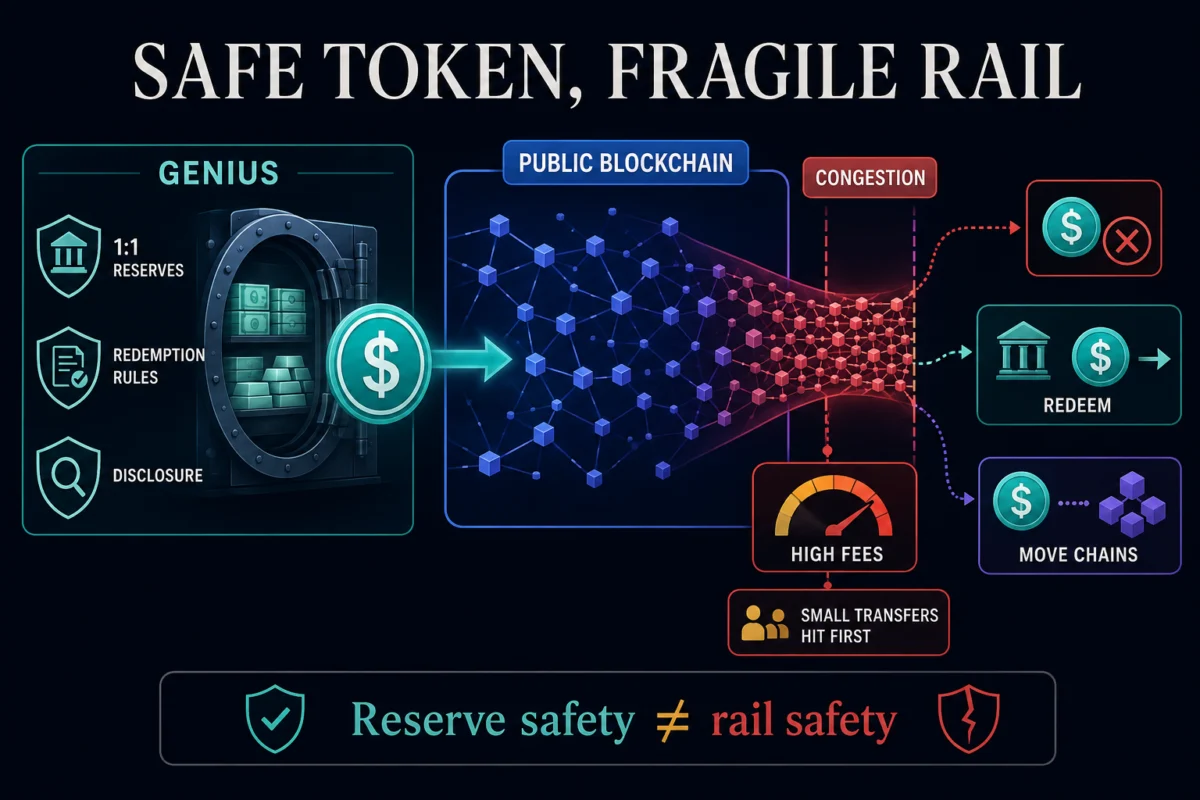
A groundbreaking Federal Reserve staff paper, initially dated June 2, 2026, and subsequently updated on August 31, 2026, has illuminated a potential vulnerability in the digital dollar ecosystem: the fragility of even perfectly backed stablecoins when faced with transaction congestion. Authored by Federal Reserve economists, the paper, which carries the standard disclaimer that its views do not necessarily represent the official stance of the Federal Reserve Board or System, models how escalating transaction fees on public blockchains can destabilize digital currencies, even those with robust reserve backing.
This research emerges at a critical juncture as the U.S. Treasury Department actively implements the GENIUS Act, a legislative effort designed to provide a comprehensive regulatory framework for stablecoin issuers. While the Act equips regulators with extensive tools to oversee issuers, their reserves, and redemption commitments, it conspicuously avoids setting explicit price or capacity standards for the public blockchains that facilitate token transfers. This divergence creates a potential gap, leaving the resilience of the underlying infrastructure outside the direct purview of the stablecoin issuer’s regulatory oversight.
The Unforeseen Fragility: Congestion Beyond Reserve Quality
Traditional analyses of stablecoin stability have predominantly focused on the quality and sufficiency of an issuer’s reserves. The underlying assumption is that if a token promises one dollar in value, any erosion in the reserves or inability to liquidate them rapidly would prompt holders to redeem their tokens before others, potentially triggering a "run." However, the Federal Reserve economists deliberately abstract this traditional risk from their model. Their stablecoin is assumed to be fully and securely backed, meaning that the potential for instability stems not from the issuer’s solvency, but from the complex interplay between transaction fees and network effects.
The paper posits that the value of a payment asset is intrinsically linked to its widespread acceptance and usage – what economists term "payment-network effects." Under conditions of low network congestion, this network can absorb external shocks with relative ease. However, the model predicts that in scenarios of high congestion, particularly when coupled with weak network effects, a threshold can be reached where individual decisions to redeem can cascade into a coordinated and abrupt exodus. As transaction fees climb, the economic viability of smaller payments diminishes, thereby reducing the token’s overall utility. This diminished utility, in turn, weakens the network effect, providing a greater number of holders with a compelling reason to exit the system.
It is crucial to interpret the term "redemption" within the context of the paper’s empirical work. In its primary empirical analysis, "redemption" is quantified as a negative change in a stablecoin’s circulation on the Ethereum blockchain. This metric encompasses not only direct cash-outs to fiat currency but also the migration of tokens to alternative, potentially less congested, blockchains. Consequently, the data capture pressure on Ethereum-based circulation rather than providing a precise count of customers cashing out directly with an issuer.
Empirical Evidence: Quantifying Congestion’s Impact
The research employs an unbalanced weekly panel dataset of five prominent stablecoins, spanning from November 2017 to December 2025, for which data were available. A striking finding emerges from the period between 2021 and 2025: for below-median transfers of USD Coin (USDC), the ratio of transaction fees to the transfer value at the 75th percentile frequently exceeded 100%. In stark contrast, for above-median transfers, this ratio was almost invariably below 5%.
This statistic does not imply that users routinely paid more in fees than they sent. Instead, it illustrates the distribution of attempted and completed transfer economics. During periods of high network fees, a representative network fee could surpass the value of numerous small transfers, rendering them uneconomical. In such circumstances, a token holder might choose to defer the transaction, consolidate multiple transfers into a single larger one (batching), or seek alternative methods of moving their assets, such as through a custodian. This pattern underscores how network congestion can effectively ration access based on the size of a transfer, even while the underlying token remains fully redeemable at its par value.
A Multifaceted Approach to Understanding Risk
The Federal Reserve paper integrates a theoretical model with several empirical tests, each designed to address distinct facets of the congestion-driven instability phenomenon.
-
Weekly Stablecoin Panel: This analysis revealed that a one-standard-deviation increase in transaction gas fees (an increase of approximately $10.83 in the model’s context) was associated with a roughly 0.9 percentage-point rise in weekly redemptions, but only when network effects were observed to be weak. This finding strongly supports the hypothesis that fee sensitivity is amplified when a stablecoin’s payment network is less robust. However, it is important to note that gas fees alone were not statistically significant in this panel; the observed effect was contingent upon the interaction with weak network effects, a state that comprised approximately 7% to 7.5% of the observed data.
-
Ethereum Empty-Slot Design: This empirical test focused on the Ethereum blockchain’s block allocation mechanism. The raw rate of "empty slots" (blocks with unused transaction space) averaged 0.7%. A one-standard-deviation increase in this empty-slot rate (an increase of 0.004) corresponded to approximately $0.77 more in gas fees. This finding provides a more direct causal link, suggesting that a plausibly exogenous shock to network capacity—represented by a higher empty-slot rate, which implies reduced available space and thus higher competition for it—can indeed lead to increased transaction fees. This part of the study effectively establishes the capacity-to-fee link but does not directly demonstrate the subsequent redemption response.
-
Matched ETH-Tron USDT Transfers: This analysis examined 1,230 instances of USDT transfers on both Ethereum and Tron blockchains within a 60-minute window, from May 2020 through December 2025. The average matched transfer value was approximately $176 million. The study found that a $1 increase in lagged, demeaned gas fees on Ethereum was associated with a 3% to 4% increase in the net matched value of USDT moving from Ethereum to Tron. This correlation suggests that higher Ethereum fees coincide with a reallocation of assets to alternative, potentially cheaper, blockchain networks. However, this association does not allow for the identification of every individual owner or the precise motive behind each transfer, nor can it definitively exclude all alternative explanations for the observed cross-chain movements.
Collectively, these findings do not constitute a definitive forecast of an impending crisis but rather offer a conditional warning: network congestion can indeed create incentives for users to exit, and historical data indicate that a portion of this activity has migrated to less expensive blockchain "rails" when Ethereum became prohibitively expensive.
The GENIUS Act: Safeguarding Issuers, Not Necessarily All Rails
The Guiding and Establishing National Innovation for U.S. Stablecoins Act (GENIUS Act) mandates that permitted payment stablecoin issuers maintain reserves equivalent to at least 100% of the value of the tokens issued, backed by specified liquid assets. Furthermore, the Act mandates clear public redemption procedures, transparency regarding issuer purchase and redemption fees, monthly reporting, and rigorous examination and certification processes. It also establishes regulatory standards encompassing capital adequacy, liquidity management, asset diversification, operational robustness, and information technology security.

These provisions are designed to address critical failure points inherent in stablecoin operations: inadequate or devalued assets, opaque redemption mechanisms, undercapitalized issuers, and insufficient operational controls. By setting these standards, the GENIUS Act provides regulators with a more defined and empowered pathway to supervise the entities responsible for creating and managing dollar-backed tokens.
The U.S. Treasury Department’s implementation proposal, published on August 17, 2026, and appearing in the Federal Register on August 18, 2026, specifically addresses Section 3 of the GENIUS Act, which pertains to the restrictions on offering or selling payment stablecoins within the United States. Public comments on this proposal were due by October 19, 2026. The Treasury anticipates that the issuer licensing framework will become effective on January 18, 2027, with a broader restriction on digital asset service providers slated to take effect on July 18, 2028.
The proposed rule draws a distinction between direct transfers between individuals acting in their personal capacity (including self-custody transactions) and compensated services provided by entities such as exchanges, transfer businesses, and custodians, which may be classified as digital asset service providers. This classification has significant implications for compliance responsibilities. However, the economic realities of a congested base layer persist across these categories. A stablecoin’s reserves can remain liquid and fully backed, yet users may still encounter transaction fees that exceed the value of their intended payment.
The distinction drawn by the proposed rule is nuanced. Disclosure requirements for issuer purchase and redemption fees are separate from the charges levied as blockchain gas fees or exchange withdrawal fees. As it stands, the regulatory text leaves the pricing and capacity of public blockchains outside the explicit purview of the stablecoin issuance rules. Nevertheless, the GENIUS Act grants supervisors broad authority over an issuer’s operational and technological risks. This could empower regulators to scrutinize how an issuer manages its exposure to blockchain network conditions, even if they do not directly control public blockspace allocation. The Treasury’s public comment process remains open, offering an opportunity for potential adjustments to implementation choices before the rules are finalized.
This dual layer of oversight means that two distinct safety tests are in operation concurrently. Supervisors are tasked with verifying an issuer’s ability to honor its dollar claims and manage its internal operations. Simultaneously, users experience the practical reality of whether the chosen blockchain network can facilitate access to that dollar claim at a price that is proportionate to the payment’s value.
Fee Dynamics: Identifying Who Feels Congestion First
Stablecoins are currently distributed across various blockchain networks, each possessing its own distinct fee market. A snapshot taken shortly before the drafting of this article, drawing data from DefiLlama’s chain dashboard and API, indicated a total stablecoin supply of approximately $147.3 billion on Ethereum, $93.2 billion on Tron, and $15.7 billion on Solana. Minor variations in these figures, approximately $148.0 billion, $93.6 billion, and $15.8 billion respectively, were observed based on timing and methodology differences.
During the snapshot period, Ethereum was not experiencing congestion. Etherscan data showed gas fees hovering around 0.127 to 0.128 gwei, with Ether (ETH) trading near $2,404. Assuming an illustrative 65,000 gas units for a standard ERC-20 token transfer, this would translate to a network cost of approximately two cents. Actual gas consumption and wallet estimates can, of course, vary.
Transaction costs on Tron and Solana are structured differently. Tron charges 100 sun per Energy unit. A third-party estimator suggested that an unstaked USDT transfer to an existing account would require approximately 65,000 Energy, while a transfer to a new account would necessitate around 131,000 Energy. This equates to roughly 6.5 to 13.1 TRX, prior to factoring in staking or rented Energy. Solana’s base fee is set at 5,000 lamports per signature, with a recent analytics snapshot indicating a median total fee of approximately 5,800 lamports and a 99th-percentile fee of about 651,400 lamports.
A direct dollar-price comparison across these networks would be inherently misleading due to variations in fee systems, observation methodologies, and the inherent volatility of these figures. The more meaningful comparison is structural: the "stablecoin fee" is not a monolithic concept but varies significantly based on the chosen blockchain rail and prevailing transaction conditions. It is also important to distinguish these network charges from exchange withdrawal fees or platform fees, which are set independently by intermediaries.
The initial impact of network congestion is most acutely felt by transactions involving the smallest values, which have the least capacity to absorb a fixed network charge. A retail user holding their stablecoins in self-custody might be compelled to delay a payment, consolidate multiple transfers, migrate their assets to an exchange for processing, or even cease using that particular blockchain altogether. This response can be economically driven, even if the stablecoin itself remains fully redeemable at its nominal value.
Observable shifts in balances are more likely to originate from larger intermediaries. Exchanges, market makers, cross-chain bridges, stablecoin issuers themselves, and corporate treasury desks possess the liquidity to move substantial volumes, potentially altering chain-level circulation or replenishing inventories where user demand is high. This sequence of events is an inference based on market dynamics rather than a direct owner-level finding presented in the Federal Reserve paper.
Destination chains can consequently inherit both increased activity and potential pressure. A surge in token transfers to a particular network may deepen its stablecoin liquidity but simultaneously test the robustness of its routing mechanisms and the intermediaries responsible for rebalancing inventory. These second-order effects are analytical inferences rather than direct findings from the paper’s owner-level data. The overarching policy question extends beyond merely ensuring an issuer holds sufficient reserves; it also encompasses ensuring users have access to a tolerably priced route to the redeemable dollar claim, particularly when the chosen blockchain rail is under stress.
The snapshot taken on September 3, 2026, primarily serves to confirm that Ethereum fees were quiescent at that specific observation point; it does not provide a measure of system-wide redemption pressure. The Federal Reserve paper effectively reframes the gap between blockchain rail resilience and stablecoin safety as a monitorable risk rather than an immediate harbinger of an event. Regulators and market participants are thus encouraged to observe key indicators, including fee-to-transfer-value ratios segmented by transaction size, abrupt shifts in chain-level stablecoin circulation, matched cross-chain flows, and imbalances in exchange wallet holdings.
The GENIUS Act is poised to enhance the safety of stablecoins by focusing on issuer reserves and operational integrity. However, it does not inherently guarantee the resilience of every pathway through which these stablecoins can be accessed and transacted. If the implementation of the Act prioritizes reserve quality as the sole determinant of safety, future periods of market stress could reveal a stark reality: the dollar token itself may have remained sound, but the accessibility to it could prove precarious.