
 admin
admin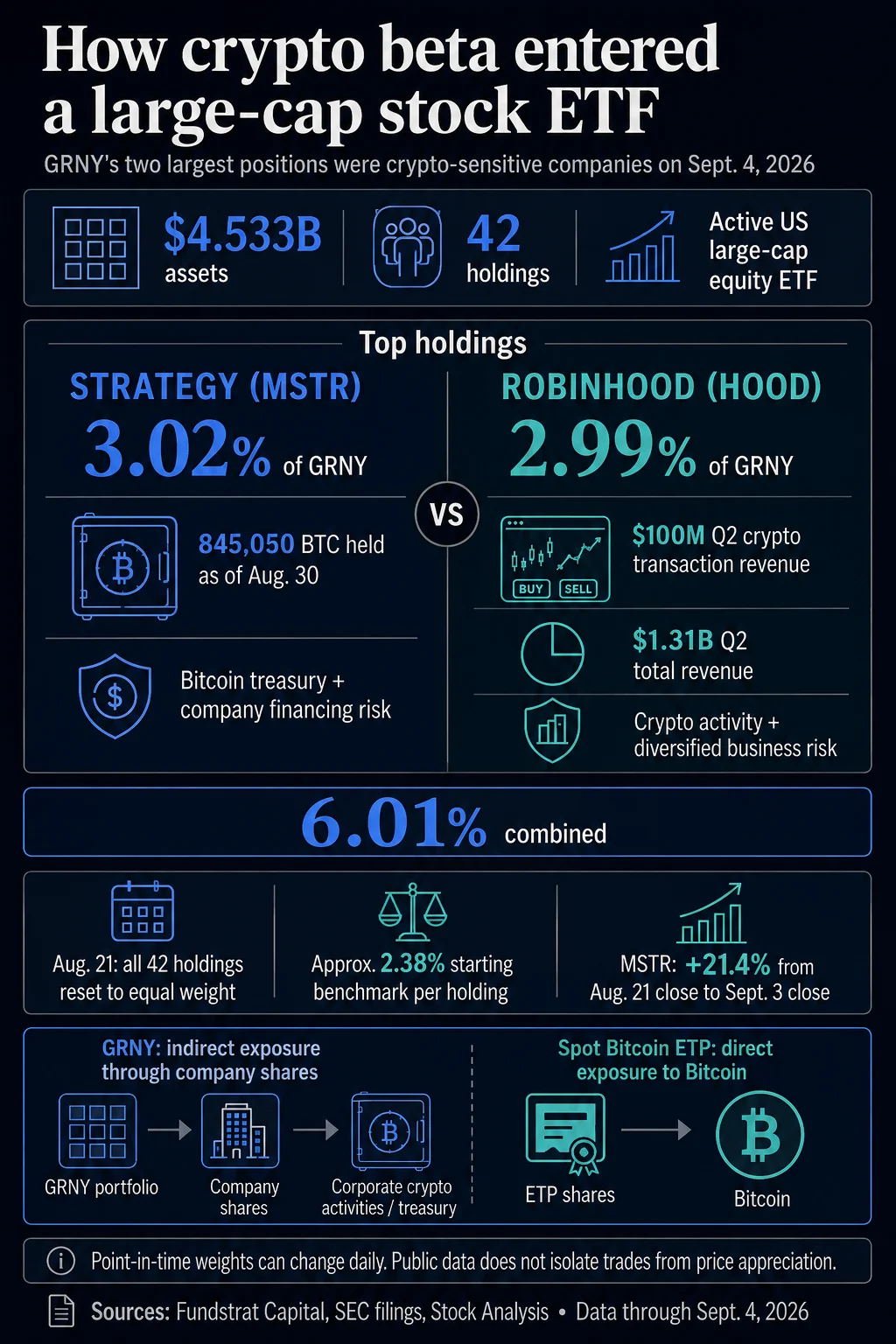
A significant shift in the portfolio composition of the $4.5 billion Fundstrat Granny Shots US Large Cap ETF (GRNY) has brought two companies with substantial ties to the cryptocurrency market to the forefront, signaling a complex pathway for investors to gain exposure to digital asset volatility through traditional equity investments. As of the fund’s September 4 holdings snapshot, MicroStrategy Incorporated (MSTR) and Robinhood Markets Inc. (HOOD) commanded the top two positions, representing a combined 6.01% of the ETF’s assets. This development underscores how macroeconomic trends and investor sentiment towards emerging asset classes can ripple through even diversified equity portfolios, albeit indirectly.
The GRNY ETF, managed by Fundstrat Capital, boasts a substantial $4.533 billion in assets under management and held 42 distinct securities as of September 3. While the fund explicitly invests in equities rather than holding cryptocurrencies directly, its strategic allocation to MSTR and HOOD highlights a growing trend where public companies serve as proxies for digital asset exposure. MicroStrategy’s prominent position stems from its extensive corporate treasury holdings of Bitcoin, a strategy that has increasingly influenced its stock performance. Robinhood, a widely recognized retail financial platform, derives a portion of its revenue from facilitating cryptocurrency trading, thereby linking its financial health to the activity and valuation of the digital asset market.
Strategic Rebalancing and Market Dynamics
The emergence of MicroStrategy and Robinhood at the apex of GRNY’s portfolio is a direct consequence of a strategic equal-weight rebalancing executed on August 21, 2026. This periodic adjustment aims to reset the allocation of all holdings to an equivalent weighting, providing a baseline from which individual stock performance can then diverge. Prior to this rebalance, both MSTR and HOOD were already constituents of the GRNY portfolio. The rebalancing notification, dated August 21, detailed a systematic reset where all 42 positions were brought to an equal footing. This implies that immediately following the reset, each holding would represent approximately 2.38% of the fund’s total assets (100% / 42 holdings).
Following this equal-weight reset, MicroStrategy experienced a notable rally. From its closing price of $119.25 on August 21, the stock surged to $144.82 by September 3, marking an impressive gain of approximately 21.4%. This significant appreciation is a primary driver behind MSTR’s ascent to the top position, pushing its weighting well above the initial equal-weight benchmark. The exact mechanics of how this increased weighting was achieved are multifaceted. While the fund experienced net creations totaling $334.82 million on August 20, a day before the rebalance, these inflows do not specifically identify which securities absorbed the capital. Therefore, it is challenging to definitively attribute MSTR’s current weighting solely to new purchases, fund creations, or the intrinsic price appreciation of the stock itself. The available data does not allow for a precise dissection of the influences on MSTR’s weighting post-rebalance.
The structure of Fundstrat Capital’s investment management further complicates attributing a singular "Tom Lee bet" to the fund’s holdings. A June filing with the Securities and Exchange Commission (SEC) indicates that day-to-day securities management is jointly overseen by Lee and Ken Xuan, while Qiao Duan and Stephen Foy are responsible for trading and execution. This distributed responsibility suggests that the prominent weighting of MSTR is likely the outcome of a collective decision-making process informed by the fund’s investment strategy and market conditions, rather than a unilateral choice by any single portfolio manager. The most plausible interpretation of the record is that GRNY maintained MicroStrategy at an equal-weight rebalance, and a subsequent sharp increase in the stock’s price propelled it to the leading position. The fund’s disclosure protocols do not extend to reconstructing every trade or assigning individual portfolio decisions to specific managers.
Differentiated Crypto Linkages
It is crucial to differentiate the nature of the crypto linkage for MicroStrategy and Robinhood, as they are not interchangeable proxies for Bitcoin exposure.
MicroStrategy (MSTR): The Bitcoin Treasury Strategy

MicroStrategy has famously embarked on a strategy of accumulating Bitcoin as its primary treasury reserve asset. As of August 30, 2026, the company reported holding 845,050 Bitcoin. Consequently, the valuation of MicroStrategy’s stock is inextricably linked to the price fluctuations of Bitcoin. Any substantial movement in Bitcoin’s value directly impacts the company’s balance sheet and, by extension, investor sentiment towards MSTR. However, it is essential to recognize that shareholders of MicroStrategy are not solely exposed to Bitcoin’s volatility. They also bear financing and capital-structure risks associated with the company’s operations, debt levels, potential equity issuances, and the overall performance of its software business. Investors’ perception of the premium or discount placed on MicroStrategy’s Bitcoin treasury strategy also plays a significant role in its stock price.
Robinhood Markets (HOOD): A Diversified Financial Platform
Robinhood’s connection to the crypto market is more operational and integrated within a broader business model. The company generates revenue through various channels, including equity and options trading, interest income, and cryptocurrency transactions. In the second quarter of 2026, Robinhood reported approximately $100 million in crypto transaction revenue, a notable component within its total revenue of $1.31 billion for the period. This indicates that while crypto trading is a significant revenue stream, it is part of a diversified business. Therefore, Robinhood’s stock performance is influenced by crypto market activity, but also by broader trends in equity and options trading, customer asset growth, and the overall competitive landscape of retail financial services.
The combined weighting of 6.01% in GRNY does not equate to a direct 6.01% allocation to Bitcoin. Instead, it represents exposure to two distinct businesses whose sensitivity to cryptocurrency prices and market activity arises through fundamentally different mechanisms. This exposure is further bundled with the unique risks inherent to each operating company.
Broader Implications for Investors and the Market
The prominent positioning of MSTR and HOOD within a large-cap generalist ETF like GRNY illustrates a pathway through which crypto-linked volatility can permeate into traditional investment portfolios. For investors who may not actively seek direct exposure to cryptocurrencies, such as through spot Bitcoin ETFs, this indirect exposure via equities offers an alternative, albeit with different risk profiles.
A direct spot-Bitcoin product, such as BlackRock’s iShares Bitcoin Trust ETF, is designed to mirror the price of Bitcoin and holds Bitcoin as its underlying asset. In contrast, shareholders of GRNY are investing in operating companies whose stock prices are influenced by a complex interplay of factors, including crypto market movements, operational performance, corporate finance, regulatory environments, and general equity market sentiment.
This phenomenon highlights the evolving nature of market interconnectedness. "Crypto beta," or the correlation of an asset’s returns with those of cryptocurrencies, can now extend beyond dedicated digital asset products. Listed companies that integrate cryptocurrency-related business lines or treasury strategies effectively carry this sensitivity into broader equity markets. While the exposure is disclosed, the character of the risk is fundamentally altered. A spot product largely tracks its underlying asset, whereas MSTR and HOOD introduce additional layers of risk management, financing considerations, regulatory scrutiny, execution challenges, and stock-market valuation dynamics.
The GRNY ETF’s current portfolio composition, while noteworthy, should be viewed as a specific instance rather than definitive proof of a widespread industry migration away from direct crypto allocations towards proxy stocks. To establish a broader trend, comprehensive holdings and flow data across a wider array of active equity funds over an extended period would be necessary. The September 4 snapshot for GRNY primarily serves to demonstrate a more limited, yet significant, point: following an equal-weight rebalance and a substantial rally in MicroStrategy’s stock, a generalist large-cap ETF found its two largest positions occupied by crypto-sensitive companies. Consequently, its shareholders are now absorbing a portion of the volatility associated with these assets, irrespective of whether direct crypto exposure was their initial investment objective. This indirect exposure necessitates a nuanced understanding of the underlying risks and the distinct channels through which digital asset market movements can influence equity performance.








