admin
admin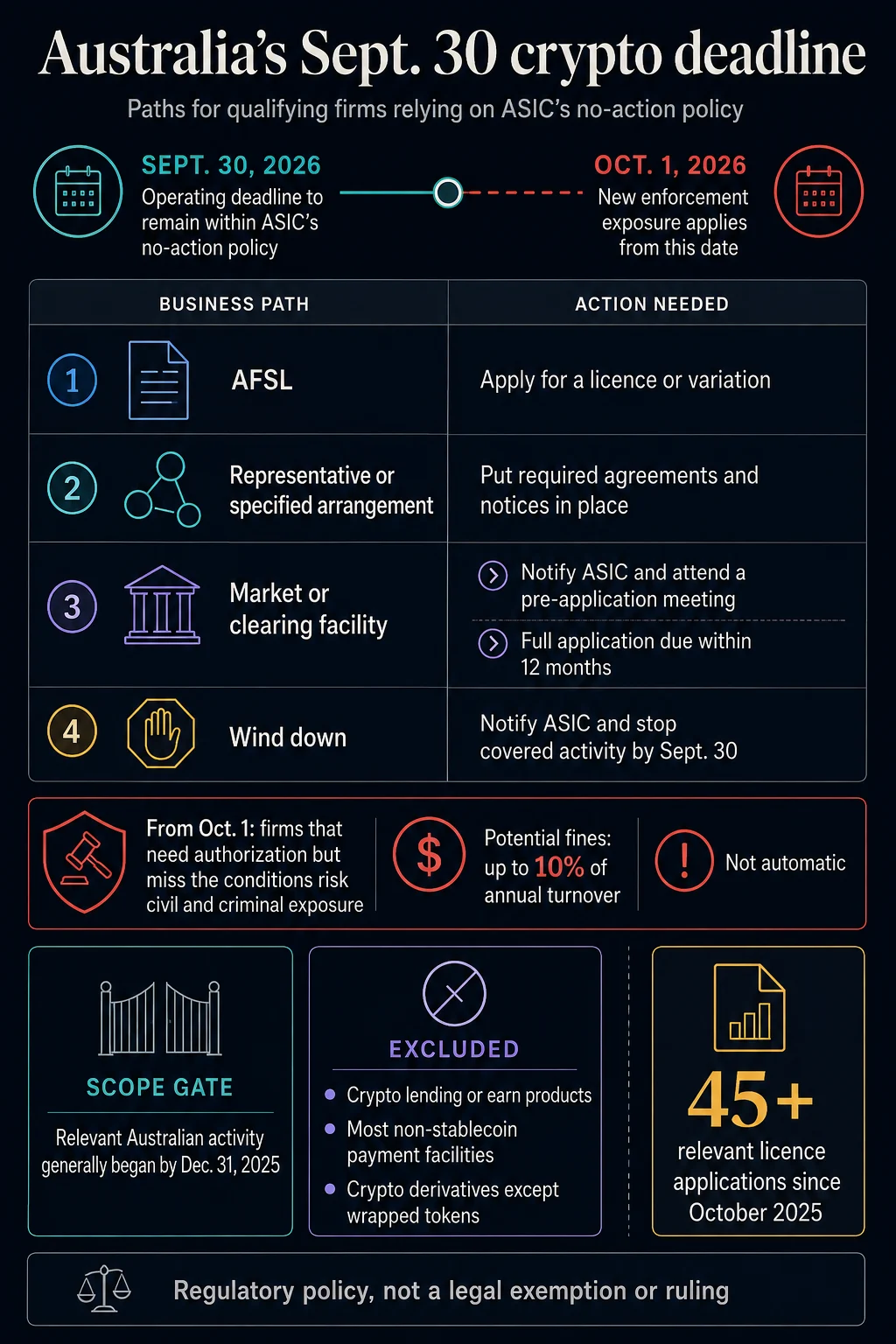
Australian cryptocurrency firms operating in areas deemed financial products by the Australian Securities and Investments Commission (ASIC) face a critical deadline of September 30, 2026, to either secure the necessary financial services authorization or prepare for stringent regulatory enforcement. This mandate signals a significant tightening of the regulatory landscape for digital asset businesses within the country, moving from a period of temporary leniency to one of mandated compliance. Failure to adhere to these new requirements could result in substantial financial penalties, including fines equivalent to up to 10% of a firm’s annual turnover, alongside potential civil and criminal sanctions.
The Australian Securities and Investments Commission (ASIC) has issued a final call to action, emphasizing that qualifying digital-asset businesses must initiate a compliance pathway before the end of September. This pathway involves several potential routes: applying for or varying a financial services license, becoming an authorized representative of an existing licensed entity, formally notifying the regulator of an intention to apply for a market license, or, for those unwilling to comply, commencing an orderly wind-down of their operations. As of October 1, 2026, firms that require authorization but have not met these stipulated conditions will no longer benefit from ASIC’s temporary no-action position. This marks a definitive shift from a period of regulatory forbearance to active oversight, designed to bring the digital asset sector under established financial services laws.
Navigating the Regulatory Labyrinth: What Constitutes a Financial Product?
The applicability of this deadline is not a broad, blanket requirement for all entities involved in the cryptocurrency space. Instead, it is contingent upon a nuanced assessment of whether the digital asset or the arrangement offered by a business qualifies as a "financial product" under Australian law, and the nature of the service provided. ASIC’s guidance clarifies that this determination hinges on a comprehensive evaluation of the rights, benefits, expectations, and specific features attached to each offering. This means that the Sept. 30 deadline functions less as a universal cut-off for licensing and more as a critical juncture for businesses to ascertain their precise position within the evolving regulatory framework.
For companies offering financial services that involve digital assets now classified as financial products, the options are clearly defined. They can pursue an Australian Financial Services Licence (AFSL), which is the standard licensing regime for financial service providers in Australia. Alternatively, they may seek to vary an existing AFSL if they already hold one for other financial services, or they can operate under specified authorized-representative arrangements, becoming an extension of an already licensed entity. This requires careful structuring and adherence to the conditions set forth by ASIC for such arrangements.

Distinct Pathways for Market Operators and Clearing Services
Market operators and clearing and settlement providers operating within the digital asset ecosystem face a distinct set of requirements and a slightly different timeline for their formal application process. These entities are mandated to notify ASIC in writing of their intention to apply for a market license by the September 30 deadline. Crucially, they must also engage in a pre-application meeting with the regulator. While this initial notification and meeting are due by the end of September, the submission of a formal application is granted a further 12 months, with the ultimate deadline for these specific applications falling in September 2027. This staggered approach acknowledges the complexity and scale of operations for market infrastructure providers.
The Wind-Down Option: A Path for Non-Compliant Entities
For businesses that determine that entering the licensing system is not feasible or desirable, a third option is available: ceasing operations through an orderly wind-down. However, this path also requires adherence to specific procedural steps. Companies choosing this route must inform ASIC of their intention to wind down by the September 30 deadline. Subsequently, they are expected to cease the covered regulated activity within a permitted timeframe, ensuring a controlled exit from the market rather than an abrupt cessation. This provision allows for a structured departure, minimizing disruption to customers and the broader market.
Exclusions and Limitations of the No-Action Policy
It is critical to note that ASIC’s temporary no-action policy, which is set to expire on September 30, 2026, does not extend to all digital asset-related activities. Certain products and services are explicitly excluded from this reprieve. These include, but are not limited to, crypto lending and earn offerings, which have been a popular, albeit high-risk, segment of the digital asset market. Most digital asset derivatives are also outside the scope of the no-action policy, as are certain non-cash payment facilities that involve digital assets. This segmentation highlights ASIC’s focus on bringing the more complex and potentially riskier financial activities within the digital asset space under direct regulatory scrutiny.
A Chronology of Regulatory Evolution
The current deadline represents the culmination of a multi-stage regulatory process initiated by ASIC. The regulator first began providing guidance on the treatment of digital assets as financial products in October 2025. Since then, ASIC has been actively processing applications from firms seeking to comply with the evolving regulatory landscape. To date, the regulator has already recorded over 45 applications for relevant digital asset financial services authorizations.
Initially, ASIC had set a deadline of June 30, 2026, for firms to come into compliance. However, recognizing the challenges and complexities faced by the industry, the regulator extended this transition period by three months. This extension was accompanied by a broadening of the available compliance routes, offering greater flexibility to businesses seeking to navigate the regulatory requirements. This latest September 30 deadline appears to be the final buffer, with no further extensions anticipated.

Implications for the Australian Crypto Market
The impending deadline carries significant implications for the Australian cryptocurrency sector. For businesses that have been operating in a regulatory grey area, the need for decisive action is paramount. Those that successfully obtain licenses or operate under authorized representative agreements will benefit from increased legitimacy and consumer trust, potentially opening doors to broader market participation and institutional investment. However, the cost and complexity of compliance may prove prohibitive for some smaller players, potentially leading to market consolidation or the exit of certain firms.
The enforcement actions threatened by ASIC underscore the seriousness with which the regulator is approaching this transition. Penalties of up to 10% of annual turnover are substantial and could cripple businesses that are not prepared. This suggests a proactive enforcement stance from ASIC, moving beyond warnings to tangible action against non-compliant entities.
It is also important to understand the nature of ASIC’s no-action letter. This regulatory statement does not confer legality on the covered activities; it merely outlines ASIC’s current intent regarding enforcement priorities. This means that even if a firm is operating under the temporary no-action position, it does not preclude courts or third parties from taking legal action based on breaches of financial services law.
The Path Forward: Compliance or Exit
Ultimately, the choice for qualifying firms operating in Australia’s digital asset sector is narrowing rapidly. They must either commit to entering the licensing system, fundamentally restructure their operations to align with regulatory requirements, or make the difficult decision to exit the regulated activities altogether before the current regulatory reprieve expires. The coming months will be a critical period of adjustment for the Australian crypto industry, as it navigates this definitive push towards greater regulatory clarity and oversight. The success of this transition will depend on the industry’s ability to adapt and ASIC’s commitment to fair and consistent enforcement.