James Watt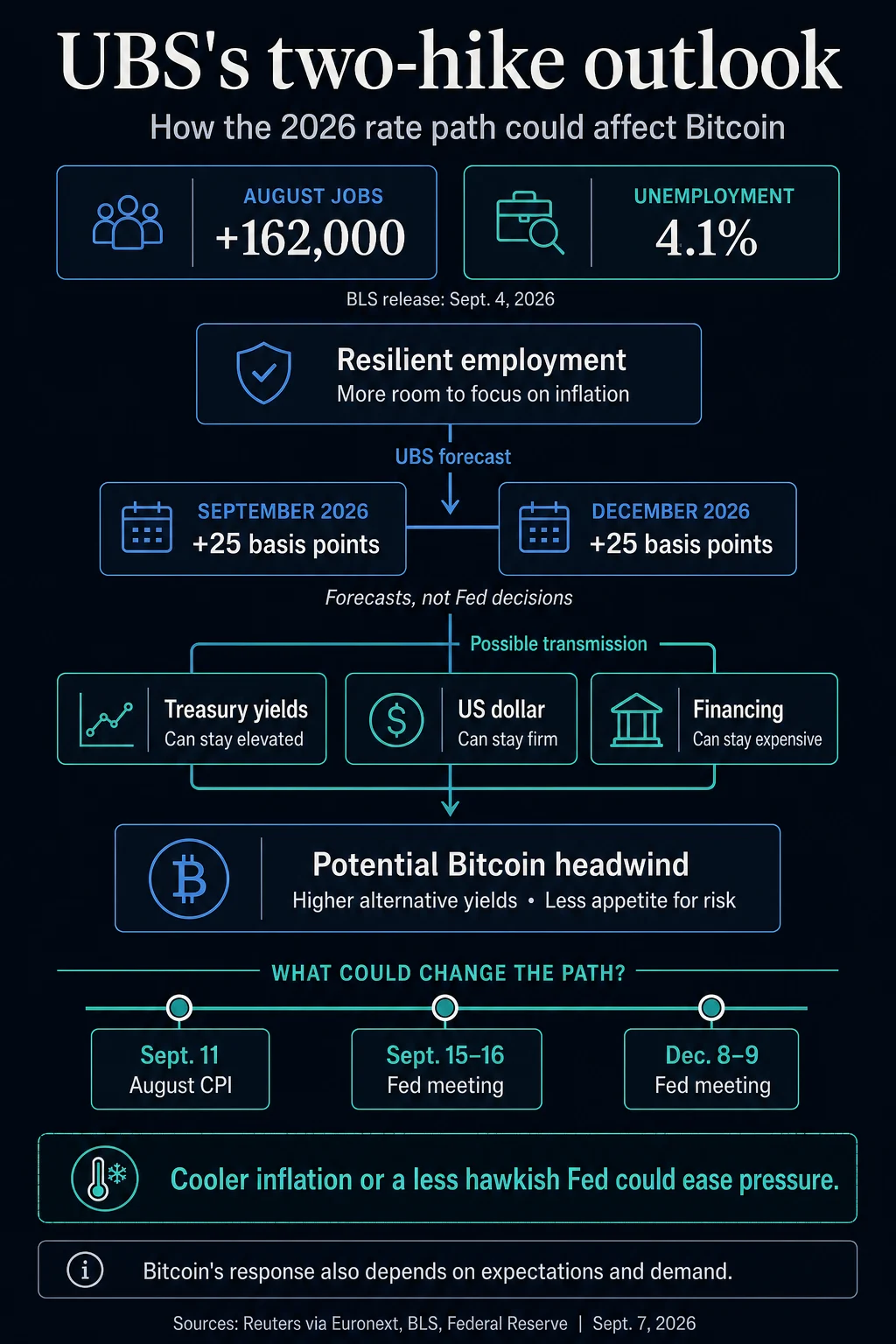
The global financial landscape underwent a significant shift on September 7, 2026, as UBS Global Wealth Management revised its interest rate projections, signaling a more hawkish path for the United States Federal Reserve. The banking giant now anticipates two additional rate hikes of 25 basis points each, scheduled for the September and December Federal Open Market Committee (FOMC) meetings. This pivot from a previous forecast of policy stability introduces a prolonged period of macroeconomic headwinds for Bitcoin and the broader digital asset market, as investors are forced to recalibrate their expectations for liquidity and the cost of capital through the end of the year.
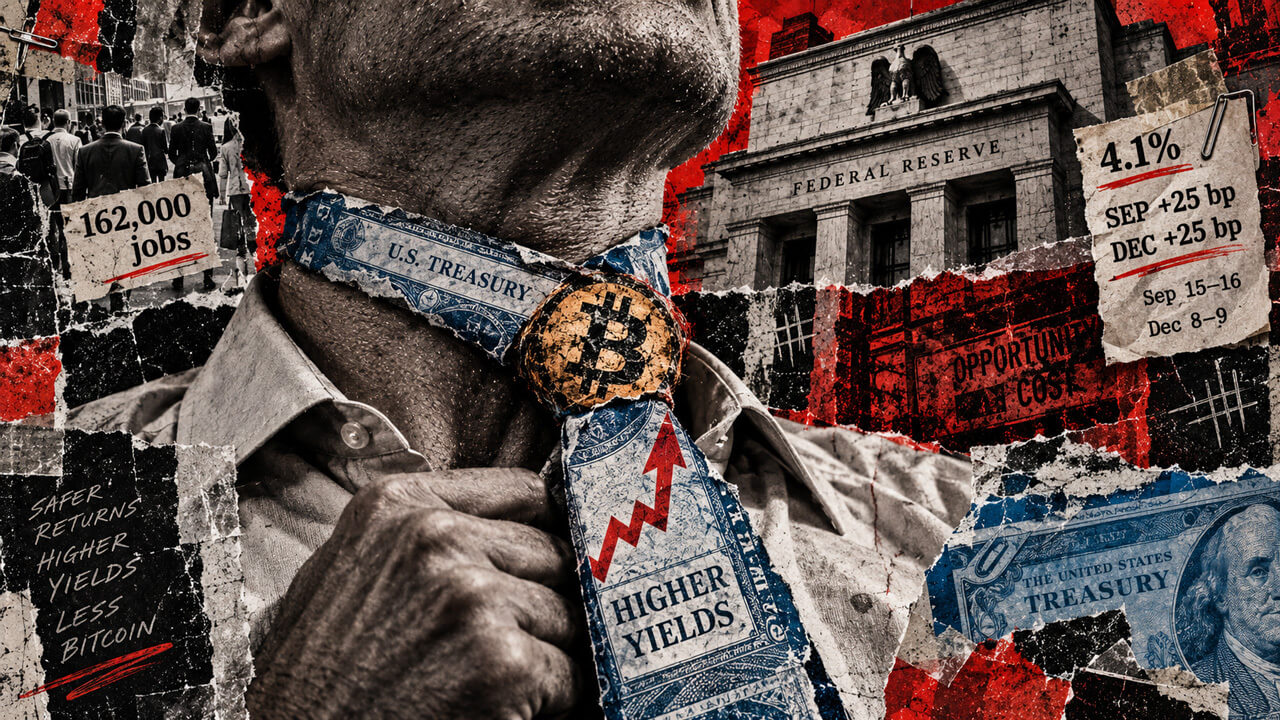
The revised outlook from UBS is predicated on a confluence of resilient labor data and persistent inflationary risks. This shift occurs at a critical juncture for Bitcoin, which had recently been testing the $80,000 threshold. The prospect of higher-for-longer interest rates fundamentally alters the "opportunity cost" of holding non-yielding assets. As Treasury yields remain supported by hawkish central bank policy, the relative attractiveness of Bitcoin—an asset that provides no contractual yield or dividends—comes under intense scrutiny from institutional and retail investors alike.
The Catalyst: A Resilient Labor Market and Inflationary Pressures
The primary driver behind the updated UBS forecast is the August employment report released by the Bureau of Labor Statistics (BLS). The data revealed that the U.S. economy added 162,000 jobs during the month, significantly outperforming the 12-month average of 31,000. While the headline unemployment rate held steady at 4.1%, the underlying strength of the labor market suggests that the economy remains robust enough to withstand further monetary tightening.
Sector-specific analysis of the August report shows an uneven but persistent growth pattern. Food services and drinking places led the gains with 59,000 new positions, followed by local government education, which added 42,000 jobs. Conversely, the information sector saw a contraction of 23,000 positions. Despite these sectoral variances, the aggregate resilience of the labor market provides the Federal Reserve with the "policy room" necessary to prioritize its inflation mandate without the immediate fear of triggering a deep recession.
UBS analysts also pointed toward supply chain bottlenecks and "hawkish Fed communication" as secondary factors for their revised forecast. Supply-side constraints continue to pose a risk to the "last mile" of the Fed’s 2% inflation target. When labor markets are tight, wage growth can contribute to service-sector inflation, creating a feedback loop that policymakers are keen to interrupt through restrictive interest rate levels.
Chronology of the Hawkish Pivot
To understand the current market volatility, it is essential to trace the timeline of events that led to the current tightening expectations:
- September 3, 2026: Federal Reserve Governor Christopher Waller delivers a pivotal speech. He notes that while progress on inflation is evident, "hot" data in the coming weeks could justify further rate increases. This serves as the first major signal that the Fed is not yet ready to pivot to a neutral stance.
- September 4, 2026: The BLS releases the August jobs report. The 162,000 figure surprises analysts to the upside, immediately shifting futures market probabilities.
- September 5, 2026: The Federal Reserve enters its "communications blackout" period. This 12-day window prior to the FOMC meeting prevents officials from making public comments, leaving the market to interpret the data without official guidance.
- September 7, 2026: UBS Global Wealth Management officially updates its forecast to include two 25-basis-point hikes in 2026 (September and December). Bitcoin trades near $79,375 as markets digest the implications of a tighter Q4.
- Upcoming – September 11, 2026: The release of the Consumer Price Index (CPI) for August. This is the final major data point before the September FOMC decision.
- Upcoming – September 15–16, 2026: The FOMC meeting where the first of the two projected hikes is expected to be announced.
The Impact on Bitcoin: The Non-Yielding Asset Dilemma
Bitcoin’s value proposition often fluctuates between being a "store of value" (digital gold) and a "high-beta risk asset." In the current environment, it is behaving largely as the latter. The core issue for Bitcoin investors is the "yield gap." When the Federal Reserve raises the federal funds rate, the yields on "risk-free" assets like U.S. Treasury bills and bonds typically rise in tandem.
For a portfolio manager, the decision to hold Bitcoin involves comparing its potential capital appreciation against the guaranteed 4% to 5% returns available in the debt markets. As interest rates climb, the "hurdle rate"—the minimum return an investor requires to justify the risk of Bitcoin—increases. This can lead to a rotation of capital out of the crypto markets and back into dollar-denominated interest-bearing instruments.
Furthermore, the strength of the U.S. dollar (DXY) is historically inversely correlated with Bitcoin’s price. High interest rates attract foreign capital seeking higher returns, boosting the value of the dollar. Since Bitcoin is globally priced in USD, a stronger dollar makes the asset more expensive for international buyers, potentially dampening demand.
Analyzing the Monetary Transmission Mechanism
The Federal Reserve’s influence on Bitcoin is not limited to the actual day a rate hike occurs. Through a process known as "monetary transmission," the central bank’s forward guidance and the market’s expectations influence financial conditions long before a policy change is enacted.
As UBS and other institutions signal a higher rate path, financing conditions begin to tighten immediately. For crypto market participants, this manifests in several ways:
- Higher Borrowing Costs: Many large-scale Bitcoin traders utilize leverage. As interest rates rise, the cost of maintaining leveraged long positions increases, which can lead to forced liquidations or a reduction in overall market depth.
- Reduced Venture Capital Inflow: Tighter monetary conditions often lead to a "flight to quality" in the private equity and venture capital space. High-risk, early-stage blockchain projects may find it more difficult to secure funding, slowing the growth of the broader ecosystem that supports Bitcoin’s utility.
- Risk-Taking Sentiment: A 2023 IMF working paper titled "The Crypto Cycle and US Monetary Policy" concluded that Fed tightening cycles are a primary driver of crypto price drawdowns. The research suggests that the "risk-taking channel" is the most potent link; when the Fed tightens, investors’ general appetite for any volatile asset diminishes, regardless of that asset’s individual fundamentals.
Institutional and Official Reactions
While the Federal Reserve remains in its blackout period, the market’s reaction is visible through futures pricing. The CME FedWatch Tool currently shows a 58% probability of a 25-basis-point hike in September, a notable increase from the 52% seen prior to the jobs report. This indicates that a majority of market participants are now aligned with the UBS view, though a significant minority still hopes for a "hold" decision.
Institutional sentiment remains cautious. Wealth managers are increasingly advising clients to maintain "neutral" weightings in risk assets as the year-end approaches. The consensus among analysts is that the "soft landing" narrative—where the Fed tames inflation without crushing growth—is still the base case, but the path to achieving it has become narrower.
Governor Waller’s pre-blackout remarks remain the touchstone for current policy interpretation. By stating that "continued progress on inflation could justify holding rates steady," while "hot inflation could make him consider a hike," he effectively shifted the market’s focus entirely onto the upcoming September 11 CPI release.
Implications for the Remainder of 2026
The prospect of a December hike adds a layer of complexity to the year-end "Santa Claus rally" that many crypto investors typically anticipate. If the Fed delivers a hike in September and maintains a hawkish bias heading into December, the usual year-end liquidity injection may be absent.
For Bitcoin to overcome these macro headwinds, it may require a "crypto-specific" catalyst. This could include further progress on institutional adoption, such as increased inflows into spot Bitcoin ETFs, or a significant geopolitical event that reinforces Bitcoin’s status as a decentralized hedge. However, in the absence of such catalysts, the "UBS scenario" suggests a period of consolidation or downward pressure.
The broader implications extend to the entire digital asset class. Ethereum, Solana, and other major altcoins generally exhibit higher volatility than Bitcoin. If Bitcoin struggles under the weight of a 5% or 5.25% interest rate environment, smaller assets could face even steeper declines as liquidity dries up in the "risk-on" segments of the market.
Conclusion: The Inflation Test Ahead
As the financial world awaits the September 11 inflation data, the tension between economic growth and price stability remains the defining theme of 2026. UBS’s forecast of two rate hikes serves as a sobering reminder that the era of "easy money" has not yet returned.
For Bitcoin, the immediate path is clear: it must contend with a reinvigorated U.S. dollar and a Federal Reserve that is unwilling to declare victory over inflation prematurely. Whether Bitcoin can maintain its $79,000 support levels will depend on whether the upcoming CPI data supports Waller’s "hold" condition or reinforces the UBS "hike" projection. In either case, the volatility observed in early September is likely just the beginning of a complex and high-stakes fourth quarter for the global financial markets.