James Watt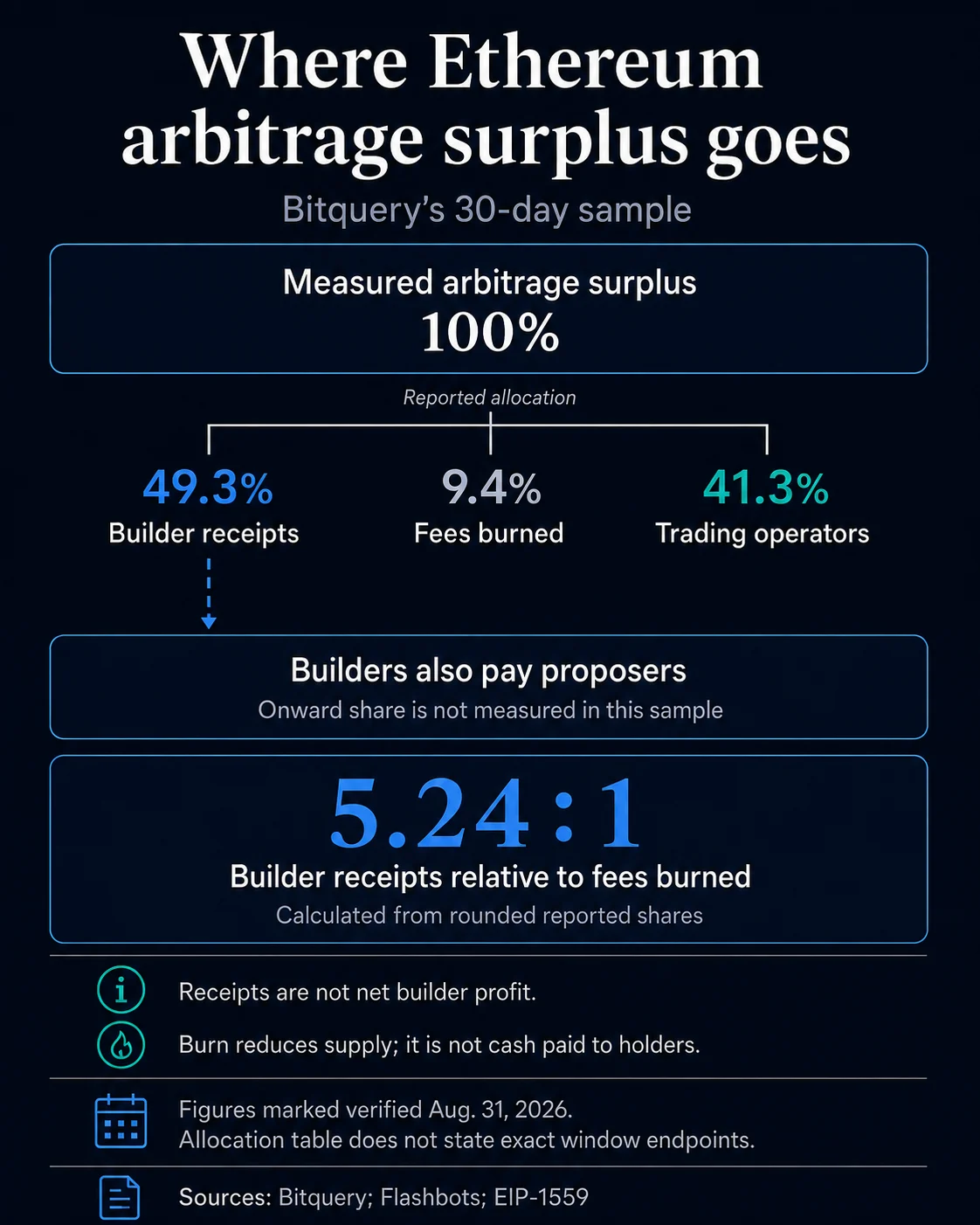
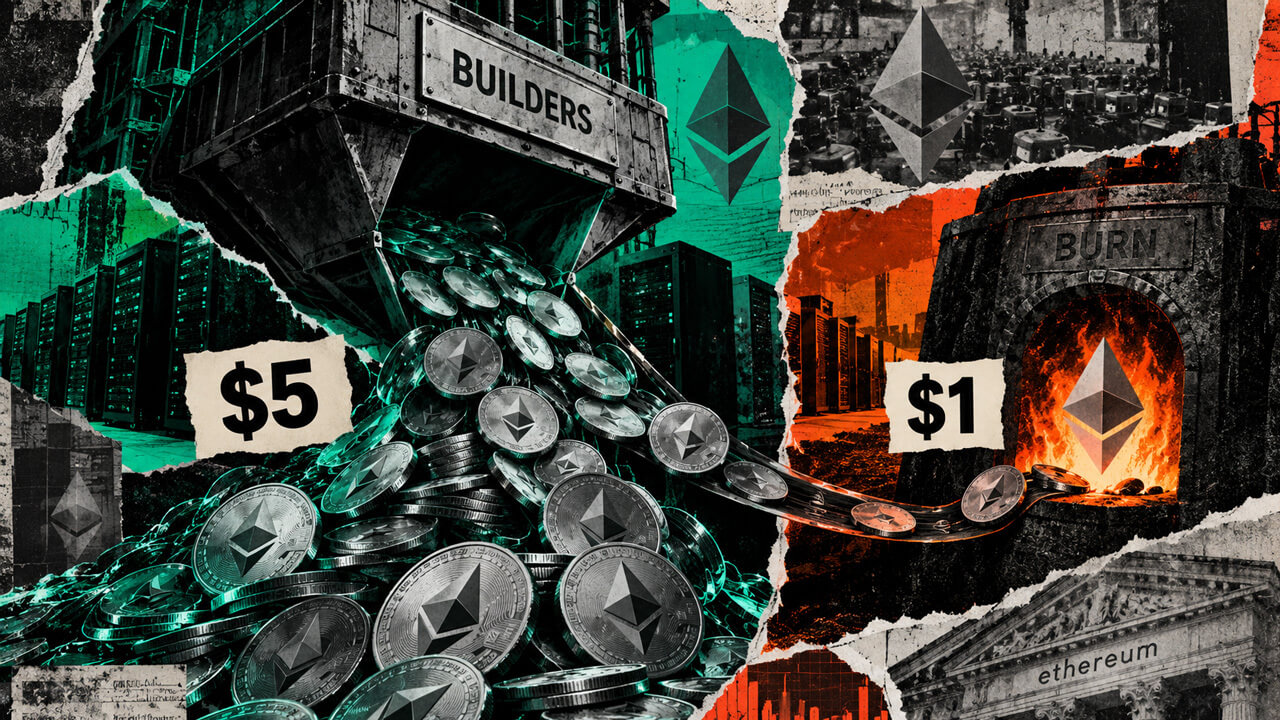
Recent data from blockchain analytics provider Bitquery indicates that for every $1 worth of Ethereum (ETH) destroyed through the protocol’s burning mechanism, arbitrage activity generates approximately $5.24 in builder receipts. This finding, derived from a 30-day sample verified as of August 31, 2026, highlights a significant divergence between the revenue captured by network intermediaries and the deflationary benefits accrued by long-term token holders. According to the investigation, the allocation of measured arbitrage surplus is divided among three primary stakeholders: block builders receive 49.3%, trading operators (searchers) retain 41.3%, and the protocol’s burn mechanism accounts for the remaining 9.4%.
The disparity between these figures underscores a fundamental complexity in the Ethereum economic model. While high trading activity is often cited as a catalyst for ETH value through fee burning, the Bitquery data suggests that the majority of the economic value generated by arbitrage is captured by participants responsible for executing and ordering trades rather than being removed from the total supply. This distinction is critical for investors who rely on the "ultrasound money" thesis, as it demonstrates that transaction volume does not translate linearly into supply reduction.
The Chronology of Ethereum’s Economic Evolution
To understand the current state of arbitrage distribution, it is necessary to trace the technological milestones that shaped Ethereum’s fee market. The journey began in August 2021 with the implementation of EIP-1559, which introduced the base fee and priority fee structure. This upgrade mandated that a portion of every transaction fee—the base fee—be burned, effectively linking network usage to ETH scarcity.
Following EIP-1559, "The Merge" in September 2022 transitioned Ethereum from Proof of Work to Proof of Stake. This shift replaced miners with validators and builders, formalizing the role of Maximal Extractable Value (MEV) in the network’s security budget. By 2024 and 2025, the rise of sophisticated MEV-Boost relays and block-building competition became the dominant force in determining how surplus value from trades was distributed.
The Bitquery investigation covers a 30-day period ending in late August 2026. It reflects a mature ecosystem where arbitrage software constantly scans decentralized exchanges (DEXs) for price discrepancies. When a searcher identifies an opportunity to buy a token at a lower price on one venue and sell it at a higher price on another, they submit a "bundle" of transactions. The competition to have these bundles included in a block has created a highly efficient, yet lopsided, revenue distribution system.
Dissecting the Arbitrage Supply Chain: Searchers, Builders, and Proposers
The 49.3% share allocated to builder receipts represents the largest slice of the arbitrage pie, but experts caution against viewing this entire amount as pure profit. The Ethereum transaction supply chain involves a tiered structure:
- Searchers (Trading Operators): These are the specialized actors who use algorithms to find arbitrage opportunities. They retained 41.3% of the surplus in the Bitquery sample. Their share is what remains after they have paid builders to ensure their trades are executed in a specific order or position within a block.
- Builders: These entities aggregate transactions and bundles from searchers to construct the most profitable blocks possible. While they received 49.3% of the receipts, they operate in a highly competitive auction environment.
- Proposers (Validators): Under the MEV-Boost framework, builders must pay validators (the proposers of the block) to have their block selected for the blockchain.
As noted in the New York Fed Staff Report 1102, builder profit is defined as direct payments plus priority fees, minus the payment made to the proposer. The Bitquery data measures the "incoming" receipts to the builder but does not fully account for the "onward" transfers to validators. This means a significant portion of the 49.3% attributed to builders eventually flows to the validators who secure the network. For the market to function, builders must retain enough revenue to cover their operational costs, while validators receive enough to incentivize honest participation.
The Mechanics of Fee Burning and the Impact on ETH Holders
The 9.4% allocation toward burned fees represents the protocol’s native "tax" on activity. This percentage is dictated by EIP-1559’s base fee, which fluctuates based on network congestion. Unlike priority fees—which are a "tip" paid to builders to jump the queue—the base fee is non-negotiable and is permanently removed from circulation.
For ETH holders, the 5.24-to-1 ratio between builder receipts and burned fees is a sobering metric. It suggests that for every dollar that benefits the collective holder base by reducing supply, over five dollars are being paid to the "supply chain" of the trade. This highlights why a busy network does not always result in a deflationary environment.
Ethereum’s issuance documentation clarifies that the total supply is a balance between new ETH created as staking rewards and the ETH destroyed via burning. If the burn rate (9.4% of arbitrage surplus plus other transaction base fees) does not exceed the issuance rate, the total supply of ETH continues to expand. The Bitquery study clarifies that while arbitrage activity is profitable for participants, its contribution to the "investment case" for ETH as a deflationary asset is secondary to its role as a revenue generator for active operators.
Comparative Data Across Blockchain Ecosystems
The Bitquery investigation extended its scope beyond Ethereum to include a 12-month annual comparison of arbitrage distribution across other major networks, including BNB Chain, Base, Arbitrum, and Polygon. Notably, the study excluded Solana and Optimism due to differing architectural or data availability constraints.
On Layer 2 (L2) networks like Base and Arbitrum, the distribution of arbitrage surplus often favors the sequencer—the entity responsible for ordering transactions. Because L2s settle their finality on Ethereum (Layer 1), a portion of their fees eventually contributes to the Ethereum burn, but the internal arbitrage dynamics are often more centralized than the competitive builder market on the Ethereum mainnet.
The data also showed that fixed reference prices used in historical series can fluctuate, affecting the perceived "surplus." Bitquery filtered for surplus that did not exceed the capital committed in each transaction, ensuring that the figures reflect realistic trading gains rather than anomalous outliers. However, the report acknowledges that incomplete decoding of certain Ethereum venues may mean that the total volume of arbitrage is even higher than reported.
Institutional Analysis and Implications for Network Health
Financial analysts and blockchain researchers view the high percentage of revenue going to builders and operators as a sign of a highly optimized, albeit competitive, market. A report from the New York Fed suggests that measuring "retained block revenue" is a more accurate way to assess the health of the network participants than looking at gross revenue.
From a network health perspective, the fact that 41.3% of the surplus stays with trading operators is vital. If builders or validators captured too much of the surplus, searchers would lose the incentive to find and close price discrepancies, leading to inefficient markets and wider spreads on decentralized exchanges. Conversely, if the burn rate were too high, it might discourage the very activity that provides liquidity to the ecosystem.
The implications for the "passive holder" are more nuanced. The study suggests that the investment thesis for ETH must be decoupled from the simple assumption that "more trades equals more value." Instead, holders must look at the specific ratio of base fees to priority fees. A network dominated by high-value arbitrage trades—which rely heavily on priority fees for inclusion—will naturally see a lower percentage of its total economic surplus burned compared to a network dominated by simple peer-to-peer transfers.
Future Outlook: MEV-Burn and Protocol Adjustments
Looking ahead to late 2026 and 2027, the Ethereum developer community is exploring protocol-level changes to address the imbalance between builder receipts and fee burning. One such proposal is "MEV-Burn," which aims to capture a portion of the competitive bids made by builders and burn them, similar to how EIP-1559 treats the base fee.
If implemented, MEV-Burn could significantly alter the 5.24-to-1 ratio identified by Bitquery. By redirecting a portion of the 49.3% currently going to builder receipts into the protocol’s burn mechanism, Ethereum could potentially increase the deflationary pressure exerted by arbitrage activity. This would align the interests of active traders and passive holders more closely.
Until such upgrades occur, the Bitquery data remains a definitive benchmark for the current era of Ethereum’s economy. It confirms that while Ethereum is a prolific engine for generating economic surplus, the current architecture prioritizes the compensation of those who build and secure the blocks over the immediate reduction of token supply. For participants in the decentralized finance (DeFi) space, the findings emphasize the need for sophisticated accounting that tracks not just the "gas spent," but where every cent of a trade’s surplus eventually lands.