James Watt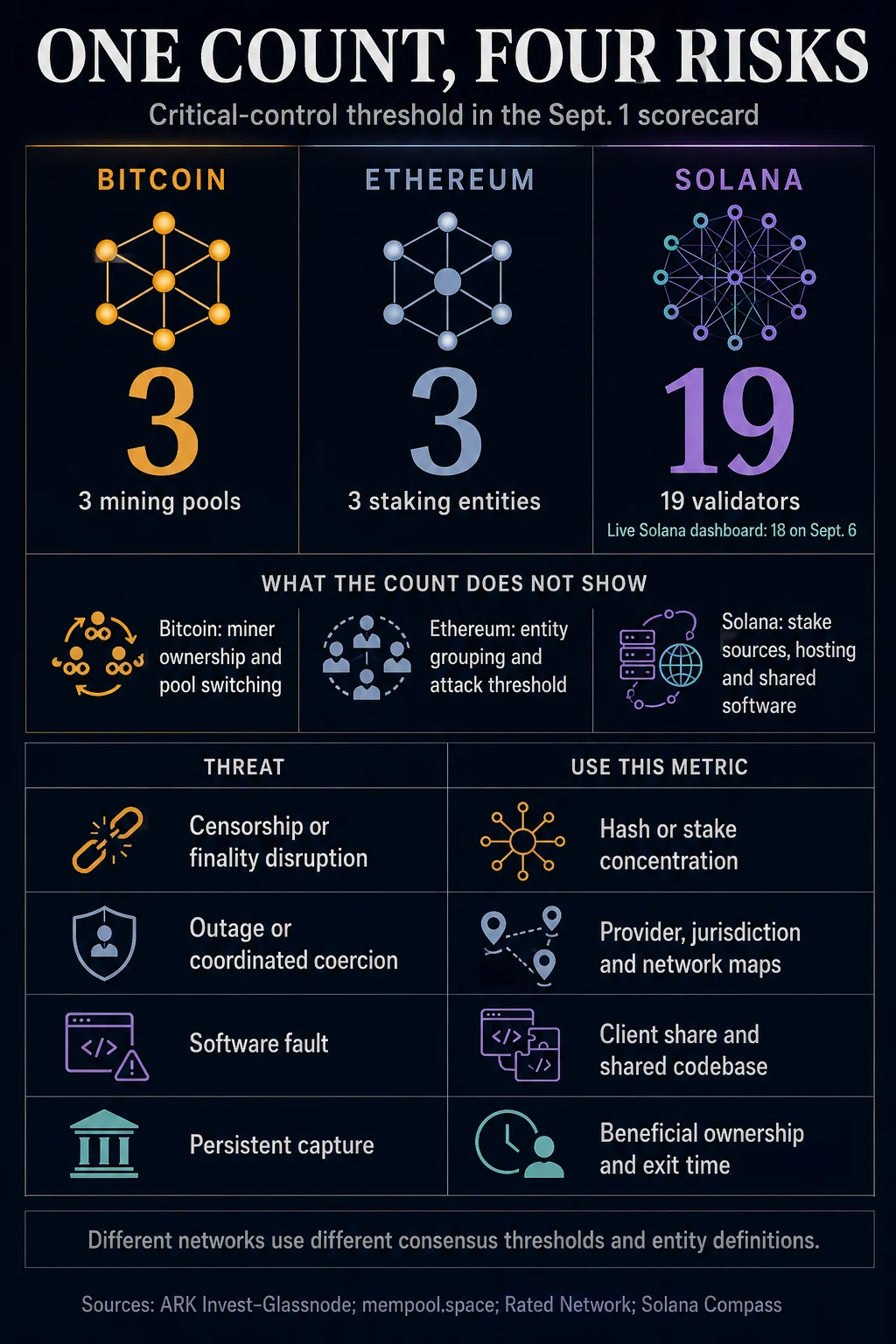
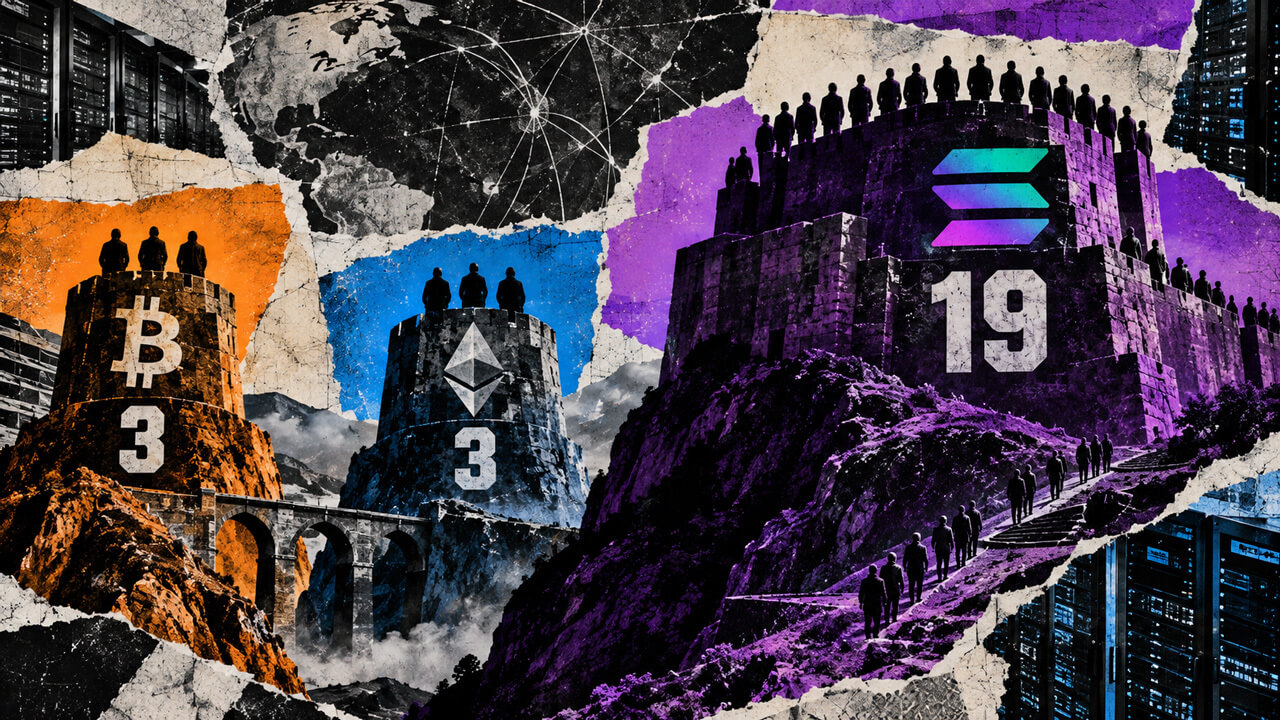
The decentralized nature of blockchain technology, often cited as its primary security feature, has long lacked a standardized, multi-dimensional framework for measurement. To address this analytical gap, ARK Invest and Glassnode recently released a comprehensive joint scorecard titled "The Decentralization Spectrum," which introduces a new metric for evaluating blockchain capture risk: the smallest number of block-production entities required to cross a protocol-relevant control threshold. According to the report published on September 1, 2024, this critical resilience threshold stands at three entities for both Bitcoin and Ethereum, while Solana requires 19 entities.
This finding highlights a nuanced tension within the digital asset ecosystem. While Bitcoin was ranked first in the report’s composite decentralization ranking due to its auditability, hardware distribution, and exit fluidity, it shares a similar "coordination risk" at the block-production level with Ethereum. These metrics provide a vital lens for institutional investors and infrastructure providers who must define the specific failure modes they need to survive—ranging from short-term censorship to permanent ledger alteration—before selecting a network for settlement.
The Mechanics of the Critical Resilience Threshold
The report’s primary innovation is the "critical resilience threshold," a measure of how many of the largest entities must coordinate to pass a concentration point governing block production or voting power. However, the inputs for this calculation vary significantly by network, reflecting the different consensus mechanisms and organizational structures of the three major blockchains.
For Bitcoin, the measure weights the hash rate attributed to various mining pools. Because mining pools coordinate the templates for the blocks they produce, they represent the most immediate point of potential censorship or template manipulation. On September 6, a seven-day snapshot of Bitcoin mining data attributed 26.88% of blocks to Foundry USA, 16.91% to AntPool, and 15.25% to F2Pool. Together, these three entities controlled 59.04% of the observed block production, confirming the report’s assessment that only three entities are needed to cross a 50% threshold.
Ethereum’s threshold is calculated based on staking entities. The report notes that the taxonomy of an "entity" in Proof-of-Stake (PoS) is complex. A single label on a dashboard might represent a liquid-staking protocol, a centralized exchange, or a distributed validator network. For instance, data from Rated Network on September 6 showed Lido controlling 21.17% of the stake, followed by SSV at 16.56% and Binance at 7.77%. While Lido appears as a single entity, it is actually comprised of 544 distinct operators, creating a layer of internal decentralization that a simple count might overlook.
Solana’s coefficient, often referred to as the Nakamoto Coefficient, measures the fewest number of validators whose combined stake reaches 33.4% of the total voting power. This specific percentage is critical because, in Solana’s delegated Proof-of-Stake (dPoS) system, a coalition controlling more than one-third of the stake can theoretically stop consensus or censor blocks. While the ARK/Glassnode report initially cited a threshold of 19, live data from Solana Compass on September 6 showed the number had shifted to 18, reflecting the dynamic nature of stake delegation.
Chronology of Network Health Reporting
The release of "The Decentralization Spectrum" follows a period of increasing scrutiny regarding network resilience. Throughout 2023 and 2024, the Solana Foundation has been proactive in publishing "Network Health Reports" to address concerns over centralization. Their June 2024 report, using data from April, recorded a Nakamoto Coefficient of 20, suggesting a slight tightening of stake concentration over the following months.
In the Ethereum community, the push for decentralization has focused heavily on "client diversity" following several near-miss incidents where bugs in dominant software threatened network finality. The ARK/Glassnode report builds on these historical concerns by categorizing risk into specific buckets: ownership, infrastructure, software, auditability, and exit speed. This evolution in reporting marks a shift from viewing decentralization as a binary state to treating it as a multi-variable spectrum of risks.
Infrastructure and Software Dependencies
The report emphasizes that nominally separate entities often share correlated failure modes through common infrastructure. A data-center operator, a cloud service provider, or a national government can exert pressure on many nodes or validators simultaneously, even if the consensus coefficient suggests wide distribution.
-
Geographic and Network Resilience: Bitcoin’s node footprint remains highly resilient due to its use of the Tor network. The joint report noted that 63% of Bitcoin nodes operate behind Tor, although other trackers like Clark Moody reported a lower figure of 48.3% (12,959 out of 26,837 reachable nodes) on September 6. This discrepancy highlights the difficulty of mapping a permissionless network but underscores Bitcoin’s focus on node visibility and privacy.
-
Cloud Concentration: Ethereum and Solana face different hosting challenges. The report cited approximately 20% of Ethereum nodes residing on Amazon Web Services (AWS), while Rated Network’s data suggested 14.4%. Solana, optimized for high throughput, relies heavily on commercial data centers. The Solana Foundation’s recent data showed that two providers—TeraSwitch and Latitude—host 45.70% of the network’s stake. While Solana Compass tracks 437 distinct data centers, the concentration among top-tier providers remains a focal point for risk assessment.
-
Client Software Diversity: Software represents a single point of failure that transcends physical location. In Ethereum, the Geth execution client maintains a 50.17% market share, which, while improved from previous years, still presents a "blast radius" risk. Solana’s ecosystem is currently dominated by the Agave/Jito codebase, used by 92% of the stake. However, the emergence of Firedancer and Frankendancer—independent client implementations—is viewed as a critical milestone for Solana’s long-term resilience.
The Role of Exit Speed and Liquidity
One of the most critical, yet often overlooked, metrics in the scorecard is "exit speed"—the ability of a participant to leave the network or change their delegation during a period of coercion. This is where the practical differences between Bitcoin and Proof-of-Stake networks become most apparent.
Bitcoin miners can redirect their hash rate to a different pool almost instantly. The report estimates that a miner could move a 1% position in roughly 30 seconds by simply switching their hardware’s destination IP. This mobility means that while mining pool concentration is a risk for short-term block template selection, the ultimate control of the physical hardware remains highly dispersed and mobile.
Conversely, Ethereum validators are subject to a rate-limited exit queue. While the ARK/Glassnode report noted that exits could take weeks under stressed conditions, live data from beaconcha.in on September 6 showed an empty exit queue with a withdrawal estimate of approximately one day. This delay is dynamic; if a mass exit were triggered by a regulatory crackdown or a network attack, the queue would lengthen, effectively "trapping" stake in a compromised environment for a period of time. Solana participants face similar constraints, though the high-speed nature of the network allows for different delegation dynamics.
Institutional Analysis and Implications
For institutional actors considering blockchain as a settlement layer, the ARK/Glassnode scorecard serves as a rubric for risk management. The report suggests that institutions must pair specific threats with corresponding measures to build a comprehensive security profile.
- For Censorship Resistance: Investors should look at the critical resilience threshold (the 3/3/19 metric) and the mobility of hash rate or stake.
- For Ledger Integrity: The focus should be on the 51% (Bitcoin) or 66% (Ethereum/Solana) thresholds required to alter history or finalize fraudulent chains.
- For Long-term Survival: Auditability and the ability to run a node on modest hardware are paramount, areas where Bitcoin currently leads the field.
The composite ranking’s preference for Bitcoin reflects a philosophy that values "user-level" decentralization—the ability for an individual to verify the entire state of the chain—over "throughput" decentralization. However, Solana’s higher Nakamoto Coefficient suggests that it may be more resistant to a "handshake" attack, where a small number of CEOs or pool operators are coerced by a single jurisdiction to halt the network.
Conclusion: A Dynamic Spectrum
The "3/3/19" result is not a static grade but a snapshot of a moving target. As stake redistributes, new mining pools emerge, and independent software clients like Firedancer go live, these numbers will fluctuate. The value of the ARK Invest and Glassnode scorecard lies in its ability to strip away the ideological rhetoric surrounding decentralization and replace it with a cold, data-driven assessment of capture risk.
Ultimately, the report concludes that no network is perfectly decentralized. Instead, each offers a different profile of trade-offs. Bitcoin provides the highest level of auditability and exit fluidity at the cost of lower throughput. Ethereum offers a middle ground with a robust ecosystem of staking entities but faces challenges with client diversity and exit queues. Solana offers high performance and a high threshold for consensus disruption but remains dependent on concentrated high-end infrastructure. For the institutional market, the choice of a blockchain is no longer about which is "the best," but about which set of risks fits their specific survival model.