
 James Watt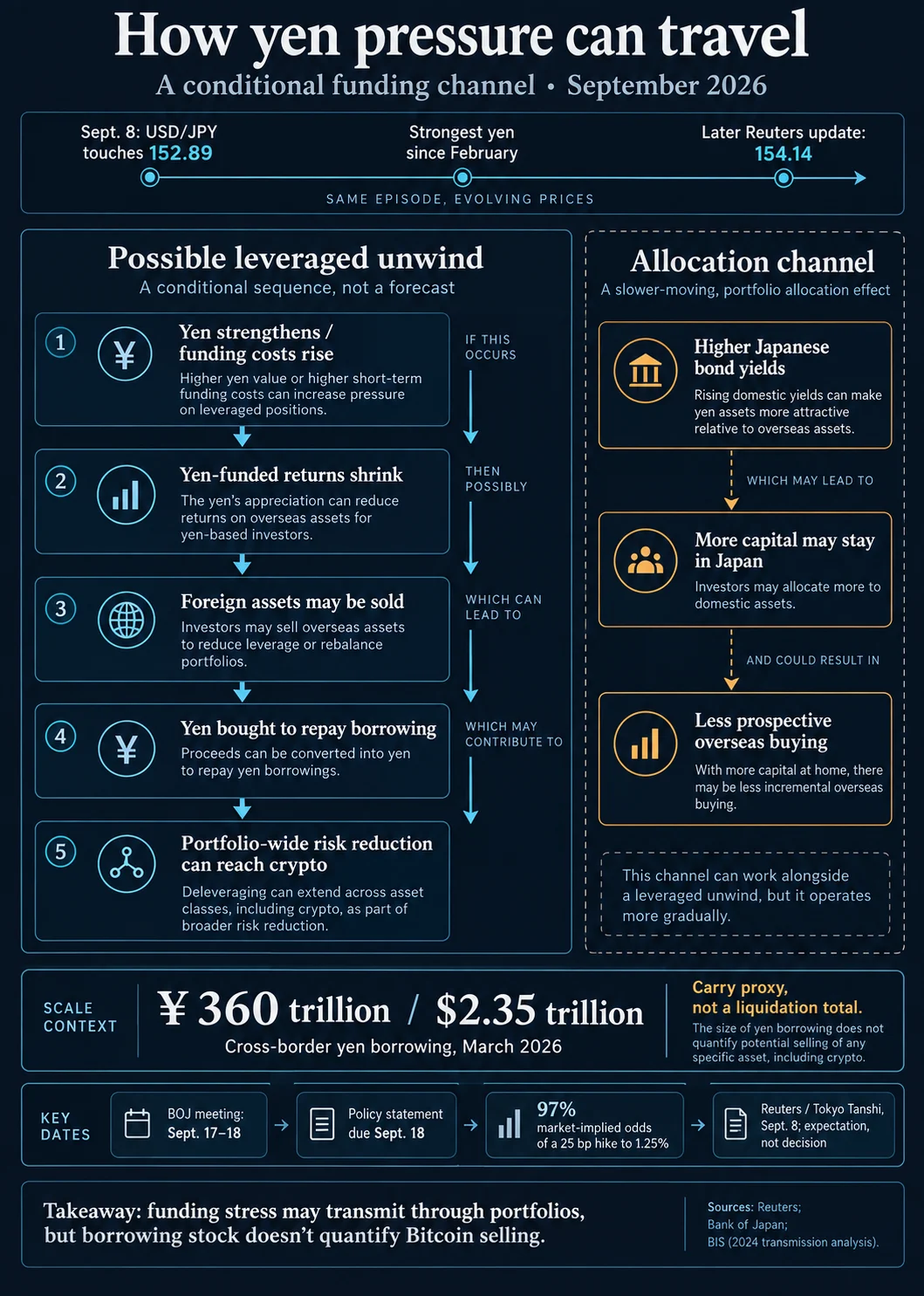
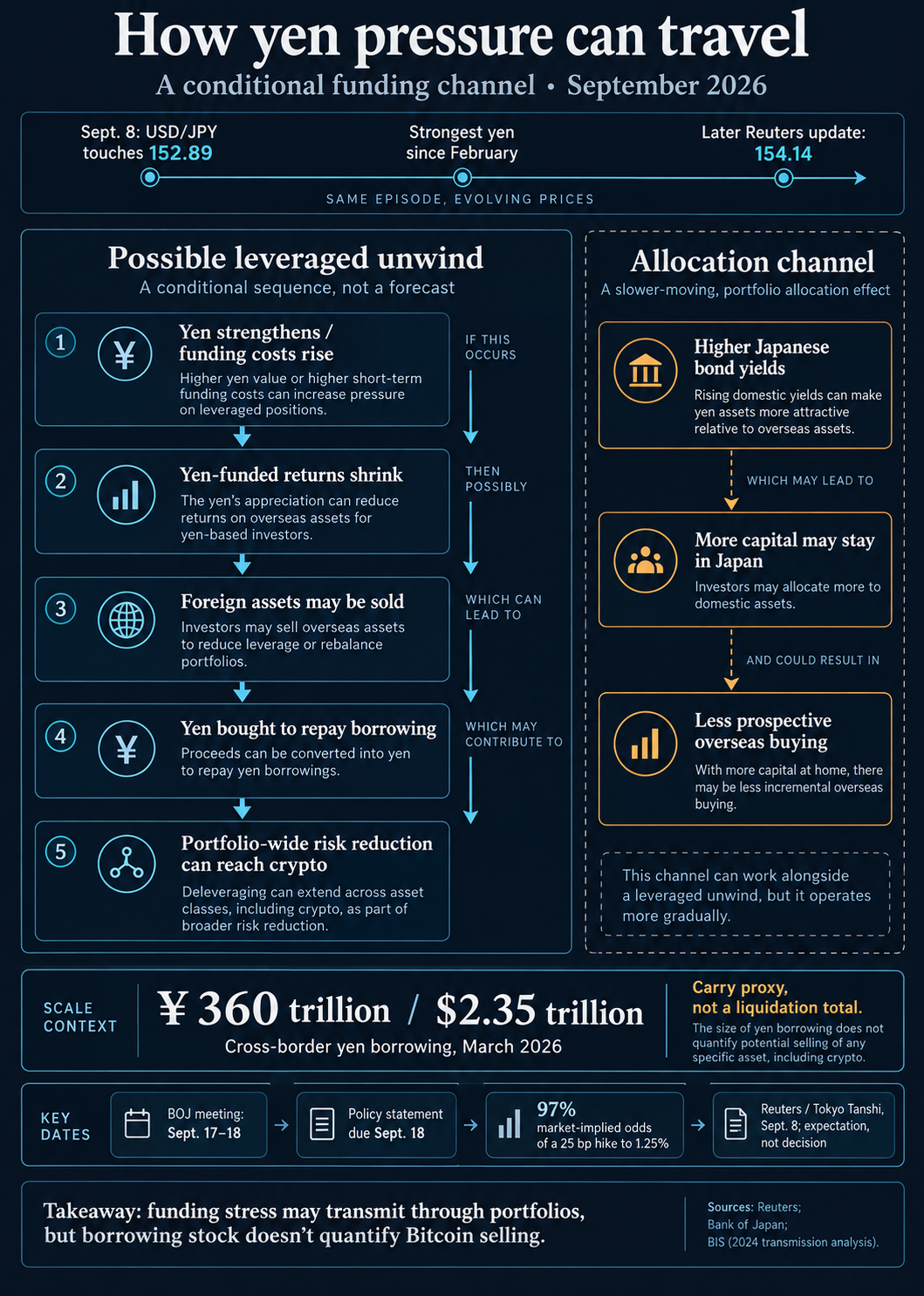
Bitcoin maintained a narrow trading range near $78,500 on September 8, 2024, as a surge in the Japanese yen to its strongest level since February introduced fresh uncertainty into global risk assets. The digital currency remained pinned within its recent consolidation corridor even as international investors began aggressively paring back bets against the yen, a move that historically precedes broader market deleveraging. During Asian trading hours, the yen reached a peak of 152.89 per dollar before settling near 154.14, a technical retracement that provided a temporary reprieve but failed to quell anxieties regarding the Bank of Japan’s (BOJ) upcoming monetary policy meeting on September 17-18.
The intersection of Japanese monetary policy and the cryptocurrency market highlights the growing sensitivity of digital assets to traditional macro-financial "plumbing." At the heart of this tension is the yen carry trade—a strategy where investors borrow yen at ultra-low interest rates to fund purchases of higher-yielding assets abroad, including equities and cryptocurrencies. As the yen strengthens and Japanese interest rates rise, the cost of servicing these yen-denominated liabilities increases, often forcing investors to liquidate their portfolios to cover margin calls or repay loans.
The Mechanics of the Yen Carry Trade and Crypto Contagion
The scale of the yen-funded investment landscape is vast. According to an analysis by Jefferies based on Bank for International Settlements (BIS) data, cross-border yen borrowing reached approximately ¥360 trillion ($2.35 trillion) in March 2024. This massive liquidity pool has functioned as a primary engine for global asset inflation over the last decade. However, the recent shift in the Bank of Japan’s stance—moving away from its long-standing negative interest rate policy—has begun to reverse this flow.
A stronger yen acts as a "squeeze" on global liquidity. When the yen appreciates, the value of the debt increases relative to the assets it funded. If an investor borrowed yen to buy Bitcoin, a 5% rise in the yen effectively means the investor must find 5% more value just to break even on the currency component of the trade. The BIS analysis of the market turmoil observed in August 2024 provides a blueprint for how this stress transmits: initial volatility in Japanese currency markets triggers a spike in the VIX (volatility index), leading to margin demands that force the sale of liquid assets like Bitcoin and gold to protect more illiquid positions.
Chronology of the September Market Shift
The current market environment is the result of a sequence of events beginning in late July when the Bank of Japan surprised markets with a rate hike.

- Late July – Early August: The Bank of Japan raises interest rates, sparking a global "unwind" of the carry trade. Bitcoin prices plunged alongside the Nikkei 225, highlighting the correlation between crypto and Japanese liquidity.
- September 3-4: Despite currency pressures, US-based spot Bitcoin ETFs saw significant activity. Farside Investors recorded a massive $730.8 million in net inflows on September 3, followed by an additional $174.6 million on September 4. This suggested a strong institutional appetite for the "dip."
- September 7: Analysis from Bitfinex identified a consolidation range for Bitcoin between $77,200 and $82,100. The report noted that while the market showed an "upside bias," higher bond yields were beginning to constrain the momentum.
- September 8: The yen hits 152.89 against the dollar. Bitcoin holds the $78,500 level, but on-chain data shows a reliance on futures markets rather than organic spot demand.
- Mid-September Expectations: Market participants are now focused on the September 18 BOJ statement. Tokyo Tanshi reports suggest a 97% probability of another 25-basis-point increase, bringing the target rate to 1.25%.
Institutional Demand vs. On-Chain Fragility
While the headline price of Bitcoin remains resilient, underlying metrics suggest a market divided between institutional accumulation and speculative fragility. The robust inflows into spot ETFs indicate that Bitcoin is increasingly being viewed as a core portfolio asset by Western institutions. However, this demand is being tested by a lack of broader retail participation.
Data from CryptoQuant contributor CW8900 indicates that "apparent demand" for Bitcoin remains in negative territory. This suggests that while large "whales" and ETF providers are buying, the broader retail market and smaller investors are selling or remaining sidelined. Furthermore, the recent rally has been heavily driven by the derivatives market. Aggregate open interest rose from $25.2 billion to $27.5 billion during the first week of September, according to CryptoQuant’s Carmelo Alemán. A market driven by leverage is inherently more susceptible to "flash crashes" if the yen’s appreciation forces a sudden reduction in risk.
Support Levels and Holder Behavior
For Bitcoin to withstand further currency-driven shocks, it must maintain key technical and on-chain support levels. Glassnode’s September 2 report placed the "short-term holder cost basis" at approximately $71,000. This figure represents the average price at which investors who have held Bitcoin for less than 155 days acquired their coins.
As long as Bitcoin trades significantly above $71,000, this cohort remains in "unrealized profit," reducing the likelihood of panic selling. However, the cushion is thinning. Short-term holder whale unrealized profits, which hit a record $9 billion on September 4, quickly retracted to $7.5 billion by the following day. This volatility in paper profits illustrates how quickly sentiment can shift if the price begins to trend toward the $71,000 breakeven point.
Another critical metric is the Short-Term Holder Spent Output Profit Ratio (STH-SOPR). On September 8, the SOPR sat at 1.003, indicating that those who were selling were doing so at a very marginal profit. If this metric drops below 1.0 for a sustained period, it would signal that recent buyers are exiting at a loss—a classic sign of market capitulation that often precedes a deeper correction.
The Bank of Japan’s Looming Policy Decision
The ultimate trajectory for Bitcoin in the coming weeks will likely be determined in Tokyo. The Bank of Japan is currently navigating a difficult path between normalizing interest rates and preventing a disorderly collapse of the carry trade.
If the BOJ delivers the expected 25-basis-point hike but accompanies it with "dovish" or cautious guidance—suggesting that further hikes will be slow and data-dependent—the yen rally may pause. In this scenario, Bitcoin could break out of its $77,200–$82,100 range as the "fear factor" regarding the carry trade diminishes.
Conversely, a "hawkish" surprise—where the BOJ signals an aggressive tightening cycle to combat inflation—could trigger a sharp yen spike. Such a move would likely lead to a "risk-off" event across all global markets. For Bitcoin, this could mean a breach of the $71,000 cost-basis support, potentially leading to a test of the $60,000 level as forced liquidations from yen-leveraged traders hit the exchanges.
Broader Implications for the Digital Asset Ecosystem
The current situation underscores the evolving nature of Bitcoin’s role in the global financial system. Once viewed as an "uncorrelated" asset or "digital gold," Bitcoin’s integration into institutional portfolios via ETFs and its use as collateral in sophisticated trading strategies have tied its fate more closely to traditional macro factors.
The expansion of stablecoin supply, noted by Bitfinex, provides a potential floor for the market. Expanding liquidity in the form of USDT or USDC suggests that there is "dry powder" on the sidelines waiting to enter the market. However, if Japanese domestic bond yields continue to rise, Japanese institutional capital—which has historically sought returns in foreign markets—may begin to "repatriate," or move back home. This reduction in overseas buying power could affect not just Bitcoin, but US Treasuries and equities as well.
In conclusion, Bitcoin’s ability to hold the $78,500 level amid the yen’s surge is a testament to the current strength of spot demand, particularly through ETF channels. However, the heavy reliance on futures leverage and the looming BOJ decision create a "fragile" equilibrium. The decisive evidence for the next phase of the market will come from whether buyers can continue to absorb the supply if the cost of Japanese funding continues to rise. Investors are advised to watch the $77,200 range floor and the $71,000 short-term holder cost basis as the primary indicators of market health heading into the second half of September.








