
 James Watt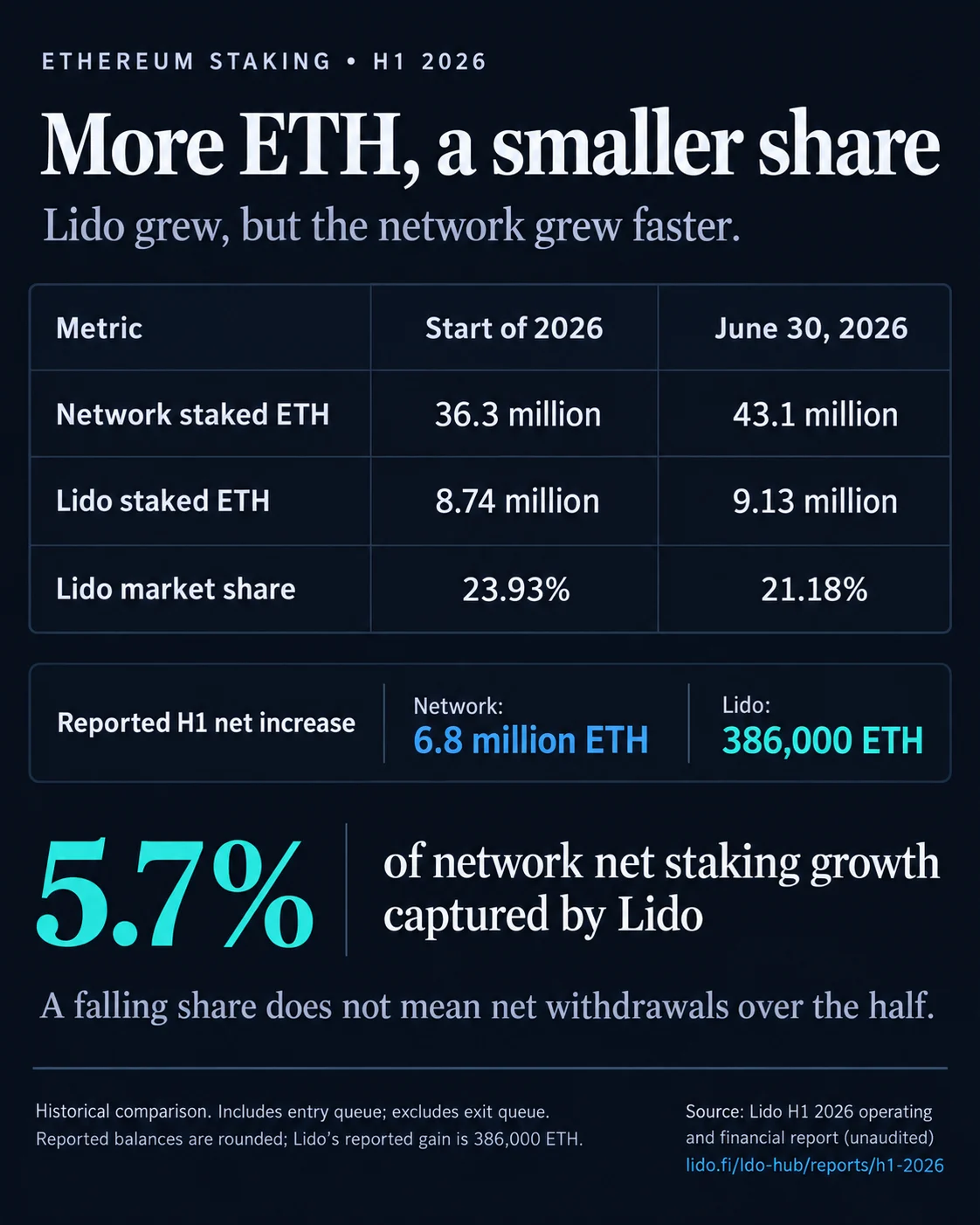
The liquid-staking landscape underwent a significant structural shift during the first six months of 2026, as the industry’s largest protocol, Lido, grappled with a stark divergence between total market expansion and its own growth capture. According to the protocol’s H1 2026 operating and financial report, Ethereum’s total staked supply surged by 6.8 million ETH, yet Lido accounted for only 386,000 ETH of that net increase. This translates to a capture rate of just 5.7% of the network’s staking growth, a figure that highlights the intensifying competition from institutional-grade providers and centralized exchanges. For holders of the LDO governance token, this trend has created a complex business challenge: how to convert a maturing, multi-billion dollar market into sustainable DAO income capable of supporting automated buyback mechanisms.
The Widening Gap Between Market Growth and Protocol Capture
The disparity in growth rates has led to a measurable dilution of Lido’s dominance. At the beginning of 2026, Lido held a 23.93% share of the Ethereum staking market. By June 30, that figure had retreated to 21.18%. While the protocol did experience positive net growth—ending the half-year with 9.13 million ETH compared to 8.74 million ETH in January—it failed to keep pace with the broader network. Ethereum’s total staked ETH rose from 36.3 million to 43.1 million in the same period, driven largely by a massive influx of institutional capital that bypassed decentralized liquid staking protocols in favor of direct routing through custodians and specialized staking firms.
Lido’s internal analysis attributes much of this dilution to the "institutional segment," which expanded its footprint from 25.9% to 35.3% of the total staking market during the first half of the year. This migration suggests that large-scale capital allocators are increasingly prioritizing direct control, regulatory compliance, and customized fee structures over the immediate liquidity offered by stETH. As of June 30, the competitive landscape showed Bitmine holding 11.5%, Coinbase at 10.9%, and Binance at 7.9% of the market. Notably, Grayscale’s 3.1% share is routed specifically through Coinbase, illustrating a consolidation of power among a few key institutional gateways.
Analyzing the NEST Buyback Deficit and LIP-36 Constraints
The financial friction resulting from this slowed growth became visible in the operations of NEST, Lido’s automated buyback mechanism designed to support the LDO token. On September 9, 2024, at 00:00 UTC, the smart contract responsible for releasing funds for LDO purchases recorded a negative cumulative budget of approximately $517,024. Consequently, the mechanism skipped its scheduled allocation. This negative balance did not represent a lack of liquid funds—the allocator held roughly 41 stETH at the time—but rather a failure to meet the strict surplus requirements dictated by the protocol’s governance rules.
Under the framework established by Lido Improvement Proposal 36 (LIP-36), the NEST mechanism operates on a "surplus-only" basis. The protocol must first subtract a daily reserve of $109,589 (equivalent to roughly $40 million annually) from its tracked revenue. Only 50% of the remaining surplus is then allocated to the cumulative budget for LDO buybacks. When market conditions, such as a drop in the price of Ethereum or a reduction in staking rewards, cause revenue to fall below the reserve threshold, a deficit is recorded. This accounting deficit must be fully erased by future surpluses before any new buyback transactions can be executed. This "high-water mark" style of accounting ensures that the DAO maintains a robust treasury buffer but also means that LDO holders may see long periods of inactivity in the buyback program during bearish or stagnant market phases.
Financial Performance and the Impact of ETH Price Volatility
Lido’s unaudited H1 2026 accounts provide a detailed look at the protocol’s economic health during this period of transition. The DAO reported $27.51 million in gross staking revenue after rewards were distributed to stETH holders. However, after accounting for operational deductions, net staking revenue stood at $15.71 million. When including income from other initiatives like "Earn," total net DAO revenue reached $15.94 million.
The report identifies Ethereum price weakness as the primary driver behind the reduction in dollar-denominated revenue. Despite this, the staking product itself remained profitable, generating a $6.73 million result at the product level. The broader organization, however, faced headwinds. Foundation expenses totaling $14.33 million left a slim operating surplus of $1.61 million. This surplus was ultimately wiped out by a one-off expenditure of $6.06 million related to Kelp, resulting in a total net loss of $4.45 million for the half-year. These figures underscore the sensitivity of the Lido ecosystem to the underlying price of ETH; the report’s break-even illustration suggests a price floor of roughly $2,730 ETH is required to maintain a positive daily revenue balance under current stake and reward parameters.

Strategic Adaptation: Institutional Partnerships and Fee Waivers
To combat market share erosion, Lido has pivoted toward aggressive institutional onboarding strategies. On August 13, the protocol announced a major partnership with Sharplink, which committed to deploying $200 million of ETH through Lido’s infrastructure, with the resulting wstETH to be held in custody with Anchorage Digital. This move highlights a growing trend where Lido acts as the middleware for institutional-grade custody solutions.
However, attracting this capital comes at a cost to immediate protocol revenue. Lido’s "stVaults," designed for professional node operators and large-scale depositors, have been subject to significant fee waivers. According to the August operator update, qualifying stVaults—those with more than 250 ETH in total value locked—are eligible for a 0% Lido infrastructure fee through October 31. While this campaign is intended to drive adoption and lock in long-term balances, it contributes zero immediate revenue to the DAO’s buyback capacity. The strategic gamble is that the increased Total Value Locked (TVL) will eventually transition to fee-paying terms or provide secondary benefits to the ecosystem’s liquidity and network effects.
The Validator Queue and the Opportunity Cost of Capital
The commercial challenge for Lido is further complicated by the technical constraints of the Ethereum network itself. As of September 9, the Ethereum Validator Queue showed 1,931,206 ETH waiting to be activated, with an estimated delay of approximately 33 days and 13 hours. With an annual reward rate of 2.59%, a new deposit faces a "delayed reward opportunity" cost of roughly 0.24% of the principal just to enter the network.
Lido’s value proposition in this environment is its ability to offer immediate exposure to rewards through existing liquid-staking positions. However, for institutions looking to migrate existing validators into the Lido ecosystem, the process is more nuanced. Lido’s "validator consolidation" guidance allows some source stake to continue earning rewards while target validators in stVaults await activation, but the transfer delays still impose a capital efficiency hurdle. The protocol’s ability to minimize these "dead periods" for capital is a key factor in its competitiveness against centralized exchanges, which can often internalize these delays for their clients.
Broader Implications for the Liquid Staking Ecosystem
The current state of Lido reflects a broader maturation of the Decentralized Finance (DeFi) sector, where early-mover advantages are being challenged by institutional integration and rigorous financial modeling. For LDO holders, the primary indicators of health have shifted from simple TVL growth to "spendable surplus." The September 9 checkpoint, which saw the NEST mechanism stalled despite having funding, serves as a reminder that protocol revenue and token value accrual are governed by complex on-chain logic that prioritizes treasury stability over market optics.
The 5.7% growth capture rate is a signal that the "retail-first" era of liquid staking may be reaching saturation. Future growth for decentralized protocols likely depends on their ability to integrate with the traditional financial (TradFi) stack, as seen in the Sharplink and Anchorage Digital collaboration. If Lido can successfully transition its massive stETH liquidity pool into a foundational layer for institutional products, it may yet reverse its market share decline. However, in the near term, the protocol must navigate a environment of suppressed ETH prices and high operational costs, all while rebuilding the cumulative budget necessary to resume its LDO buyback program.
Ultimately, the first half of 2026 has shown that while Ethereum staking continues to grow in popularity, the "Lido-centric" model of the past is being tested. The protocol’s survival as a market leader will depend on its ability to capture a larger slice of the institutional pie on terms that are financially accretive to the DAO and its governance participants.









