admin
admin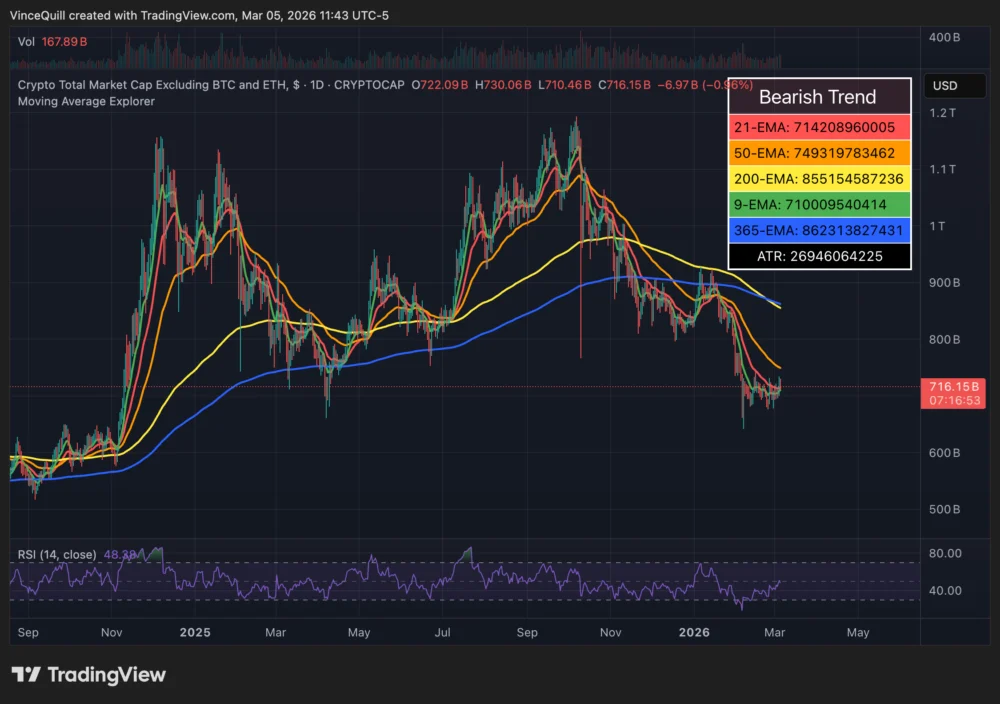
The digital asset landscape is currently grappling with a significant divergence in performance, as a staggering 38% of altcoins are now trading at or near their all-time lows. This metric, highlighted by CryptoQuant analyst Darkfost, indicates a market condition that is statistically more severe than the period immediately following the collapse of the FTX exchange in late 2022. As the broader financial environment shifts toward a "risk-off" posture, altcoins—traditionally viewed as high-beta, high-risk assets—are bearing the brunt of investor caution, leading to a massive regression in valuation across the sector.
According to the analysis, the current percentage of altcoins hovering at historic price floors surpasses previous crisis benchmarks. For context, this specific metric reached 37.8% in the wake of the FTX bankruptcy, a moment widely considered the nadir of the previous bear market. In April 2025, the figure sat at 35%. The rise to 38% suggests that despite Bitcoin’s relative resilience and institutional adoption, the secondary and tertiary tiers of the cryptocurrency market are facing an existential liquidity crisis. Darkfost noted that the current environment is profoundly unfavorable for risk-on assets, with crypto markets acting as the primary "absorber" of global macroeconomic anxiety.
Comparative Analysis: The Post-FTX Era vs. Modern Market Conditions
The comparison to the post-FTX period is particularly striking for market historians. In November 2022, the collapse of Sam Bankman-Fried’s empire triggered a systemic panic that wiped out billions in market capitalization. At that time, the 37.8% metric represented a total loss of confidence in centralized entities. Today’s 38% figure, however, appears to be driven by different structural factors: a combination of "altcoin fatigue," a lack of retail participation, and a fundamental shift in how capital enters the ecosystem.
Investors are no longer moving down the "risk curve" with the same enthusiasm seen in previous cycles. Historically, a surge in Bitcoin’s price would eventually lead to "altseason," a period where profits from Bitcoin would rotate into smaller-cap tokens. However, the current data suggests this cycle is broken. Investors remain cautious, and interest in altcoins is not just stagnating but actively retreating. This loss of interest is reflected in both price action and social engagement metrics, painting a picture of a market that is increasingly top-heavy, favoring established assets like Bitcoin and, to a lesser extent, Ethereum.

Case Studies in Capitulation: ADA, DOT, and POL
To understand the severity of the drawdown, one must look at the performance of former "blue-chip" altcoins. Cardano (ADA), once a top-five cryptocurrency by market cap, is currently trading approximately $0.10 above its all-time low of $0.17. While it maintains a dedicated community, the price action reflects a broader lack of new capital inflow. Similarly, Polkadot (DOT), which reached an all-time low of $1.13 in February, has seen a modest recovery of 33%, yet it remains far below its historical peaks, struggling to regain its status as a leading interoperability protocol.
Perhaps the most telling example is Polygon (POL, formerly MATIC). The asset is currently trading just $0.02 above its all-time low of $0.08. Polygon’s struggle is particularly noteworthy given its high level of institutional partnership and technical development. The fact that such a prominent project is flirting with its absolute price floor underscores the "liquidity drain" affecting even the most reputable projects in the space. These assets are caught in a cycle where minor shifts in market sentiment trigger outsized sell-offs, as there is insufficient buy-side pressure to absorb the liquidations.
The Institutional Siphon: Equities, Commodities, and BTC ETFs
A primary driver of the altcoin decline is the redirection of liquidity. Darkfost’s analysis points to a clear migration of capital away from altcoins and toward traditional equities and commodities. This shift is exacerbated by the success of Bitcoin exchange-traded funds (ETFs). While the approval of these spot products was seen as a win for the entire industry, it has created a "liquidity trap" for altcoins.
Institutional investors can now gain exposure to the crypto sector via regulated, familiar vehicles that focus exclusively on Bitcoin. This "digital gold" narrative has effectively walled off institutional capital from the rest of the market. Because Bitcoin ETFs do not require investors to hold assets on crypto-native exchanges, the traditional path of "on-ramping" through an exchange and then diversifying into altcoins has been bypassed. Consequently, altcoins lack the institutional support and the fundamental narrative that currently bolists Bitcoin’s valuation.
The volume data further illustrates this volatility. On October 10, a date marked by a historic crypto market crash, daily trading volumes surged to over $417 billion as investors fled positions. In contrast, during the relatively stable months of February and March 2026, daily volumes ranged between $49.4 billion and $268 billion. This discrepancy highlights a market where activity is driven more by panic and liquidation than by sustained, healthy accumulation.

The Total3 Metric and Market Capitalization Trends
Market analysts often look to the "Total3" metric to gauge the health of the altcoin sector. Total3 tracks the market capitalization of the entire cryptocurrency market while excluding the two largest assets, Bitcoin and Ethereum. Current data from TradingView shows that the Total3 metric has retraced to levels not seen since November 2024.
This retracement is significant because it erases over a year of growth. It indicates that the "altcoin market" as a standalone entity has failed to maintain its gains, even as Bitcoin has explored new price discovery zones. The "liquidity drain" mentioned by Jimmy Xue, co-founder of liquidity platform Axis, is a direct cause of this. Xue noted that altcoins suffer because even minor shifts in sentiment trigger massive sell-offs. Without the "digital gold" or "store of value" defense that Bitcoin enjoys, altcoins are treated as purely speculative instruments to be discarded at the first sign of macroeconomic trouble.
Social Sentiment and the Erosion of Retail Interest
The decline in price is mirrored by a collapse in social engagement. According to Santiment, a crypto market sentiment analysis platform, mentions of "altcoins" on social media have dropped to two-year lows. This lack of "chatter" is a bearish indicator for retail-driven assets, which rely heavily on community hype and viral trends to drive price action.
Google Trends data corroborates this finding. Worldwide search volume for the term "altcoins" has hit a yearly low of 4 out of 100. For comparison, during the heights of previous bull runs, this metric consistently stayed near the 100 mark. The lack of search interest suggests that the general public—the primary demographic for many utility and meme tokens—has largely checked out of the market. This retail exodus leaves altcoins in a precarious position, as they lose their most active buying force.
The "Zombie Token" Problem: Over-Saturation and Dilution
A structural issue contributing to the altcoin malaise is the sheer number of tokens in existence. At the time of writing, CoinMarketCap lists more than 36.8 million different crypto tokens. This represents a massive oversupply of "investable" assets competing for a shrinking pool of capital.

Analysts argue that the market has become over-saturated. In previous cycles, investors had a few hundred or a few thousand projects to choose from. Today, the ease of token creation has led to an explosion of assets, many of which lack utility, liquidity, or a clear roadmap. This dilution means that even if new capital enters the market, it is spread so thin across millions of tokens that it fails to produce a meaningful "altseason." The result is a market filled with "zombie tokens"—assets that exist on the blockchain but have no trading volume, no development, and no hope of returning to their former highs.
Chronology of the 2025-2026 Altcoin Regression
The timeline of the current decline provides insight into the "largest regression" recorded in the current market cycle.
- April 2025: The percentage of altcoins near all-time lows hits 35%, signaling early signs of distress despite a stable Bitcoin price.
- Late 2025: Institutional interest shifts heavily toward Bitcoin ETFs, siphoning liquidity from decentralized finance (DeFi) protocols and Layer-1 alternatives.
- February 2026: Polkadot (DOT) hits a historic low of $1.13. Trading volumes across the sector remain sluggish, ranging between $49 billion and $268 billion.
- October 10, 2026: A historic market crash occurs, sending trading volumes over $417 billion as mass liquidations take place.
- Current Period: The percentage of altcoins near all-time lows reaches 38%, surpassing the FTX crash benchmark. Total3 market cap returns to November 2024 levels.
Implications and Future Outlook
While the data presents a grim picture for current holders, some analysts, including Darkfost, suggest that this level of capitulation could present a generational buying opportunity. The "regression" of the market often serves as a cleansing mechanism, flushing out weak projects and over-leveraged positions. For long-term investors, the current lows may offer entry points into projects that possess actual utility and staying power, provided they can survive the ongoing liquidity drought.
However, the risks remain high. The lack of institutional support for altcoins, combined with the "digital gold" dominance of Bitcoin, creates a high barrier to recovery. If the 38% figure continues to climb, it may signal a fundamental change in the cryptocurrency ecosystem—one where the vast majority of tokens eventually trend toward zero, leaving only a handful of dominant assets.
The current state of the market is a stark reminder of the volatility inherent in the crypto space. As mentions and searches hit multi-year lows, the sector finds itself in a period of quiet desperation. Whether this is the "bottom" or merely a pause in a longer decline will depend on the return of retail interest and the potential for a rotation of capital out of Bitcoin—a rotation that, for now, remains nowhere in sight.