
 admin
admin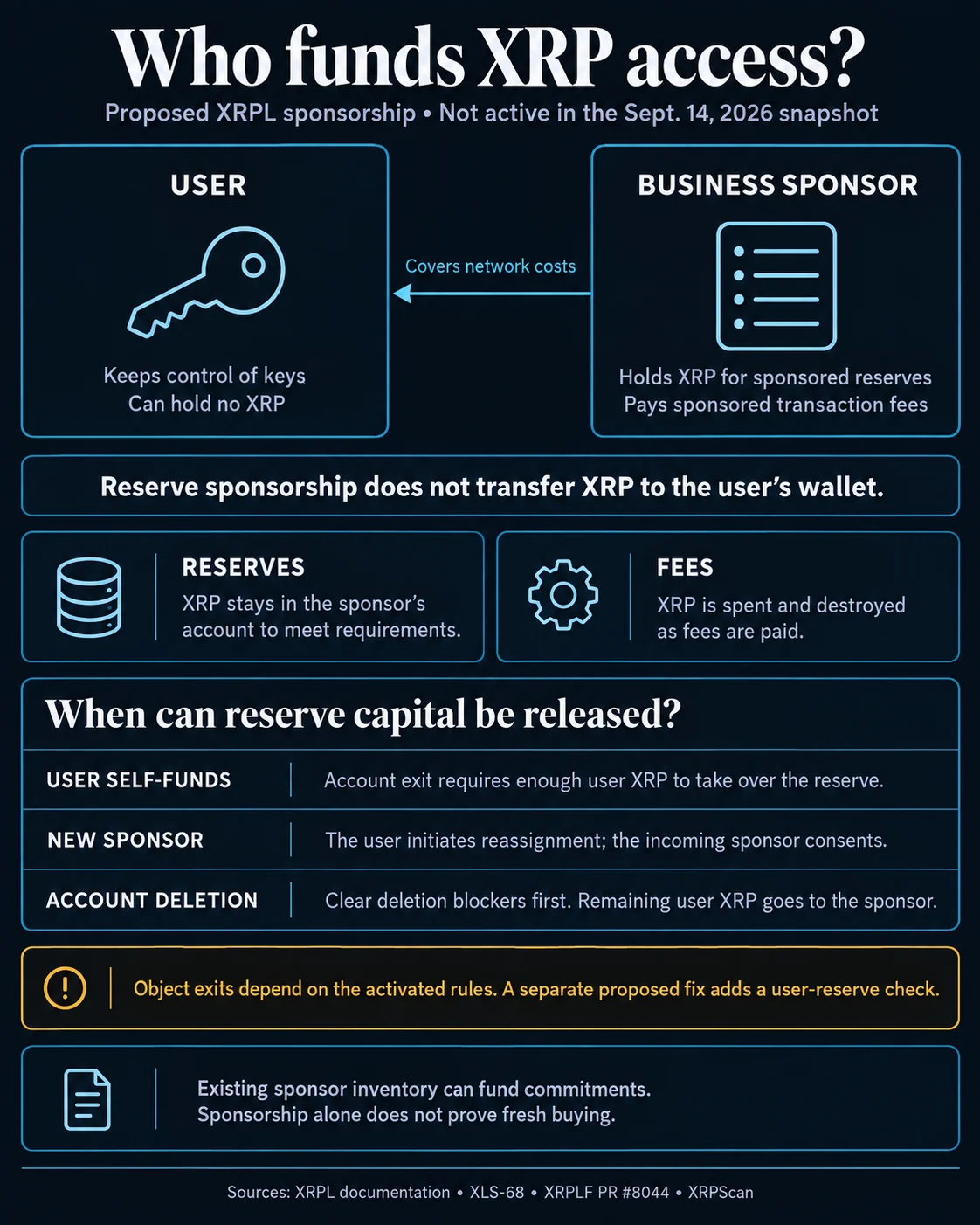
A significant proposed upgrade to the XRP Ledger (XRPL) could fundamentally alter how financial institutions interact with the network, potentially removing a key barrier to widespread adoption. The "Sponsor" amendment, formally known as XLS-68 Sponsored Fees and Reserves, aims to empower companies, such as banks and fintech firms, to cover the costs associated with XRPL account reserves and transaction fees on behalf of their customers. This innovation would allow customers to engage with tokenized assets, payment systems, and other XRPL-based applications without needing to hold, manage, or understand the underlying XRP token.
This proposed change represents a substantial shift in the economic dynamics of the XRPL, moving the burden of capital requirements from individual end-users to the deploying institutions. Currently, interacting with the XRPL necessitates holding a minimum balance of XRP to cover account reserves, with additional XRP required for transaction fees. For financial entities looking to leverage the XRPL for consumer-facing products, this has been a point of friction, requiring complex user onboarding processes that often involve educating customers about cryptocurrency and managing digital assets.
Jazzi Cooper, Ripple’s head of product, has articulated the vision behind this feature, stating that it is designed for a sponsor, such as a bank, issuer, or platform, to absorb these costs for their users. This architectural change promises to streamline the customer experience, allowing consumer-facing applications and institutional platforms to abstract away the complexities of XRP mechanics, presenting a more seamless interface to the end-user.
The Mechanics of Sponsored Fees and Reserves
Under the proposed Sponsor amendment, companies would be able to pay for both the initial XRP required to establish an account reserve and the ongoing XRP transaction fees for their users. Crucially, this sponsorship would not transfer ownership or control of the private keys to the sponsoring entity; the customer would retain full control over their account.
The XRP allocated for account reserves would remain on the sponsor’s balance sheet, though the XRPL would ledger the obligation, clearly indicating which party is responsible for that reserve. Transaction fees, which are currently destroyed upon settlement, would continue to be paid by the sponsor in XRP. This effectively means that businesses could become the primary XRP holders supporting a customer base that itself owns no XRP.
The implications for XRP’s economic model are significant. Instead of a decentralized distribution of reserve requirements across a vast number of individual users, the responsibility could become concentrated among a smaller group of institutional sponsors. This could lead to a scenario where widespread XRPL adoption does not necessarily translate into an equivalent increase in retail XRP holders. Instead, financial institutions would manage the XRP inventory centrally to facilitate their product offerings.
A Timeline Towards Potential Activation
The journey of the Sponsor amendment from proposal to activation is a multi-stage process governed by the XRPL’s consensus mechanism. As of the latest available data, the amendment had not yet achieved the necessary validator support for activation. XRPScan data indicated that only a fraction of the required validators—six out of the 29 needed—had expressed support for the amendment. Consequently, no activation date has been scheduled, underscoring that this remains a forward-looking proposal rather than an imminent network change.
The development of the Sponsor amendment has been a collaborative effort, with contributions from entities like Ctrl Alt, who have worked alongside Ripple and other XRPL developers. Ctrl Alt has publicly described the model as a mechanism for institutions to manage XRP requirements internally, enabling customers to interact with tokenized assets without the prerequisite of acquiring XRP.
Bridging the Gap: Removing Friction for Financial Institutions
For banks and fintech companies, the primary allure of the Sponsor amendment lies in its ability to remove a significant hurdle to deploying products on the XRPL. Currently, any entity wishing to offer services on the XRPL, such as tokenized deposits, payments, or access to other tokenized assets, must ensure that its customers possess XRP. This requirement necessitates intricate user education and wallet management solutions, which can deter adoption, particularly among less tech-savvy or crypto-averse demographics.
By allowing institutions to sponsor these costs, the XRPL can present a more familiar and user-friendly interface. Imagine a customer using a bank’s app to purchase a tokenized bond or to make a cross-border payment facilitated by the XRPL. Under the current system, the customer would need to acquire XRP, potentially navigate exchange volatility, and manage a separate digital asset. With the Sponsor amendment, the bank would handle these underlying XRP requirements, presenting the customer with a service that feels akin to traditional financial products.
This shift could be particularly impactful for the burgeoning market of tokenized assets. As the XRPL ecosystem matures with offerings like tokenized real estate, bonds, and money market instruments, the ability for institutions to abstract away XRP complexity becomes a critical enabler. Companies could launch these products at scale, knowing that the operational overhead of XRP management is borne by the institution, not the end-user.
The Capital Commitment for Sponsors
While the Sponsor amendment aims to simplify the customer experience, it introduces a new set of capital management considerations for the sponsoring institutions. The underlying XRP reserve requirement, which is currently 1 XRP per account plus 0.2 XRP for each additional owner-reserve unit (though these parameters are adjustable by validators), would still need to be met. Under sponsorship, this XRP would be held within the sponsor’s account but designated as fulfilling the reserve obligation for a specific user.
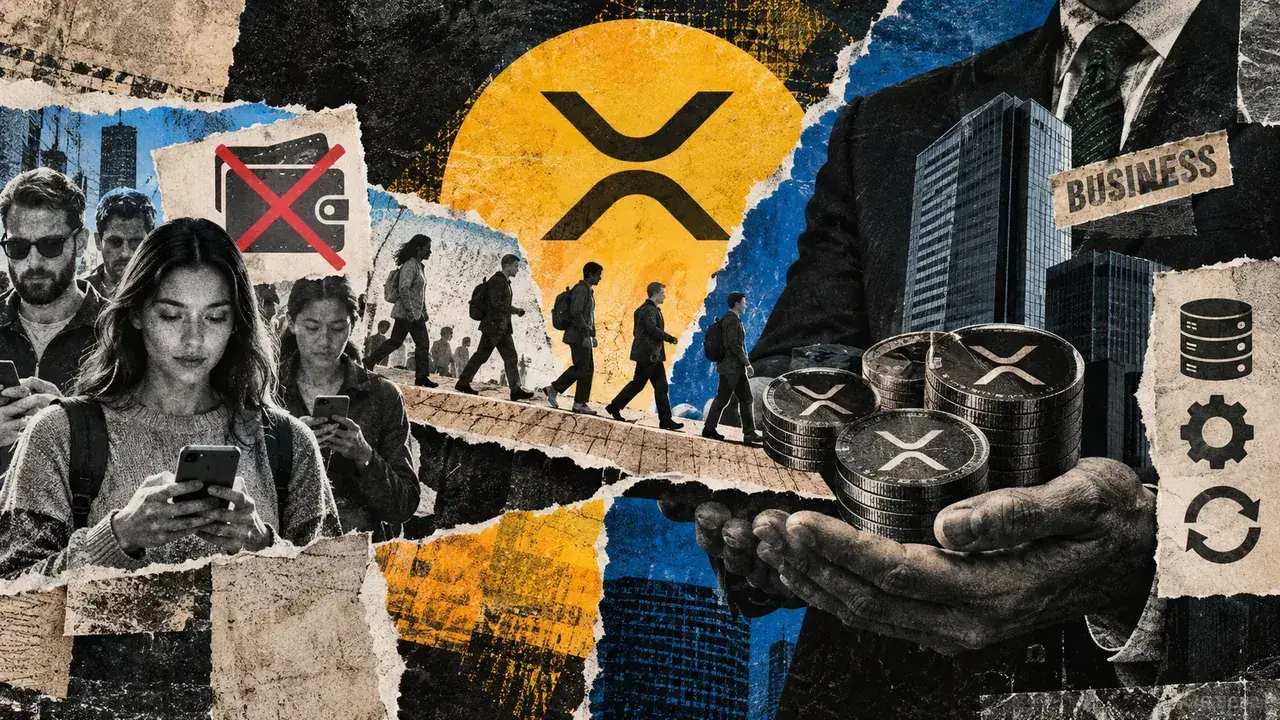
Consider a bank that wishes to onboard one million customers onto an XRPL-based payment service. Under current XRPL reserve requirements, this would necessitate approximately one million XRP for base account reserves alone, before accounting for trust lines, token objects, and transaction fees. If these customers were to fund their own accounts, this XRP requirement would be distributed amongst them. However, with sponsorship, the bank would cumulatively hold this significant XRP balance to meet the reserve obligations for its entire user base.
This concentration of reserve requirements could lead to a substantial demand for XRP from institutions, even if individual customers remain unaware of its existence. The exact scale of this demand would depend on the number of sponsored accounts, the average reserve units per account, and the types of XRPL objects each account interacts with.
Furthermore, the "Optional Sponsorship" ledger entries introduce another layer of complexity and potential reserve consumption. These entries allow businesses to establish pre-funded sponsorship relationships, streamlining the process for subsidizing transactions. However, each of these entries also consumes reserve capacity on the ledger.
Navigating the Exit Strategy: Reserve Release and Object Sponsorship
The Sponsor amendment also introduces mechanisms for ending sponsorship and releasing reserves, though these come with their own set of conditions and potential complexities. The SponsorshipTransfer mechanism allows for sponsorships to be ended or reassigned. However, when a sponsored account transitions back to requiring self-funded reserves, the beneficiary must possess sufficient XRP to meet the requirement.
This presents a potential challenge for the very users the feature is designed to benefit. A customer who has never acquired XRP might be unable to cover the reserve shortfall if a bank decides to cease sponsoring their account. In such scenarios, the sponsor could transfer XRP to the customer to cover the deficit, but this incurs a direct cost. Alternatively, the customer could seek a new sponsor to assume the obligation, contingent on the incoming sponsor’s consent.
Account deletion offers another pathway for reserve release, provided that relevant "blockers" are cleared. Once a sponsored account is eligible for deletion, its reserve obligation is released, and any remaining XRP within the account can be directed according to the proposed rules.
Object sponsorship, which pertains to the sponsorship of specific ledger objects like trust lines or token metadata, adds further considerations. A recent code change merged into XRPL’s development branch in August introduced reserve checks when certain sponsorships end. However, the behavior of these checks is contingent on the activation of a separate amendment, fixCleanup3_4_0. The eventual mainnet status of this amendment will influence the predictability and ease with which some reserve commitments can be unwound.
Consequently, financial institutions contemplating the Sponsor amendment must conduct thorough financial modeling. This modeling would need to encompass not only the initial cost of acquiring XRP but also projections for customer churn, average reserve requirements per user, transaction fee consumption, and the amount of XRP that could become indefinitely committed to inactive accounts.
Implications for XRP Demand and Network Growth
The Sponsor amendment holds the potential to create a novel and significant use case for XRP within institutional finance. However, the immediate impact on XRP buying pressure remains a subject of analysis. Institutions that already hold XRP on their balance sheets could reallocate these existing holdings to fulfill sponsorship obligations without necessarily purchasing new supply.
The emergence of new market demand will likely hinge on the gap between an institution’s existing XRP inventory and the total reserve and fee commitments it chooses to assume. Therefore, the true measure of the amendment’s success in driving demand will be evident in post-activation deployment data. Metrics such as the number of sponsored accounts, the aggregate balances of sponsoring entities, transaction volumes, and the volume of XRP tied to tokenized assets will be crucial indicators. These data points will reveal whether businesses are actively accumulating XRP to support new services or primarily recycling their existing holdings.
The immediate prerequisite for any of these economic shifts is the successful activation of the Sponsor amendment. If it garners sufficient support from validators and successfully navigates the required activation period, the decision will then rest with banks and platforms. They will need to weigh the strategic advantages of removing XRP from the customer experience against the commitment of holding the token themselves as an infrastructure cost.
For enterprises planning to launch large-scale tokenized asset products on the XRPL, this calculation could fundamentally redefine XRP’s role. It could transition from an asset that every end-user must actively manage to a foundational infrastructure expense, borne and managed by the institution at the heart of the service. This evolution could be a pivotal moment in the XRPL’s journey towards broader institutional adoption and integration into the global financial system.








