
 James Watt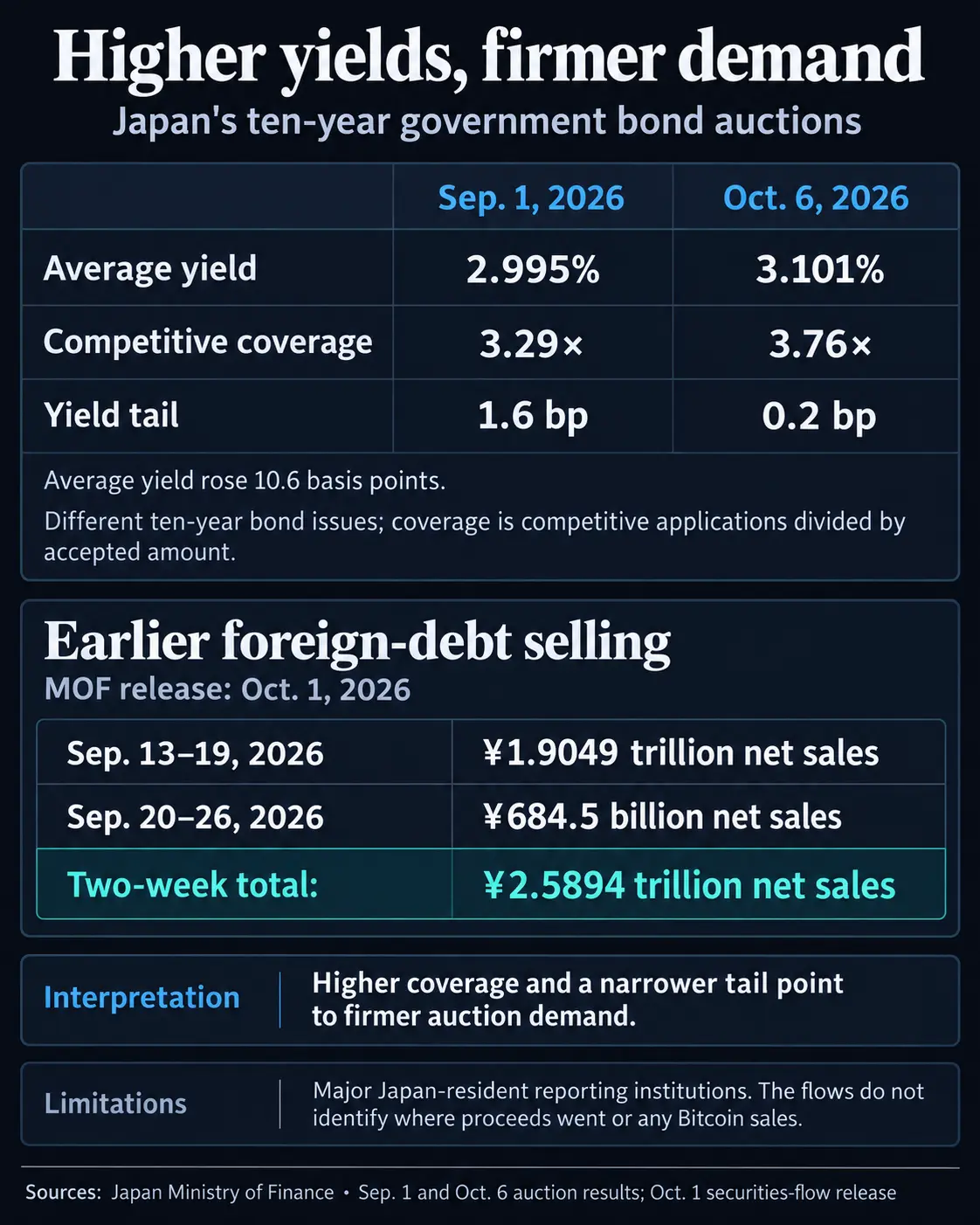
The October 6 Auction: A Turning Point for Domestic Yields
The Ministry of Finance’s recent auction results highlight a shifting appetite among Japan’s largest financial players. The average yield for the ten-year government bond climbed to 3.101%, up from 2.995% recorded during the previous sale on September 1. This 10.6 basis point increase reflects a broader trend of rising interest rates within the Japanese domestic market, which has long been characterized by near-zero or negative yields.
Market participants showed a heightened level of engagement. The competitive auction coverage ratio—a key metric representing the amount of debt sought by bidders divided by the amount actually accepted—surged from 3.29 times in September to 3.76 times in October. Furthermore, the "yield tail," which measures the difference between the average yield and the highest yield accepted (the lowest price), narrowed dramatically from 1.6 basis points to a mere 0.2 basis points.
In the world of bond trading, a narrowing tail combined with rising coverage indicates "firmer" demand. It suggests that institutions are not just participating in the auction but are aggressively bidding at or near the average yield, fearing they might be left out of the allocation. This domestic pivot suggests that Japanese institutions, ranging from massive insurance companies to commercial banks, are finding the risk-reward profile of their own sovereign debt increasingly attractive compared to overseas alternatives.
Chronology of the ¥2.6 Trillion Foreign Debt Sell-Off
The surge in demand for Japanese Government Bonds (JGBs) did not happen in a vacuum. It was preceded by two weeks of aggressive selling of foreign debt by Japanese resident reporting institutions. According to the MOF’s capital flow data released on October 1, the scale of this divestment was historic.
During the week of September 13–19, Japanese institutions recorded net long-term foreign debt sales of ¥1.9049 trillion. This was followed by another net sale of ¥684.5 billion during the week of September 20–26. Combined, these two weeks saw a total of ¥2.5894 trillion (approximately $17.5 billion at current exchange rates) exiting foreign bond markets.

While the MOF data does not explicitly categorize these sales—meaning it does not specify whether the proceeds were from U.S. Treasuries, European sovereign debt, or corporate bonds—the timing suggests a strategic repatriation of capital. The sequence of events is clear: a massive liquidation of foreign holdings followed by a high-demand auction for domestic debt. For Bitcoin investors, this sequence is a warning sign of a "liquidity vacuum" forming in the global markets that typically support risk-on assets.
The BIS Perspective: Global Funding Conditions and Crypto Flows
The relationship between Japanese bond yields and Bitcoin price action is found in the mechanics of global financing. A working paper published by the Bank for International Settlements (BIS) titled "Defying Gravity: An Empirical Analysis of Cross-Border Bitcoin, Ether, and Stablecoin Flows" provides the theoretical framework for understanding this risk.
The BIS researchers identified two primary drivers for cross-border cryptocurrency flows: speculative motives and global funding conditions. Using a sample period from 2017 to mid-2024, the paper argues that when global liquidity is abundant and borrowing costs are low, capital flows more freely into decentralized finance (DeFi) and crypto-assets.
Japan has historically been the world’s primary provider of low-cost liquidity. For decades, the "Yen Carry Trade"—where investors borrow yen at low interest rates to invest in higher-yielding assets elsewhere—has been a cornerstone of global market stability. However, as JGB yields rise to 3.101%, the cost of "borrowing yen" effectively increases, and the incentive to keep capital within Japan grows. If Japanese institutions persistently prefer domestic bonds over overseas debt, the resulting reduction in foreign bond demand could raise borrowing costs globally, weighing heavily on the capital available for speculative risk-taking in the Bitcoin market.
Institutional Allocation vs. The Carry Trade Unwind
It is essential to distinguish between institutional portfolio reallocation and the more volatile leveraged carry trade. Institutional allocation, as seen in the recent MOF data, involves long-term shifts by pension funds and insurers who are moving away from foreign currency-hedged debt toward domestic JGBs. This is a structural change that suggests a long-term reduction in the "global dollar" supply.
In contrast, the "yen carry trade" involves shorter-term, highly leveraged positions. While a ten-year auction yield does not directly measure the short-term cost of borrowing for these trades, it sets the psychological and structural floor for the entire Japanese interest rate curve.

The BIS researchers, in an August 2024 analysis of market turbulence, noted how deleveraging and margin increases can amplify market stress. When Japanese yields rise, the "spread" between Japan and the rest of the world narrows. This forces leveraged players to close their positions, selling off their riskier assets—like Bitcoin—to pay back their yen-denominated loans. The October 6 auction results suggest that the "gravity" of Japanese domestic yields is becoming stronger, potentially pulling capital away from the digital asset ecosystem.
Broader Implications for Bitcoin and Risk Assets
For Bitcoin, the risk is twofold: liquidity and valuation. Bitcoin is often viewed as a "liquidity barometer." When central banks, particularly the Bank of Japan, tighten the taps, Bitcoin is often the first asset to feel the chill.
- Reduced Buy-Side Pressure: As Japanese institutions repatriate ¥2.6 trillion, that capital is no longer available to support foreign equity markets or the shadow banking systems that often provide the leverage used by crypto hedge funds.
- Higher Opportunity Cost: With domestic Japanese yields at 3.101%, the "risk-free" rate in Japan is no longer negligible. For a Japanese institutional investor, the hurdle rate for investing in a volatile asset like Bitcoin has just moved higher.
- Currency Volatility: The sale of foreign debt often involves selling the U.S. Dollar or Euro to buy Yen. This strengthens the Yen, which can lead to a "risk-off" sentiment across global desks, historically a bearish signal for Bitcoin.
Fact-Based Analysis: What to Watch Next
The sustainability of this trend is now the primary concern for macro-focused crypto analysts. The October 6 auction confirms that there is a "floor" of demand for JGBs at the 3% level, which may embolden the Bank of Japan to allow rates to climb even higher if inflation persists.
Investors should monitor the next several MOF flow releases. If the pattern of foreign debt selling continues alongside independently observed stress in global funding markets (such as rising repo rates or widening credit spreads), the "Bitcoin financing channel" theory will be validated. Conversely, if Japanese institutions return to buying foreign debt, it would suggest that the September sell-off was a temporary rebalancing, potentially providing a "soft landing" for crypto liquidity.
The narrowing of the yield tail to 0.2 basis points is perhaps the most telling statistic. It indicates a market in total agreement about the value of the debt at current prices. When institutional giants like Japan’s "Post Bank" or major life insurers move in unison, they create a tide that is difficult for any asset class—even one as decentralized as Bitcoin—to swim against.
Conclusion
The October 6 auction marks a period of transition. As Japan moves away from its era of hyper-easy money, the ripples are being felt far beyond Tokyo. The ¥2.5894 trillion divestment from foreign debt is a tangible manifestation of this shift. For Bitcoin investors, the lesson is clear: the era of "free" yen-denominated liquidity is ending, and the digital asset market must now prepare to compete for capital in a world where Japanese domestic bonds once again offer a competitive, low-risk return. The "lighthouse" of the Japanese bond market is guiding capital back home, leaving Bitcoin and other risk assets to navigate increasingly darker and more turbulent global waters.








