admin
admin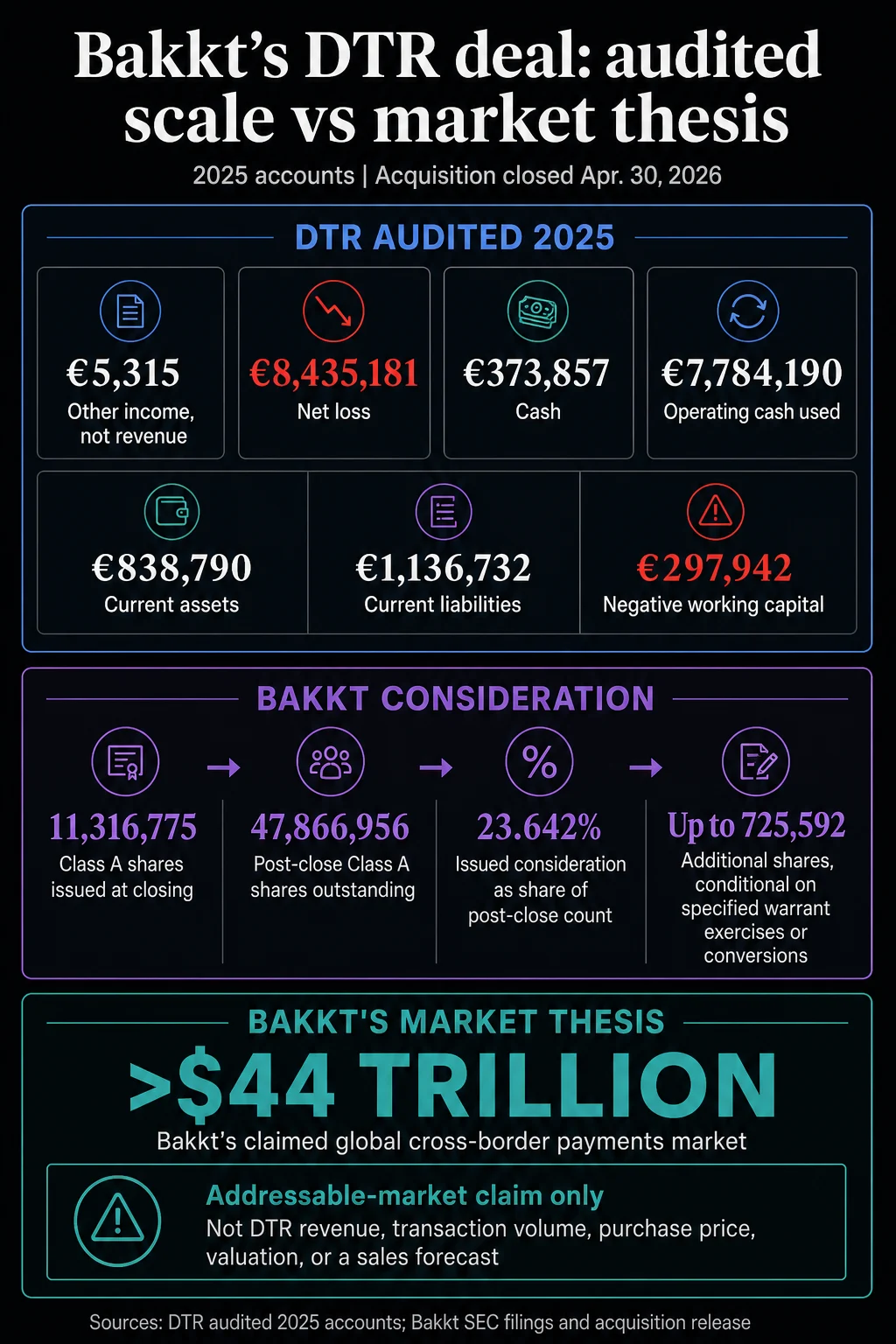
The much-heralded acquisition of Distributed Technologies Research (DTR) by Bakkt, a company with aspirations to revolutionize the global payments landscape, has been met with scrutiny following the release of DTR’s audited financial statements for 2025. These documents reveal a business that, prior to its acquisition by Bakkt in April, recorded a mere £5,315 in "other income" and incurred a substantial loss of £8.4 million for the year. This stark financial performance stands in sharp contrast to Bakkt’s ambitious pronouncements of tapping into a $44 trillion payment market.
The audited accounts for DTR, a fintech software group, present a sobering picture of its financial health leading up to the acquisition. For the full year 2025, DTR reported "other income" of just £5,315, a figure that is explicitly distinguished from revenue in the financial statements. This minimal income was overshadowed by an operating loss of £8,435,181. These figures represent DTR’s first consolidated reporting year, with no prior comparative data available, and crucially, they predate the official closing of the acquisition on April 30. Bakkt acquired all of DTR’s outstanding equity in a deal valued at 11.3 million shares, a move intended to bolster Bakkt’s stablecoin infrastructure and agentic payments capabilities.
DTR’s Financial Footprint: A Deep Dive into the 2025 Accounts
The financial statements categorize DTR as a group providing fintech software. However, Bakkt had positioned it as a pivotal developer of stablecoin and agentic payments infrastructure. Under a prior cooperation agreement, DTR was instrumental in contributing its payments technology, application programming interfaces (APIs), intellectual property, and a skilled workforce to the burgeoning Bakkt ecosystem. In return, Bakkt provided access to its systems and crucial regulatory licenses, laying the groundwork for what was envisioned as a transformative payment solution.
The audited 2025 accounts reveal a significant cash burn within DTR. As of the end of 2025, the company held £373,857 in cash. Its liquidity position was further challenged by current liabilities of £1,136,732, which significantly exceeded its current assets of £838,790, resulting in negative working capital of £297,942. The operational activities of DTR consumed a considerable £7,784,190 in cash during the year. This cash outflow was largely funded through the issuance of share capital, which brought in £11,718,611.
The Share Consideration and Evolving Deal Terms
The acquisition was finalized with Bakkt issuing 11,316,775 Class A shares. This figure was adjusted downwards by 196,532 shares to account for specified shareholder loans and excess transaction expenses. Subsequent filings, including a registration statement, indicated that as of April 30, there were 47,866,956 Class A shares outstanding. This means the shares issued as consideration for DTR represented approximately 23.642% of Bakkt’s post-acquisition share count.
It is important to note that this percentage differs from the initially stated 31.5% term of the deal. This discrepancy arose because the 31.5% figure was based on a defined pre-close, as-converted share base. Bakkt retains the option to issue up to an additional 725,592 consideration shares. However, these additional shares are contingent upon the issuance of shares through the exercise or conversion of specific warrants. Any calculation incorporating this maximum potential issuance would necessitate adding the corresponding warrant shares to the denominator, further complicating the precise ownership dilution.
Related-Party Transactions and Impairment Charges
The acquisition of DTR was characterized as a related-party transaction, adding another layer of complexity. Akshay Naheta, who held the positions of CEO, president, and director at Bakkt, was also the CEO and principal owner of DTR. Consequently, Naheta personally received 8,322,949 Bakkt shares as part of the DTR consideration. Bakkt maintained that the transaction was negotiated and approved by an independent special committee, with Naheta recusing himself and abstaining from the vote. The issuance of shares was subsequently approved by Bakkt’s stockholders prior to the deal’s closure.
The financial statements also detail a significant impairment expense of £3,205,828. This charge is described as a write-off of a related-party balance, indicating a reduction in the value of assets or receivables owed by or to entities connected to Bakkt or its leadership. Furthermore, the cash-flow reconciliation highlighted a movement of £3,614,868 in an amount due from a related party. This figure represents the net change during the year, not the year-end receivable balance of £409,040. These related-party elements suggest a degree of financial interconnectedness that warrants careful examination by investors.
The Disconnect Between Ambitious Claims and Financial Reality
Bakkt’s official announcement of the DTR acquisition completion painted a picture of strategic foresight, positioning the deal as a gateway into the "global cross-border payments market worth more than $44 trillion." This widely publicized figure, however, has been clarified as representing the total addressable market and not DTR’s revenue, transaction volume, purchase price, or valuation. It also does not represent a forecast of Bakkt’s achievable sales within that market. The significant disparity between this enormous market potential and DTR’s minimal reported income raises questions about the valuation and the projected returns on Bakkt’s investment.

Commercial Outlook and Delayed Integrations
The commercial viability of the Bakkt-DTR acquisition is now under intense scrutiny. Bakkt’s own transaction proxy filing acknowledged that DTR had fallen behind its internal forecasts prior to the acquisition. The document revealed that several prospective customer integrations had experienced delays, and anticipated large merchant partnerships had failed to materialize. The newly released audited accounts from DTR serve to underscore this gap, sharply illustrating the disconnect between the technological capabilities of the acquired entity and the commercial traction it had demonstrated before being integrated into Bakkt.
The implications of these findings are significant for Bakkt’s strategic direction and investor confidence. The company had gambled on DTR to accelerate its push into the digital payments arena, promising a revolution in how transactions are conducted globally. The reality, as laid bare by DTR’s financial statements, points to a business struggling with profitability and operational scale. The considerable cash burn, negative working capital, and minimal income raise critical questions about the underlying assumptions of the acquisition and the path forward for Bakkt’s ambitious payment initiatives.
Future Prospects and Investor Scrutiny
Moving forward, Bakkt will need to demonstrate a clear and compelling strategy to leverage DTR’s technology and personnel effectively. The company faces the challenge of not only integrating DTR’s operations but also of proving its ability to generate substantial revenue and achieve profitability in a highly competitive payments market. The recent disclosure of DTR’s pre-acquisition financial performance is likely to intensify investor scrutiny and place greater pressure on Bakkt’s management to deliver tangible results. The promise of a $44 trillion market remains a distant horizon, and the immediate focus will be on the operational and financial realities of the acquired asset. The coming quarters will be crucial in determining whether Bakkt can bridge the gap between its grand vision and the grounded financial performance of its key acquisitions.