James Watt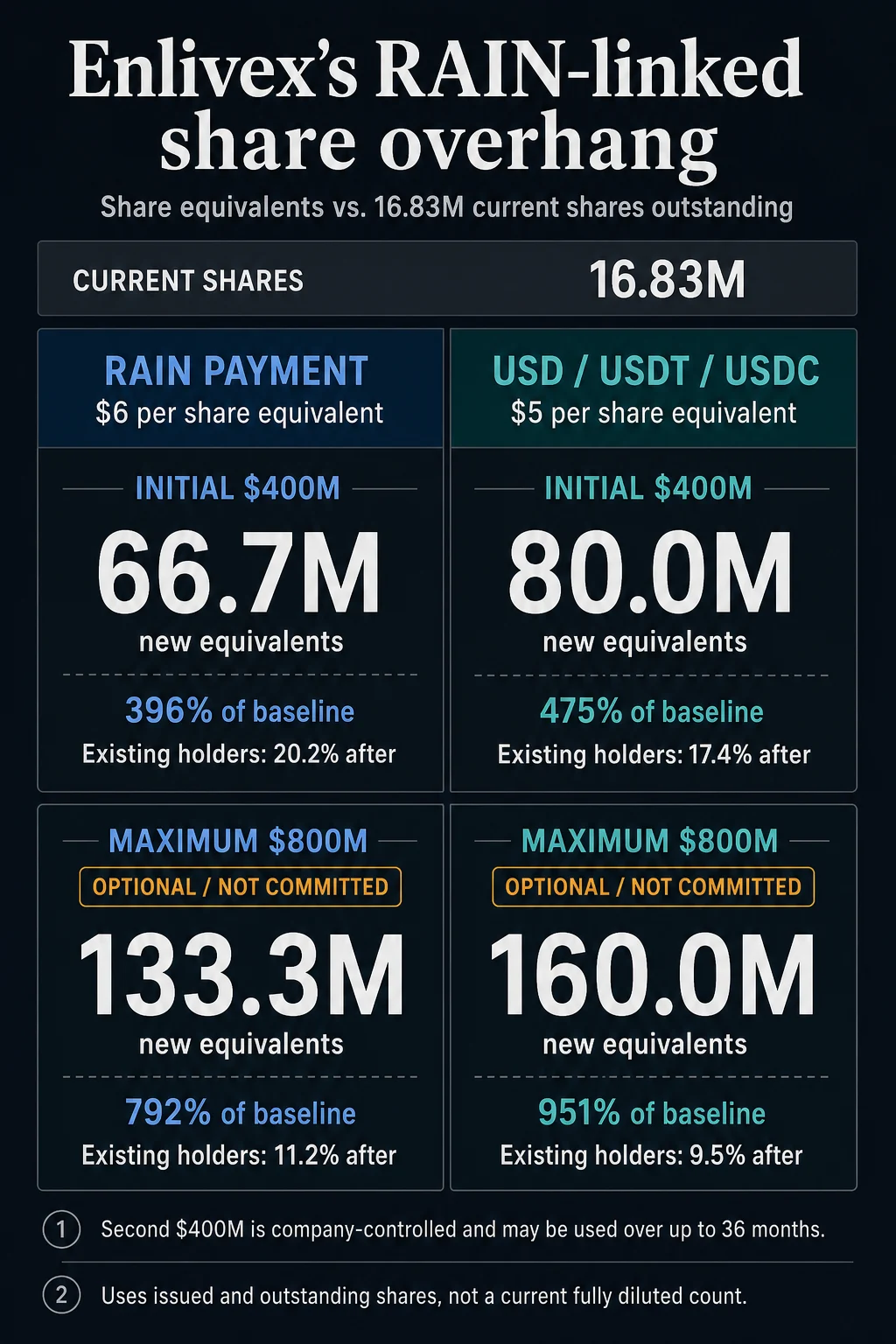
The proposal represents a radical departure from the standard operating procedures of the biotechnology sector. Enlivex has historically focused on the development of Allocetra, an off-the-shelf macrophage-reprogramming immunotherapy designed to treat life-threatening conditions such as sepsis and solid tumors. However, the terms of the new securities purchase agreement suggest that the company’s primary focus is shifting toward the accumulation of digital assets. Under the proposed agreement, substantially all proceeds from the financing—whether delivered in cash or stablecoins—are earmarked for the acquisition of the RAIN token, debt servicing, and transaction costs. A mere 5% of the remaining liquid proceeds is designated for the continued development of Allocetra, raising questions about the company’s long-term commitment to its original pharmaceutical objectives.
The Structure of the $800 Million Financing Agreement
The financing is organized into two distinct $400 million components. The first tranche involves a mandatory $400 million placement that requires immediate shareholder approval. The second $400 million remains an optional "put" arrangement, which Enlivex can choose to exercise over a 36-month period following the initial closing. This structure gives the company the ability to compel the investor to purchase additional shares or pre-funded warrants, though the investor does not have the reciprocal right to demand these purchases.
According to a Form 6-K filed with the U.S. Securities and Exchange Commission (SEC), Enlivex has committed to using "commercially reasonable efforts" to organize a shareholder meeting to vote on these measures within 60 days of the July 27 agreement date. Under Israeli law and Nasdaq listing rules, such a massive issuance of securities requires the explicit consent of the current voting block, particularly given the magnitude of the potential dilution.
The payment terms for the deal provide a unique window into the company’s valuation of digital versus fiat assets. The investor has the option to pay in the RAIN token, U.S. dollars, or stablecoins such as USDT and USDC. Notably, the pricing is incentivized toward the use of RAIN: if the investor pays in the crypto token, the price per ordinary-share equivalent is set at $6.00. If the payment is made in cash or stablecoins, the price drops to $5.00 per share. This $1.00 premium for the crypto-based payment suggests a strategic desire by the company to hold the token directly in its treasury.
Calculating the Impact: A 951% Dilution Scenario
To understand the scale of the proposed dilution, it is necessary to examine Enlivex’s current capital structure. On July 7, the company implemented a 1-for-15 reverse stock split, which reduced its issued and outstanding shares to approximately 16.83 million. This baseline serves as the starting point for calculating the impact of the new financing.
If the first $400 million tranche is paid entirely in RAIN at the $6.00 price point, Enlivex would issue approximately 66.7 million new shares (or share equivalents via pre-funded warrants). This alone represents a 396% increase over the current outstanding share count. If the investor opts for the cash/stablecoin route at $5.00 per share, the issuance rises to 80 million shares, a 475% increase. In this scenario, existing shareholders would see their ownership stake compressed to approximately 17.4% to 20.2% of the company.
The secondary, optional $400 million tranche compounds this effect significantly. If the company exercises its full $800 million capacity using the cash-like price of $5.00, the total number of new shares issued would reach 160 million. When added to the existing 16.83 million shares, the total share count would explode to 176.83 million. This represents a staggering 951% increase in shares outstanding. Under these conditions, the original shareholders would retain less than 10% of the total equity in the company, effectively handing over control to the new investors.
Liquidity Concerns and the RAIN Token Market
One of the most scrutinized aspects of this deal is the liquidity of the RAIN token itself. While the token carries a substantial reported market capitalization of approximately $8.85 billion, its trading volume tells a different story. Market data indicates a 24-hour reported volume of roughly $28 million to $30 million.
The $400 million initial tranche is approximately 13.4 times the total daily turnover of the token. In the world of finance, attempting to liquidate or even hold such a large portion of an asset’s circulating supply relative to its daily volume can create significant "slippage" and volatility. Because the quantity of RAIN to be delivered to Enlivex will be determined by CoinMarketCap’s average closing price over the five business days preceding the close, the company is exposed to the risk that the paper value of the tokens does not reflect their actual realizable cash value in a market exit.
Furthermore, the identity of the buyer remains somewhat opaque in the public filings. The Form 6-K refers to the "Rain Foundation," while the primary Securities Purchase Agreement (SPA) defines the "Token Factor Foundation" as the lead investor. The signature blocks in the public documents were left blank at the time of filing, leaving a lack of clarity regarding whether these two names refer to the same entity or separate organizations.
Strategic Pivot: Biotech or Crypto Treasury?
Enlivex’s move mirrors a growing trend among some publicly traded companies to adopt a "Bitcoin Standard" or crypto-treasury model, popularized by firms like MicroStrategy and, more recently, Metaplanet. However, those companies typically focus on Bitcoin, the most liquid and established digital asset. Enlivex’s decision to tie its future to RAIN—a token with significantly lower liquidity and a different risk profile—marks a much more aggressive and speculative approach.

The allocation of funds is perhaps the most telling indicator of this pivot. Traditional biotech companies raise capital to fund "R&D burn"—the high costs associated with clinical trials and regulatory filings. In this agreement, however, the language is restrictive. Only up to 5% of the net USD proceeds remaining after the payment of transaction fees, expenses, and existing debt can be used to fund Allocetra. If the transaction is settled entirely in RAIN tokens, those tokens are intended to be held in the company’s treasury wallets rather than being liquidated to fund drug development.
This has led to internal and external debates regarding fiduciary duty. Shareholders must decide whether they are investing in a pharmaceutical company with a promising pipeline or a digital asset holding company that happens to own a small percentage of a biotech subsidiary.
Chronology of Recent Events
The timeline leading up to this proposal suggests a rapid shift in corporate strategy:
- Late 2025 – Early 2026: Enlivex manages its clinical pipeline for Allocetra, dealing with the typical high-burn environment of mid-stage biotech.
- July 7, 2026: The company executes a 1-for-15 reverse split to maintain Nasdaq listing requirements and consolidate its share price.
- July 27, 2026: Enlivex enters into a Securities Purchase Agreement with the Token Factor Foundation/Rain Foundation for up to $800 million.
- July 31, 2026: Public disclosure of the 6-K filing reveals the massive dilution potential and the crypto-centric nature of the proceeds.
- Next 60 Days: The company is expected to call a special meeting of shareholders to authorize the issuance of the shares and warrants necessary to close the deal.
Market and Regulatory Implications
The broader implications of this deal could resonate across the Nasdaq. If successful, it may provide a blueprint for other struggling or "cash-strapped" biotech firms to pivot into the crypto space as a means of survival. Conversely, it could trigger regulatory scrutiny from the SEC or Nasdaq regarding "backdoor" changes in business purpose. Nasdaq rules generally require companies to maintain the business focus for which they were originally listed; a total shift from biotech to crypto treasury management might trigger a delisting review or a requirement to re-list under a different category.
For existing shareholders, the choice is stark. They can vote to approve the dilution in the hopes that the RAIN token appreciates in value significantly enough to offset the 951% increase in share count, or they can oppose the measure, which might leave the company without the capital necessary to pay down its existing debts or continue even the minimal 5% funding for Allocetra.
As the 60-day window for the shareholder vote begins, the market will be watching Enlivex closely. The company’s stock price is likely to experience heightened volatility as investors weigh the potential of a massive crypto-infused treasury against the near-total dilution of their original equity stakes. This transaction serves as a landmark case in the merging of traditional equity markets and the volatile world of decentralized finance, highlighting the lengths to which some firms will go to secure capital in an increasingly digital economy.