James Watt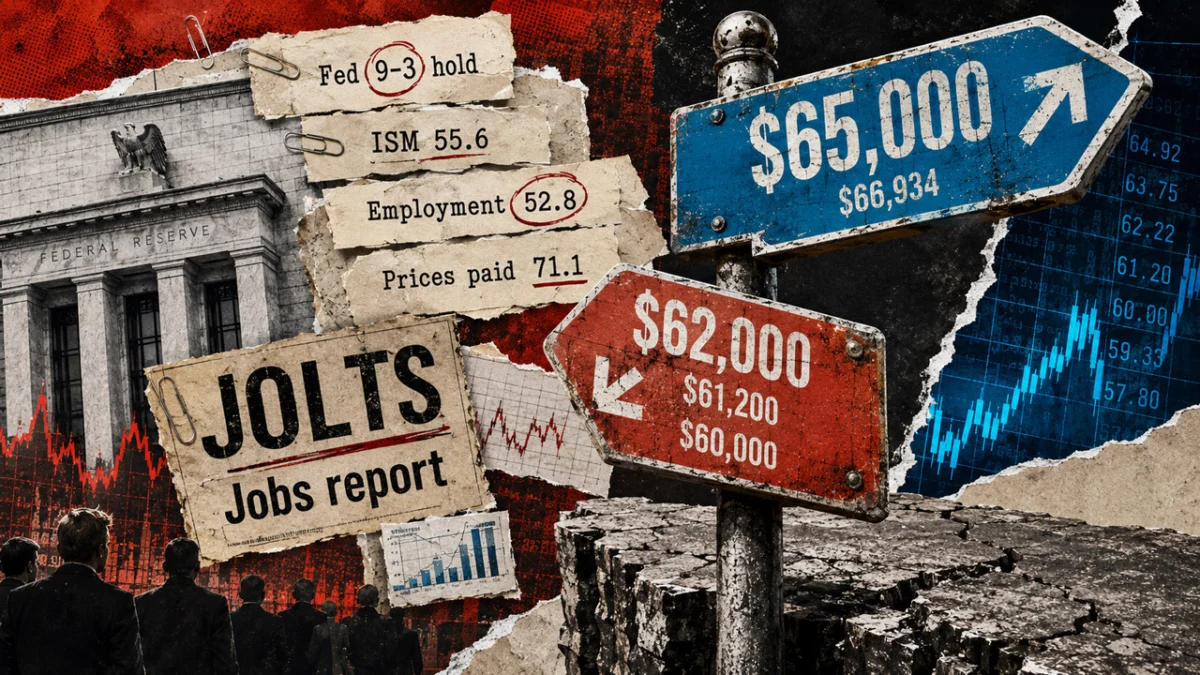
The global financial markets have entered a high-stakes week as Bitcoin remains tightly range-bound, caught between critical support and resistance levels while a barrage of United States economic data threatens to upend the current price stability. Following the release of the first major economic indicator of the month, the Institute for Supply Management (ISM) Manufacturing Purchasing Managers’ Index (PMI), Bitcoin has found itself pinned between $62,200 and $65,000. The ISM data, which arrived stronger than anticipated, has provided unexpected leverage to hawkish members of the Federal Reserve, complicating the narrative for a potential easing of monetary policy and putting immediate pressure on risk assets.
The ISM Manufacturing PMI for July printed at 55.6 on August 3, significantly outperforming the consensus estimate of 54.0 and rising from June’s reading of 53.3. This represents the highest reading for the manufacturing sector since May 2022. Of particular concern for those hoping for a dovish Federal Reserve was the employment component, which entered expansion territory for the first time in 33 months, reaching 52.8. Additionally, new orders climbed to 56.7, signaling robust demand. Perhaps most critically, the "prices paid" index—a key proxy for inflationary pressure within the supply chain—held steady at 71.1. This combination of accelerating growth and persistent price pressure suggests that the "inflation case" remains very much alive, even as the broader economy shows signs of resilience.
The Internal Fracture at the Federal Reserve
The impact of this week’s data is magnified by recent internal developments at the Federal Open Market Committee (FOMC). While the committee officially voted to maintain the target interest rate range at 5.25% to 5.50% (often cited in reference to the effective federal funds rate or specific target brackets) during the July 29 meeting, the consensus was notably fragile. The final vote split 9-3, a rare level of public dissent within the central bank.
Three high-ranking officials—Beth Hammack, Neel Kashkari, and Lorie Logan—voted in favor of an immediate 25-basis-point rate hike. This internal rift indicates that a significant minority of the Fed’s leadership believes that current policy is not yet restrictive enough to fully quell inflation. For Bitcoin investors, this split is a warning sign: strong economic data this week serves as direct "ammunition" for these hawks. If subsequent reports on labor and services confirm the ISM’s strength, the pressure to tighten further, or at least delay cuts, will intensify, potentially removing the "liquidity floor" that has supported Bitcoin’s recent valuations.
A Chronological Roadmap: The Data Gauntlet
The path forward for Bitcoin is gated by four major data releases, each capable of shifting the needle on interest rate expectations.
Tuesday: The JOLTS Report
On Tuesday at 10 a.m. Eastern, the Bureau of Labor Statistics will release the June Job Openings and Labor Turnover Survey (JOLTS). Market participants are looking to see if the May figures—7.6 million openings, 5.2 million hires, and 3.1 million quits—show signs of moderation.
From a Bitcoin perspective, a rise in job openings would confirm that labor demand remains overheated, likely exerting downward pressure on the $62,200 price floor. Conversely, a drop in openings paired with steady hiring would suggest a "controlled slowdown" or a "soft landing," providing the necessary breathing room for Bitcoin to challenge the $64,000 resistance level. Analysts note that the "quits rate" is a vital metric to watch; when workers stop voluntarily leaving their jobs, it is often the first sign that consumer confidence is beginning to crack.
Wednesday: ISM Services PMI
The ISM Services report, due Wednesday at 10 a.m. Eastern, is arguably more influential than the manufacturing data, as services account for the vast majority of U.S. economic activity. The employment and prices-paid components will be the primary focus. If the services sector mirrors the manufacturing sector’s strength, the hope for a dovish pivot in September may vanish entirely. A soft employment print here, however, could be the catalyst Bitcoin needs to reclaim the $65,000 mark.
Thursday: Productivity and Labor Costs
Thursday morning brings preliminary second-quarter figures for productivity and unit labor costs, alongside the standard weekly jobless claims. While productivity data rarely causes immediate market volatility, it provides the underlying logic for the Fed’s inflation outlook. High productivity allows for wage growth without causing a corresponding spike in consumer prices. If productivity is weak while unit labor costs are high, the Fed’s hawks will have a data-backed reason to argue that wage-push inflation is still a primary risk.
Friday: The Non-Farm Payrolls (NFP)
The week culminates Friday at 8:30 a.m. Eastern with the July Employment Situation report. This is the "make-or-break" moment for the week’s price action. June’s report was relatively soft, showing payroll additions of only 57,000 and an unemployment rate of 4.2%. A repeat of this moderate hiring, with no acceleration in wages, would provide the cleanest path for a Bitcoin rally toward $65,000 and beyond. However, a "beat" on payrolls—characterized by strong hiring and upward revisions to previous months—would likely solidify the bear case, validating the dissenters at the Fed and threatening a breakdown toward $60,000.
Technical Analysis: Bitcoin’s Critical Levels
Bitcoin’s price action has been characterized by a tug-of-war between a well-defended floor and a stubborn ceiling. Since the beginning of August, traders have aggressively defended the $62,200 to $62,500 zone. This area matches the lows seen on August 1 and intraday lows on Monday.
On the upside, $64,000 has served as a temporary ceiling, rejecting multiple rally attempts. However, the $65,000 level is the "decisive" hurdle. Technical analysts point out that Bitcoin has made several intraday "pokes" above $65,000 throughout July, but it has failed to maintain a daily close above that level. A confirmed close above $65,000 that holds for more than one session would likely signal a shift in momentum, putting the July high of $66,934 back in focus.
Conversely, a sustained close under $62,000 would be a major bearish signal, exposing the July 3 low of $61,239. Should the $60,000 psychological barrier fail, the 52-week low near $57,800 would become a realistic target, as Bitcoin would transition from a range-bound market into a clear downtrend.
External Market Pressures: Equities, Oil, and the Yen
While domestic labor data is the primary driver, Bitcoin is also reacting to external macro-environmental factors. Interestingly, Bitcoin has recently shown a decoupling from U.S. equity markets. While the S&P 500 and Nasdaq recovered late last week on the back of strong earnings from tech giants like Microsoft and Amazon, Bitcoin failed to follow. This divergence suggests that Bitcoin is currently trading almost exclusively on macro liquidity drivers rather than general "risk-on" sentiment.
The commodities market is also providing a mixed signal. Crude oil fell roughly 5% on Monday, influenced by geopolitical developments and OPEC+ approving a production increase. While lower energy prices typically help cool inflation, the ISM’s 71.1 prices-paid reading indicates that these lower costs have not yet permeated the broader manufacturing sector.
Furthermore, international liquidity remains a wild card. The Bank of Japan’s recent decision to hold rates at 1.0% while the Yen sits at a 40-year low has created a volatile environment for global carry trades. The Japanese Finance Ministry’s intervention to support the Yen, in coordination with the U.S. Treasury, suggests a fragility in global liquidity. As Bitcoin is often viewed as a "liquidity barometer," a disorderly move in the Yen-Dollar pair could trigger a sell-off in Bitcoin regardless of what the U.S. jobs data reveals.
Implications and Potential Outcomes
The intersection of Bitcoin and jobs data this week defines a clear set of scenarios for the market.
The Bull Case: This scenario relies on a "Goldilocks" labor market—one that is cooling but not collapsing. If JOLTS openings soften, ISM services employment weakens, and Friday’s payrolls remain moderate without wage surprises, the risk of a hawkish Fed move in September fades. In this environment, Bitcoin likely breaks $65,000 and retests the $67,000 range.
The Bear Case: If the data remains "hot"—with high job openings, sticky service prices, and strong payroll growth—the three Fed dissenters who wanted a hike will look vindicated. This would likely lead to a "higher-for-longer" interest rate environment, pushing Bitcoin through the $62,000 floor and toward the $60,000 mark.
The Liquidity Shock: In this outlier scenario, external pressures such as Yen volatility or a sudden spike in oil prices due to Middle Eastern tensions could overwhelm the labor data. In such a case, Bitcoin could drop to $57,800 as investors flee to the safety of the U.S. Dollar.
As the week progresses, the narrative remains clear: for Bitcoin to break out of its current cage, the economic data must be soft enough to silence the Fed’s hawks, but firm enough to convince investors that the U.S. economy is not sliding into a recession. Any deviation from this narrow path will likely result in a volatility spike that could define Bitcoin’s trajectory for the remainder of the quarter.