James Watt
The digital asset landscape underwent a significant structural shift in July as Ethereum delivered a commanding performance, outpacing Bitcoin for the first time in several months through a combination of aggressive institutional adoption and steady corporate treasury expansion. While the broader cryptocurrency market remained characterized by volatility, Ethereum’s 19% monthly surge stood in stark contrast to Bitcoin’s more tempered 8% rise, marking what many analysts describe as a critical period of capital rotation. According to market data, Ethereum climbed as high as $1,970 during the month before stabilizing at $1,868, while Bitcoin’s momentum stalled repeatedly as it struggled to clear the psychological and technical resistance level of $65,000.
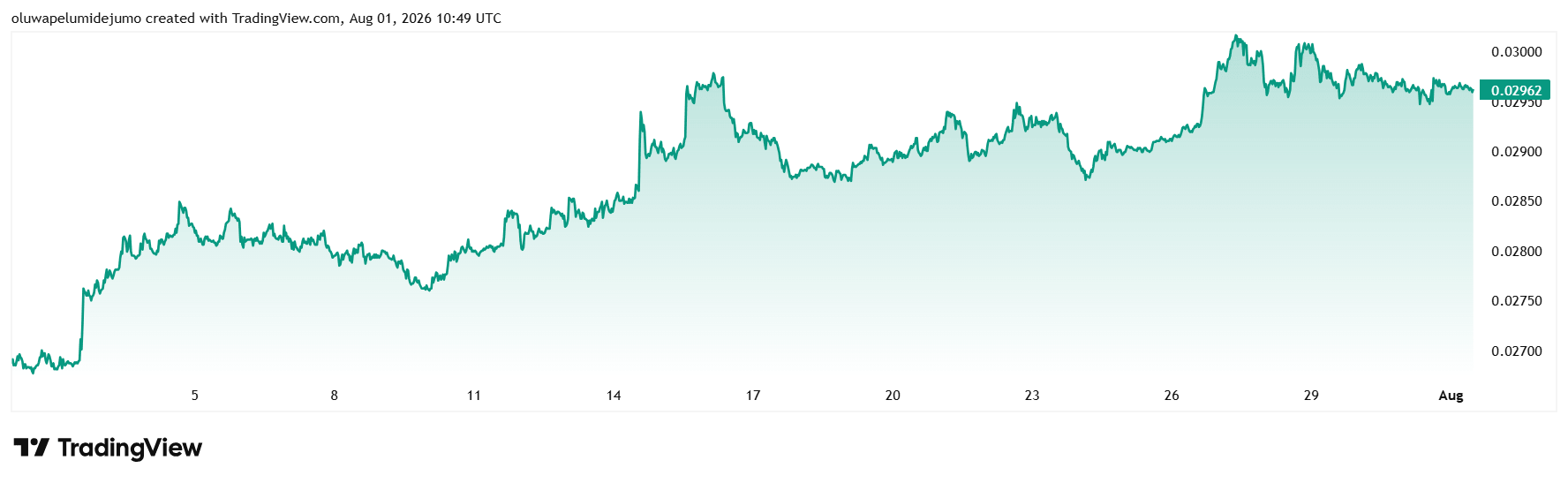
This performance gap has revitalized the ETH/BTC ratio, a key metric used by traders to gauge the relative strength of the two largest blockchain networks. The ratio ascended above 0.030 for the first time in a fiscal quarter, eventually easing to approximately 0.02962. This 10% appreciation in the pair’s value over a 30-day window reflects a widening advantage for Ethereum, suggesting that the "altcoin leader" is beginning to reclaim ground lost during a year-long period of Bitcoin dominance fueled by the latter’s early-year ETF approvals.
The July Momentum: A Chronology of Performance
The month of July began with a cautious atmosphere across the crypto sector, but the narrative quickly shifted as Ethereum-specific catalysts began to emerge. In the first week of the month, Ethereum maintained a steady floor near $1,600, while Bitcoin faced selling pressure from government-linked wallet movements and miner capitulation concerns. However, by the second week, the momentum shifted toward Ethereum as rumors—and later confirmation—of major banking institutions readying specialized investment products began to circulate.
By mid-month, the divergence became undeniable. While Bitcoin saw several "fake-outs" near the $64,000 and $65,000 marks, failing to sustain any breakout, Ethereum benefited from a "supply crunch" narrative. Corporate entities began reporting increased holdings, and the launch of new regulated products provided a gateway for sidelined capital. The final week of July saw Ethereum touch its monthly peak of $1,970, driven by a surge in spot demand that outweighed the typical end-of-month profit-taking.

Institutional Catalysts: The Rise of Ethereum ETFs
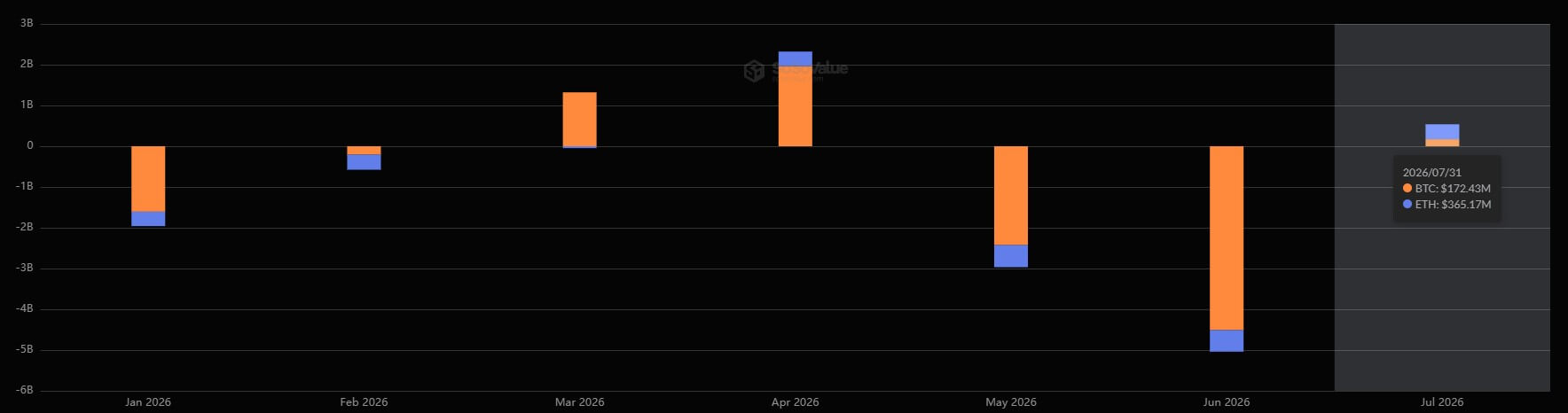
A primary driver of Ethereum’s July outperformance was the dramatic reversal in investment product flows. Data provided by SoSoValue indicates that U.S. spot Ethereum ETFs recorded net inflows of $365.17 million during July. This figure represents the strongest monthly performance for Ethereum-focused regulated funds in the current calendar year. The influx is particularly noteworthy because it follows a period of significant hardship; in the two months preceding July, Ethereum products had bled more than $1 billion in outflows as investors grew impatient with regulatory delays and market stagnation.
In contrast, Bitcoin ETFs, which had been the darlings of the institutional world since January 2024, saw their weakest monthly performance since their inception. Bitcoin-focused funds drew only $172.43 million in July, less than half of the capital captured by Ethereum. This suggests a tactical rotation among institutional desks, moving away from the "digital gold" narrative of Bitcoin to capture the potential "growth and utility" narrative associated with Ethereum’s smart-contract ecosystem.
The institutional landscape was further bolstered by the high-profile launch of the Morgan Stanley Ethereum Trust (MSSE). Although the fund accumulated a relatively modest $20 million in its initial days of trading, its strategic importance cannot be overstated. Morgan Stanley maintains a massive distribution network of approximately 16,000 financial advisers who oversee an estimated $7 trillion in client assets. The introduction of MSSE with a competitive 0.14% management fee has forced a repricing of risk and fees across the sector, making Ethereum more accessible to a conservative class of wealth-management clients who previously lacked direct exposure to the asset.
Corporate Treasury Strategies: BitMine vs. Strategy
The divergence in performance was also mirrored in the behavior of major corporate holders. Treasury management has become a significant factor in crypto price discovery, and July provided a clear look at two opposing philosophies.
BitMine, currently the world’s largest corporate holder of Ether, continued its aggressive accumulation strategy throughout July. While the company’s pace of buying showed signs of a slight deceleration compared to earlier in the year, it nevertheless increased its total holdings every single week of the month. BitMine’s balance rose from 5.70 million ETH at the end of June to 5.79 million ETH by July 26. This consistent "bid" in the market provided a strong support level for Ethereum, signaling to other corporate entities that the asset remains a viable long-term treasury reserve.
Conversely, the company known as Strategy—the largest corporate entity holding Bitcoin—chose to sit on the sidelines in July. Under the leadership of Michael Saylor, Strategy focused its efforts on shoring up cash reserves and supporting its preferred securities. This pause in accumulation followed a challenging period where the company faced an $8.2 billion loss, forcing a temporary halt to its recurring Bitcoin purchases. Without the consistent "Saylor bid" that has historically propped up Bitcoin during periods of weakness, the asset struggled to overcome technical resistance, allowing Ethereum to take the lead in market sentiment.
Technical Analysis and On-Chain Realities
Despite the bullish price action and inflow data, seasoned analysts remain cautious about declaring a permanent trend reversal. Technical indicators suggest that while July was a stellar month for Ethereum, the asset has not yet cleared the hurdles required for a structural "cycle bottom" against Bitcoin.
According to data from TradingView, the ETH/BTC ratio, while improving, remains roughly 13% lower on a year-to-date basis. More strikingly, the ratio is still 73% below the historic high of 0.11 reached in 2017. The current stabilization near 0.02963 is viewed by some as a "relief rally" from the multi-year lows of 0.028, rather than a confirmed breakout.
On-chain metrics provided by CryptoQuant further complicate the bullish narrative. The ETH/BTC Market-Value-to-Realized-Value (MVRV) ratio is a critical tool for identifying market extremes. This ratio has retreated from 0.95 in August 2025 to its current level of 0.65. While this decline shows that the "overvaluation" of Ethereum relative to Bitcoin has cooled, historical data suggests that true cyclical bottoms occur when the MVRV ratio drops below 0.45. This was the case during the major market pivots of 2019 and early 2025. Therefore, Ethereum may still need to undergo a period of "valuation compression" before a multi-year bull run can be sustained.
Furthermore, exchange flow data indicates an incomplete adjustment. The ratio of Ethereum-to-Bitcoin deposits on global trading platforms has dropped from 1.5 last August to approximately 0.8. A lower ratio typically indicates reduced selling pressure for Ethereum relative to Bitcoin. However, historical reversals have traditionally required this ratio to fall toward the 0.4 level. The current reading suggests that while the "panic selling" phase for Ethereum has ended, the market has not yet reached the "exhaustion" phase that typically precedes a massive upward move.
Broader Implications and Market Outlook
The events of July have sparked a wider debate about the "flippening"—the theoretical moment when Ethereum’s market capitalization might surpass Bitcoin’s. While that milestone remains distant, the current shift in capital flows highlights a growing sophistication among crypto investors.
The success of Ethereum in July is increasingly tied to its role as the foundational layer for decentralized finance (DeFi) and tokenization. As traditional financial institutions like Morgan Stanley and BlackRock explore the tokenization of real-world assets, Ethereum’s network utility provides a value proposition that is distinct from Bitcoin’s role as a store of value. This "utility premium" appears to be what attracted the $365 million in ETF inflows during a month when Bitcoin demand stalled.
Looking ahead, the sustainability of Ethereum’s advance will likely depend on two factors: continued institutional participation and the stabilization of the ETH/BTC ratio above the 0.030 mark. If Ethereum can convert its July momentum into a permanent support level, it may signal the end of the "Bitcoin-only" era of institutional crypto investment.
However, the shadow of Bitcoin’s $65,000 resistance remains. As the "tide that lifts all boats," a sustained failure by Bitcoin to break higher could eventually drag Ethereum back down, regardless of its relative strength. For now, the market is watching the 0.030 ETH/BTC level with intense scrutiny. A successful defense of this level, combined with further compression in MVRV and exchange deposit ratios, would provide the technical foundation needed for Ethereum to lead the market into the final quarter of the year.
In summary, July was a transformative month that saw Ethereum emerge from Bitcoin’s shadow. Driven by a combination of new institutional vehicles, consistent corporate buying from BitMine, and a cooling of previous sell pressure, the second-largest cryptocurrency has proven its resilience. While on-chain metrics suggest the bottom may not be fully in, the "relative advance" of Ethereum has fundamentally altered the market’s trajectory for the foreseeable future.