Lina Irawan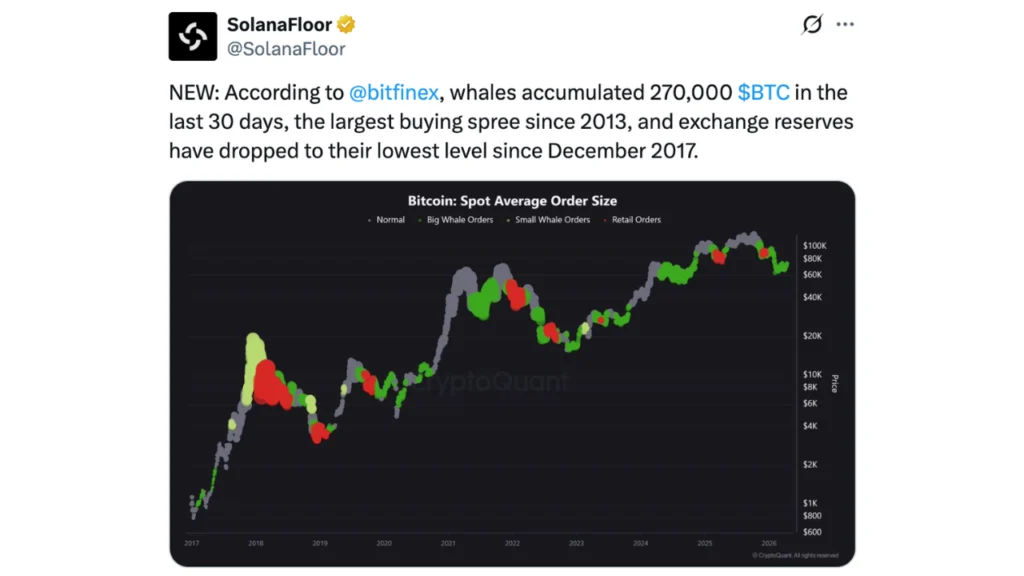
Bitcoin is once again poised at a pivotal juncture, trading in the mid-$70,000 range. While the surface may appear calm, beneath the veneer, significant structural shifts are rapidly reshaping the cryptocurrency’s market dynamics. A dramatic surge in accumulation by large-holder entities, coupled with a substantial decrease in Bitcoin reserves held on exchanges, has created a supply squeeze reminiscent of a decade ago. This confluence of factors has ignited fervent discussion among investors: will this tightening supply pave the way for a decisive breakout towards the $80,000 mark and beyond?
A Historic Wave of Whale Accumulation Signals Deepening Conviction
On-chain data has revealed an extraordinary trend: over the past 30 days, Bitcoin whales—defined as entities holding substantial quantities of BTC—have accumulated approximately 270,000 Bitcoin. This represents the most aggressive accumulation phase witnessed since 2013, a period that historically preceded one of Bitcoin’s earliest and most significant bull runs. The sheer volume, estimated to be worth around $23 billion at current market prices, is a signal that the market cannot afford to ignore.
This is not a fleeting anomaly or a mere opportunistic play. The sustained and deliberate nature of this repositioning of supply suggests a profound conviction among these large holders. In previous market cycles, spikes in whale activity could often be attributed to internal transfers or shifts in custodial arrangements. However, the persistence of this accumulation trend over an entire month imbues this signal with significant weight. It points to a strategic maneuver by major players, who appear to be positioning themselves ahead of a potential, and perhaps substantial, repricing event. This sustained buying pressure from significant market participants indicates a belief in Bitcoin’s long-term value proposition and its potential for future appreciation.
The image accompanying this development visually represents the scale of this accumulation. Whales have effectively "scooped up" a staggering 270,000 BTC in just 30 days, a $23 billion signal that underscores the magnitude of this buying spree. This data point, derived from on-chain analytics, provides concrete evidence of a significant shift in asset distribution.
Exchange Supply Vanishes, Amplifying Scarcity
Concurrently with this unprecedented whale accumulation, Bitcoin reserves held on cryptocurrency exchanges have plummeted to their lowest levels since December 2017. This metric is arguably more significant than immediate price action itself, as it directly impacts the immediate availability of Bitcoin for sale.
Coins held on exchanges are readily accessible and can be liquidated rapidly, representing liquid supply. Conversely, when large volumes of Bitcoin are moved off exchanges, often to be secured in cold storage or private wallets, it signifies a commitment to longer-term holding. This reduction in exchange reserves effectively shrinks the immediate sell-side liquidity within the market.
This creates a critical imbalance:

- Reduced Availability: Fewer Bitcoins are readily available for immediate sale on exchanges.
- Increased Holding Behavior: Large holders are demonstrating a preference for long-term accumulation rather than short-term trading.
- Potential for Volatility: A thinner order book environment, where even modest buying pressure can trigger outsized price movements, is created.
Historically, such conditions have preceded significant expansions in market volatility, not necessarily in an immediate fashion, but often explosively once a catalyst emerges. This vanishing exchange supply, coupled with active accumulation by whales, paints a picture of a market where available Bitcoin is becoming increasingly scarce.
The Supply Shock Narrative Gains Momentum
Bitcoin’s inherent scarcity, rooted in its fixed supply of 21 million coins, has always been a cornerstone of its value proposition. However, the current market structure is amplifying this scarcity in unprecedented ways. With over 20 million BTC already mined, the remaining supply is becoming progressively harder to obtain. The 2024 halving event further exacerbated this by reducing block rewards to just 3.125 BTC, significantly curtailing the rate at which new Bitcoin enters circulation.
Layering on top of these fundamental scarcity drivers are several additional factors:
- Reduced Issuance: The halving event has drastically slowed the introduction of new Bitcoin.
- Whale Accumulation: Large holders are actively removing Bitcoin from circulation.
- Exchange Reserve Depletion: The amount of Bitcoin readily available for sale on exchanges has reached multi-year lows.
- Increased Demand from ETFs: Spot Bitcoin Exchange-Traded Funds (ETFs) have introduced a new, institutional avenue for demand, further absorbing available supply.
This combination of factors suggests that the market is not merely experiencing a narrative of scarcity; it is undergoing a measurable supply shock in progress. Crucially, the market price has not yet fully reflected the extent of this tightening. Bitcoin is still trading approximately 40% below its all-time high near $126,000, a figure reached in March 2025. This divergence—tight supply dynamics juxtaposed with a price that has yet to fully reprice—represents a significant point of interest and potential opportunity, as well as risk, for investors.
The accompanying chart, illustrating "BTC: Shark Net Position Change," provides a visual representation of how different market participants, including whales (sharks), are altering their holdings. This data often serves as an indicator of sentiment and strategic positioning within the market.
Demand Shows Signs of Recovery, Albeit Unevenly
If supply is the coiled spring, then demand acts as the trigger for a significant price move. Recent data on Bitcoin Spot ETF flows indicates a market that is indeed recovering, but not without its inconsistencies. Periods of substantial inflows are interspersed with sudden outflows, a pattern that can be attributed to prevailing macroeconomic uncertainties and cautious investor positioning.
This unevenness in demand is a critical factor. A sustained rally towards the $80,000 level necessitates:
- Consistent ETF Inflows: Sustained institutional buying pressure is vital for driving prices higher.
- Retail Demand Re-engagement: Broader retail investor interest needs to return to complement institutional activity.
- Positive Macroeconomic Sentiment: A favorable global economic outlook can boost risk appetite for assets like Bitcoin.
Currently, demand is present but fragmented. This fragmentation is a key reason why Bitcoin has repeatedly encountered resistance in breaking cleanly above the $75,000-$76,000 zone. Sellers remain active in this range, even as the underlying supply continues to tighten, indicating a tug-of-war between buyers and sellers.

The "Total Bitcoin Spot ETF Net Inflow" chart from Coinglass offers a granular view of this demand dynamic. It visually depicts the ebb and flow of capital entering and exiting these newly established investment vehicles, providing insight into the strength and consistency of institutional demand.
Derivatives Markets Hint at a Potential Short Squeeze
Adding another layer of complexity to the market’s current state are signals emerging from the derivatives markets. Funding rates, which represent the cost of holding long or short positions, have turned negative. This means that traders holding short positions are paying those holding long positions. While typically indicative of bearish sentiment, negative funding rates often appear near local market bottoms.
The rationale behind this phenomenon is rooted in the potential for a short squeeze. When a significant number of traders establish short positions, they create a pool of liquidity that can be rapidly absorbed if the price begins to rise. If the price continues to climb, these short sellers are forced to close their positions by buying Bitcoin, thereby adding further fuel to the upward momentum.
Bitcoin has already demonstrated resilience by climbing from the low-$60,000 range to the mid-$70,000s while funding rates remained negative. This divergence suggests a market that is not yet overcrowded on the long side, indicating that there may be substantial room for further price appreciation without encountering excessive speculative froth.
The $80,000 Threshold: A Psychological and Structural Hurdle
The $80,000 level is more than just a round number; it represents a significant psychological and structural milestone for Bitcoin. It signifies:
- A New All-Time High: Breaking above this level would push Bitcoin into uncharted price territory, potentially igniting further FOMO (Fear Of Missing Out).
- Validation of Current Trends: A decisive move above $80,000 would validate the ongoing supply tightening and demand resurgence narratives.
- A Clear Path for Price Discovery: Beyond this level, the market structure becomes even more compelling, with limited nearby supply that could accelerate price discovery.
A decisive move above $75,500, particularly when accompanied by strong trading volume, appears to open a relatively clear path toward the $80,000-$80,600 range. Beyond this immediate target, the prospect of rapid price discovery becomes more pronounced due to the reduced availability of Bitcoin for sale.
The "Bitcoin 7D price chart" from Coinglass provides a visual representation of recent price action, highlighting key resistance and support levels, and offering context for the current trading environment.
Macroeconomic Factors Remain Paramount
Despite the bullish supply-side dynamics, it is crucial to acknowledge that Bitcoin does not operate in a vacuum. Broader macroeconomic factors continue to exert significant influence on its price movements. These include:

- Inflationary Pressures: Persistent inflation can drive investors towards hard assets like Bitcoin as a hedge.
- Interest Rate Policies: Central bank decisions on interest rates impact liquidity and risk appetite in financial markets.
- Geopolitical Stability: Global events and conflicts can trigger risk-off sentiment, leading to outflows from riskier assets.
- Regulatory Developments: Evolving regulations surrounding cryptocurrencies can create uncertainty or provide clarity, influencing investor confidence.
Recent market behavior has demonstrated that macroeconomic shocks can, and often do, override on-chain signals. For instance, periods of geopolitical stress have coincided with outflows from Bitcoin ETFs, illustrating how quickly sentiment can shift.
This creates a dual identity for Bitcoin:
- An Asset Driven by Scarcity: Its fundamental supply dynamics point towards long-term appreciation.
- A Risk-On Asset Influenced by Macro: Its price remains sensitive to broader economic and geopolitical conditions.
Until macroeconomic conditions stabilize and become more predictable, this inherent tension is likely to persist, creating periods of both opportunity and uncertainty.
Three Potential Scenarios Ahead
From the current vantage point, Bitcoin faces three realistic paths forward:
Bull Case: A sustained surge in ETF inflows, coupled with continued whale accumulation and a stable macroeconomic backdrop, would likely propel Bitcoin above the $75,500 resistance. This could trigger a rapid ascent towards $80,000 and potentially beyond, driven by increased demand and limited supply.
Neutral Case: If demand remains inconsistent, with fluctuating ETF inflows and cautious retail participation, Bitcoin may continue to trade within a range, potentially between $70,000 and $75,500. In this scenario, accumulation would continue beneath the surface, further tightening supply while price action remains relatively muted.
Bear Case: A significant macroeconomic shock or aggressive policy tightening by central banks could lead to a sharp decline in demand. Despite the tight supply, Bitcoin’s price might retest lower levels, potentially revisiting the $68,000-$70,000 range.
It is important to note that even the neutral case presents a structurally constructive outlook. The underlying supply compression does not disappear; it merely waits for a more opportune moment to influence price.

A Market Quietly Repricing Itself
Perhaps the most significant takeaway from the current market setup is not the specific $80,000 price target itself, but the underlying transformation of Bitcoin’s market structure. For months, price action has appeared relatively subdued, masking a profound redistribution of assets.
Beneath this surface calm, a significant shift is occurring:
- Concentration of Supply: Whales are consolidating their holdings, reducing the amount of Bitcoin readily available on the market.
- Long-Term Holding: Exchange reserves are dwindling, indicating a growing preference for holding rather than trading.
- Institutional Absorption: ETFs are consistently buying Bitcoin, creating a new and sustained source of demand.
This is the typical modus operandi of markets preparing for substantial moves—not with overt fanfare, but through quiet rebalancing and structural adjustments. The current environment suggests that Bitcoin is no longer operating in a loose, highly liquid market. Instead, it is functioning within a tightening system where supply is becoming increasingly inelastic.
In such systems, when demand eventually returns with conviction, price discovery does not merely drift higher; it reprices, often rapidly.
Conclusion: $80,000 is a Test, Not the Final Destination
Bitcoin’s push towards the $80,000 mark represents more than just a technical milestone; it serves as a critical test of the newly emerging market structure. If demand proves robust enough to absorb the remaining sell-side liquidity, the implications will extend far beyond this single price level. It would serve as definitive confirmation that the supply shock is real and that the next phase of Bitcoin’s market cycle has officially commenced.
Conversely, if demand falters and is unable to overcome the existing resistance, the market may continue to consolidate, allowing supply to tighten further in a more protracted manner.
Regardless of the immediate outcome, one truth is becoming increasingly evident: Bitcoin is no longer abundant where it matters most – on the open market. When supply diminishes significantly before price fully reflects this scarcity, historical precedent suggests that the subsequent price action is rarely subtle. The stage is set for a significant move, and investors are watching closely to see if the market will reprice itself to reflect the new reality of Bitcoin’s tightening supply.