James Watt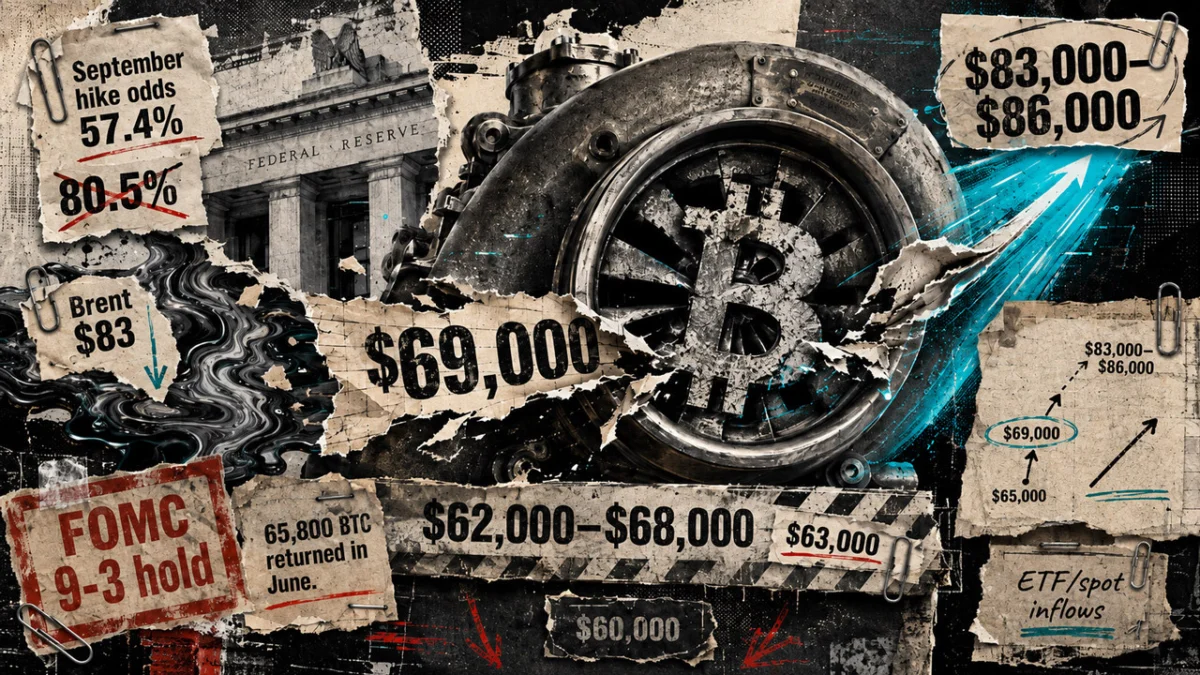
The global financial landscape is currently navigating a period of heightened volatility and shifting expectations, with Bitcoin at the center of a complex tug-of-war between macroeconomic pressures and internal market dynamics. On August 5, Bitcoin attempted a significant breakout, briefly surging above the $65,000 threshold. However, the move lacked the necessary momentum to sustain itself, as the cryptocurrency retreated back into a familiar trading range. This price action occurred against a backdrop of rapidly evolving sentiment regarding the Federal Reserve’s next moves. As of August 5, Fed funds futures indicated that the odds of a rate hike in September have plummeted to 57.4%, a sharp decline from the 80.5% probability recorded just one week prior.
This shift in interest rate expectations is being driven by a confluence of factors, including a notable cooling in energy markets and a series of mixed economic data points. Brent crude, the international benchmark for oil, fell more than 5% on August 4, settling near $79 per barrel. This decline was fueled by optimism surrounding a potential de-escalation deal regarding the Strait of Hormuz, a vital chokepoint for global energy supplies. Historically, lower interest rate hike probabilities and cheaper oil prices act as catalysts for risk assets by easing the macro-inflationary pressures that have capped Bitcoin’s growth throughout much of the year. Despite these favorable tailwinds, Bitcoin has remained tethered to a tight range between $62,000 and $68,000 for several weeks, leaving investors focused on the upcoming July employment report as the potential tie-breaker for the market’s next directional move.
The Federal Reserve’s Internal Divide and Shifting Hike Odds
While the market has significantly repriced the likelihood of a September rate hike, a tightening of monetary policy remains the base-case scenario, albeit by a narrow margin. Only seven days ago, the CME FedWatch Tool assigned a 22.9% probability to a half-point (50 basis points) hike in September, with a 57.6% probability for a quarter-point (25 basis points) increase. Collectively, these figures represented an 80.5% conviction that the Federal Open Market Committee (FOMC) would continue its tightening cycle.
In a dramatic shift, the scenario for a 50-basis-point hike has evaporated from the futures market entirely. The current 57.4% odds for a 25-basis-point hike suggest that while the central bank is still leaning toward tightening, the move is no longer viewed as a near-certainty. This uncertainty is mirrored within the FOMC itself. During the most recent meeting, the committee voted 9-3 to hold the target rate at 3.50% to 3.75%. Notably, three officials dissented in favor of an immediate quarter-point hike, signaling a hawkish undercurrent that persists despite signs of cooling inflation. The official FOMC statement characterized economic growth as "solid" and inflation as "elevated," providing little comfort to those hoping for an imminent pivot to a more accommodative stance.
Manufacturing and Services: A Tale of Two Economies
Recent economic indicators present a contradictory picture of the U.S. economy, complicating the Federal Reserve’s decision-making process. The Institute for Supply Management (ISM) reported that manufacturing activity accelerated to 55.6 in July, its strongest reading since May 2022. Within this report, production jumped to 58.5, and factory employment expanded for the first time in 33 months. However, the most concerning metric for the Fed remains the input price index, which held at an elevated 71.1, suggesting that inflationary pressures in the industrial sector are not yet fully contained.
Conversely, the services sector showed signs of resilience tempered by labor weakness. Services activity remained healthy with a reading of 54.1, and new orders climbed to 57.2. However, the employment component of the services PMI fell into contraction territory at 47.4. Despite the softening labor demand in services, prices in the sector reached 70.3, indicating that cost pressures remain "sticky" and are being passed through to consumers.
Labor market data from the Job Openings and Labor Turnover Survey (JOLTS) further illustrated a cooling trend. Openings hovered near 7.4 million, with hiring at approximately 5.3 million. While these figures suggest a gradual easing of the post-pandemic labor shortage, layoffs have held steady, preventing the kind of "weakness" that would force the Fed to abandon its hawkish stance. Inflation data offered a glimmer of hope as the June headline Personal Consumption Expenditures (PCE) price index fell 0.1% month-over-month, while core PCE rose a modest 0.1%. Nevertheless, the annual rates of 3.7% and 3.3%, respectively, remain well above the Federal Reserve’s 2% target.
The Strait of Hormuz and the Energy Inflation Factor
The geopolitical situation surrounding the Strait of Hormuz remains a critical variable for both global inflation and Bitcoin’s macro environment. Brent crude’s settlement near $83 on August 5 (following its dip to $79) reflects the market’s sensitivity to progress—or lack thereof—toward a de-escalation deal. While there have been reports of potential agreements to ensure safe passage, Iran has publicly denied that direct negotiations with the United States are underway.
The physical reality on the water remains stark. On August 4, only eight vessels transited the Strait of Hormuz, a massive decline from the 130 to 140 daily transits recorded before the current regional conflict escalated. A genuine reopening of this maritime corridor would likely lead to a sustained drop in energy prices, reducing headline inflation and giving U.S. Treasury yields room to fall. Conversely, if negotiations collapse and the "war premium" returns to oil prices, the Fed would have a renewed mandate to hike rates to combat the resulting inflationary spike, a scenario that would likely exert downward pressure on Bitcoin.
The Friday Jobs Report: A Make-or-Break Catalyst
The financial world is now bracing for the July Employment Situation report, scheduled for release on Friday at 8:30 a.m. ET. Economists are forecasting the addition of roughly 80,000 new jobs, an increase from June’s 57,000, with the unemployment rate expected to hold steady near 4.2%.
For Bitcoin bulls, the ideal outcome is a "Goldilocks" print: hiring that is moderate enough to show economic stability but soft enough to discourage further rate hikes. This would include stable unemployment and, crucially, softer wage growth. A "hot" report featuring strong hiring and accelerating wages would likely revive the case for a September hike, driving Treasury yields higher and Bitcoin lower. On the other hand, an excessively weak report could be double-edged. While it might eliminate the odds of a rate hike and cause a brief relief rally in Bitcoin as yields fall, it could eventually lead to a "growth shock" sell-off as investors begin to fear a looming recession.
On-Chain Analysis and Technical Support Shelves
Data from Glassnode provides a sobering perspective on Bitcoin’s recent performance. While traditional equities and gold reached record highs last week, Bitcoin effectively "sat out" the rally, trailing the S&P 500 by more than 4%. Glassnode’s Seller Exhaustion Constant has moved into a region historically associated with market bottoms, yet it remains roughly 33% above the absolute floors reached in previous bear cycles.
The demand for Bitcoin through U.S.-traded spot ETFs has also seen a significant cooling. In June, these ETFs saw a return of approximately 65,800 BTC, marking the worst month for the instruments since their inception. This outflow was not fully offset by corporate treasury buying, leaving the market without a strong "bid" to drive prices higher. Furthermore, options market data shows that implied volatility for the upside has fallen to approximately 23%, its lowest level in the current series. This suggests that traders are no longer willing to pay a premium for bullish bets, a sign of waning short-term confidence.
Technically, the $63,000 level represents the center of a massive "demand shelf." The range between $62,000 and $68,000 contains a higher concentration of supply (investor cost basis) than any other price band. For a structural change in the market to occur, Bitcoin must decisively reclaim $69,000—the Short-Term Holder Cost Basis. This is the level where recent buyers reach breakeven; moving above it would likely flip resistance into support and open the path toward the $83,000 to $86,000 range, where supply is significantly thinner.
Broader Economic Implications and the Path Ahead
The coming days will determine whether Bitcoin can break out of its multi-week stagnation or if it will succumb to the gravity of a "higher-for-longer" interest rate environment. The bull case requires a delicate alignment of factors: a moderate jobs report, softening wage growth, a decline in September hike odds to below 50%, and a normalization of traffic through the Strait of Hormuz. For this to translate into price action, the 10-year Treasury yield must fall below the 4.45% ceiling, providing the necessary "bond-market confirmation" for a risk-on rally.
Conversely, the bear case is built on the persistence of "sticky" inflation and a resilient labor market that forces the Fed’s hand. If Friday’s data exceeds expectations and oil prices rebound, the $62,000 support shelf will be put to a rigorous test. A failure to hold that level, especially if accompanied by increased exchange deposits and continued ETF outflows, would likely see Bitcoin revisit the $60,000 psychological floor.
As the market awaits Friday’s payroll data, the overarching narrative remains one of caution. While the macro pressures of high interest rates and expensive energy have eased slightly, they have not dissipated enough to trigger a definitive breakout. Bitcoin remains a captive of the Federal Reserve’s data-dependency, waiting for a clear signal that the cycle of tightening has truly reached its end.