James Watt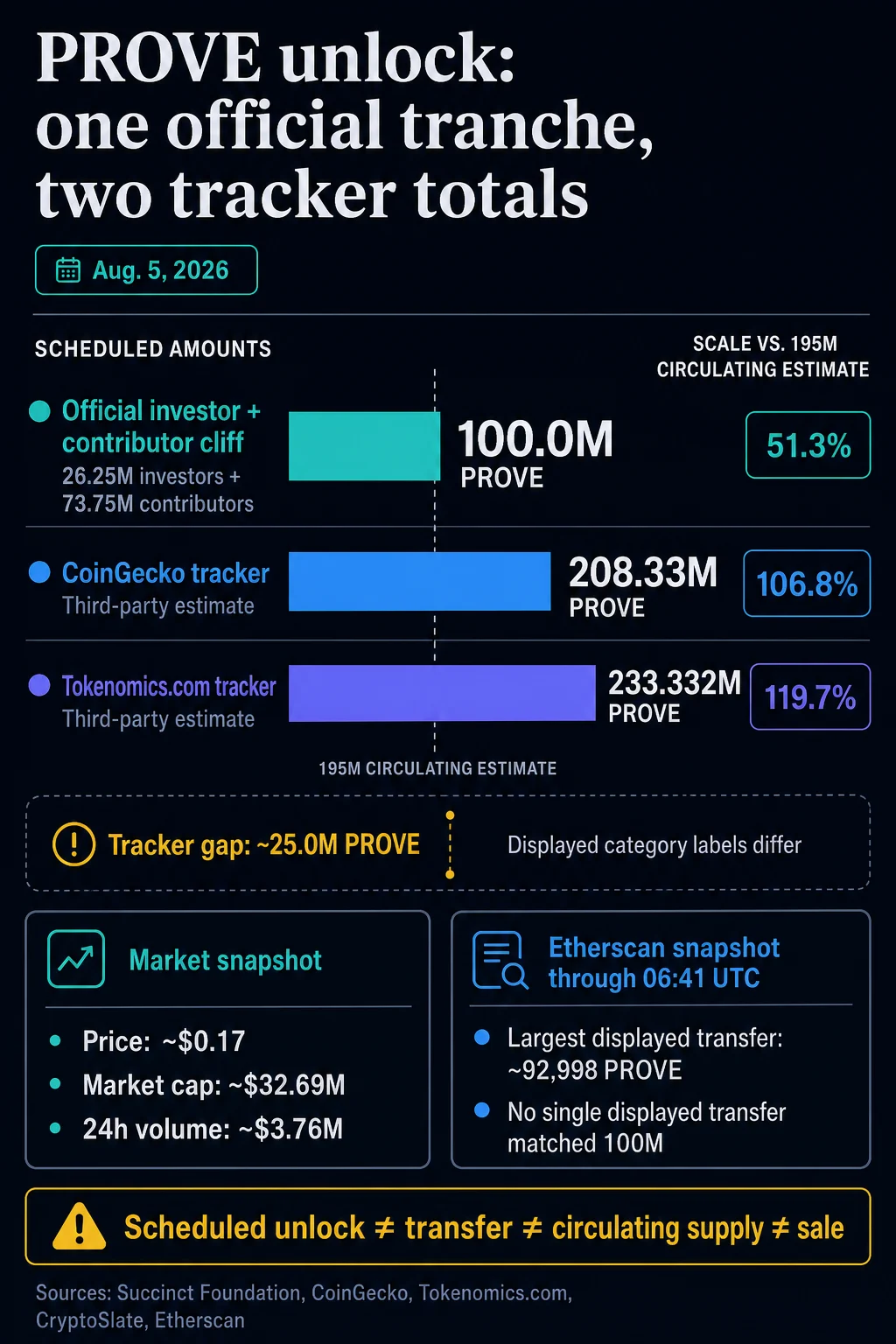
The PROVE token, which serves as the native utility and governance asset for the Succinct protocol, is currently navigating a precarious liquidity environment. According to the foundational terms established during the project’s inception, the 100 million tokens scheduled for release are allocated specifically to the "Investor" and "Contributor" tranches. This volume constitutes approximately 51.3% of the currently estimated circulating supply of 195 million tokens, effectively increasing the liquid float by more than half in a single day. For a digital asset with a relatively modest market capitalization, such a concentrated influx of supply poses a structural challenge to price stability.
Understanding the Succinct Tokenomics and Allocation Structure
To comprehend the scale of today’s unlock, it is necessary to examine the overarching tokenomics of the Succinct Foundation. The PROVE token has a fixed total supply of 1 billion units. Under the official documentation, the distribution is divided among several key stakeholders, with specific lock-up periods designed to align long-term incentives.
The two primary groups affected by the August 5 cliff are:
- Investors: This group was allocated 10.5% of the total supply, or 105 million tokens.
- Contributors: This group, which includes the core development team and early advisors, was allocated 29.5% of the total supply, or 295 million tokens.
The vesting schedule for both groups dictates a one-year cliff, after which 25% of their respective allocations become liquid. Consequently, 26.25 million investor tokens and 73.75 million contributor tokens—totaling 100 million—are being released today. The remaining 75% of these allocations are typically scheduled to vest linearly over the subsequent 36 months, ensuring that while today’s shock is significant, it is only the first of several phases of supply expansion.
Data Discrepancies and Market Transparency Challenges
A complicating factor in the PROVE unlock event is the lack of consensus among major cryptocurrency data aggregators. While the Succinct Foundation’s documentation provides a clear roadmap for the investor and contributor tranches, public trackers such as CoinGecko and Tokenomics.com report varying figures for the current circulating supply and the total number of tokens entering the market.
CoinGecko, utilizing data powered by the Tokenomist module, reported a circulating supply of 208.33 million PROVE tokens as of early August 5. Their breakdown includes 16.67 million tokens for public allocation and incentives, 8.33 million for the foundation treasury, and 83.33 million earmarked for ecosystem development and research.
Conversely, Tokenomics.com arrived at a higher figure of 233.332 million PROVE. The 25-million-token discrepancy between these two major platforms appears to stem from differing classifications of "public" versus "foundation" buckets. For instance, Tokenomics.com attributes approximately 33.33 million tokens to public investors, whereas CoinGecko’s estimate is nearly half that.

These inconsistencies create a "fog of war" for retail traders and institutional investors alike. When measured against CryptoSlate’s more conservative estimate of 195 million tokens in circulation, the tracker totals from CoinGecko and Tokenomics.com represent 106.8% and 119.7% of the expected float, respectively. Such variations in reported data can lead to mispriced risk, as the market struggles to determine the exact percentage of the supply that is truly liquid and available for trade.
The Liquidity Deficit: A $100 Million Pressure Point
The most pressing concern surrounding the August 5 unlock is the "razor-thin" liquidity available on centralized exchanges. Market depth—a measure of a market’s ability to sustain relatively large market orders without impacting the price—is currently at levels that suggest the market cannot absorb a fraction of the newly unlocked tokens without significant slippage.
As of 06:34 UTC on the day of the unlock, CoinGecko data for Binance’s PROVE/USDT pair showed a depth of only $102,821 within a 2% range above the current price, and $100,419 below it. Bybit, another primary venue for PROVE trading, showed even less resilience, with approximately $68,422 in depth above and $105,212 below the mid-price.
To put these numbers into perspective, if only 1% of the 100 million newly unlocked tokens (1 million PROVE) were sold at the current market price of roughly $0.17, it would represent a sell order of $170,000. On an exchange like Bybit, a single $170,000 sell order would exhaust the entire 2% buy-side depth, potentially triggering a cascading price drop. With 100 million tokens becoming available, the theoretical sell pressure is $17 million—a figure that dwarfs the combined depth of all major exchanges.
Chronology of the PROVE Token and the Path to the Cliff
The journey to today’s supply shock began in August 2025, following the successful launch of the Succinct protocol. Succinct gained traction in the blockchain industry by focusing on Zero-Knowledge (ZK) proof infrastructure, aiming to make ZK-proofs more accessible and efficient for developers.
- August 2025: The PROVE Token Generation Event (TGE) occurs. Initial circulating supply is limited to public sale participants and small ecosystem incentives to ensure a controlled launch.
- Late 2025 – Early 2026: Succinct expands its partnerships with various Layer 2 scaling solutions, increasing the utility of the PROVE token for proof-generation fees and governance.
- March 2026: The project hits a milestone of 1 million proofs generated, boosting the token price to a local high. However, the impending August cliff begins to weigh on long-term price projections.
- July 2026: Market volatility increases as the one-year anniversary of the TGE approaches. Trading volume rises as speculators position themselves for the unlock.
- August 5, 2026: The 12-month cliff expires. 100 million tokens are programmatically released from the vesting contracts.
On-Chain Observations and the "Silent" Unlock
Despite the massive theoretical release, on-chain data from Etherscan provides a more nuanced view of the actual movement of funds. As of 06:41 UTC on the day of the unlock, the largest visible transfer on the official PROVE smart contract was recorded at approximately 92,998 tokens. This figure is negligible compared to the 100 million tokens scheduled for release.
This lack of immediate, large-scale movement suggests several possibilities:
- Custodial Delays: Many institutional investors and contributors use third-party custodians or multi-sig wallets that may not execute transfers the second a cliff expires.
- Internal Vesting Structures: The tokens may have been "unlocked" within a vesting contract but not yet "claimed" by the beneficial owners.
- OTC Arrangements: Large holders may be seeking to sell their stakes through Over-The-Counter (OTC) desks to avoid the slippage associated with public exchanges, meaning the tokens would move in private transactions rather than hitting the Binance or Bybit order books.
- Long-Term Conviction: A portion of the contributors and investors may choose to hold or stake their tokens rather than selling, mitigating the immediate impact of the supply shock.
However, the absence of movement in the early hours of the unlock does not guarantee price safety. In many historical crypto unlocks, the downward price pressure manifests days or even weeks after the cliff as holders gradually distribute their positions.

Broader Implications for the Zero-Knowledge Proof Sector
The Succinct unlock event serves as a case study for the broader Zero-Knowledge (ZK) proof sector, which has seen a proliferation of new tokens over the past two years. As of August 2026, the global cryptocurrency market cap stands at $2.21 trillion, with Bitcoin dominance at 58.81%. Within this environment, mid-cap projects like Succinct are fighting for liquidity in a market that remains heavily concentrated in top-tier assets.
The "supply shock" phenomenon is a recurring theme in decentralized finance. When a project experiences a 51% increase in circulating supply, it tests the fundamental value proposition of the token. If the utility of PROVE—such as its role in the Succinct proof-aggregator or its governance rights—is perceived as valuable enough, the market may eventually absorb the supply. However, in the short term, the imbalance between supply and liquidity often leads to "vampire" trading strategies, where short-sellers target the asset in anticipation of the unlock.
Fact-Based Analysis of Market Preparedness
The data suggests that the market for PROVE was largely unprepared for the magnitude of this event. With a 24-hour trading volume of approximately $7.16 million—though up 89.53%—the asset remains relatively illiquid. The Fully Diluted Valuation (FDV) of PROVE stands at $158.52 million, while its actual market cap is only $30.91 million. This wide gap between the current market cap and the FDV is a classic indicator of "low float, high FDV" tokens, which are notoriously susceptible to drastic price corrections during unlock events.
Furthermore, the lack of official communication regarding the discrepancy in tracker data has not helped investor sentiment. While the Succinct Foundation has been transparent about the investor and contributor tranches, the "ecosystem and R&D" tokens mentioned by CoinGecko remain a point of ambiguity. If those tokens are also being moved or utilized for market-making, the actual liquid supply could be even higher than the reported 195 million.
Conclusion and Future Outlook
As the day progresses, the focus for PROVE holders will remain on wallet flows and exchange inflows. The calendar has set the date, and the smart contracts have executed the release. Now, the market must decide the price at which it is willing to absorb 100 million tokens.
The coming days will reveal whether Succinct’s backers are long-term believers or if the "razor-thin" liquidity will lead to a significant re-rating of the PROVE token’s value. For the broader industry, the PROVE unlock is a reminder of the critical importance of liquidity management and transparent tokenomics in an era where massive cliffs remain a standard feature of venture-backed blockchain projects. If Succinct can navigate this supply shock without a total collapse in price, it may set a positive precedent for other ZK-infrastructure projects facing similar milestones in late 2026. Conversely, a sharp decline would serve as a cautionary tale regarding the dangers of high-FDV token structures in a liquidity-constrained environment.