
 James Watt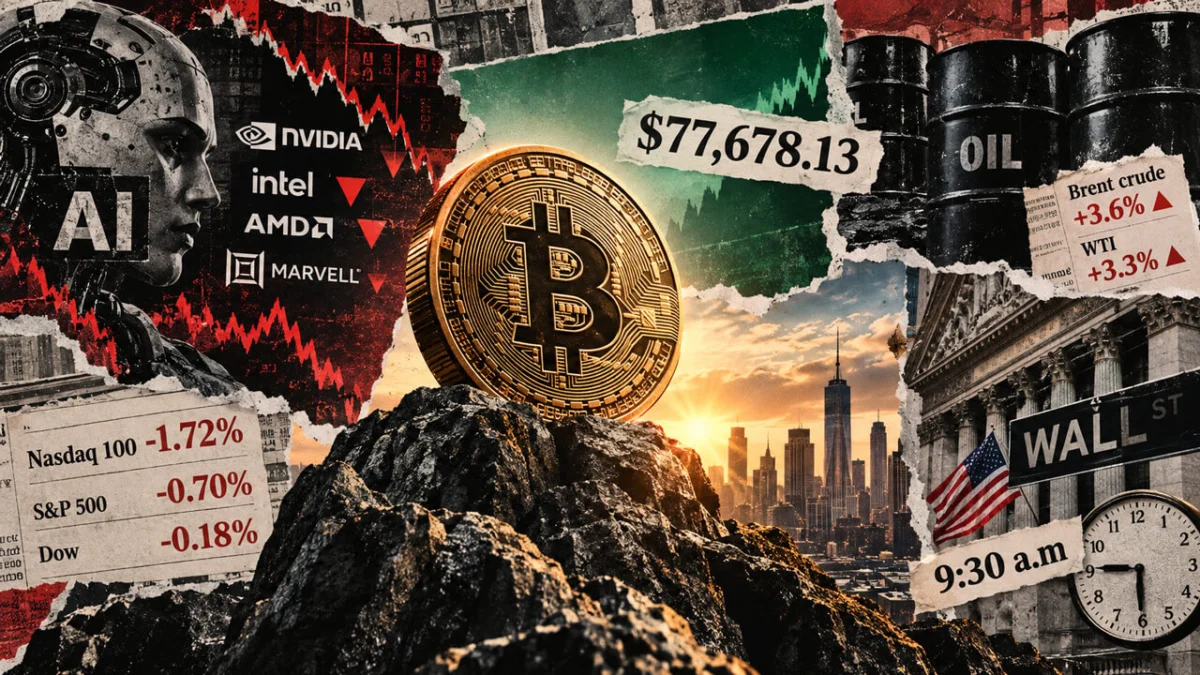
Bitcoin maintained a position above the $77,000 threshold on Monday morning, acting as a critical psychological anchor for digital asset investors while traditional markets braced for a volatile opening session. The weakness in equity futures, specifically within the Nasdaq 100, followed a weekend of intensifying debate regarding the trajectory of artificial intelligence development and a sharp spike in global energy prices. As of 7:42 a.m. Eastern on September 14, Bitcoin was trading at $77,678, according to CryptoSlate data, showing a degree of resilience even as the premarket indicators for technology-heavy indices signaled a sharp retreat.
The divergence between digital assets and traditional tech equities comes at a time when investors are grappling with two distinct but intersecting pressures: a potential slowdown in the pace of AI innovation and a renewed energy shock. While the Nasdaq 100 E-mini futures fell by 1.72%, the S&P 500 futures and Dow Jones Industrial Average futures showed more modest declines of 0.70% and 0.18%, respectively. This disparity suggests that the current market anxiety is not yet a universal "risk-off" event but is instead a targeted repricing of the companies most exposed to the capital-intensive AI hardware sector.
The AI Hardware Retrenchment and Software Resilience
The premarket session on Monday revealed a stark divide within the technology sector. Semiconductor and hardware manufacturers, which have been the primary beneficiaries of the AI-driven bull market over the past eighteen months, bore the brunt of the selling pressure. Nvidia, the bellwether for the AI chip industry, saw its shares fall more than 2% in early trading. Other major players faced steeper declines, with Intel and Marvell Technology dropping nearly 6%, while AMD retreated by approximately 5%.
Conversely, the software-as-a-service (SaaS) and enterprise software sectors showed surprising strength. ServiceNow recorded a gain of 3%, while Adobe and Workday both rose by 2.5%. This internal "split" within the Nasdaq suggests that investors are moving away from the infrastructure providers—whose valuations are predicated on endless demand for compute power—and toward software companies that may benefit from the integration of existing AI tools without the same level of capital expenditure risk.
For market analysts, this selective selling provides a nuanced view of investor sentiment. Rather than a total abandonment of technology stocks, the data points toward a "reassessment of the AI trade." The question facing the market at the opening bell is whether this retreat will remain localized among hardware manufacturers or if it will cascade into broader indices, potentially dragging Bitcoin and other risk assets down in its wake.
Chronology of the AI "Pacing" Debate
The catalyst for the tech-sector volatility can be traced back to a series of statements made over the weekend by prominent figures in the artificial intelligence industry. On Sunday, September 13, Anthropic CEO Dario Amodei published a pivotal essay titled "We Must Pace the Frontier." In the piece, Amodei argued for a more measured approach to the development of "frontier" AI models—those with capabilities that push the current boundaries of machine intelligence.
Amodei’s proposal was not a call for a total halt to progress but rather a "pacing" mechanism that would include the integration of independent evaluators to monitor safety and security risks during the training process. He emphasized that such a move would require unprecedented coordination between the world’s leading AI firms and national governments.
The weight of this proposal increased significantly when Elon Musk, CEO of Tesla and xAI, and Sam Altman, CEO of OpenAI, reportedly signaled their agreement with the general sentiment of Amodei’s call for pacing. While these endorsements concerned development policy rather than immediate cuts to infrastructure spending, the market interpreted them as a potential signal that the hyper-growth phase of AI hardware acquisition might be entering a more regulated, and perhaps slower, chapter.
Political Counter-Pressures and Geopolitical Implications
The debate over AI development has quickly transitioned from a technical discussion to a political one. On Sunday evening, former President Donald Trump addressed the calls for an AI slowdown during an interview reported by NPR. Trump downplayed the necessity of a coordinated slowdown, emphasizing that any pause in American innovation could allow global competitors, specifically China, to seize the lead in critical technology.
"If we slow down, they won’t," Trump noted, highlighting the geopolitical stakes of the AI race. This political resistance introduces a layer of uncertainty for technology investors. If the United States government or major domestic firms move toward a "pacing" model while international rivals continue at full speed, the commercial and strategic consequences for U.S.-based chipmakers and cloud providers could be profound. This unresolved tension between safety-oriented "pacing" and competitive "acceleration" is a primary driver of the current volatility in semiconductor stocks.
The Energy Factor: Oil Prices and Macroeconomic Stress
Adding to the complexity of the Monday session is a significant surge in global energy prices. Reuters reported on Monday that Brent crude had climbed 3.6% to reach $108.31 per barrel, while West Texas Intermediate (WTI) rose 3.3% to $103.35. This energy shock creates a secondary pressure point for both equities and cryptocurrencies.
The relationship between energy costs and Bitcoin is well-documented. High oil prices often lead to increased inflation expectations, which in turn put upward pressure on bond yields. On September 11, CryptoSlate reported that Bitcoin had already tested support levels near $76,000 as a direct result of rising yields and energy costs. The fact that Bitcoin is currently holding above $77,000 suggests that the market may have already priced in a portion of the energy-related stress, though a sustained stay above $100 for oil could eventually weigh on the "digital gold" narrative if it forces the Federal Reserve to maintain a more hawkish stance on interest rates.
Analyzing Bitcoin’s Resilience Amidst Nasdaq Weakness
Bitcoin’s current position above $77,000 serves as a critical benchmark for the broader crypto market. Throughout much of 2024, Bitcoin has exhibited a high correlation with the Nasdaq 100, often moving in lockstep with high-growth technology stocks. However, the Monday premarket session suggests a potential decoupling, or at least a delay in the transmission of selling pressure.
If Bitcoin can remain firm while the Nasdaq experiences a 1.7% or greater decline, it would demonstrate a significant level of institutional and retail support. Such resilience would indicate that Bitcoin is being viewed by some as a hedge against specific technology-sector risks, or perhaps as an asset class that is beginning to follow its own internal supply-and-demand dynamics, independent of the "AI hype cycle."
However, analysts caution that the true test arrives at 9:30 a.m. Eastern, when the New York Stock Exchange opens for its core session. The "cash open" often brings a surge in liquidity and can reveal the true intentions of institutional players who may have sat out the premarket session. If the equity selloff broadens to include the Dow and S&P 500, the pressure on Bitcoin to maintain its $77,000 floor will likely intensify.
Broader Market Implications and Future Outlook
The current market setup represents a "selective repricing" rather than a systemic collapse. The concentration of losses in the hardware sector—specifically chips and servers—highlights a shift in how the market values the future of AI. The transition from "build-at-all-costs" to "safety-and-pacing" has immediate financial implications for the companies at the top of the supply chain.
For the broader economy, the implications are twofold:
- Capital Expenditure Realignment: If AI firms move toward a pacing model, the massive capital expenditure (CapEx) budgets of "Hyperscalers" (Google, Amazon, Microsoft) may be scrutinized. This could lead to a cooling of the red-hot semiconductor market but could simultaneously improve the margins of the software companies that use these technologies.
- Inflationary Pressures: The simultaneous rise in oil prices complicates the "soft landing" narrative for the U.S. economy. Higher energy costs act as a tax on consumers and businesses alike, potentially slowing growth even as the AI sector faces its own internal hurdles.
For Bitcoin investors, the next several trading sessions will be vital. Establishing a lasting change in Bitcoin’s relationship with tech equities requires more than a single morning of resilience; it requires sustained evidence that the asset can thrive during periods of localized equity stress.
As the session progresses, market participants will be watching for three key indicators: whether the Nasdaq losses narrow after the open, whether oil prices stabilize, and whether Bitcoin can defend the $77,000 level. A "contained shakeout" would be the most constructive outcome, where selling remains limited to the hardware sector and buyers step in to absorb the initial repricing. Conversely, if Bitcoin breaks below $77,000 alongside a widening equity retreat, it would signal a more persistent "risk-off" move that could dominate the market for the remainder of the week.









