admin
admin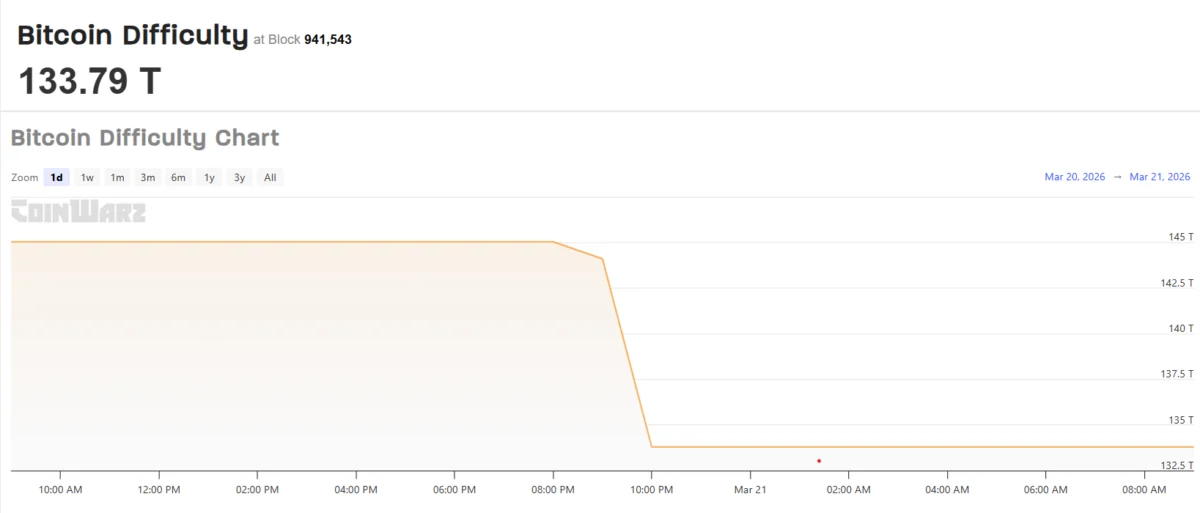
The Bitcoin network underwent a significant downward difficulty adjustment on March 20, marking a 7.7% decrease that brought the metric to 133.79 trillion at block height 941,472. According to data provided by CoinWarz and CloverPool, this represents the sharpest contraction in mining difficulty since February, reflecting a period of reduced computational activity on the world’s largest decentralized ledger. This adjustment serves as a critical rebalancing mechanism for the network, ensuring that the issuance of new Bitcoin remains consistent despite fluctuations in the total amount of hardware dedicated to securing the blockchain.
The reduction follows a period where the network struggled to maintain its target block time of 10 minutes. In the 2,016 blocks leading up to the adjustment, average block production slowed significantly, with data from CloverPool indicating an average time of approximately 12 minutes and 36 seconds per block. This discrepancy prompted the protocol’s automated algorithm to lower the difficulty threshold, effectively making it easier for the remaining miners to find valid hashes and earn block rewards. For firms that have managed to remain operational during this period, the 7.7% drop offers a slight reprieve in the form of improved revenue per unit of hashrate, as less electrical power and computational work are now required to achieve the same output.
Historical Context and Recent Volatility
The journey to the current difficulty level of 133.79 trillion has been characterized by notable volatility throughout the first quarter of the year. At the start of 2024, Bitcoin’s mining difficulty sat at approximately 148 trillion, driven by a surge in hashrate as new, more efficient application-specific integrated circuits (ASICs) were deployed globally. By mid-March, this figure had moderated to around 145 trillion before the most recent slide.
This is not the first major disruption the network has faced this year. In February, the mining industry experienced a sharp drop in difficulty following severe weather-related disruptions in the United States. During that period, extreme winter conditions forced several large-scale American mining facilities—particularly those located in Texas—to curtail their power usage or shut down entirely to support the stability of the local electrical grid. As these facilities went offline, the network’s total hashrate plummeted, leading to a subsequent difficulty drop. Once weather conditions normalized and power was restored, the hashrate surged back, resulting in a 15% rebound in difficulty. The current 7.7% drop suggests a different set of pressures, likely tied to economic factors and a strategic shift in how large-scale data centers allocate their energy resources.
The Mechanics of the Difficulty Adjustment
Bitcoin’s difficulty adjustment is a foundational component of Satoshi Nakamoto’s original design, intended to regulate the supply of the digital asset. The protocol is programmed to adjust the difficulty every 2,016 blocks, a cycle that typically takes about two weeks. The goal is to ensure that, on average, one block is added to the blockchain every 10 minutes.
When the aggregate hashrate of the network increases—meaning more miners are competing or hardware is becoming more powerful—blocks are found faster than the 10-minute target. To compensate, the network increases the difficulty. Conversely, when miners exit the network or shut down machines, block times slow down, and the network responds by lowering the difficulty. This self-correcting mechanism ensures that Bitcoin’s total supply of 21 million coins is released at a predictable rate, regardless of the technological or economic environment surrounding the mining industry.
The recent slowdown to 12 minutes and 36 seconds per block is a clear indicator of a "hashrate retreat." This occurs when a substantial portion of the network’s computing power is withdrawn, either due to hardware failure, operational costs exceeding revenue, or the intentional migration of energy to other sectors.
The Competitive Threat of Artificial Intelligence
A burgeoning trend within the infrastructure sector is the increasing competition between Bitcoin mining and the burgeoning field of Artificial Intelligence (AI). As the demand for generative AI and high-performance computing (HPC) continues to skyrocket, the data center capacity and electrical power previously reserved for Bitcoin mining are being re-evaluated.

Industry analysts and market participants have noted that AI and Bitcoin mining are now competing for the same fundamental resources: high-voltage power interconnections and advanced cooling infrastructure. Crypto trader Ran Neuner recently highlighted this tension, suggesting that the profitability and demand for AI-driven workloads are beginning to overshadow the incentives of cryptocurrency mining. Neuner’s assertion that "AI has killed Bitcoin forever" may be a hyperbolic assessment of the industry’s end, but it underscores a very real shift in the capital expenditure strategies of major mining firms.
Publicly traded mining companies have increasingly sought to diversify their revenue streams by pivoting toward AI infrastructure. This transition is driven by the search for steadier, long-term returns compared to the volatile nature of Bitcoin rewards.
- Core Scientific: Recently secured a significant credit facility from Morgan Stanley to develop data center capacity specifically for AI and HPC workloads.
- MARA Holdings: Formerly known primarily as a pure-play Bitcoin miner, the company has faced quarterly losses and is exploring broader digital infrastructure opportunities.
- Hut 8: The company reported a substantial loss recently, largely attributed to its pivot toward a $7 billion AI data center lease, signaling a clear move away from a 100% reliance on Bitcoin mining.
- Cipher Mining: Has been active in acquiring power market sites in regions like Ohio, with an eye toward multi-purpose data center development that can accommodate various computational needs beyond SHA-256 mining.
Corporate Financial Pressures and Asset Liquidations
The economic pressure on miners is further evidenced by recent moves from major players to shore up their balance sheets. Bitdeer, a prominent player in the space, recently made headlines by liquidating its entire Bitcoin treasury. On February 21, the company sold 943 BTC and has since continued to sell newly mined coins rather than holding them as "HODL" assets. As of its latest update on March 21, Bitdeer confirmed that its corporate Bitcoin holdings remained at zero.
This strategy reflects a growing need for liquidity in an environment where operational costs—specifically electricity and hardware maintenance—are surging. For many firms, the cost of mining a single Bitcoin has begun to approach or exceed the market price of the asset, particularly for those using older, less efficient mining rigs. When profitability tightens, operators are forced to shut down these "legacy" machines, leading to the decline in hashrate that triggers difficulty drops like the one seen on March 20.
The financial strain is not limited to smaller operators. Cango, another entity involved in the sector, reported a $285 million loss in the fourth quarter, citing surging mining costs as a primary factor. These losses suggest that the "arms race" for hashrate has reached a point where only the most efficient and well-capitalized firms can maintain a positive margin.
Implications for Network Security and Future Projections
From a network health perspective, a 7.7% drop in difficulty does not pose an immediate threat to Bitcoin’s security. The network remains the most secure decentralized computer network in the world, with a hashrate that is still significantly higher than it was in previous years. However, the drop does indicate a period of transition.
The immediate impact of the March 20 adjustment is a "reset" for the mining ecosystem. With a lower difficulty, the "hashprice"—a measure of expected revenue from a given unit of hashrate—effectively increases for the miners who stayed online. This can provide a temporary buffer for struggling firms, allowing them to remain operational while they wait for either a rise in Bitcoin’s market price or a further cooling of energy costs.
Looking ahead, the next difficulty adjustment is currently estimated to occur on April 3. However, this projection is highly dynamic. If the 7.7% reduction successfully incentivizes miners to turn their machines back on, block times will accelerate, potentially leading to an upward adjustment in the next cycle. Conversely, if the migration toward AI and HPC continues at its current pace, the network may see a prolonged period of stagnant or declining difficulty.
The broader implication for the Bitcoin ecosystem is a maturing of the "industrial" phase of mining. The days of small-scale enthusiasts dominating the hashrate are long gone, replaced by multi-billion-dollar corporations that must answer to shareholders and navigate complex energy markets. As these firms weigh the rewards of securing a global monetary network against the lucrative contracts offered by the AI revolution, the Bitcoin network’s difficulty algorithm remains the ultimate arbiter, silently adjusting the math to ensure the ledger continues to tick forward, one block at least every ten minutes.