admin
admin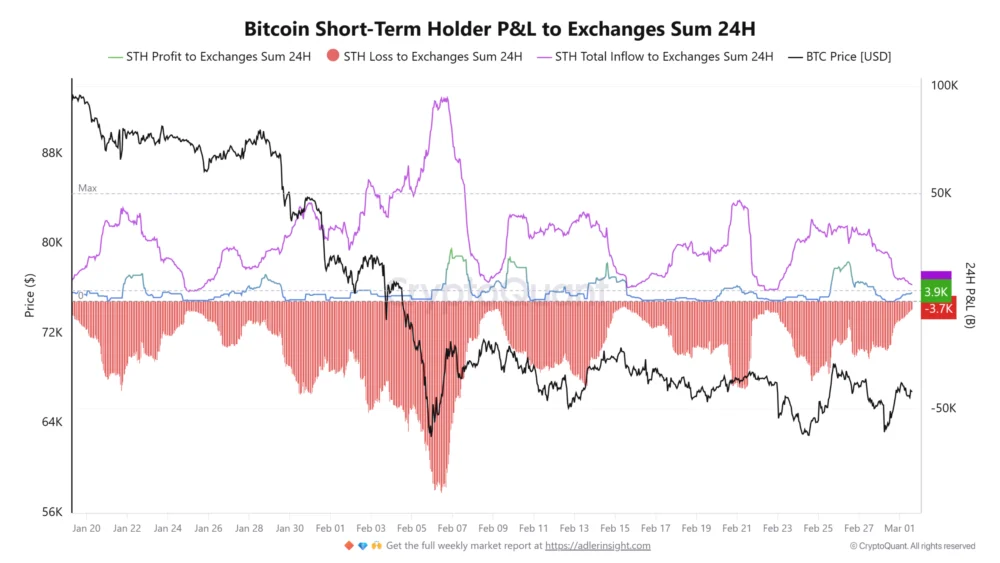
The digital asset market witnessed a significant resurgence on Monday as Bitcoin (BTC) reclaimed the $70,000 price level, navigating a complex landscape of escalating geopolitical friction in the Middle East and shifting internal market dynamics. Despite the looming threat of expanded conflict between the United States and Iran, on-chain data indicates that the aggressive selling pressure characterized by short-term traders has reached a notable exhaustion point. According to metrics provided by Glassnode and CryptoQuant, the volume of Bitcoin being transferred to exchanges at a loss by short-term holders (STHs) has plummeted to a two-week low, signaling a transition from panic-driven distribution to a more stabilized holding pattern. This cooling of sell-side pressure stands in stark contrast to the massive capitulation events observed earlier in the quarter, suggesting that the current investor base may be growing more desensitized to external macro-volatility.
Resilience in the Face of Geopolitical Uncertainty
The recent price action unfolded against a backdrop of increasing military and diplomatic tensions in the Middle East. Historically, such events trigger a "risk-off" sentiment in traditional markets, often leading to a temporary retreat in speculative assets. However, Bitcoin’s climb to $70,000 suggests a decoupling from traditional risk-asset narratives, or perhaps a reinforcement of its role as a decentralized hedge. While Bitcoin briefly dipped to the $63,000 range during the peak of the recent geopolitical headlines, exchange inflows from short-term participants did not surge. This lack of a reactionary sell-off is a critical indicator of market maturity.

On March 1, realized losses among short-term holders—those who have held their coins for less than 155 days—fell to approximately 3,700 BTC. This figure is statistically insignificant when compared to the capitulation window of February 5–6, during which this same cohort liquidated a staggering 89,000 BTC at a loss within a single 24-hour period. The compression of these loss-driven inflows indicates that the "weak hands" have largely been flushed out of the system, leaving behind a more resilient class of buyers who are less inclined to blink in the face of negative news cycles. Analysts have described this phenomenon as "zero panic," noting that even as the shadow of war looms, the most event-sensitive market participants have chosen to hold their positions rather than seek the perceived safety of fiat currency.
A Chronology of Market Deleveraging
The path to $70,000 was paved by a significant period of deleveraging within the cryptocurrency derivatives market. Throughout the early months of the year, high leverage often led to "long squeezes," where small price drops triggered cascades of liquidations. However, recent data from Binance, the world’s largest cryptocurrency exchange by volume, shows a healthy contraction in speculative positioning. Since the start of the year, Binance’s open interest has declined from 130,800 BTC to 97,680 BTC, representing a 25% reduction in active futures contracts.
This deleveraging process is further evidenced by the estimated leverage ratio, which measures the ratio of open interest to the total Bitcoin reserves held on exchanges. This ratio recently touched a weekly average of 0.146. In the context of the current market cycle, levels falling below the 0.15 threshold have historically served as a precursor to aggressive and sustainable price expansions. By flushing out excessive leverage, the market reduces the risk of sudden, volatility-induced crashes, allowing for a more organic, spot-driven price discovery process.

Technical Foundations and the Role of RVWAP
From a technical perspective, the ability of Bitcoin to maintain its momentum above the $68,000 mark has been instrumental in shifting market sentiment. Analysts are closely watching the Monthly Realized Volume-Weighted Average Price (RVWAP), which currently sits in the high-$68,000 region. The RVWAP is a sophisticated metric that anchors the average price paid for Bitcoin to the start of the calendar month, weighted by the volume of trades at each price point.
Trading above the Monthly RVWAP is a psychological and technical milestone, as it signifies that the average participant who entered the market this month is now in a profitable position. When the price sustains itself above this anchor, it typically shifts the short-term positioning bias from bearish to bullish, as traders are less likely to sell when "in the green." The successful reclamation of $70,000 has turned this previous resistance into a potential support zone, providing a launchpad for further testing of all-time highs.
Spot Flow Dynamics: The Return of Aggressive Bidding
Unlike previous rallies that were often driven by futures and perpetual swaps, the current move toward $70,000 appears to be underpinned by robust spot market demand. Spot flow data across major global exchanges shows a consistently positive delta, indicating that buyers are aggressively hitting the "ask" side of the order book. During the recent breakout leg, Binance spot markets recorded approximately $7.79 million in positive delta. This was mirrored by Coinbase, which contributed $1.16 million, and OKX, which saw nearly $3.7 million in positive delta.

This synchronized bidding across geographically diverse exchanges suggests a broad-based institutional and retail appetite. When spot buying outpaces derivatives-driven speculation, the resulting price moves tend to be more durable. The market’s attention is now focused on a critical "external liquidity pocket" situated between $70,000 and $71,500. This range contains a high concentration of low-leverage liquidation clusters. If Bitcoin can successfully convert this $71,500 level into support, analysts anticipate a rapid expansion toward the $80,000 region, where historical supply has previously capped upside potential.
Institutional Confidence and Macro Implications
The narrative of Bitcoin as a core institutional asset was further reinforced by the recent actions of MicroStrategy. The firm, led by Michael Saylor, announced its 101st Bitcoin purchase, acquiring an additional $204 million worth of the asset. This continued institutional accumulation serves as a signal to the broader market that long-term conviction remains unshaken by short-term geopolitical or economic headwinds.
However, the road ahead is not without obstacles. Market participants remain wary of the potential impact of rising energy costs. With oil prices flirting with the $100 per barrel mark due to Middle Eastern instability, there are concerns regarding the inflationary impact on global economies. High energy prices typically lead to a stronger U.S. Dollar, which has historically acted as a headwind for Bitcoin. Nevertheless, the "digital gold" thesis is being tested in real-time. If Bitcoin continues to rise while traditional risk assets falter under the weight of high oil prices and geopolitical strife, it could solidify its status as a premier alternative store of value.

Broader Impact and Market Outlook
The cooling of short-term holder selling pressure marks a pivotal moment in the current market cycle. It suggests that the speculative "froth" has been removed, and the current price levels are being supported by a more committed investor base. The combination of reduced leverage, strong spot demand, and institutional accumulation creates a favorable environment for price appreciation.
As the market enters the mid-point of the year, the focus will remain on the sustainability of these spot inflows. Should the geopolitical situation stabilize, the reduction in the "uncertainty premium" could lead to a significant re-rating of digital assets. Conversely, if tensions escalate further, the market will look to see if Bitcoin can maintain its newfound resilience. For now, the "zero panic" exhibited by short-term holders provides a strong foundation for the $70,000 level. With liquidity pools above $71,500 acting as magnets for price action, the technical and fundamental stars appear to be aligning for a continued push into uncharted territory.
The shift from a derivatives-dominated market to one led by spot accumulation is a sign of a maturing ecosystem. Investors are no longer merely gambling on price fluctuations but are increasingly viewing Bitcoin as a necessary component of a modern, diversified portfolio. As long as realized losses remain contained and the deleveraging trend continues, the path of least resistance for Bitcoin appears to be upward, with the $80,000 milestone now firmly within the market’s sights.