Lina Irawan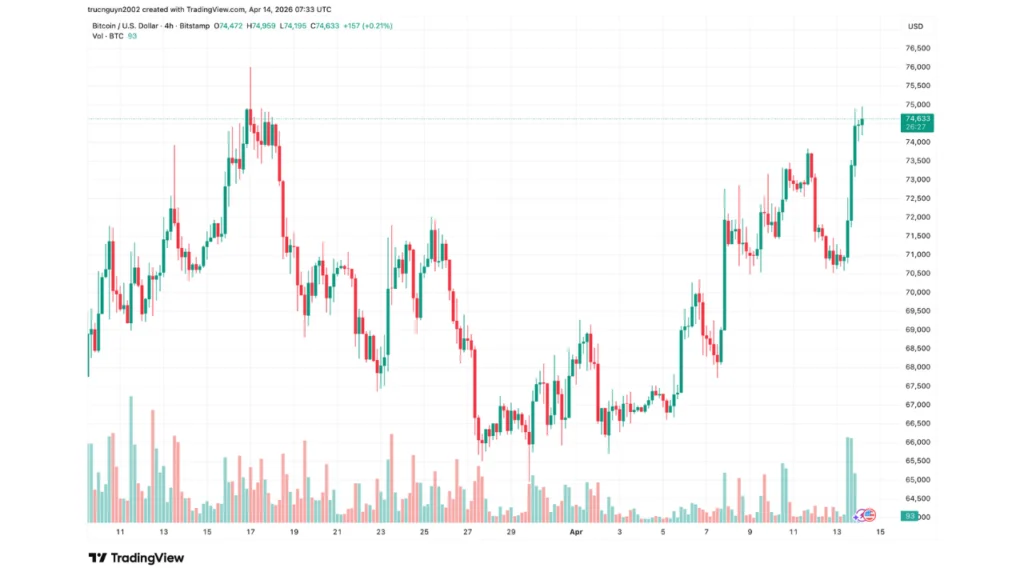
Bitcoin experienced a dramatic intraday surge on April 14th, climbing back towards the $74,900 mark and surprising many traders who had anticipated a deeper market correction. This powerful rebound followed a sharp weekend sell-off, which had been fueled by escalating geopolitical tensions in the Middle East, specifically the U.S.-led naval blockade targeting Iranian-linked shipping activities in the Strait of Hormuz. Contrary to initial market expectations, Bitcoin not only reversed its losses but staged a rapid and high-conviction ascent, demonstrating a significant shift in market sentiment driven by tangible macroeconomic recalibrations and strategic positioning dynamics.
Hours prior to the rebound, the cryptocurrency market had been bracing for a potential downturn. The news of increased naval presence and targeted sanctions in the Strait of Hormuz, a critical artery for global energy supply, had sent ripples of concern through financial markets. The potential for significant disruption to oil flows raised fears of renewed inflation spikes, which would typically pressure central banks to maintain or even increase interest rates. This scenario is historically bearish for risk assets, including cryptocurrencies. Bitcoin, after dipping to a low of $70,741, managed to reclaim over $4,000 in a matter of hours, stabilizing in the $74,200-$74,700 range. This swift recovery was not merely speculative; it was underpinned by a confluence of three key factors: a pullback in oil prices below the psychologically significant $100 per barrel mark, the realization that the U.S.-led blockade was proving less disruptive than initially feared, and the market’s prior pricing-in of downside risk from the geopolitical developments. These elements coalesced to create fertile ground for a sharp rebound, which was further amplified by a potent short squeeze in the derivatives market.
A Swift Macroeconomic Repricing, Not a Random Rally
To fully comprehend the factors driving Bitcoin’s upward trajectory on April 14th, it is crucial to examine the rapid evolution of market narratives over the preceding weekend. Markets had initially reacted negatively to reports of stalled U.S.-Iran ceasefire talks. This sentiment contributed to Bitcoin’s decline from approximately $73,000 to near $70,500, coinciding with a broader deterioration in risk appetite across global markets. The subsequent announcement of a U.S.-led blockade aimed at Iranian shipping routes triggered a predictable initial response: fears of a worst-case scenario involving a significant disruption of one of the world’s most vital oil corridors.
The Strait of Hormuz, a narrow waterway situated between the Persian Gulf and the Gulf of Oman, is a critical chokepoint for global energy distribution. Its strategic importance cannot be overstated, as a substantial percentage of the world’s oil and liquefied natural gas (LNG) passes through its waters daily. Any sustained disruption to this vital shipping lane would almost certainly lead to a surge in oil prices, reignite inflationary concerns, and potentially delay expectations for monetary policy easing by central banks, particularly the U.S. Federal Reserve. Such a macroeconomic environment is inherently unfavorable for risk assets, including Bitcoin and other cryptocurrencies.

In the immediate aftermath of the blockade news, markets exhibited the expected correlation. Oil prices surged past $100 per barrel, equity markets weakened, and Bitcoin extended its decline, approaching key support levels near the $70,000 mark. This initial reaction painted a grim picture for risk assets. However, this pessimistic scenario proved to be short-lived. Within the subsequent trading session, oil prices reversed course sharply. U.S. crude futures dropped to around $96.50 per barrel, while Brent crude fell to approximately $96.90. This decisive move back below the $100 threshold became a pivotal turning point for broader market sentiment. It signaled that the market’s initial assessment of a major supply shock was likely an overestimation of the immediate impact.
Oil Price Correction and the Easing of Inflationary Fears
The decline in oil prices below $100 per barrel stands out as arguably the most significant catalyst for Bitcoin’s recovery. When crude oil fails to sustain levels above this critical psychological and technical barrier, it directly reduces the probability of a renewed inflation spike. This, in turn, alleviates pressure on central banks, particularly the Federal Reserve, to maintain a hawkish stance or prolong restrictive monetary policies. For Bitcoin, which has increasingly traded as a macro-sensitive asset, this development carries direct implications. The chain reaction of lower oil prices leading to lower inflation expectations, subsequently fostering a more favorable liquidity outlook, provides a supportive backdrop for risk assets.
In practical terms, the market transitioned from pricing in a significant inflation shock to factoring in a more contained geopolitical event. This shift in perception unlocked risk appetite almost instantaneously across various asset classes. Bitcoin’s rebound closely mirrored this change in sentiment, demonstrating a clear correlation between perceived macroeconomic stability and investor confidence in risk assets.
The impact of oil prices on Bitcoin’s performance can be further contextualized by historical data. Periods of elevated oil prices have often coincided with increased inflation and a more cautious approach from central banks, leading to reduced liquidity and downward pressure on risk assets. Conversely, periods of stable or declining oil prices have generally coincided with lower inflation expectations, more accommodative monetary policy, and a greater willingness among investors to allocate capital to growth-oriented and speculative assets like Bitcoin. The events of April 14th represented a clear instance of this dynamic playing out in real-time.
The Blockade: Headline Risk vs. Actual Implementation
A second critical factor underpinning Bitcoin’s rebound was the nuanced distinction between the initial "headline risk" and the actual implementation and scope of the U.S.-led blockade. Initial market reactions to the news of the blockade had assumed a broad and sweeping disruption of shipping traffic through the Strait of Hormuz. Given that this waterway accounts for a significant portion of global oil supply, even a partial closure or severe restriction could have triggered substantial economic consequences.

However, as more detailed information emerged shortly after the initial announcement, a more refined picture began to take shape. Reports indicated that the blockade was primarily focused on Iran-linked vessels and specific ports associated with Iranian activities, rather than a blanket shutdown of all maritime traffic. Crucially, shipping operations not directly tied to Iran were reportedly not broadly restricted, and there were accounts of some tankers continuing to navigate the region without encountering significant impediments.
This distinction proved to be more significant than the initial, more alarming headlines. Markets that had rapidly priced in a worst-case scenario of supply disruption were compelled to adjust their valuations. This recalibration led to a reversal in oil prices, a stabilization of equity markets, and a corresponding recovery in the cryptocurrency sector, with Bitcoin at the forefront. Bitcoin’s rally, therefore, can be understood not as a dismissal of geopolitical tensions, but rather as an accurate repricing of the actual, rather than perceived, level of threat to global energy flows.
Pre-existing Downside Risk Already Priced In
Another crucial element contributing to the sharp nature of the rebound was the fact that much of the anticipated downside risk had already been factored into market prices by the time the blockade was formally announced. In the days and weeks leading up to April 14th, several factors had contributed to a generally bearish sentiment in the crypto market:
- Increased U.S.-Iran Tensions: The ongoing geopolitical friction between the United States and Iran had already been a source of market anxiety, leading to cautious positioning and some selling pressure.
- Stalled Ceasefire Talks: The failure of U.S.-Iran ceasefire talks over the weekend further fueled concerns about potential escalation, contributing to the initial decline in Bitcoin’s price.
- Broader Risk-Off Sentiment: A general trend of risk aversion had begun to emerge in global financial markets, partly driven by concerns about inflation and the trajectory of interest rates, which naturally impacted speculative assets like cryptocurrencies.
By the time the blockade was formally announced, the market was already leaning towards a more bearish outlook. This created an asymmetrical setup. When new information emerged suggesting that the situation was less severe than initially feared, there was limited further downside to price in. Conversely, there was significant room for a rapid reversal and price appreciation. This reversal occurred swiftly. Bitcoin experienced a notable bounce, surging from its intraday low of $70,741 to above $74,900, successfully reclaiming key technical levels and pushing back towards the upper boundary of its multi-week trading range. This phenomenon underscores the principle that markets often overreact to negative news, creating opportunities for sharp recoveries when the reality proves less dire than the initial perception.
Short Squeeze Amplifies Recovery into Breakout Attempt
The sheer velocity and verticality of Bitcoin’s price surge on April 14th cannot be solely attributed to spot market demand. The derivatives market played a pivotal role in amplifying the recovery and transforming it into a potential breakout attempt. In the days leading up to this dramatic rebound, the derivatives market had been positioned for further downside:

- Elevated Short Interest: A significant number of traders had taken short positions in Bitcoin, betting on a continued price decline. This meant that many market participants were holding positions that would become increasingly unprofitable if Bitcoin’s price rose.
- High Open Interest in Bearish Bets: The open interest, representing the total number of outstanding derivative contracts, reflected a substantial commitment to bearish strategies.
As Bitcoin began to reclaim critical price levels, particularly the $72,000-$73,000 zone, liquidation pressure began to build rapidly. Traders who had opened short positions found themselves facing mounting losses. To stem these losses, they were forced to close their positions by buying back Bitcoin. This forced buying activity injected further upward momentum into the market, creating a powerful feedback loop:
- Forced Short Coverings: As Bitcoin rose, short sellers were compelled to buy to exit their losing positions.
- Increased Upward Momentum: This surge in buying pressure further drove prices higher, triggering more stop-loss orders and liquidations for other short sellers.
- Accelerated Price Appreciation: The cascading effect of these liquidations significantly accelerated the upward price movement, pushing Bitcoin towards the $75,000 mark.
Within a matter of hours, millions of dollars in short positions were wiped out, a phenomenon commonly referred to as a "short squeeze." This short squeeze was a primary driver of the sharp and vertical nature of the rally, highlighting the significant impact of market positioning and derivative dynamics on price action, often in conjunction with fundamental macroeconomic shifts.
Approaching Resistance: $75,000 Becomes the Critical Juncture
Following its impressive rebound, Bitcoin has once again found itself trading at a technically significant level. For nearly two months, the cryptocurrency has largely traded within a defined range, fluctuating between approximately $65,000 and $75,000. During this period, Bitcoin has repeatedly attempted to break above the upper boundary of this range but has consistently faced resistance. The rally on April 14th has brought the price back to this exact zone, making it a crucial level to watch for future price action.
The key technical levels are now clearly defined for traders and analysts. On the upside, a confirmed breakout and sustained hold above the $75,000 level is essential for signaling a potential continuation of the bullish trend. This level has acted as a significant ceiling, and overcoming it would be a strong indication of renewed buying conviction. Conversely, if Bitcoin fails to break decisively above $75,000, it is likely to revert to consolidation within its established $65,000-$75,000 range.
On shorter timeframes, the market structure has shown improvement. The rapid ascent has created new support levels, with the $72,000-$73,000 zone now acting as an immediate area of interest. However, the $74,000-$75,000 region remains highly sensitive. Early signs of profit-taking have begun to emerge as traders lock in gains near this resistance. A decisive breakout above $75,000, particularly if it is accompanied by continued short covering from derivative markets, could pave the way for a move towards the $78,000-$80,000 targets. Conversely, a failure to breach this resistance could lead to a pullback and a retest of lower support levels within the existing range.

Broader Market Strength Bolsters the Move
Bitcoin’s impressive recovery is not an isolated event; it is occurring within the context of a broader resurgence in the cryptocurrency market. Across various digital assets, a significant recovery has been observed, indicating a return of general risk appetite rather than a Bitcoin-specific phenomenon. For instance, major altcoins like Ethereum (ETH), Solana (SOL), and Cardano (ADA) have also experienced notable price increases in the 24 hours leading up to April 14th. This broad-based strength suggests that investor confidence is returning to the crypto space as a whole, driven by the same macroeconomic recalibrations that benefited Bitcoin.
Furthermore, this cryptocurrency market recovery aligns with stabilization observed in traditional financial markets. The easing of immediate fears surrounding the Strait of Hormuz and the subsequent decline in oil prices have contributed to a more positive sentiment in global equities and other risk assets. This correlation reinforces the interpretation that the current market movements are primarily macro-driven, rather than being fueled by a unique narrative within the crypto ecosystem. The interplay between traditional finance and the digital asset market underscores the increasing integration and interconnectedness of these asset classes.
Underlying Structural Demand Remains Robust
While the immediate catalyst for the recent rally was the swift macroeconomic repricing and the short squeeze, the underlying structural demand for Bitcoin continues to provide a solid foundation. Recent data on institutional flows highlights this persistent interest. For example, the U.S. Bitcoin Exchange-Traded Funds (ETFs) have continued to see significant inflows, indicating sustained institutional adoption. Notably, one major ETF provider, Strategy, added a substantial 13,927 BTC to its holdings in a single week, representing an investment of approximately $1 billion. This significant accumulation by institutional players underscores their ongoing conviction in Bitcoin’s long-term value proposition.
This persistent structural demand plays a crucial role in the cryptocurrency market’s resilience. It helps explain why Bitcoin did not experience a more severe breakdown during the initial period of geopolitical uncertainty and why it was able to rebound so rapidly once macroeconomic pressures eased. The consistent accumulation by large institutional investors provides a steady source of buying pressure, acting as a buffer against short-term volatility and supporting upward price movements when favorable market conditions arise. This underlying demand is a key factor that differentiates the current market cycle from previous ones, suggesting a more mature and institutionally-supported asset class.
Conclusion: A Clear Answer to Bitcoin’s Upward Momentum
In summary, Bitcoin’s surge back towards the $74,900 level on April 14th was driven by a clear set of measurable factors, rather than speculative fervor alone. The primary drivers were a rapid macroeconomic repricing, a less disruptive-than-feared geopolitical event, and the market’s prior pricing-in of downside risk. These fundamental shifts were amplified by a significant short squeeze in the derivatives market, propelling Bitcoin’s price higher.

The events of April 14th illustrate that in the current market environment, investors are not solely reacting to headlines. Instead, they are focused on how the unfolding reality compares to initial expectations. In this instance, the outcome of the geopolitical tensions was less severe than feared, creating a discrepancy between perceived risk and actual impact. This difference was sufficient to transform an initial risk-off sell-off into a sharp and powerful recovery, pushing Bitcoin back towards its key resistance level of $75,000 and placing the focus squarely on its next significant price movement. The confluence of macro-economic stability, accurate risk assessment, and derivative market dynamics has provided a clear, data-driven explanation for Bitcoin’s impressive upward trajectory.