
 James Watt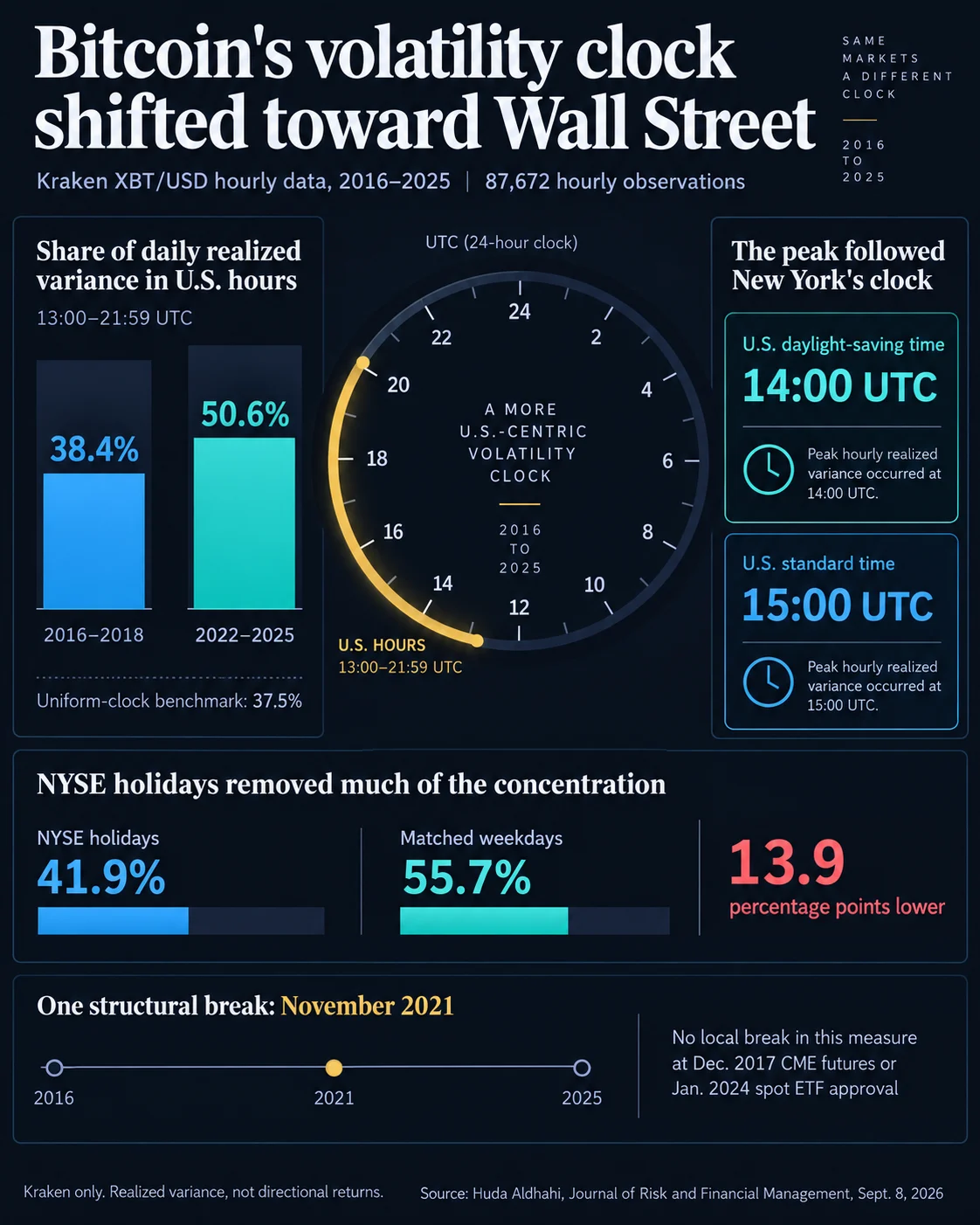
Bitcoin has long been celebrated—and occasionally feared—for its status as a 24-hour, borderless financial asset that never sleeps. However, a decade of market data reveals a profound structural shift in how the world’s largest cryptocurrency behaves. While the digital asset continues to trade nonstop across global exchanges, its price discovery and volatility are increasingly tethered to the traditional operating hours of Wall Street. A comprehensive study of historical trading patterns suggests that the "wild west" era of around-the-clock, uniform volatility is giving way to a market that observes distinct "office hours," dictated largely by the New York financial calendar.
According to recent research analyzing 87,672 hourly observations from Kraken’s XBT/USD market between 2016 and 2025, the concentration of Bitcoin’s price movement during U.S. business hours has reached unprecedented levels. The study, published in the Journal of Risk and Financial Management, found that the nine-hour window from 13:00 to 21:59 UTC now accounts for 50.6% of Bitcoin’s daily realized variance. This is a significant increase from the 2016–2018 period, when that same window—representing only 37.5% of a full day—accounted for a more modest 38.4% of volatility. This concentration implies that more than half of Bitcoin’s price action is now packed into a fraction of its total trading time, coinciding almost perfectly with the opening and closing bells of the New York Stock Exchange (NYSE).
The Synchronization of the Volatility Clock
The most definitive evidence of Bitcoin’s "New York lean" comes from its reaction to changes in the American schedule. Researchers utilized the transition between U.S. Daylight Saving Time (DST) and Standard Time to isolate Wall Street’s influence from other global market participants. Because Asian markets and many automated trading algorithms operate on a fixed UTC schedule, they do not shift their activity when American clocks change. Bitcoin, however, does.
Between 2022 and 2025, Bitcoin’s peak volatility hour was observed to move in lockstep with New York. During the summer months (Daylight Saving Time), the peak occurred at 14:00 UTC. When the U.S. shifted back to Standard Time in the winter, the peak moved to 15:00 UTC. This one-hour shift confirms that the primary drivers of current Bitcoin price action are participants whose schedules are dictated by the U.S. Eastern Time zone. Statistical analysis showed that the variance-weighted center of the U.S. trading window moved by 0.33 hours during these transitions, a shift that was nonexistent in the 2016–2018 data.
Further proof of this dependency is found in the "Holiday Effect." On weekdays when the NYSE was closed for public holidays, Bitcoin’s volatility during what would normally be the U.S. session plummeted. During the 2022–2025 period, the share of variance occurring during these hours dropped by 13.9 percentage points on holidays, falling from 55.7% to approximately 41.9%. When the titans of Wall Street take a day off, Bitcoin’s volatility profile flattens, returning to a distribution that is nearly indistinguishable from a random, even spread across the 24-hour cycle.
A Chronology of Institutionalization
The transformation of Bitcoin from a retail-driven experiment into a Wall Street-aligned asset did not happen overnight. While the launch of U.S. spot Bitcoin ETFs in January 2024 is often cited as the catalyst for institutionalization, the data suggests the structural break occurred much earlier.
A statistical change-point analysis identified November 2021 as the singular major turning point in Bitcoin’s volatility trend. This period coincided with Bitcoin reaching its then-all-time high of nearly $69,000 and the broader adoption of crypto assets by hedge funds and corporate treasuries. Interestingly, the study found no comparable "structural break" during the December 2017 introduction of CME Bitcoin futures or the 2024 ETF approvals.
The role of ETFs, while significant, appears to be part of a longer-running trend rather than its origin. When researchers applied a symmetric 12-month window around the ETF launch, the increase in U.S.-hour variance share was a negligible 0.1 percentage point. This indicates that the market had already moved toward a U.S.-centric model years before the "Big Nine" ETFs began trading. The institutional infrastructure—ranging from regulated futures and options to the inclusion of Bitcoin on the balance sheets of public companies like MicroStrategy—had already laid the groundwork for New York to become the gravity well of the crypto market.

The Decline of the Weekend Warrior
As Bitcoin adopts the rhythms of traditional finance, the legendary volatility of crypto weekends is fading. In 2016, Saturdays and Sundays were nearly as active as weekdays, with a weekend-to-weekday volatility ratio of 0.96. By 2024, that ratio had dropped to 0.60. Trading volume has followed a similar trajectory, with the weekend-to-weekday volume ratio falling from 0.78 in 2016 to just 0.43 in 2024.
This "weekend lull" creates a bifurcated market. For five days a week, Bitcoin behaves like a high-octane tech stock, reacting to U.S. employment data, Federal Reserve announcements, and Wall Street liquidity flows. On the weekends, it enters a period of relative dormancy. This shift poses a challenge for the original ethos of crypto as a 24/7 alternative to the "closed" traditional system. Instead of crypto forcing traditional finance to stay open longer, traditional finance appears to be training crypto to take the weekends off.
The "Altcoin" Contagion
Bitcoin is not the only asset being pulled into the New York orbit. The study expanded its scope to seven other major cryptocurrencies, finding that the trend toward U.S.-hour concentration is an industry-wide phenomenon.
Ethereum (ETH) saw its share of U.S.-hour variance rise from 41.8% in its early years to 48.2% in the most recent period. XRP experienced an even sharper climb, moving from 37.2% to 46.2%. Similar patterns were observed in Solana (SOL), Cardano (ADA), Dogecoin (DOGE), and Chainlink (LINK). Of the major assets tested, only Litecoin (LTC) failed to show a statistically significant trend toward U.S.-hour concentration, perhaps reflecting its diminishing role as a primary vehicle for new institutional capital.
The synchronization of these diverse assets suggests that the "crypto market" is increasingly traded as a unified asset class by institutional desks in the United States. When a macro event triggers a move in Bitcoin during the New York session, the liquidity and algorithmic correlations ensure that the rest of the market follows suit, further cementing the U.S. session’s dominance over global price discovery.
Implications for Global Trading and Risk Management
For professional trading desks and retail investors alike, the "Wall Street-ification" of Bitcoin carries practical consequences. Risk management models that were built on the assumption that Bitcoin’s risk is spread evenly across 24 hours are now fundamentally flawed.
- Underestimation of Exposure: Risk models that do not account for the New York concentration may understate the potential for "gap" moves or extreme volatility during the U.S. open. Conversely, they may overstate the risk during the Asian and European sessions, leading to inefficient capital allocation.
- Liquidity Fragmentation: As activity concentrates in a nine-hour window, liquidity during the remaining 15 hours of the day—and especially on weekends—can become "thin." This increases the risk of slippage for large orders placed outside of U.S. hours.
- Hedging Complexity: The gap between the 24/7 spot market and the Monday-Friday futures and options markets creates "basis risk." If a major market-moving event occurs on a Saturday, institutional traders may find it difficult to hedge their positions until the CME or NYSE opens on Monday, despite the spot market being active.
- The Role of Market Makers: The study suggests that market-maker hedging is a likely driver of this trend. As more derivatives are traded on U.S.-regulated exchanges, market makers must hedge their delta on spot exchanges. This activity naturally clusters during the hours when the derivatives markets are most liquid.
A New Era of Price Discovery
The findings highlight a paradox in the evolution of digital assets. Bitcoin was designed to be decentralized and independent of centralized financial hubs. Yet, its success in attracting institutional capital has led to a geographical and temporal centralization of its price discovery.
While the study relies on data from Kraken and focuses on the period up to 2025, the trend appears robust. The next phase of research will likely involve analyzing order-book depth and trade-level data across multiple global venues to see if "off-hour" liquidity is permanently migrating to the New York window.
For the global crypto community, the message is clear: the market may never close, but the "heartbeat" of Bitcoin is now firmly located in Manhattan. For traders in London, Hong Kong, or Singapore, the most important clock on the wall is no longer their own—it is the one tracking the minutes until the 9:30 a.m. opening bell in New York. As Bitcoin continues to integrate with the global financial system, the distinction between "crypto markets" and "capital markets" continues to blur, leaving a 24/7 industry that is increasingly content to work a 9-to-5.









