James Watt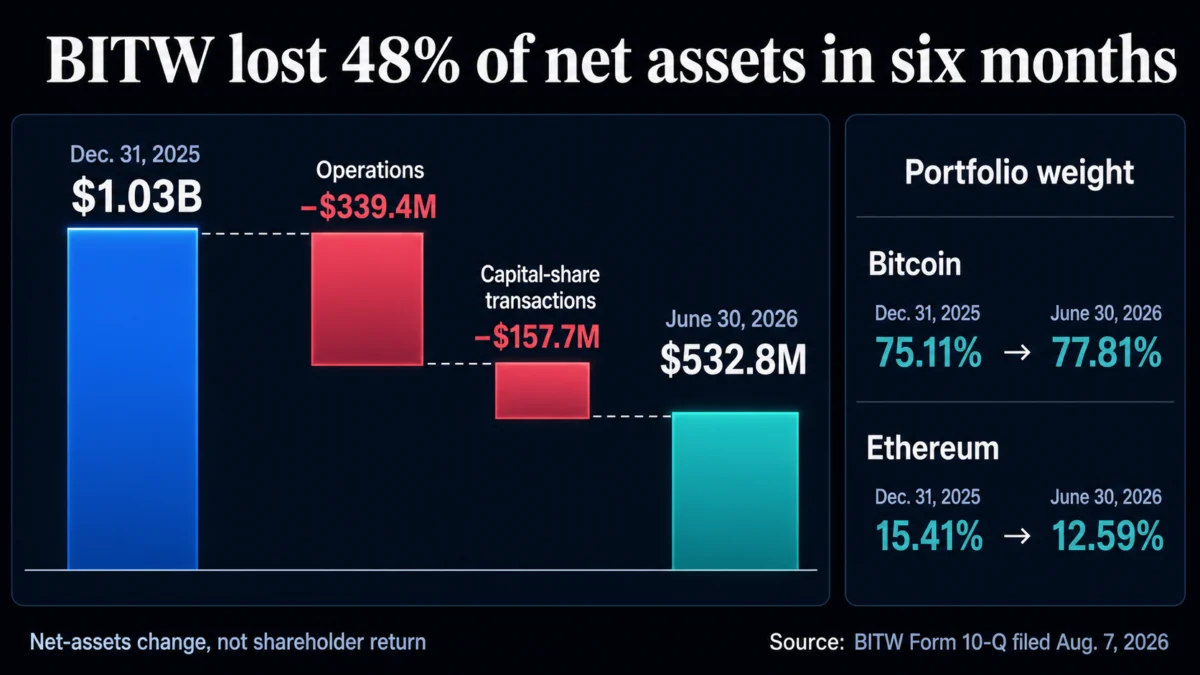
The erosion of the fund’s capital base occurred alongside a notable shift in its internal composition. While the fund is designed to track the performance of the ten largest crypto assets by market capitalization, the weighting has become increasingly lopsided. By the end of June 2026, Bitcoin (BTC) accounted for a staggering 77.81% of the portfolio, up from 75.11% at the start of the year. This concentration underscores a broader market trend where Bitcoin’s dominance has marginalized smaller "altcoins," challenging the very premise of diversification that Bitwise originally marketed to institutional and retail investors.
Financial Performance and Operational Losses
The financial health of BITW in the first half of 2026 was defined by two primary downward pressures: operational losses and capital-share transactions. The fund’s operational activities resulted in a net decrease of $339.4 million. This figure was largely comprised of $430.7 million in unrealized depreciation—representing the falling market value of the assets held in the trust—and a $2.8 million net investment loss. These losses were only partially mitigated by $94.1 million in realized gains, likely triggered by the rebalancing of assets or the sale of holdings to meet redemption demands.
From an investor’s perspective, the performance was equally stark. The fund reported a negative 36.16% Principal Market Net Asset Value (NAV) total return per share for the six-month period. This indicates that even for those who did not exit the fund, the underlying value of their investment eroded by more than a third in just six months.
The second major factor in the fund’s contraction was the reduction in shares outstanding, which fell from 17,451,947 to 14,141,947, a decline of nearly 19%. This share reduction was the result of $161.2 million in redemptions, compared to a mere $3.5 million in new share creations. These transactions are handled by "authorized participants"—large financial institutions that trade directly with the fund in blocks of 10,000 shares. While the identities of the end-investors are not disclosed, the volume of redemptions suggests a strategic exit by significant market players rather than a simple retail sell-off.
The Narrowing Basket: Bitcoin Dominance and Asset Shifts
The Bitwise 10 Crypto Index Fund is governed by a rules-based methodology that rebalances the portfolio monthly to reflect the current state of the crypto market. However, the data from the first half of 2026 reveals a portfolio that is becoming increasingly homogeneous.
In December 2025, Bitcoin represented 75.11% of the fund’s equity. By June 30, 2026, that figure had climbed to 77.81%. Conversely, Ethereum (ETH), the second-largest asset in the fund, saw its share drop from 15.41% to 12.59%. Together, Bitcoin and Ethereum now represent over 90% of the "diversified" fund, leaving the remaining eight assets to share less than 10% of the total weighting.

The constituents of the index also saw turnover, reflecting the volatile nature of the mid-cap crypto market. The June 30 schedule revealed that Avalanche (AVAX) and Polkadot (DOT) had been dropped from the index. In their place, the fund added Hyperliquid—a rising decentralized perpetual exchange token—and Stellar (XLM).
Despite these changes, the "long tail" of the portfolio has failed to provide a hedge against Bitcoin’s volatility or to offer the outsized gains that investors often seek in a diversified index. The filing does not explicitly state whether the inclusion of these newer assets cushioned or exacerbated the losses, but it confirms that the portfolio’s fate is now almost entirely tethered to the price action of Bitcoin.
Chronology of the 2026 Market Contraction
The decline of BITW did not happen in a vacuum. The first half of 2026 was marked by specific macroeconomic and sector-specific headwinds that pressured digital assets.
- January – February 2026: The year began with a cooling period following a late-2025 rally. BITW entered the year with over $1 billion in assets, but early signs of "Bitcoin dominance" began to emerge as liquidity drained from smaller ecosystem tokens like Polkadot and Avalanche.
- March – April 2026: A period of heightened volatility saw Bitcoin test previous support levels. While Bitcoin held relatively firm, the "altcoin" market experienced a sharper drawdown. This prompted the first major wave of redemptions as institutional investors sought to de-risk their portfolios.
- May 2026: The monthly rebalancing led to the removal of Polkadot and Avalanche. The entry of Hyperliquid signaled a shift toward decentralized finance (DeFi) infrastructure, but market sentiment remained bearish.
- June 2026: The fund hit its mid-year low of $532.8 million. The SEC filing finalized on June 30 confirmed that redemptions had outpaced new creations by a ratio of nearly 50 to 1 over the preceding six months.
Analysis of Redemption Mechanics and Investor Sentiment
The $157.7 million reduction in net assets attributed to capital-share transactions is a critical metric for understanding investor sentiment. In the world of Exchange Traded Products (ETPs), redemptions are often seen as a vote of no confidence or a tactical shift in asset allocation.
The BITW fund operates via a trust structure where authorized participants (APs) facilitate the creation and redemption of shares. The fact that $178.3 million was paid out for redemptions (including $17.1 million from late 2025 settlements) indicates that large-scale investors were actively pulling capital out of the index.
This trend may be driven by the emergence of "spot" Bitcoin and Ethereum ETFs, which offer lower fees and more direct exposure to the two primary assets. As BITW’s portfolio became 90% concentrated in BTC and ETH, investors may have found it more cost-effective to hold those assets directly rather than paying the management fees associated with a 10-crypto index fund that is struggling to maintain its diversified character.
The Diversification Paradox in Crypto Investing
The primary value proposition of the Bitwise 10 Crypto Index Fund was to offer "the S&P 500 of crypto." By holding a basket of the top ten assets, investors were told they could capture the growth of the entire sector without having to pick individual winners. However, the 2026 data highlights a "diversification paradox" unique to the crypto market.

In traditional equities, the S&P 500 is weighted by market cap, but no single stock typically accounts for 78% of the index. In crypto, Bitcoin’s massive market capitalization creates a gravitational pull that makes true diversification difficult within a market-cap-weighted framework. When Bitcoin falls, the rest of the market tends to fall further; when Bitcoin rises, it often sucks liquidity out of the altcoin market.
The result for BITW has been a fund that offers the downside of the broader market with a concentration that prevents it from benefiting from the "decoupling" of specific altcoins. The removal of Avalanche and Polkadot suggests that even established "Blue Chip" altcoins are struggling to maintain the scale required to stay in the top ten, leading to a portfolio that looks less like a diversified index and more like a Bitcoin-heavy trust with a small, rotating experimental wing.
Broader Implications for Bitwise and the Crypto Industry
The $500 million loss in asset value is a significant blow to Bitwise Asset Management, which has long been a leader in crypto indexing. While the firm still manages substantial assets across various products, the contraction of its flagship index fund reflects a broader skepticism regarding the efficacy of multi-asset crypto products in the current regulatory and market environment.
For the wider industry, the BITW filing serves as a cautionary tale about the limitations of market-cap-weighted indices in a lopsided market. It also highlights the "flight to quality" (or flight to liquidity) that defines crypto bear markets or periods of stagnation. As Bitcoin dominance sits at 58.74% globally, BITW’s internal dominance of 77.81% shows that the fund is actually more concentrated than the global market it seeks to represent.
Looking forward, Bitwise may face pressure to adjust its methodology or lower its fee structure to remain competitive against pure-play Bitcoin ETFs. The inclusion of new assets like Hyperliquid suggests the firm is still looking for the "alpha" that could justify the index model, but until the altcoin market can find a sustained floor against Bitcoin, the Bitwise 10 may continue to struggle with its identity as a diversified fund.
The data from the first half of 2026 is clear: the dream of a balanced, ten-asset crypto portfolio is currently being overshadowed by the reality of Bitcoin’s market supremacy. For investors, the lesson of BITW’s recent performance is that in the world of digital assets, diversification does not always equal safety—and sometimes, it simply means a more complex way to hold Bitcoin.