James Watt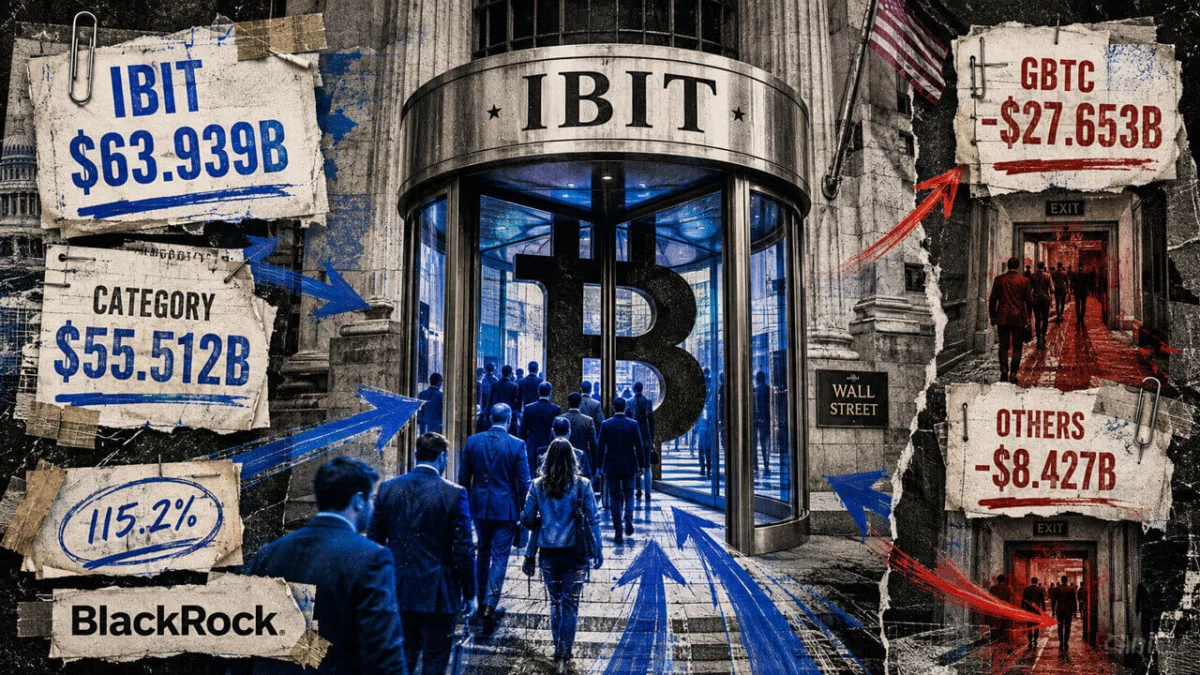
The landscape of digital asset investment in the United States has undergone a fundamental transformation since the beginning of 2024, characterized by the emergence of a singular, dominant force that now acts as the primary gateway for institutional and retail capital. The iShares Bitcoin Trust (IBIT), managed by BlackRock, the world’s largest asset manager, has evolved into what market analysts are increasingly describing as the "buyer of last resort" for the US spot Bitcoin exchange-traded fund (ETF) category. This phenomenon was strikingly illustrated on Aug. 27, when IBIT recorded a net inflow of $277.6 million. On that same day, the entire US spot Bitcoin fund category saw a collective inflow of only $242.3 million. The discrepancy reveals a stark reality: while BlackRock’s product was drawing in significant capital, its competitors were suffering from a combined net loss of $35.3 million. Without the intervention of IBIT’s massive liquidity draw, the day would have ended in the red for the sector as a whole.
This pattern of IBIT carrying the weight of the entire industry is not an isolated event but a consistent trend observed throughout the history of these financial products. From their landmark launch in January 2024 through Sept. 3, 2026, the data paints a picture of a market that is increasingly bifurcated between BlackRock and every other participant. According to the fund ledger maintained by Farside Investors, IBIT has amassed over $63.9 billion in cumulative net inflows. During the same period, the entire group of US spot Bitcoin ETFs—including IBIT—retained a total of $55.5 billion. The mathematical implication is profound: when IBIT is removed from the equation, every other fund in the category, when combined, has experienced a net outflow of $8.4 billion.
The Mathematical Dominance of IBIT
The statistical dominance of BlackRock’s IBIT is perhaps best understood through the lens of its share of total market inflows. As of early September 2026, IBIT’s share of the category’s net inflow stands at 115.2%. While a percentage exceeding 100% initially appears to be a statistical anomaly, it is a direct reflection of the massive withdrawals occurring elsewhere in the market. In a scenario where one entity adds a significant amount of capital while all other entities combined remove a portion of that value, the primary contributor ends up representing more than the final total remaining on the table.
This dynamic has effectively positioned IBIT as the backstop for the US Bitcoin ETF market. For every dollar that has stayed within the US spot Bitcoin fund group, IBIT provided that dollar plus additional funds to compensate for the net exits of its rivals. This level of concentration is unique in the ETF world, where competition usually results in a more distributed share of assets under management (AUM). However, the brand power of BlackRock, combined with its institutional-grade infrastructure, has created a "winner-take-most" environment.
A Chronology of Market Consolidation
The journey to this point began in January 2024, following a decade of regulatory hurdles and denials by the Securities and Exchange Commission (SEC). When the spot Bitcoin ETFs were finally greenlit, a dozen funds entered the arena simultaneously. The early days were marked by a frantic race for liquidity, with issuers slashing fees to attract the initial wave of capital.
Initially, the market was dominated by the Grayscale Bitcoin Trust (GBTC). Having existed for years as a closed-end fund, GBTC transitioned into an ETF with a massive existing pool of Bitcoin. However, it also carried a significant hurdle: a 1.50% sponsor fee, which was substantially higher than the 0.20% to 0.25% fees offered by newcomers like BlackRock and Fidelity. This fee disparity triggered a massive and prolonged migration. Shareholders who had been locked into the Grayscale product for years finally had a redemption route, and many chose to move their capital into cheaper, more liquid alternatives.
By mid-2024, the "Grayscale bleed" became a defining characteristic of the daily flow data. GBTC has recorded a staggering $27.6 billion in net outflows since its conversion. While some of this capital likely exited the Bitcoin market entirely, a significant portion moved into IBIT. By the time the market reached late 2026, the gap between IBIT and the rest of the field had widened into a chasm. Even when excluding the Grayscale outflows to provide a more "normalized" view of the market, IBIT’s performance remains peerless. The remaining field of cheaper products, led by Fidelity’s Wise Origin Bitcoin Fund (FBTC), brought in a combined $19.2 billion—a healthy figure, yet still less than one-third of the $63.9 billion attracted by IBIT alone.
The Mechanics of the BlackRock Distribution Machine
The success of IBIT is not merely a result of marketing but is deeply rooted in the technical and structural advantages of the BlackRock ecosystem. To understand how IBIT functions as a buyer of last resort, one must distinguish between the secondary and primary markets.
In the secondary market, investors trade existing shares of IBIT on the Nasdaq. These trades involve billions of dollars in daily volume but do not directly change the amount of Bitcoin held in the trust. The "buying" and "selling" that impact the actual Bitcoin supply happen in the primary market. This is where Authorized Participants (APs)—large financial institutions like Jane Street, JPMorgan, and Virtu Financial—interact directly with the trust.
When demand for IBIT shares exceeds the current supply, causing the ETF to trade at a premium to its net asset value (NAV), APs create new shares. They deliver cash or Bitcoin to the trust, and in exchange, the trust issues new blocks of shares. This process creates a direct bid for Bitcoin in the underlying market. Conversely, when investors sell and the ETF trades at a discount, APs redeem shares, causing the trust to shrink.
IBIT’s scale has created a self-reinforcing loop of liquidity. As of Sept. 3, 2026, the fund reported approximately $63.44 billion in net assets and a 30-day median bid-ask spread of just 0.02%. This narrow spread makes it the most efficient vehicle for large institutional orders. For a corporate treasury or a pension fund looking to allocate $500 million to Bitcoin, IBIT offers the least amount of "slippage," ensuring that the execution price remains as close to the market rate as possible.
Institutional Infrastructure and the "Revolving Door"
The concentration of capital into a single fund highlights a significant shift in how Bitcoin is perceived by the traditional financial (TradFi) world. For years, the Bitcoin ethos was built on decentralization and the elimination of intermediaries. However, the rise of IBIT suggests that for a large segment of the investing population, the intermediary is the attraction, not the obstacle.
Financial advisors, who manage trillions of dollars in US household wealth, require products that fit into existing workflows. IBIT appears on conventional account statements, can be held in 401(k)s and IRAs, and does not require the management of private keys or the use of specialized cryptocurrency exchanges. By providing a familiar ticker and the backing of a brand like BlackRock, the "explaining requirement" for an advisor is significantly reduced.
This has turned the US financial entrance for Bitcoin into a "single revolving door." While the Bitcoin network remains decentralized at the protocol layer, the capital flows are increasingly centralized at the access layer. This centralization provides a stable and predictable path for new demand to reach the asset, but it also means that the health of the US Bitcoin market is now inextricably linked to the performance and perception of a single financial product.
Risks and Implications: A Backstop Without a Mandate
Despite its role as a buyer of last resort, IBIT differs fundamentally from a central bank or a government-mandated backstop. A central bank has a public mandate to maintain stability and the power to create money to support a failing market. IBIT, however, is a passive vehicle. It expands and contracts based solely on the whims of its shareholders.
This lack of a mandate means that the "backstop" provided by IBIT can disappear as quickly as it arrived. If market sentiment shifts and investors begin a mass exodus from the asset class, IBIT will become a primary channel for selling pressure. The same mechanism that creates a bid for Bitcoin during periods of high demand will facilitate the liquidation of Bitcoin during a crash.
The data from early September 2026 illustrates this volatility. On Sept. 1, IBIT joined the rest of the market in a downturn, losing $201.2 million in a single day. However, just two sessions later, on Sept. 3, the "BlackRock effect" returned with a massive $454 million inflow, helping the entire category finish the day with $730.8 million in net gains. This "on-again, off-again" support demonstrates that while IBIT is a powerful force, it is ultimately a reflection of the collective psychology of its investors.
Future Outlook: The Maturation of the ETF Era
As the market for spot Bitcoin ETFs matures, the dominance of IBIT is likely to face new challenges and opportunities. The current concentration of assets reflects the early-stage "brand-name" phase of the market. Over time, as institutional investors become more comfortable with the asset class, they may seek to diversify their holdings across multiple issuers to mitigate counterparty and custodial risk.
However, for the foreseeable future, BlackRock’s iShares Bitcoin Trust remains the undisputed heavyweight. It has successfully bridged the gap between the volatile world of crypto-assets and the regulated, structured world of Wall Street. By absorbing the exits from legacy products and providing a steady stream of fresh capital, IBIT has not only sustained the US ETF category but has also fundamentally changed the marginal bid for Bitcoin on a global scale.
The story of IBIT is the story of Bitcoin’s integration into the global financial mainstream. It is a story of how a decentralized protocol found its most effective distribution channel in the most centralized of financial institutions. Whether this concentration is a long-term benefit or a structural risk remains to be seen, but for now, the "buyer of last resort" continues to hold the line for the digital asset industry.