admin
admin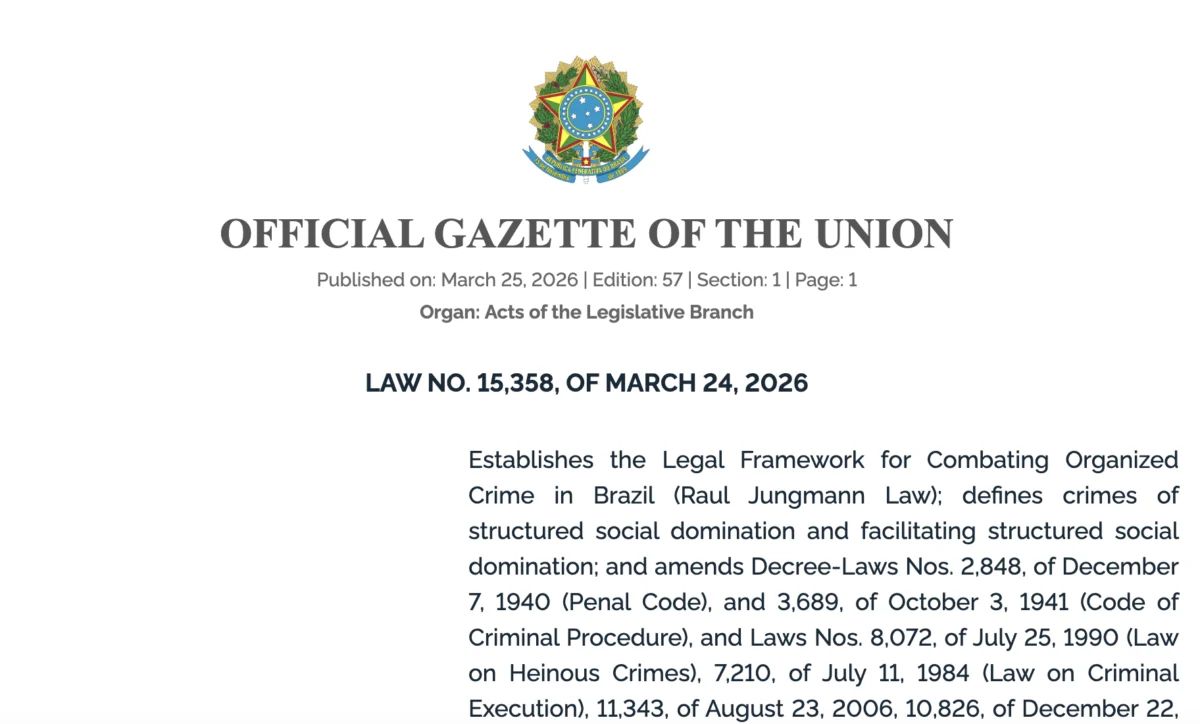
In a decisive move to modernize the nation’s arsenal against organized crime, the Brazilian government has officially enacted a legal framework that allows public security agencies to repurpose confiscated cryptocurrencies for law enforcement operations. On Wednesday, the legislative branch published Law No. 15.358, a landmark piece of legislation that effectively turns digital assets seized from criminal syndicates into a state-funded "war chest" for police re-equipment, specialized training, and complex tactical operations.
This legislative milestone marks a significant shift in how South America’s largest economy manages digital assets. By classifying cryptocurrencies as "instruments of crime," the law removes previous legal ambiguities that often left seized digital wallets in a state of jurisdictional limbo. Under the new provisions, the Brazilian state is empowered not only to freeze and confiscate these assets but to actively liquidate or deploy them to bolster the country’s internal security infrastructure.
Legal Definitions and the Forfeiture Framework
Law No. 15.358 introduces a rigorous definition of what constitutes an instrument of illicit activity. According to the translated text of the statute, "any asset that has been used to commit a crime shall be considered an instrument of the crime, even if it was not intended exclusively for that purpose." This broad definition is designed to capture the multifaceted nature of modern money laundering, where legitimate businesses or personal crypto accounts may be partially utilized to facilitate the movement of illicit funds.
The law mandates that the forfeiture of these assets and valuables is subject to authorization from the judge overseeing the execution of the sentence. Once cleared by the judiciary, public security agencies—including the Federal Police and civil police forces—may use the funds provisionally. This ensures that the assets do not sit idle during lengthy appeal processes, allowing the state to benefit from the value of the seized crypto while the legal proceedings continue.
The immediate priorities for these funds include the procurement of high-tech surveillance equipment, the enhancement of cybersecurity units, and the funding of "special operations" targeting the upper echelons of organized crime. In a country where criminal organizations like the Primeiro Comando da Capital (PCC) have increasingly turned to blockchain technology to evade traditional banking monitors, the law provides a direct mechanism to turn the criminals’ financial tools against them.
Chronology of Brazil’s Crypto Regulatory Evolution
The passage of Law No. 15.358 is the culmination of a multi-year effort to bring the Brazilian digital asset market under a coherent regulatory umbrella. The journey toward this point has been marked by several key milestones:
- December 2022: The "Marco Legal das Criptomoedas" (Law 14.478) was signed into law, establishing the first comprehensive regulatory framework for virtual asset service providers (VASPs) and designating the Central Bank of Brazil as the primary overseer.
- June 2023: Law 14.478 officially came into effect, requiring crypto exchanges to obtain operating licenses and adhere to strict anti-money laundering (AML) and "know your customer" (KYC) protocols.
- August 2025: Lawmakers held the first major hearings regarding the creation of a National Bitcoin Reserve (RESBRA), signaling a growing interest in treating cryptocurrency as a strategic national asset.
- Late 2025: Operation Lusocoin, conducted by the Federal Police, exposed a massive money laundering network, highlighting the urgent need for updated forfeiture laws.
- March 2026: Law No. 15.358 is published, officially authorizing the use of seized crypto for public security funding.
Operation Lusocoin: The Catalyst for Reform
The impetus for Law No. 15.358 can be traced back to the scale of illicit activity uncovered in 2025. Operation Lusocoin stands as one of the largest crypto-related investigations in Latin American history. According to reports from blockchain intelligence firm TRM Labs, the Federal Police dismantled a "laundering and foreign exchange evasion architecture of massive scale."
Authorities estimated that the network moved tens of billions of Brazilian reais through a sophisticated web of shell companies, over-the-counter (OTC) crypto brokers, and non-custodial wallets. The operation revealed that organized crime groups were using digital assets not just for simple transactions, but as a shadow financial system to move capital out of the country and purchase illicit goods globally. The sheer volume of assets seized during Operation Lusocoin—and the subsequent difficulty in integrating those assets into the public budget—underscored the necessity for the new law.
Supporting Data: Brazil’s Growing Crypto Footprint
Brazil’s push for these regulations is driven by its status as a global leader in cryptocurrency adoption. With a population exceeding 213 million, the country consistently ranks in the top 10 of the Chainalysis Global Crypto Adoption Index.
Data from the Brazilian Federal Revenue Service (Receita Federal) indicates that millions of citizens regularly declare crypto holdings. In 2024 and 2025, the volume of stablecoin transactions, particularly USDT (Tether), surged as both retail investors and businesses sought hedges against inflation and efficient cross-border payment methods. However, this high volume of legitimate activity has also provided a "noise" floor for criminal organizations to hide their transactions.

By establishing a clear path for asset recovery and international cooperation, Law No. 15.358 allows Brazil to work more closely with organizations like INTERPOL and the U.S. Department of Justice. The law specifically authorizes coordination with international authorities for investigation and asset recovery, acknowledging that crypto-crime is rarely confined within national borders.
Political Context and the Tax Policy Delay
The enactment of the forfeiture law comes at a sensitive political time for Brazil. Finance Minister Dario Durigan recently confirmed that the government would delay discussions on changing the country’s tax policy regarding cryptocurrencies.
The decision to shelve tax reforms until after the presidential election in October 2026 is seen as a strategic move to avoid divisive legislative battles. While the government is keen to increase tax revenue from the digital asset sector, it has prioritized the "security first" approach of Law No. 15.358, which garnered broader bipartisan support. By focusing on fighting crime rather than taxing everyday users, the administration has managed to strengthen its law enforcement capabilities without alienating the large base of Brazilian crypto investors.
Public Security vs. The National Bitcoin Reserve
One of the most intriguing aspects of Brazil’s crypto strategy is the dual-track approach currently being debated in the halls of power. While Law No. 15.358 focuses on "spending" seized crypto to fund security, another proposed bill seeks to "hold" crypto as a national reserve.
The National Bitcoin Reserve (RESBRA) bill, reintroduced in early 2026, proposes that the Brazilian Treasury could allocate up to 5% of its international reserves to purchase Bitcoin. Some versions of the bill suggest a target of up to one million BTC.
The contrast between these two policies is stark. Law No. 15.358 treats seized crypto as a functional resource to be liquidated or used for immediate operational needs. Conversely, the RESBRA proposal treats Bitcoin as a sovereign financial asset, similar to gold. While Law No. 15.358 has now become a reality, the future of the National Bitcoin Reserve remains uncertain, with many lawmakers waiting to see the results of the 2026 elections before committing to a massive treasury shift into digital assets.
Broader Impact and Implications for the Crypto Industry
The implications of Law No. 15.358 extend beyond the police force. For cryptocurrency exchanges operating in Brazil, the law creates a more stringent compliance environment. Authorities now have the explicit power to prohibit transactions on exchanges if the assets involved are deemed instruments of a crime. This will likely lead to increased pressure on VASPs to enhance their monitoring systems and cooperate more frequently with the Federal Police.
Furthermore, the law sets a precedent for other Latin American nations struggling with the intersection of gang violence and digital finance. If Brazil successfully demonstrates that it can reclaim the "financial territory" of the blockchain, neighboring countries may follow suit with similar forfeiture frameworks.
From a journalistic and legal perspective, the success of this law will depend on the transparency of the judicial authorization process. Critics and civil liberties advocates will be watching closely to ensure that the "provisional use" of assets does not lead to due process violations or the premature liquidation of assets belonging to individuals who have not yet been convicted.
Conclusion
Brazil’s Law No. 15.358 represents a sophisticated evolution in the global fight against crypto-enabled crime. By integrating digital asset forfeiture directly into the funding mechanism for public security, the Brazilian government is not just reacting to crime but is building a sustainable model to combat it. As the Federal Police continue to untangle the remnants of networks like those found in Operation Lusocoin, the ability to turn confiscated Bitcoin, Ethereum, and stablecoins into police cruisers, forensic software, and officer training programs will likely become a cornerstone of Brazil’s internal security strategy for years to come.