Lina Irawan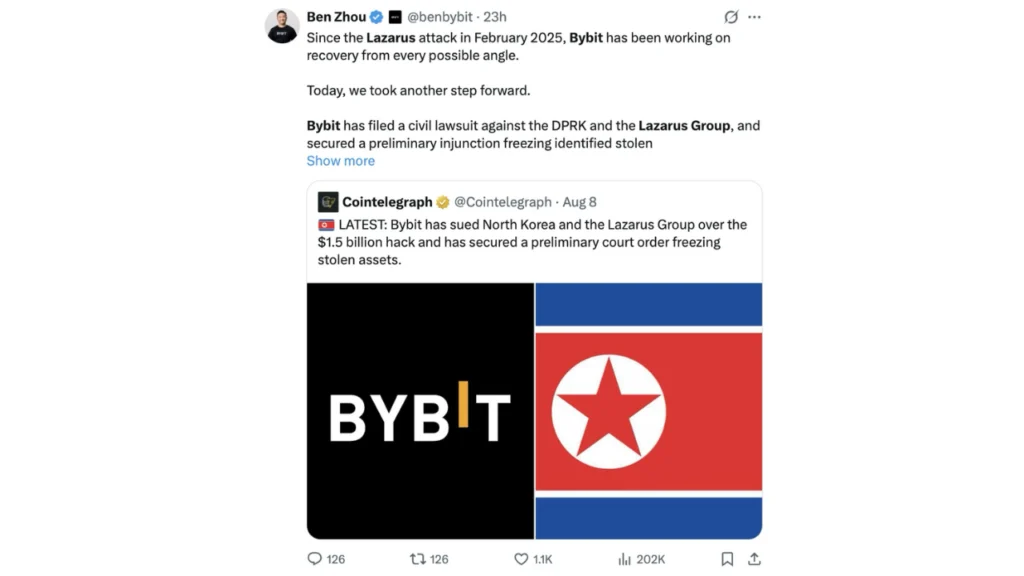
Cryptocurrency exchange Bybit has initiated a significant legal battle by filing a civil lawsuit against North Korea, its intelligence agency the Reconnaissance General Bureau (RGB), and the notorious Lazarus Group, seeking to recover assets lost in a colossal $1.5 billion cryptocurrency heist that occurred in February 2025. The landmark legal action, lodged in the U.S. District Court for the District of Columbia, represents a pivotal escalation in Bybit’s ongoing efforts to reclaim the stolen digital wealth and bring the alleged perpetrators to justice. In conjunction with the lawsuit, Bybit has successfully secured a preliminary injunction, a court order designed to freeze specific digital assets that have been linked to the February 2025 breach. These assets are currently held by a number of unidentified individuals and entities, who have been designated as "John Doe" defendants in the legal proceedings.
This court order is explicitly intended to preserve the identifiable stolen assets, ensuring they remain accessible for potential recovery as the litigation progresses. Bybit has stated its intention to pursue further legal remedies as its investigative teams continue to trace the flow of the misappropriated funds. The exchange’s proactive legal stance underscores the growing complexity of asset recovery in the decentralized digital asset landscape, where traditional legal frameworks are increasingly being tested.
The Genesis of the Record-Breaking Heist
The audacious attack, which sent shockwaves through the global cryptocurrency market, unfolded on February 21, 2025. Malicious actors managed to drain a staggering amount of cryptocurrency, specifically over 400,000 ETH (Ether) and stETH (Staked Ether), from a Bybit cold wallet. At the prevailing market rates, the stolen digital assets were valued at approximately $1.5 billion, instantly marking this incident as the largest single cryptocurrency theft ever recorded.
Investigations quickly pointed towards the Lazarus Group, a sophisticated hacking collective with well-documented ties to the North Korean regime. This group has a long and extensive history of targeting cryptocurrency exchanges, blockchain projects, and decentralized finance (DeFi) platforms for years, amassing substantial illicit gains to fund state objectives.
The breach itself was not a direct assault on Bybit’s robust cold storage infrastructure. Instead, the attackers reportedly exploited vulnerabilities within the infrastructure used to manage the compromised wallet. Forensic analysis revealed that a developer associated with SafeWallet, a multisignature wallet solution employed by Bybit, had fallen victim to a cyber compromise. This allowed the attackers to inject malicious code that manipulated what appeared to be a legitimate transaction. By altering the underlying logic of the transaction, the hackers were able to divert the substantial cryptocurrency holdings to their own controlled addresses. This incident served as a stark reminder that even advanced security measures like cold storage and multisignature protocols can be circumvented if the human element or supporting software infrastructure is compromised.

North Korea’s Escalating Cryptocurrency Theft Operations
The February 2025 Bybit hack represented a significant portion of North Korea’s total cryptocurrency theft activities for the year. According to comprehensive data compiled by blockchain analytics firm Chainalysis, North Korean-linked hackers are estimated to have stolen approximately $2.02 billion in cryptocurrency throughout 2025, marking a substantial increase of 51% compared to the previous year, 2024. Over time, Chainalysis estimates that hackers associated with the Democratic People’s Republic of Korea (DPRK) have illicitly acquired an estimated $6.75 billion in digital assets.
The sheer scale of these operations has become a pressing concern for governments worldwide and the burgeoning digital asset industry. It is widely understood that these stolen cryptocurrencies provide a crucial revenue stream for the North Korean regime, with a significant portion of these funds allegedly being channeled into the development of its controversial weapons programs, including ballistic missile and nuclear initiatives.
The Lazarus Group, in particular, has been implicated in a string of high-profile cryptocurrency heists. Notable among these are the $620 million Ronin Network bridge hack and the $100 million Harmony Horizon Bridge exploit, both of which occurred in 2022. These repeated and increasingly sophisticated attacks have solidified North Korea’s position as one of the most significant state-sponsored cyber threats facing the global cryptocurrency ecosystem.
The Arduous Task of Tracing Stolen Funds
The recovery of Bybit’s stolen assets has proven to be an exceptionally challenging undertaking, largely due to the speed and sophistication with which the attackers moved the funds immediately following the breach. Investigators have meticulously tracked the cryptocurrency across thousands of wallet addresses and through multiple blockchain networks. In a common tactic to obfuscate their trail, significant portions of the stolen Ethereum were converted into Bitcoin, while other funds were routed through cross-chain bridges, anonymizing mixers, and various cryptocurrency services specifically designed to complicate transaction tracing.
While the inherent transparency of blockchain technology has aided investigators in monitoring many of the movements, tracing the flow of funds does not automatically guarantee their recovery. Once assets are fragmented across thousands of addresses or moved between different blockchain networks, pinpointing the ultimate beneficiaries becomes exponentially more difficult. Bybit has been actively collaborating with leading blockchain analytics firms, other cryptocurrency exchanges, regulatory bodies, and international law enforcement agencies to meticulously track and, where possible, freeze portions of the stolen funds.
Legal Action as a New Frontier in Asset Recovery
The preliminary injunction secured by Bybit represents a significant new legal weapon in its ongoing asset recovery campaign. This court order effectively prohibits certain unidentified holders, who are believed to be in possession of traceable stolen assets, from transferring or liquidating these funds while the civil litigation proceeds. Bybit has emphasized that this measure is crucial for preserving the assets that investigators have managed to identify thus far.

Beyond the immediate objective of asset preservation, Bybit is actively seeking further legal relief, including the direct recovery of the stolen cryptocurrency and monetary damages. The exchange has made it clear that this civil lawsuit is a separate undertaking from ongoing criminal investigations being conducted by U.S. authorities into the matter.
Ben Zhou, the CEO of Bybit, reiterated the company’s unwavering commitment to its users and the integrity of the platform. "Our focus has never changed: protect our users first, recover what we can, and make sure the people behind these attacks are held accountable," Zhou stated. He characterized the Lazarus Group’s attack not just as a breach of Bybit’s security, but as a direct assault on the fundamental trust that underpins the entire cryptocurrency industry. This sentiment highlights the broader implications of such attacks, which can erode confidence among retail and institutional investors alike.
Navigating the Path Forward
The civil lawsuit presents a unique set of challenges, particularly given that one of the named defendants is the North Korean government itself. Even if Bybit achieves a favorable judgment in court, the practical enforcement of such a ruling directly against the DPRK could prove to be an immensely complex and potentially insurmountable legal hurdle.
However, the more immediate and potentially impactful aspect of the lawsuit lies in its ability to target unidentified defendants and intermediaries who may be holding traceable stolen assets. If any of these funds have flowed into exchanges or custodians that fall under U.S. jurisdiction, the court’s orders could provide Bybit with the legal authority to freeze these assets and compel the disclosure of information vital for recovery efforts.
This case also exemplifies a growing trend in major cryptocurrency theft investigations, where sophisticated blockchain analysis is increasingly being integrated with traditional legal and diplomatic strategies. While blockchains offer unprecedented transparency into the movement of digital assets, their ultimate recovery often hinges on the cooperation of a complex ecosystem of exchanges, custodians, financial institutions, regulators, and law enforcement agencies across multiple jurisdictions.
For Bybit, this lawsuit is a critical component of a comprehensive recovery strategy that commenced in the immediate aftermath of the February 2025 breach. For the broader cryptocurrency industry, this legal action could serve as a crucial test case, exploring the efficacy of judicial intervention in reclaiming digital assets that have been systematically moved and laundered by sophisticated, state-linked hacking groups across a labyrinth of blockchains and international borders. The outcome of this case could set important precedents for how future crypto heists are investigated and how victims might seek recourse in the evolving landscape of digital finance.