
 James Watt
Cactus Custody, a leading institutional digital asset custodian, has officially announced its comprehensive support for Lido V3 stVaults through its proprietary DeFi connector, Cactus Link. This pivotal integration enables Cactus Custody’s institutional clientele to seamlessly create and manage dedicated stVaults directly from their existing custody accounts, marking a significant stride towards bridging traditional finance with the burgeoning decentralized finance (DeFi) ecosystem. The move is poised to enhance institutional participation in Ethereum’s proof-of-stake network, offering unparalleled control, customization, and liquidity for large-scale stakers.
A New Era for Institutional Staking: Unpacking the Integration
The integration of Lido V3 stVaults into Cactus Custody’s platform represents a critical development for institutions seeking to engage with staking mechanisms in a compliant and secure manner. Historically, institutional engagement with DeFi protocols, particularly staking, has been hampered by concerns surrounding security, regulatory clarity, and operational complexity. Cactus Custody’s support for stVaults addresses these challenges head-on by providing a robust, audited framework that aligns with institutional risk management protocols.
Lido V3 stVaults introduce a modular staking infrastructure designed specifically for large staking entities, including investment funds, exchange-traded funds (ETFs), exchange-traded products (ETPs), and asset managers. Unlike traditional pooled staking approaches, stVaults operate on a single-operator architecture. This innovative design grants institutions granular control over crucial staking parameters, such as validator choice, fee structures, and underlying infrastructure. Crucially, it also retains the vital element of on-demand liquidity through optional stETH minting, a feature that distinguishes Lido’s liquid staking solution. This flexibility is paramount for institutional players who often need to meet specific internal risk, compliance, and policy requirements, allowing them to define geographic or jurisdictional parameters, configure MEV (Maximal Extractable Value) routing strategies, and implement tailored insurance mandates.
Cactus Custody: A Pillar of Institutional Trust
Cactus Custody, the institutional digital asset custody solution of BIT (formerly Matrixport), has rapidly established itself as a trusted custodian in the digital asset landscape since its founding in February 2019. The platform’s robust infrastructure is designed to safeguard digital assets across more than 60 blockchain ecosystems for a diverse client base exceeding 400 institutional clients. This includes a broad spectrum of entities such as investment funds, asset managers, exchanges, OTC providers, payment platforms, mining pools, and increasingly, institutional DeFi participants.
The company’s commitment to security and compliance is underscored by its impressive array of credentials. Cactus Custody holds a Hong Kong Trust or Company Service Provider (TCSP) license and a Bhutan Gelephu Mindfulness City Authority (GMCA) Financial Services Licence (FSL). Furthermore, its custody operations are attested by SOC 1 Type II and SOC 2 Type II reports from Deloitte, demonstrating adherence to stringent international standards for security, availability, processing integrity, confidentiality, and privacy. Its architectural design combines highly secure Hardware Security Module (HSM)-backed cold storage with an institutional-grade Multi-Party Computation (MPC) offering, providing clients with the flexibility to choose between qualified-custodian and self-custody-style configurations, tailored to their specific operational preferences and risk appetite. This multi-layered security approach is vital for institutions considering significant capital deployment into decentralized protocols.
The Evolution of Staking: From Pooled to Customizable
The evolution of Ethereum staking has seen a progression from individual validator setups to pooled staking solutions, and now to more advanced, customizable models like stVaults. Initially, running an Ethereum validator required 32 ETH and significant technical expertise, creating a high barrier to entry for many, especially institutions. Pooled staking protocols, such as Lido, emerged to democratize access, allowing users to stake any amount of ETH and receive liquid staking tokens (LSTs) like stETH in return, which could then be used in other DeFi applications.
While pooled staking offers liquidity and ease of access, institutions often require greater control over their staking operations for reasons spanning regulatory compliance, risk management, and strategic asset allocation. StVaults directly address this "control-versus-liquidity" tradeoff. By enabling institutions to run validators with their chosen counterparty and infrastructure, stVaults offer a hybrid model that marries the benefits of decentralized staking with the operational rigor demanded by traditional financial entities. This level of customization ensures that institutions can align their staking activities with internal governance frameworks and external regulatory mandates, a crucial factor in accelerating institutional adoption.
Operationalizing Institutional Staking with Cactus Link
The technical bridge facilitating this integration is Cactus Link, a browser extension designed to function akin to a standard hot wallet but within a secured institutional custody environment. The setup process for vault owners is streamlined and involves a simple two-step connection. Once connected, institutions gain the ability to perform a comprehensive suite of day-two operations for their stVaults. These operations include supplying or withdrawing ETH, minting or repaying stETH, diligently monitoring vault health, triggering rebalancing or closure procedures, and executing emergency protocols as needed.
Before any interaction, administrators are required to whitelist the specific stVaults smart contract addresses, a critical security measure detailed in the Qualified Custodians overview documentation. This whitelisting ensures that only approved contracts can interact with institutional funds, adding an essential layer of protection. The flow is specifically designed for institutions that wish to directly create and operate their own vaults, providing them with autonomy while leveraging Cactus Custody’s security infrastructure. It is important to note that support may vary by jurisdiction, entity type, and onboarding scope, necessitating prior confirmation with a Cactus account manager to ascertain availability and policy settings.
Security and Risk Mitigation in a Decentralized World
Engaging with decentralized protocols inherently carries certain risks, and Ethereum staking is no exception. Standard Ethereum staking risks apply, and Lido provides a comprehensive Risk Assessment Framework for stVaults to detail potential vulnerabilities. However, the integration with Cactus Custody significantly bolsters the security posture for institutional participants.
Key security measures implemented to support Lido V3 include rigorous audits of the protocol’s smart contracts by reputable third-party firms, robust bug bounty programs to incentivize security researchers, and stringent operational controls. While these measures are designed to substantially reduce, though not entirely eliminate, underlying protocol or market risks, they provide a strong foundation for institutional confidence. For institutions, a paramount advantage of stVaults is the ability to operate within a familiar security model: on-chain actions can be gated by their existing Cactus Custody policies, ensuring that transactions adhere to internal authorization workflows. The clarity and definition of emergency procedures within Lido V3 contracts further enhance the institutional risk management framework. Despite these safeguards, institutions are strongly advised to conduct their own thorough due diligence on smart-contract, operational, and regulatory risks, and to establish internal approvals and continuous monitoring mechanisms before initiating live operations.
Industry Reactions and Broader Implications
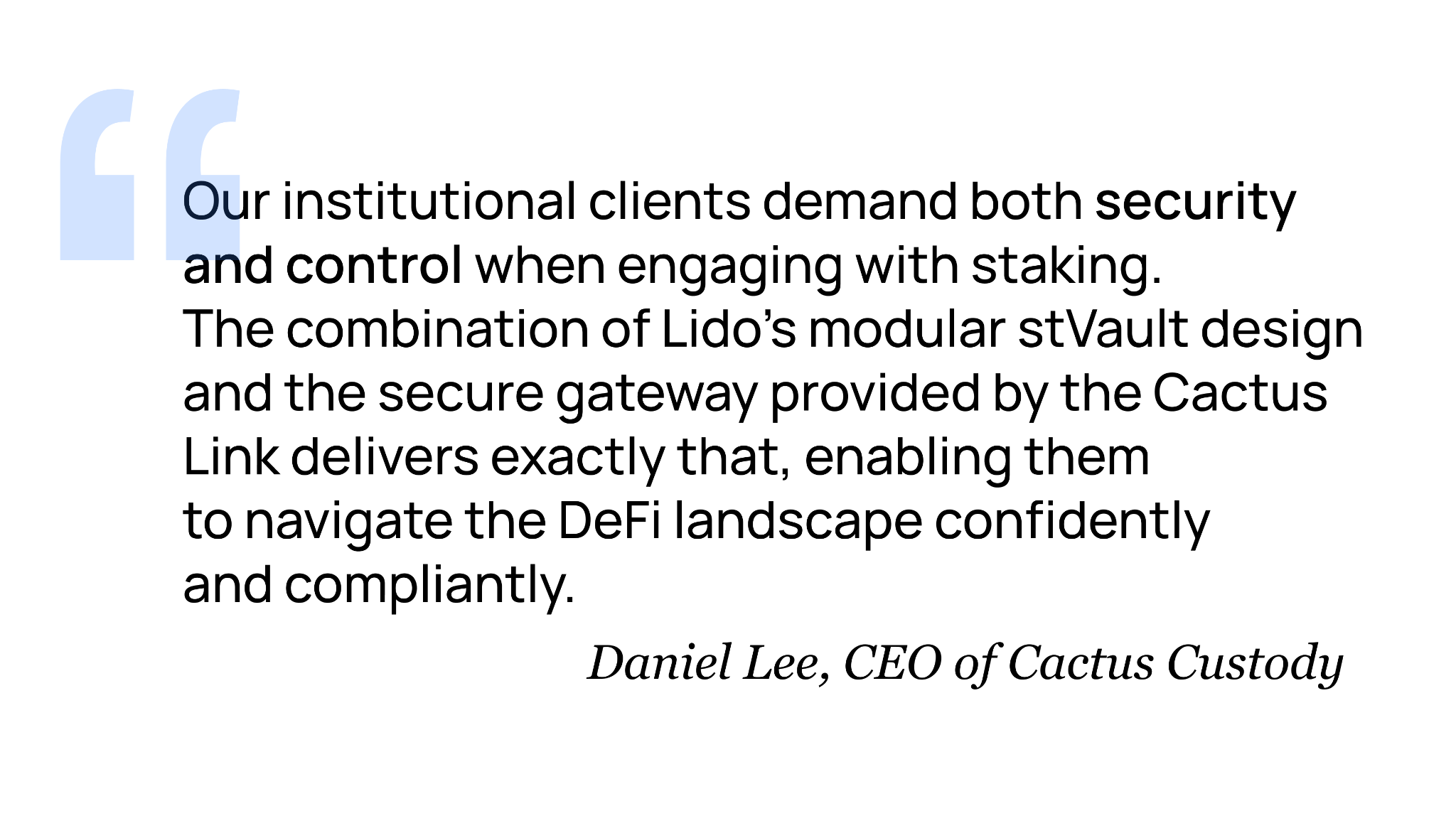
The integration has garnered positive attention within the digital asset community, signaling a maturing landscape for institutional DeFi. Sam, a representative from Cactus Custody (likely Head of Product or a similar leadership role), emphasized the strategic importance of this collaboration. "This integration with Lido V3 stVaults marks a significant milestone in our mission to empower institutions with secure and compliant access to the most innovative DeFi protocols," Sam stated. "By providing granular control and maintaining liquidity within a robust custody framework, we are removing key barriers that have traditionally prevented large-scale institutional participation in Ethereum staking. Our clients can now seamlessly combine their existing Lido liquid staking token holdings with advanced stVault operations, leveraging the full potential of their digital assets."
From Lido’s perspective, this partnership is instrumental in expanding its reach into the institutional market. A spokesperson for the Lido protocol highlighted, "Partnering with a trusted custodian like Cactus Custody for stVaults is crucial for the continued institutional adoption of liquid staking. StVaults were designed to meet the sophisticated demands of institutional capital, offering customization and security that are paramount for this segment. This integration validates our efforts to build enterprise-grade infrastructure and lowers the friction for institutions to participate in securing Ethereum while maintaining their operational requirements."
This collaboration is set to have several far-reaching implications. Firstly, it significantly lowers the barrier to entry for institutional investors into Ethereum staking, potentially driving a new wave of capital into the ecosystem. Secondly, it enhances the overall legitimacy and credibility of DeFi in the eyes of traditional finance, demonstrating that decentralized protocols can operate within established security and compliance paradigms. Thirdly, by offering customizable staking solutions, stVaults cater to a wider array of institutional strategies, from those focused on yield optimization to those prioritizing specific risk profiles or jurisdictional mandates. This flexibility is critical for attracting diverse institutional capital that might otherwise remain on the sidelines.
The growing demand for institutional-grade solutions in the digital asset space is undeniable. As regulators worldwide continue to develop frameworks for cryptocurrencies and blockchain technology, the emphasis on qualified custodians and compliant infrastructure will only intensify. Integrations like that between Cactus Custody and Lido V3 stVaults are not merely product enhancements; they are foundational steps in the ongoing institutionalization of digital assets, paving the way for mainstream adoption and the seamless integration of blockchain technology into the global financial system. The ability to manage complex DeFi strategies like staking through a trusted, regulated custodian is a testament to the maturation of the digital asset industry and its increasing alignment with the stringent demands of traditional finance. Institutions are encouraged to engage with the Lido Institutional team for further details and to explore the potential of stVaults for their specific investment strategies.









