Lina Irawan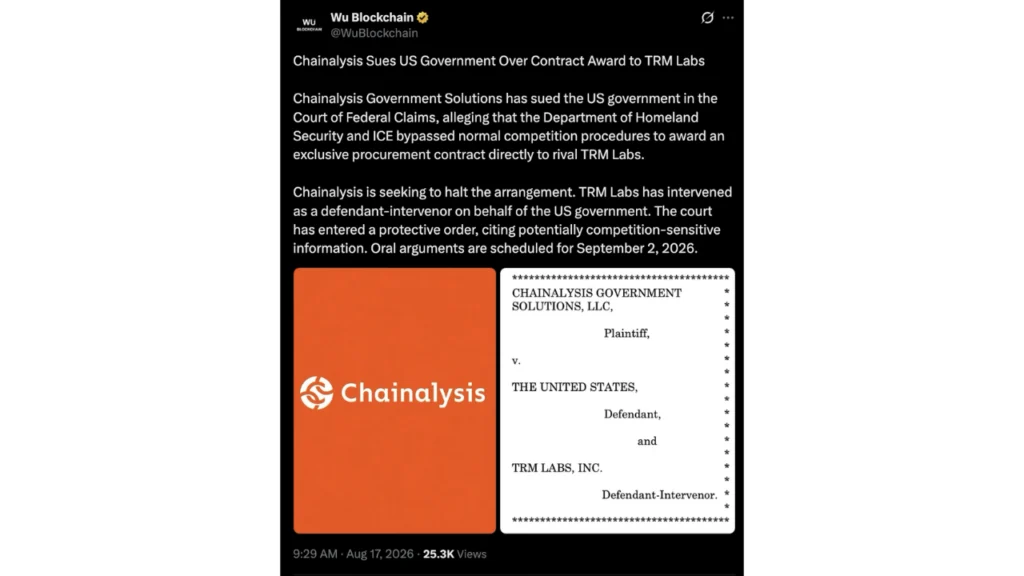
The landscape of cryptocurrency investigation technology is now the battleground for a significant legal confrontation, as Chainalysis, a prominent blockchain analytics firm, has formally sued the U.S. government. The lawsuit challenges a substantial $94.7 million contract awarded to its chief rival, TRM Labs, by U.S. Immigration and Customs Enforcement (ICE). This legal maneuver escalates a fierce competition between two of the industry’s leading providers of tools used by law enforcement to track illicit digital asset activities.
Chainalysis Government Solutions initiated legal proceedings on July 27 in the U.S. Court of Federal Claims. The core of the complaint revolves around ICE’s decision to grant TRM Labs a sole-source contract, meaning it was not subjected to a conventional competitive bidding process. The one-year agreement, which commenced on July 1, is valued at precisely $94,655,000 and encompasses the provision of forensic blockchain software and critical support services for investigations conducted by Homeland Security Task Forces.
Chainalysis argues that ICE’s selection of TRM Labs without a competitive bid was fundamentally flawed. The company contends that the government’s decision was "arbitrary, capricious, and unreasonable," asserting that the agency failed to adequately consider other qualified providers, including Chainalysis itself, which possesses extensive experience and a proven track record in serving federal agencies.
Genesis of the Dispute: A Sole-Source Award Under Scrutiny
The contentious contract stems from an announcement made by ICE in June, detailing its intention to procure TRM Labs’ specialized software and support services through a non-competitive, sole-source acquisition. Government procurement regulations typically mandate competitive bidding to ensure fairness and optimal value for taxpayer money. However, these regulations do permit noncompetitive awards under specific circumstances, primarily when an agency can definitively demonstrate that only a single provider possesses the unique capabilities or technology required to meet its stringent operational needs. ICE’s assessment, according to the initial procurement notice, concluded that TRM Labs was the sole entity capable of fulfilling these requirements.
Chainalysis vehemently disputes this assessment. The company states that it proactively submitted a capability statement to ICE following the agency’s notice of intent, signaling its readiness and ability to provide the necessary technology and services that could meet or exceed the government’s stated requirements. By asserting its capabilities, Chainalysis aimed to trigger a competitive process, rather than allow for a direct award to a competitor.
The scope of the contract is extensive, designed to bolster Homeland Security Task Force investigations across a spectrum of digital asset-related crimes. This includes sophisticated cryptocurrency tracing, in-depth blockchain analysis, the integration of open-source intelligence, and the consolidation of investigative data. Furthermore, the system is intended to aid operations targeting fraud, cybercrime, and sextortion schemes, while also providing agencies with the scalability needed to enhance their investigative capacity during large-scale or rapidly evolving operations.
For Chainalysis, the implications of this lawsuit extend far beyond the immediate financial value of a single contract. Federal government agencies represent a crucial and lucrative market for blockchain analytics firms. Large-scale contracts awarded by these entities not only provide significant revenue but also establish critical precedents and can lead to the widespread adoption and integration of specific platforms into the operational workflows of national investigative bodies. Losing such a contract, especially through a sole-source award that bypasses competition, can significantly impact a company’s market position and future growth prospects within the public sector.
A High-Stakes Rivalry in the Digital Asset Investigations Arena
Chainalysis and TRM Labs are widely recognized as two of the leading players in the burgeoning blockchain intelligence market. Both companies develop and offer sophisticated tools that empower law enforcement agencies, intelligence communities, and regulatory bodies to meticulously trace cryptocurrency transactions, map complex networks of blockchain addresses, and identify patterns indicative of illicit or suspicious activities. Their technologies are instrumental in combating a growing array of crimes facilitated by digital assets, including ransomware attacks, sophisticated financial fraud, evasion of international sanctions, and money laundering.
The U.S. government, in particular, has emerged as an increasingly vital customer base for these specialized services. As cryptocurrencies and other digital assets become more intertwined with the global financial system, their use in criminal enterprises has also surged. Consequently, federal agencies are investing heavily in advanced analytical tools to keep pace with evolving criminal methodologies.
Chainalysis already boasts a well-established relationship with ICE. As recently as April 2023, just two months prior to the disputed contract award, ICE issued Chainalysis an order valued at approximately $262,149 for licenses to its Reactor platform. This platform is a key component of Chainalysis’s suite of tools, specifically designed for the real-time analysis and tracing of cryptocurrency transactions, underscoring the agency’s existing reliance on Chainalysis’s expertise and technology.

TRM Labs, conversely, has been actively expanding its footprint and securing new partnerships within the government and law enforcement sectors. Evidence of this growth can be seen in a Florida procurement document cited in related reporting, which indicates that state law enforcement agencies collectively spent $125,000 on TRM Labs’ cryptocurrency transaction monitoring software during the 2025-2026 fiscal period. While this represents significant state-level engagement, the ICE award would represent a quantum leap for TRM Labs, solidifying its position within the federal government’s core blockchain investigation infrastructure and potentially eclipsing its competitor’s established federal presence.
The Legal Battle: A Shadowed Complaint and Accelerated Timeline
A significant aspect of the lawsuit is that much of the legal dispute remains under seal. Chainalysis’s formal complaint, filed with the court, has been protected from public view due to its inclusion of confidential information. This sensitive material reportedly comprises trade secrets and commercially sensitive data that Chainalysis seeks to shield from its competitors and the public domain. The court acknowledged the necessity of this confidentiality, approving the continued sealing of the complaint on July 31.
Consequently, the publicly accessible court records do not yet provide the full spectrum of Chainalysis’s specific arguments, the detailed evidence it plans to present, or the precise legal remedies it is seeking beyond a reconsideration of the contract award. This lack of transparency in the initial stages adds an element of uncertainty to the proceedings, as the precise legal grounds for challenging the sole-source determination are not yet fully disclosed.
TRM Labs has not remained a passive observer in this legal confrontation. The company has formally entered the case as a "defendant-intervenor," a legal status that allows a non-party to participate in a lawsuit because it has a significant interest in the outcome. TRM Labs has aligned itself with the U.S. government’s position, actively supporting the validity of the contract award. The company joined the lawsuit on July 28, signaling its intent to vigorously defend its awarded contract.
The U.S. government and TRM Labs are expected to submit their formal responses to Chainalysis’s complaint by August 21. The court has scheduled oral arguments for September 2, indicating a relatively rapid progression of the case. In a move that underscores the urgency felt by the government to finalize this contract, the government has formally requested that the court issue a decision by September 10. This accelerated timeline suggests a desire to resolve the dispute before TRM Labs becomes more deeply embedded within federal investigative operations, potentially making any subsequent reversal more complex and disruptive.
Far-Reaching Implications for the Crypto Analytics Sector
The outcome of this legal challenge could cast a long shadow over the future procurement processes for blockchain intelligence technology within U.S. federal agencies. The stakes are exceptionally high for both Chainalysis and TRM Labs, as well as for the broader industry.
If the U.S. Court of Federal Claims rules in favor of Chainalysis, ICE could be compelled to re-evaluate its decision to award the contract on a sole-source basis. This might necessitate a complete reconsideration of the procurement process, potentially leading to a full competitive bidding process where Chainalysis and other qualified firms can present their proposals on an equal footing. Such a ruling would likely foster greater competition in future federal blockchain analytics contracts and could require agencies to provide more robust and transparent justifications when opting for sole-source procurement procedures, especially for services where multiple capable providers exist.
Conversely, a victory for the U.S. government and TRM Labs would reinforce the discretion of federal agencies in awarding contracts directly when they determine that a specialized provider offers unique and indispensable capabilities that cannot be readily replicated by competitors. This could set a precedent for similar sole-source awards in the future, particularly in rapidly evolving technological fields where agencies may feel pressured to secure specialized solutions quickly.
Beyond the immediate contractual dispute, this case vividly illustrates the escalating commercial and strategic importance of blockchain analytics. As digital assets become increasingly integral to investigations concerning cybercrime, financial fraud, and illicit financial flows, the companies providing the essential tools to unravel these complex digital webs are vying for contracts that will shape the investigative capabilities of government agencies for years to come. The ability to secure these federal contracts is not merely about revenue; it is about embedding one’s technology and methodologies into the very fabric of national security and law enforcement infrastructure.
For Chainalysis, the legal fight to prevent TRM Labs from establishing an exclusive or dominant federal foothold could be as strategically vital as the $94.7 million contract itself. It represents an effort to maintain its market leadership and prevent a key competitor from gaining a significant advantage in a critical government sector. For TRM Labs, successfully defending this award would signify a monumental achievement in its ongoing competition with the industry’s established leader, marking a significant advancement in its trajectory within the lucrative government market.
Ultimately, the U.S. Court of Federal Claims’ decision will dictate whether the substantial ICE contract remains with TRM Labs, faces further intense scrutiny and potential revision, or reverts to a competitive procurement process. Regardless of the specific outcome, this high-profile lawsuit underscores a profound shift: blockchain intelligence has transcended its origins as a niche cryptocurrency service to become an indispensable component of modern investigative infrastructure. As this sector matures, the competition for control over this vital market is intensifying, with significant financial and strategic implications for all involved.