Lina Irawan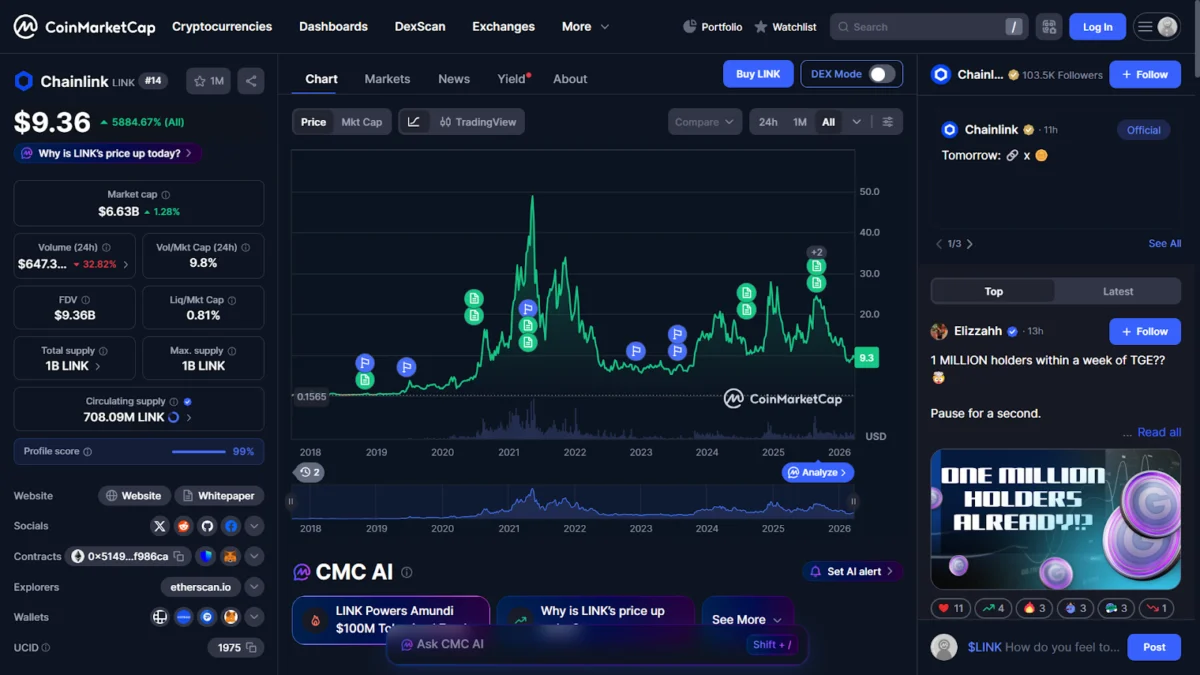
Chainlink, a pioneering decentralized oracle network, stands as a crucial infrastructure layer for the burgeoning world of decentralized finance (DeFi) and beyond. By bridging the critical gap between blockchain smart contracts and real-world data, Chainlink enables a vast array of innovative applications that were previously impossible. This in-depth analysis explores Chainlink’s current market standing, its historical trajectory, and the underlying technological advancements that are driving its widespread adoption across the global digital economy.
Chainlink’s Current Market Performance: A Stable Foundation
As of recent data, Chainlink (LINK) is trading at approximately $9.36, exhibiting a modest daily gain of +0.55%. The token’s 24-hour trading range has been observed between $9.02 and $9.38, indicating a period of relative stability. The circulating supply of LINK tokens stands at an estimated 708 million, contributing to a robust market capitalization of $6.44 billion.
Trading activity remains vigorous, with a substantial $408 million in 24-hour trading volume. This sustained interest is further underscored by the dominance of buyers in the capital markets, accounting for 74.8% of trades, compared to 25.2% from sellers. This strong buyer sentiment suggests a healthy level of confidence from both retail investors and larger institutional players who are increasingly integrating Chainlink’s oracle services into their strategies. The consistent demand for LINK, both for its utility within the network and as an investment, points to its established role in the crypto ecosystem.
A Look Back: Chainlink’s Historical Milestones and Growth
Understanding Chainlink’s present performance necessitates a review of its historical price action and developmental milestones. Like many digital assets, LINK has experienced significant volatility, a characteristic inherent to the nascent cryptocurrency market. However, its journey from its inception to its current standing highlights a clear pattern of adoption and consistent growth.
Examining the all-time high and low price points offers invaluable context for investors seeking to understand long-term market dynamics, support, and resistance levels. Chainlink reached its all-time high of $52.70 on May 9, 2021. This peak occurred during the broader cryptocurrency bull market of that year, largely propelled by the explosive growth of DeFi, which heavily relies on Chainlink’s robust oracle solutions to access external data. In stark contrast, its all-time low was recorded at a mere $0.09 on September 17, 2017, during its early post-token sale phase.
Despite its current price being significantly below its all-time peak, the astronomical percentage increase from its initial low (+10,011.00%) is a testament to Chainlink’s enduring value proposition and its successful navigation of market cycles. This trajectory suggests a strong foundational technology and a growing ecosystem that continues to support its long-term potential. Further analysis of its price prediction indicates that while past performance is not indicative of future results, the ongoing development and adoption trends offer a promising outlook.
What is Chainlink (LINK)? The Backbone of Decentralized Connectivity
At its core, Chainlink operates as a decentralized blockchain oracle network. To fully grasp its significance, it’s essential to understand a fundamental limitation of blockchain technology: its inherent isolation. Blockchains, by design, are closed, self-contained systems. They cannot natively access or interact with data that exists outside their own digital ledgers. This isolation poses a significant barrier to the development of sophisticated smart contracts that require information from the real world, such as asset prices, weather data, sports scores, or the results of external computations.
Addressing the Oracle Problem: Chainlink’s Innovative Solutions
Chainlink directly tackles this critical "oracle problem," which has been a major bottleneck for blockchain adoption and the expansion of smart contract functionalities. By providing a secure and reliable mechanism for off-chain data to be fed into on-chain smart contracts, Chainlink unlocks a multitude of use cases. This includes enabling DeFi protocols to accurately track asset prices for lending and borrowing, facilitating parametric insurance contracts that trigger payouts based on real-world events, and empowering supply chain management systems to record tangible events on the blockchain. The absence of such a solution would severely limit the practical application of smart contracts, confining them to purely on-chain activities.
The Mechanics of Chainlink: Decentralized Data Fetching
Chainlink’s innovative architecture relies on a decentralized network of independent oracle nodes. When a smart contract requires external data, it initiates a request. The Chainlink network then routes this request to multiple, geographically distributed Chainlink nodes. These nodes are tasked with retrieving the requested information from highly reputable and diverse data sources.
Upon gathering the data, the nodes engage in an aggregation process. They compare their findings, identify any discrepancies, and collaboratively arrive at a consensus-based, tamper-proof data point. This aggregated data is then cryptographically signed and delivered back to the requesting smart contract. This multi-node, consensus-driven approach is paramount to Chainlink’s security and reliability. It eliminates the single point of failure that would exist with a centralized oracle and ensures that the data provided to smart contracts is accurate, trustworthy, and resistant to manipulation. This robust design has positioned Chainlink as a trusted provider for high-value, mission-critical applications across various industries.
LINK Tokenomics and Supply: Fueling the Network
The LINK token is the native utility token that powers the entire Chainlink ecosystem. Its tokenomics are designed to incentivize network participation, secure the network, and facilitate transactions. LINK serves a dual purpose:

- Payment for Services: Node operators who provide data feeds to smart contracts are compensated in LINK tokens. This economic incentive ensures that a network of reliable and dedicated node operators is maintained.
- Network Security and Staking: LINK tokens can be staked by network participants to enhance the security and reliability of Chainlink’s data feeds. By staking their LINK, individuals contribute to the network’s integrity and, in return, earn additional LINK rewards. This staking mechanism aligns the economic interests of token holders with the overall health and security of the Chainlink network.
The distribution of LINK tokens is as follows:
- Node Operators & Ecosystem: 35% (350 million LINK) is allocated to incentivize network participants and foster ecosystem growth.
- Private Token Sale: 32.3% (323 million LINK) was distributed to early backers who supported the project during its private funding rounds.
- Company Retained: 30% (300 million LINK) is held by the company to fund ongoing development, research, and operational expenses.
- Public Token Sale: 27% (27 million LINK) was sold to the broader community during the initial coin offering (ICO), allowing for wider distribution and public participation.
The maximum supply of LINK tokens is capped at 1 billion. The project team is gradually releasing approximately 70 million LINK into the circulating supply each year, with the aim of achieving full market circulation by the first quarter of 2030. This controlled release schedule is designed to manage inflation and provide predictable supply dynamics.
Staking requires a minimum deposit of 1,000 LINK tokens. By locking up their assets and providing cryptographic security guarantees, stakers are rewarded with additional LINK, further encouraging participation and network security.
Chainlink Project Development: A History of Innovation
Chainlink was co-founded in 2017 by Sergey Nazarov and Steve Ellis, two figures who have become prominent in the blockchain space. The project successfully raised $32 million through its initial token sale, attracting both private investors who acquired tokens at $0.09 and public investors at $0.11. This early funding provided the necessary capital to build out the robust infrastructure that Chainlink is known for today.
The official launch of the Chainlink mainnet on May 30, 2019, marked a significant milestone, transitioning the project from its developmental phase to a fully operational network. Since its inception, Chainlink has facilitated trillions of dollars in transaction value, a testament to its widespread adoption and the critical role it plays in securing billions of dollars worth of smart contract assets.
The project has consistently focused on expanding its ecosystem and forging new partnerships. Chainlink’s ongoing integrations with traditional financial institutions and global systems underscore its ambition to bring real-world assets and processes onto the blockchain. This includes initiatives like the Cross-Chain Interoperability Protocol (CCIP), which aims to enable seamless communication and value transfer between different blockchain networks, further solidifying Chainlink’s position as a foundational technology for a multi-chain future.
Chainlink’s Impact and Future Implications
Chainlink’s impact extends far beyond the realm of decentralized finance. Its ability to securely connect smart contracts with the real world is paving the way for innovations in areas such as:
- Decentralized Insurance: Parametric insurance products can automatically payout based on verifiable real-world events like natural disasters or flight delays, using Chainlink oracles to fetch the necessary data.
- Gaming and NFTs: Chainlink’s Verifiable Random Function (VRF) provides provably fair and unpredictable randomness, essential for in-game mechanics, loot box generation, and the creation of unique NFTs.
- Enterprise Solutions: Businesses can leverage Chainlink to integrate their existing data systems with blockchain applications, creating more transparent and efficient supply chains, financial reporting, and asset management.
- Cross-Chain Functionality: The development of protocols like CCIP by Chainlink is crucial for the future of blockchain interoperability, allowing for seamless asset transfers and data sharing across disparate blockchain networks.
The continuous development of new oracle services and the expansion of its network of partners signal a strong commitment to innovation. As the blockchain ecosystem matures and the demand for reliable off-chain data integration grows, Chainlink is exceptionally well-positioned to remain a central pillar of this evolution. Its role in enabling complex smart contract logic and its growing adoption by both decentralized and traditional entities solidify its status as a vital piece of infrastructure for the digital economy.
Frequently Asked Questions About Chainlink (LINK)
-
What is LINK used for?
LINK is the native utility token of the Chainlink network. Its primary function is to pay Chainlink node operators for providing secure and reliable data to smart contracts. Additionally, LINK can be staked to enhance network security and earn rewards, making it an integral component of the Chainlink ecosystem’s economic model and security framework. -
Who are the founders of Chainlink?
Chainlink was co-founded by Sergey Nazarov and Steve Ellis. Sergey Nazarov, a prominent figure in the blockchain industry since 2011, serves as the visionary leader of the project. Steve Ellis, the Chief Technology Officer, co-authored the Chainlink whitepaper and was instrumental in the technical development and architecture of the network. -
What is the projected value of Chainlink in the future?
The future value of Chainlink is subject to various factors, including the continued adoption of its oracle services, the participation rates in its staking programs, and ongoing technological advancements. Analysts have provided predictions, with some suggesting that LINK could reach an average market price of $16 by 2026. However, its potential for further growth is significantly tied to the expansion of its oracle solutions across DeFi, NFTs, and enterprise applications, as well as broader market conditions. -
How can one purchase LINK tokens?
To acquire LINK tokens, individuals can register on reputable cryptocurrency exchanges that list the token. Popular platforms include Binance, Kraken, and Coinbase. After completing the account verification process and depositing funds, users can search for the LINK trading pair and execute a buy order. It is highly recommended to store purchased LINK tokens securely in a dedicated cryptocurrency wallet for enhanced safety and control. -
What differentiates Chainlink from other oracle solutions?
Chainlink distinguishes itself as a leading decentralized oracle network that provides secure and reliable connections between blockchain smart contracts and real-world data. Key differentiating features include its robust decentralized architecture, its Cross-Chain Interoperability Protocol (CCIP) which facilitates cross-blockchain communication, and its Verifiable Random Functions (VRF) for provably fair randomness. These innovations position Chainlink as a critical infrastructure layer for decentralized finance and a wide array of other applications. -
What factors influence the price of Chainlink?
The price of Chainlink is influenced by a confluence of factors. These include the adoption rate of its oracle services by new projects and existing protocols, the level of participation in its token staking mechanisms, and ongoing technological developments and upgrades. Broader cryptocurrency market trends, evolving regulatory landscapes, and macroeconomic conditions also play a significant role in determining LINK’s overall market value and price fluctuations.