James Watt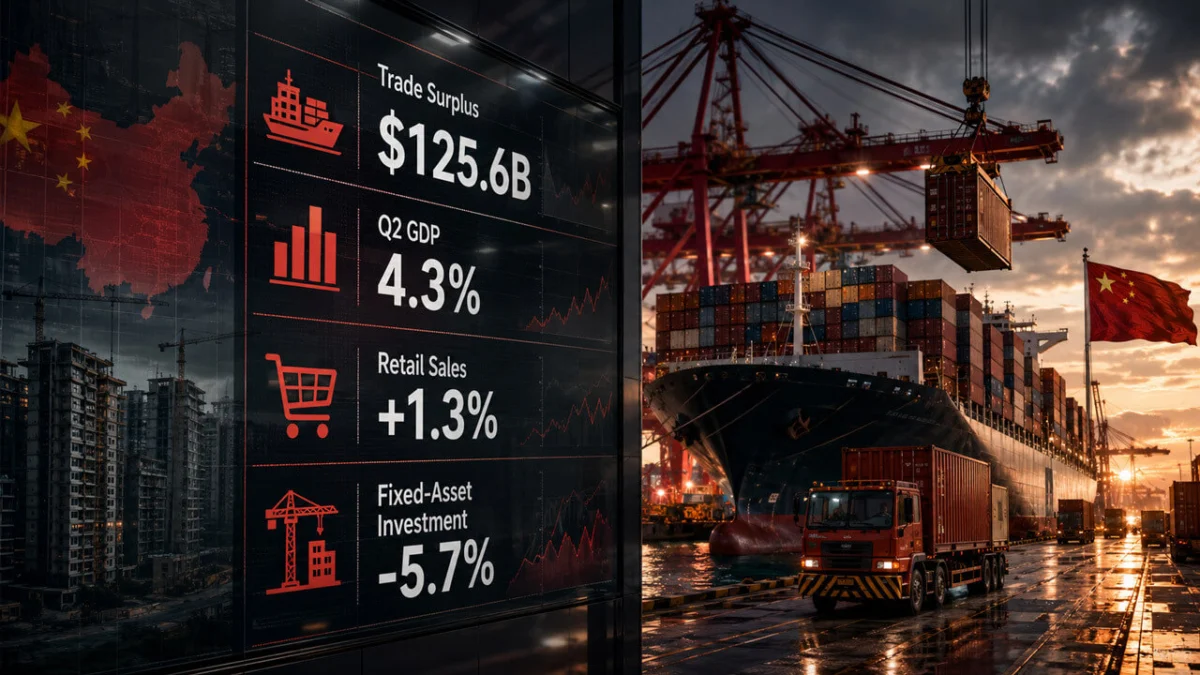
The People’s Republic of China released a series of macroeconomic indicators for June and the second quarter of 2026 that present a starkly bifurcated view of the world’s second-largest economy. While the nation’s industrial machine continues to churn out goods for global markets at a record pace, the internal engines of consumption, property development, and private investment are showing signs of significant exhaustion. This divergence has created a paradoxical economic landscape where a staggering $125.6 billion monthly trade surplus exists alongside a Gross Domestic Product (GDP) growth rate that has failed to meet market expectations, signaling a profound imbalance between production and domestic absorption.
According to the official data released by the National Bureau of Statistics (NBS), China’s GDP grew by 4.3% year-over-year in the second quarter of 2026. This figure represents a notable deceleration from the 5.0% growth recorded in the first quarter and falls short of the 4.5% expansion forecasted by a consensus of international economists. On a quarter-over-quarter basis, the economy expanded by a mere 0.9%, underscoring a loss of momentum in a system that remains historically reliant on high levels of investment and industrial throughput.
A Tale of Two Economies: External Strength vs. Internal Fragility
The primary driver of China’s continued growth remains its export sector, which has increasingly pivoted toward higher-value industrial and high-tech goods. The State Council’s summary of the June data indicates that total imports and exports surged by 24.2% year-over-year. Exports specifically rose by 20.8%, while imports—driven largely by industrial inputs rather than consumer goods—grew by 29.4%.
For the first half of 2026, the cumulative value of trade reached 25.47 trillion yuan, a 16.9% increase over the previous year. A critical component of this success is the mechanical and electrical sector, which saw exports rise by 20.1%, now accounting for 63.5% of the nation’s total goods trade. Furthermore, China’s strategic "Belt and Road" partnerships have proven resilient, with trade involving these nations rising by 14.8%. Private enterprises, often cited as the most dynamic segment of the Chinese economy, were responsible for 57% of the total trade volume.
However, these robust trade figures fail to mask the systemic vulnerabilities within the domestic economy. The same reporting period revealed a contraction in nearly every major category of domestic investment. Fixed-asset investment declined by 5.7% in the first half of the year, while infrastructure investment—traditionally a reliable lever for government stimulus—fell by 2.4%. Manufacturing investment dipped by 1.2%, and private sector investment saw a sharp decline of 8.5%, reflecting a pervasive lack of confidence among business owners regarding future demand.
The Property Sector Crisis and the Wealth Effect
The most significant drag on the Chinese economy remains the protracted crisis in the real estate market. Once the backbone of Chinese household wealth and a primary source of revenue for local governments, the sector continues to shrink at an alarming rate. Real estate development investment plummeted by 18% in the first half of 2026.
The secondary effects of this decline are evident in the transaction data. The total floor space of commercial buildings sold fell by 11.6%, and the total value of newly built commercial property sales dropped by 13.6%. This contraction creates a negative wealth effect: as property values stagnate or decline, Chinese households—who hold the vast majority of their assets in real estate—feel significantly poorer.
This psychological and financial shift is reflected in retail sales, which grew by a tepid 1.3% over the first half of the year. When households are concerned about job security and the declining value of their primary asset, they tend to increase precautionary savings rather than engage in discretionary spending. This cycle of weak demand becomes self-reinforcing, as lower consumer spending leads to reduced revenue for businesses, which in turn leads to further cuts in private investment and employment.
Chronology of Economic Transition (2024–2026)
To understand the current impasse, it is necessary to view the 2026 data within the context of China’s recent economic trajectory.
- Late 2024: Beijing began a concerted effort to shift the economy away from "low-quality" property-led growth toward "New Productive Forces," focusing on high-tech manufacturing, green energy, and aerospace.
- Early 2025: Initial success in the EV and battery sectors led to increased trade tensions with the EU and the United States, as Western nations raised concerns regarding Chinese overcapacity and subsidies.
- Late 2025: Local government debt reached critical levels, limiting the ability of regional authorities to fund traditional infrastructure projects. The central government began emphasizing "debt repair" over aggressive expansion.
- Q1 2026: China posted a 5.0% GDP growth rate, buoyed by a post-holiday manufacturing surge and strong demand from emerging markets.
- Q2 2026: The divergence between factory output and domestic consumption widened. Despite a record trade surplus in June, internal indicators like retail sales and property investment reached multi-year lows, resulting in the 4.3% GDP miss.
Supporting Data: The Growth-Weakness Gap
The following table summarizes the disparity between the sectors that continue to drive the economy and those that are currently acting as a significant drag on national growth.
| Indicator of Strength | June/H1 Performance | Indicator of Weakness | Q2/H1 Performance |
|---|---|---|---|
| Total Goods Trade (June) | +24.2% YoY | Q2 GDP Growth (YoY) | 4.3% |
| Total Exports (June) | +20.8% YoY | Q2 GDP Growth (QoQ) | 0.9% |
| Mechanical & Electrical Exports | +20.1% YoY | Fixed-Asset Investment | -5.7% |
| Belt and Road Trade | +14.8% YoY | Infrastructure Investment | -2.4% |
| High-Tech Industry Investment | +4.6% YoY | Manufacturing Investment | -1.2% |
| Private Enterprise Trade Share | 57.0% | Real Estate Investment | -18.0% |
| Monthly Trade Surplus | $125.6 Billion | Private Investment | -8.5% |
| Aerospace Manufacturing | Strong Gains | Retail Sales | +1.3% |
Official Responses and the Policy Crossroads
The disappointing second-quarter results have placed intense pressure on Beijing to deliver a more robust policy response. Premier Li Qiang recently called for an "objective understanding" of the current economic challenges, urging officials to implement "counter-cyclical adjustments" to stabilize the market. While this language suggests that the government is aware of the building pressure, specific details on new stimulus measures remain sparse.
Market analysts and investors are now focused on the upcoming Politburo meeting scheduled for late July. This meeting is expected to set the tone for economic policy for the remainder of the year. The central question is whether Beijing will double down on its investment-led model by funneling more capital into industrial supply or if it will pivot toward direct household support.
There are three primary paths available to Chinese policymakers:
- Industrial Stimulus: Further investment in high-tech manufacturing. While this supports GDP in the short term, it risks exacerbating global trade tensions and ignores the underlying demand problem.
- Household Support: Implementing income transfers, consumer subsidies, or social safety net enhancements. This would address the consumption gap but requires a fundamental shift in the Chinese Communist Party’s long-standing economic philosophy.
- Managed Deceleration: Accepting slower growth rates while focusing on deleveraging local government debt and cleaning up the property sector. This path risks social instability if unemployment rises or wealth continues to evaporate.
Global Implications and the Crypto Liquidity Link
The health of the Chinese economy has far-reaching consequences for global financial markets. China’s reliance on exports to offset weak domestic demand has turned its trade surplus into a "pressure valve." By shipping excess capacity abroad, China maintains industrial employment, but this strategy increasingly exposes the nation to protectionist policies, anti-subsidy investigations, and tariffs in the US and Europe.
From a macroeconomic perspective, the way Beijing chooses to stimulate its economy often dictates global liquidity cycles. Historically, aggressive easing by the People’s Bank of China (PBoC) has led to easier global financial conditions and a weaker US Dollar. This environment is typically favorable for speculative and risk-on assets, including cryptocurrencies.
Market analysts have observed a consistent correlation between PBoC liquidity injections and the price of Bitcoin. If the July Politburo meeting results in significant monetary easing to support domestic demand, global investors may interpret this as a signal of increased liquidity, potentially boosting the crypto market. Conversely, if Beijing maintains a restrained posture while export frictions rise, the yuan could come under pressure, leading to capital flight and a stronger US Dollar, which generally creates a challenging environment for digital assets.
Conclusion: The Limits of Production-Led Growth
The data from the second quarter of 2026 serves as a definitive reminder that production is not a substitute for demand. While China’s ability to dominate global manufacturing remains unparalleled, an economy cannot thrive indefinitely on external demand alone—especially when its largest trading partners are increasingly wary of its industrial scale.
The record trade surplus is a testament to China’s industrial efficiency, but it is also a symptom of a domestic economy that cannot consume what it produces. Until there is a meaningful recovery in the property sector and a restoration of consumer confidence, China’s growth will remain fragile and overly dependent on the political and economic climates of foreign nations. The coming months will determine if Beijing can successfully rebalance its economy or if it will continue to rely on an export-heavy model that is increasingly at odds with the rest of the world.