
 admin
admin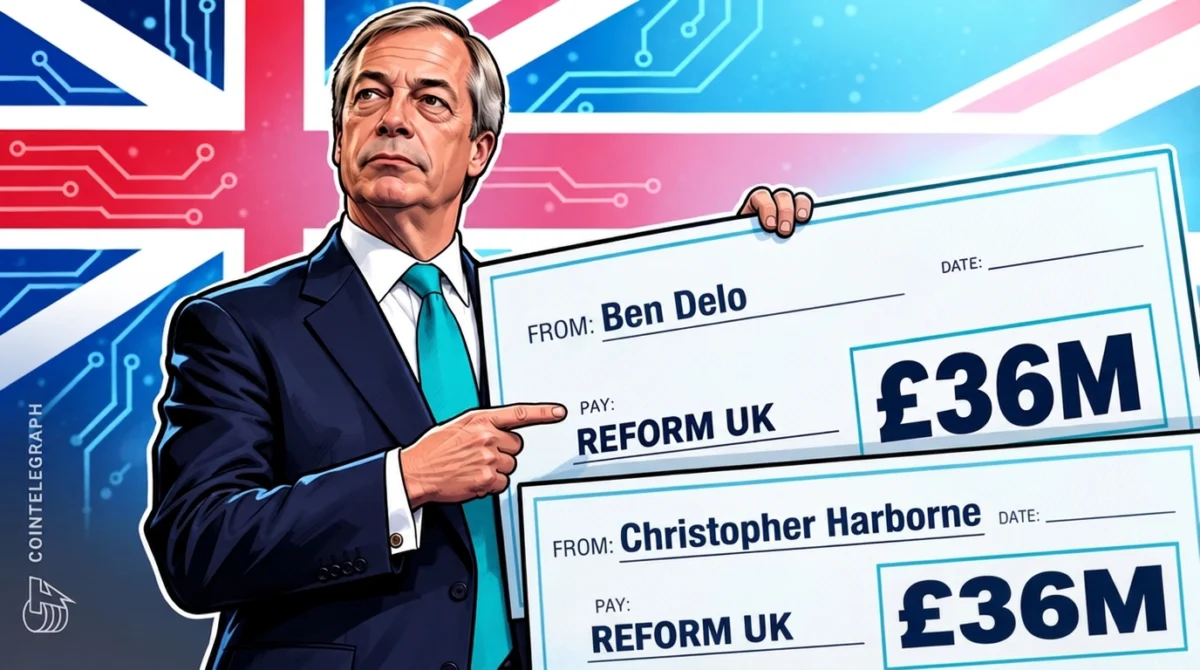
The landscape of British political financing has undergone a seismic shift following the announcement that Reform UK, led by Nigel Farage, has secured a combined 72 million pounds ($97 million) from two prominent figures in the cryptocurrency industry. This unprecedented influx of capital, provided by BitMEX co-founder Ben Delo and tech investor Christopher Harborne, represents the largest joint donation ever recorded in the history of United Kingdom politics. The scale of the funding, confirmed in mid-September 2026, has fundamentally altered the financial trajectory of the party as it prepares for a long-term campaign leading into the next general election.
The surge in funding began on Friday, September 11, 2026, when Ben Delo announced a 36 million pound contribution. Within 24 hours, Christopher Harborne matched the figure, bringing the total to 72 million pounds. This financial injection follows an earlier donation of 9 million pounds made by Harborne in August 2025, solidifying his position as one of the party’s most significant financial backers. The sheer volume of these contributions has sparked intense debate within Westminster regarding the influence of digital asset wealth on the democratic process and the transparency of political funding in the digital age.
The Mechanics of the Record-Breaking Donations
The 72 million pound total is a figure that dwarfs the annual fundraising capabilities of the UK’s traditionally dominant parties, the Conservatives and Labour. To put the figure into perspective, the Conservative Party typically reports annual donation totals ranging between 25 million and 50 million pounds during non-election years. Reform UK’s acquisition of such a substantial sum in a single weekend effectively grants the party a war chest that exceeds the legal spending limits for a single general election cycle, which currently sits at approximately 35 million pounds per party for constituency and national campaigning combined.
Ben Delo, who gained prominence as a co-founder of the cryptocurrency derivatives exchange BitMEX, characterized his 36 million pound donation as a strategic, long-term commitment. In a statement provided to The Telegraph, Delo explained that the sum was intended to represent 1 million pounds for every month leading up to the anticipated 2029 general election. Crucially, Delo opted to provide the entire amount as an upfront payment. He noted that this maneuver was intended to ensure the funds reached the party’s accounts immediately, thereby bypassing potential future legislative hurdles or banking blocks that might arise from shifting regulations surrounding cryptocurrency-derived wealth.
Christopher Harborne’s decision to match Delo’s contribution was, by his own admission, a reactionary move inspired by Delo’s commitment. Harborne, a British businessman with extensive interests in aviation and technology, has been a recurring figure in the financing of pro-Brexit and right-leaning political movements. Writing in The Telegraph, Harborne emphasized that his contribution was made without the expectation of personal gain or political patronage. He explicitly stated that he sought "no peerage, no policy change," but rather aimed to facilitate the development of a political alternative that he believes is "ready for government."
A Timeline of Reform UK’s Financial Evolution
The path to this record-breaking weekend has been marked by both financial growth and significant political controversy. Understanding the context of these donations requires a look at the chronological developments involving Nigel Farage and his party over the preceding 24 months.
August 2025: Christopher Harborne makes a 9 million pound donation to Reform UK, signaling the start of a period of rapid financial scaling for the party. This donation coincided with Reform UK’s efforts to professionalize its grassroots infrastructure.
March 2026: In response to the increasing prevalence of digital asset-linked donations, the UK government announces a temporary moratorium on direct cryptocurrency donations to political parties, pending further legislative review. While this did not ban donations from individuals who made their wealth in crypto, it created a climate of heightened scrutiny for such donors.
July 2026: Nigel Farage resigns his position as a Member of Parliament (MP) following a scandal involving "gifts" and donations from Christopher Harborne and George Cottrell, another figure with ties to the crypto industry. The resignation triggers a high-profile by-election.
August 2026: Despite the controversy, Farage contests the by-election for his vacated seat. He secures a decisive victory with 63% of the vote, defeating a field of candidates that included the satirical figure Count Binface. The victory is seen as a validation of his leadership by his constituency, despite the ongoing investigations.
September 11-12, 2026: Ben Delo and Christopher Harborne announce their matching 36 million pound donations, totaling 72 million pounds.
Profiles of the Donors and Legal Context
The backgrounds of the two primary donors have become a focal point for critics of the party. Ben Delo’s involvement is particularly noteworthy due to his previous legal challenges in the United States. In 2022, Delo and his fellow BitMEX co-founders, Arthur Hayes and Samuel Reed, pleaded guilty to federal charges of violating the Bank Secrecy Act (BSA) by failing to implement adequate anti-money laundering (AML) protocols at their exchange.
While Delo paid a $10 million criminal fine and served a period of probation, he avoided a prison sentence. The legal narrative took another turn in March 2025, when outgoing US President Donald Trump issued a full presidential pardon to Delo and his colleagues. This pardon effectively cleared Delo’s record in the United States, a factor that likely played a role in his ability to move large sums of capital internationally for political purposes without the immediate interference of international financial regulators.
Christopher Harborne, while not facing the same criminal history as Delo, has nonetheless been a central figure in the investigation into Farage’s financial disclosures. Harborne’s wealth is largely derived from his ownership of AML Global and his early investments in technology and digital assets. His repeated support for Farage—spanning from the Brexit Party era to the current Reform UK structure—has made him a primary target for parliamentary committees looking into "dark money" and the transparency of non-traditional political funding.
Official Responses and Political Repercussions
Nigel Farage has welcomed the donations with characteristic defiance, framing the 72 million pounds as a necessary tool to combat what he describes as a rigged political system. In statements following the news, Farage argued that the funding would allow Reform UK to compete on a "level playing field" with the Conservative and Labour parties, both of which benefit from established donor networks and, in the case of Labour, significant trade union backing.
"For too long, the two-party duopoly has held a monopoly on political funding," Farage stated. "This support ensures that we can take our message to every doorstep in the country without being outspent by the Westminster establishment."
However, the reaction from the opposing benches has been one of alarm. Labour MPs, who have been increasingly vocal about the risks of cryptocurrency influence, are reportedly pushing for more stringent measures. Following the resignation of Farage in July and the subsequent by-election, several high-ranking Labour officials suggested that the March moratorium on crypto-related donations should be made permanent.
The concern among lawmakers is twofold: first, the volatility and pseudonymity associated with digital assets could make it difficult to trace the ultimate source of political funds; and second, the sheer scale of the wealth generated in the crypto sector allows individual billionaires to exert a disproportionate influence on national policy.
Analysis of Broader Implications for UK Politics
The injection of 72 million pounds into a single minority party carries profound implications for the future of British elections. Historically, UK politics has been defined by relatively modest spending compared to the multi-billion dollar cycles seen in the United States. This massive donation suggests a "hyper-financialization" of the UK political landscape, where the entry of a few high-net-worth individuals can suddenly elevate a third party to the financial status of a major contender.
For Reform UK, the money provides several strategic advantages:
- Professionalization: The party can now afford to hire top-tier political consultants, data analysts, and digital marketing firms to refine its messaging.
- Ground Operations: Unlike the Conservatives or Labour, Reform UK has historically lacked a robust local branch network. These funds could be used to establish permanent offices in every constituency.
- Media Presence: A significant portion of the funds is expected to be diverted toward sophisticated social media advertising and independent media production, bypassing traditional broadcasting channels.
Furthermore, the involvement of crypto-wealthy individuals highlights a growing trend of "digital asset lobbying." As the UK government seeks to position the country as a global hub for fintech and cryptocurrency, the financial interests of donors like Delo and Harborne may naturally align with specific regulatory outcomes. While Harborne denied seeking policy changes, the presence of such significant backers ensures that the interests of the crypto industry will remain a central theme in Reform UK’s economic platform.
Regulatory Scrutiny and the Future of Funding
The Electoral Commission, the UK’s independent watchdog for political finance, is expected to come under pressure to review the legality and ethics of these donations. Current rules require that donors be on the UK electoral register or be companies registered and carrying on business in the UK. As long as Delo and Harborne meet these criteria and the funds are shown to be personal wealth rather than corporate or foreign-sourced, the donations are technically legal under existing statutes.
However, the "upfront" nature of Delo’s 36 million pound payment suggests a tactical awareness of potential future changes to the law. If the Labour government moves to cap individual donations or further restrict the use of wealth derived from unregulated financial sectors, Reform UK’s current windfall will be "grandfathered" in, giving them a sustained advantage for the next three years.
As the investigation into Farage’s previous "gifts" continues, the 72 million pound donation stands as a testament to the shifting power dynamics in British society. The traditional gatekeepers of political influence—old-money families, trade unions, and established corporations—now face a new challenger in the form of the "crypto-elite." Whether this leads to a more diverse political discourse or simply a new form of financial dominance remains the central question for the UK’s democratic future.








