Nila Kartika Wati
US-listed spot Bitcoin exchange-traded funds (ETFs) experienced a significant return to net inflows on Monday, driven almost entirely by BlackRock’s considerable contribution, signaling a renewed bullish sentiment in the digital asset market. This resurgence in capital inflow comes after a brief pause, with Ether, XRP, and Solana funds simultaneously extending their impressive streaks of attracting investor capital, underscoring a broader institutional embrace of diverse cryptocurrency assets.
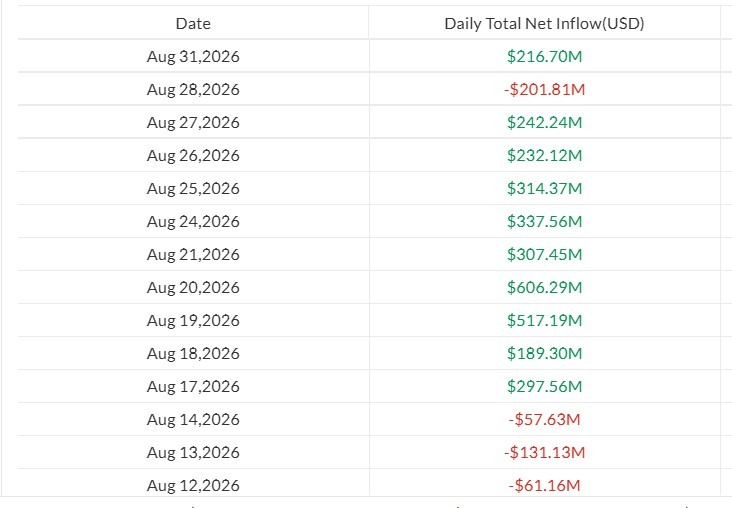
According to data compiled by SoSoValue, Bitcoin ETFs collectively recorded $216.7 million in net inflows on Monday. This positive shift effectively reversed the $201.8 million in net withdrawals observed on Friday, which had momentarily interrupted a robust nine-session run that had seen over $3 billion flow into these funds. The market reacted positively, with Bitcoin (BTC) trading near $78,700 at the time of reporting, marking an approximate 1.5% increase over the preceding 24 hours, as per CoinGecko. Beyond Bitcoin, the momentum continued across the altcoin spectrum, with spot Ether ETFs extending their inflow streak to an eleventh consecutive trading session. Similarly, XRP and Solana funds each posted their tenth consecutive session of positive capital accumulation, highlighting a growing appetite for diversified crypto exposure through regulated investment vehicles.
The Genesis and Impact of Spot Bitcoin ETFs
The journey for spot Bitcoin ETFs to gain regulatory approval in the United States was protracted and arduous, spanning over a decade. Initially, the U.S. Securities and Exchange Commission (SEC) consistently rejected proposals, citing concerns over market manipulation, lack of surveillance-sharing agreements, and investor protection. This stance slowly began to shift following the introduction of Bitcoin futures ETFs in late 2021 and increasing pressure from industry participants and legal challenges. The landmark approval of nearly a dozen spot Bitcoin ETFs in January 2024 marked a pivotal moment, opening the floodgates for traditional finance to directly access Bitcoin without the complexities of direct cryptocurrency ownership or the premium/discount issues often associated with closed-end funds like Grayscale Bitcoin Trust (GBTC) prior to its conversion.
The introduction of these ETFs immediately catalyzed a massive influx of institutional capital, providing a regulated, accessible, and familiar investment avenue for pension funds, hedge funds, wealth managers, and retail investors alike. Their launch coincided with a significant bull run for Bitcoin, pushing its price to new all-time highs and legitimizing cryptocurrency as a mainstream asset class in the eyes of many traditional investors. The initial weeks saw billions pour into new offerings from major financial players, even as GBTC experienced substantial outflows as investors migrated to lower-fee alternatives. This period firmly established the spot Bitcoin ETF as a cornerstone of modern digital asset investment.
Bitcoin ETF Rebound: A Closer Look at Monday’s Dynamics
Monday’s return to net inflows for spot Bitcoin ETFs, totaling $216.7 million, was a strong signal of renewed investor confidence following Friday’s minor correction. This rebound was overwhelmingly spearheaded by BlackRock’s iShares Bitcoin Trust (IBIT), which alone garnered an impressive $205.9 million in net inflows. This figure represents approximately 95% of the entire category’s daily total, according to data from Farside Investors, solidifying BlackRock’s position as a dominant force in the nascent spot Bitcoin ETF market.
BlackRock’s aggressive marketing, vast distribution network, and established reputation in traditional finance have consistently positioned IBIT as a frontrunner among its peers. Its ability to attract such a disproportionate share of inflows on a day of overall category recovery underscores its appeal to both institutional and sophisticated retail investors seeking exposure to Bitcoin through a trusted brand.

Beyond BlackRock, several other funds also contributed positively to the day’s total. Fidelity’s Wise Origin Bitcoin Fund (FBTC) added a respectable $6.9 million, while the Bitwise Bitcoin ETF (BITB) saw $4.3 million in new capital. Morgan Stanley’s Bitcoin Trust recorded $3.6 million in inflows, and Grayscale’s Bitcoin Mini Trust, a more recent offering designed to compete with lower-fee products, attracted $9.4 million. These contributions, while smaller than BlackRock’s, demonstrate a diversified interest across multiple issuers.
In contrast, VanEck’s Bitcoin ETF (HODL) was the sole fund to register withdrawals, posting $13.4 million in net outflows. The remaining funds within the category reported no significant flows, indicating a stable or neutral stance from their respective investor bases. The overall pattern suggests a consolidation of investor preference towards a few key players, with BlackRock emerging as the clear leader in this competitive landscape. The market’s quick absorption of Friday’s outflows and the robust return to positive flows suggest that the underlying demand for Bitcoin exposure through ETFs remains strong, indicating that recent price movements might be interpreted as buying opportunities by institutional players.
Expanding Horizons: Altcoin ETFs Gain Traction
The narrative of institutional adoption is not confined solely to Bitcoin. The success of spot Bitcoin ETFs has paved the way for other major cryptocurrencies to gain similar investment vehicles, signaling a maturation of the broader digital asset ecosystem. Spot Ether ETFs, in particular, have demonstrated remarkable consistency, attracting $87.7 million on Monday alone, marking their eleventh consecutive trading session of inflows.
This sustained interest in Ether ETFs reflects growing optimism surrounding Ethereum’s ecosystem and its pivotal role in decentralized finance (DeFi), NFTs, and smart contracts. Following a similar, albeit shorter, regulatory journey to Bitcoin, the approval of spot Ether ETFs in the US was a significant milestone. BlackRock’s iShares Ethereum Trust ETF (ETHA) led the charge with $59.9 million in inflows on Monday, mirroring its dominance in the Bitcoin space. Grayscale’s Ethereum Mini Trust followed with $13.5 million, and Fidelity’s Ethereum Fund added $9.3 million, according to Farside data. The consistent inflows suggest that investors are increasingly viewing Ether as a strategic long-term holding, recognizing its potential for significant growth and its fundamental importance to the Web3 landscape.
Beyond Ethereum, other prominent altcoins are also making inroads into the ETF market. XRP ETFs extended their positive run to ten sessions, securing $5.64 million in net inflows on Monday, as reported by SoSoValue. These funds have consistently attracted capital during every US trading session since August 18. This sustained interest in XRP ETFs is particularly noteworthy given the token’s past regulatory uncertainties. The resolution of key legal challenges and the potential for a clearer regulatory pathway have seemingly reignited investor confidence, positioning XRP as an attractive asset for diversified crypto portfolios. The consistent inflows indicate a belief among investors that XRP’s utility in cross-border payments and its established ecosystem will drive future value.
Solana ETFs also celebrated their tenth consecutive positive session, though Monday’s daily inflows saw a slight deceleration to $925,010 from a more robust $18.1 million on Friday. Despite the slower pace, this marks the longest continuous inflow streak for Solana ETFs since their inception. Solana has emerged as a high-performance blockchain, lauded for its speed and scalability, making it a compelling alternative to Ethereum for various decentralized applications. The steady, albeit sometimes modest, inflows into Solana ETFs indicate a recognition of its technological advancements and growing developer ecosystem. Even smaller, consistent inflows signify that institutional capital is gradually flowing into assets beyond the top two, suggesting a deeper exploration of the altcoin market for growth opportunities.
Market Dynamics, Investor Sentiment, and Broader Implications
The recent trends in cryptocurrency ETF inflows paint a vivid picture of a maturing market characterized by increasing institutional participation and a sophisticated approach to digital asset investment. The rebound in Bitcoin ETF flows, particularly BlackRock’s dominant contribution, underscores the continued strong demand for the flagship cryptocurrency as a strategic asset. This demand is driven by factors such as Bitcoin’s perceived role as a store of value, a hedge against inflation, and its growing acceptance in mainstream finance.
The sustained inflows into Ether, XRP, and Solana ETFs highlight a broader shift in investor sentiment, moving beyond a singular focus on Bitcoin towards a diversified portfolio of digital assets. This diversification strategy is indicative of investors seeking exposure to different facets of the crypto economy, from smart contract platforms like Ethereum and Solana to payment-focused cryptocurrencies like XRP. It also suggests a growing understanding and acceptance of the unique value propositions offered by various blockchain networks.
From an economic perspective, these consistent inflows could be interpreted as a ‘risk-on’ sentiment among investors, where capital is being allocated to higher-growth, albeit potentially more volatile, assets like cryptocurrencies. This trend might be influenced by broader macroeconomic conditions, such as prevailing interest rates, inflation expectations, and the performance of traditional equity markets. As investors seek yield and diversification outside conventional assets, cryptocurrencies, accessed through regulated ETF products, become increasingly attractive. The ease of trading, liquidity, and regulatory oversight offered by ETFs further lowers the barrier to entry for a wider range of institutional and retail investors.
The long-term implications of these trends are profound. The continuous flow of capital into spot crypto ETFs signifies a structural integration of digital assets into the global financial system. This integration fosters greater market efficiency, liquidity, and price discovery for cryptocurrencies. Furthermore, it paves the way for the development of more sophisticated financial products, such as options and futures on these ETFs, further deepening market participation.
Expert Perspectives and Future Outlook
Market analysts widely interpret the current patterns of crypto ETF inflows as a bullish indicator for the digital asset space. Industry experts suggest that the consistent inflows into a diversified basket of crypto ETFs underscore a maturing market, where institutional players are increasingly comfortable allocating capital to this asset class. Analysts from major financial institutions often highlight that the accessibility and regulatory clarity provided by these ETFs are key drivers, facilitating investment from entities previously constrained by compliance and operational hurdles.
Looking ahead, the regulatory landscape remains a critical factor. While spot Bitcoin and Ether ETFs have gained approval in the US, the path for other altcoin ETFs may still involve significant scrutiny. However, the precedent set by these approvals creates a framework for future applications, potentially leading to a broader array of single-asset or even multi-asset crypto ETFs. The success of current offerings could incentivize issuers to explore ETFs for other major cryptocurrencies with strong fundamentals and clear use cases.
Despite the prevailing optimism, challenges persist. Market volatility remains a characteristic of the cryptocurrency space, and macroeconomic headwinds could impact investor sentiment. Regulatory shifts, both within the US and globally, could also influence the trajectory of these investment products. Geopolitical events and technological developments within the blockchain ecosystem will also play a role in shaping future demand.
Nonetheless, the overwhelming consensus points towards a future where digital assets are an undeniable part of mainstream investment portfolios. The consistent and diversified inflows into spot crypto ETFs are not merely transient market fluctuations but rather a testament to the enduring appeal and growing legitimacy of cryptocurrencies as a distinct and valuable asset class, reshaping the landscape of global finance for decades to come. The significant rebound in Bitcoin ETF inflows, led by financial titans like BlackRock, alongside the sustained momentum in altcoin funds, marks a pivotal phase in this ongoing financial revolution.