
 admin
admin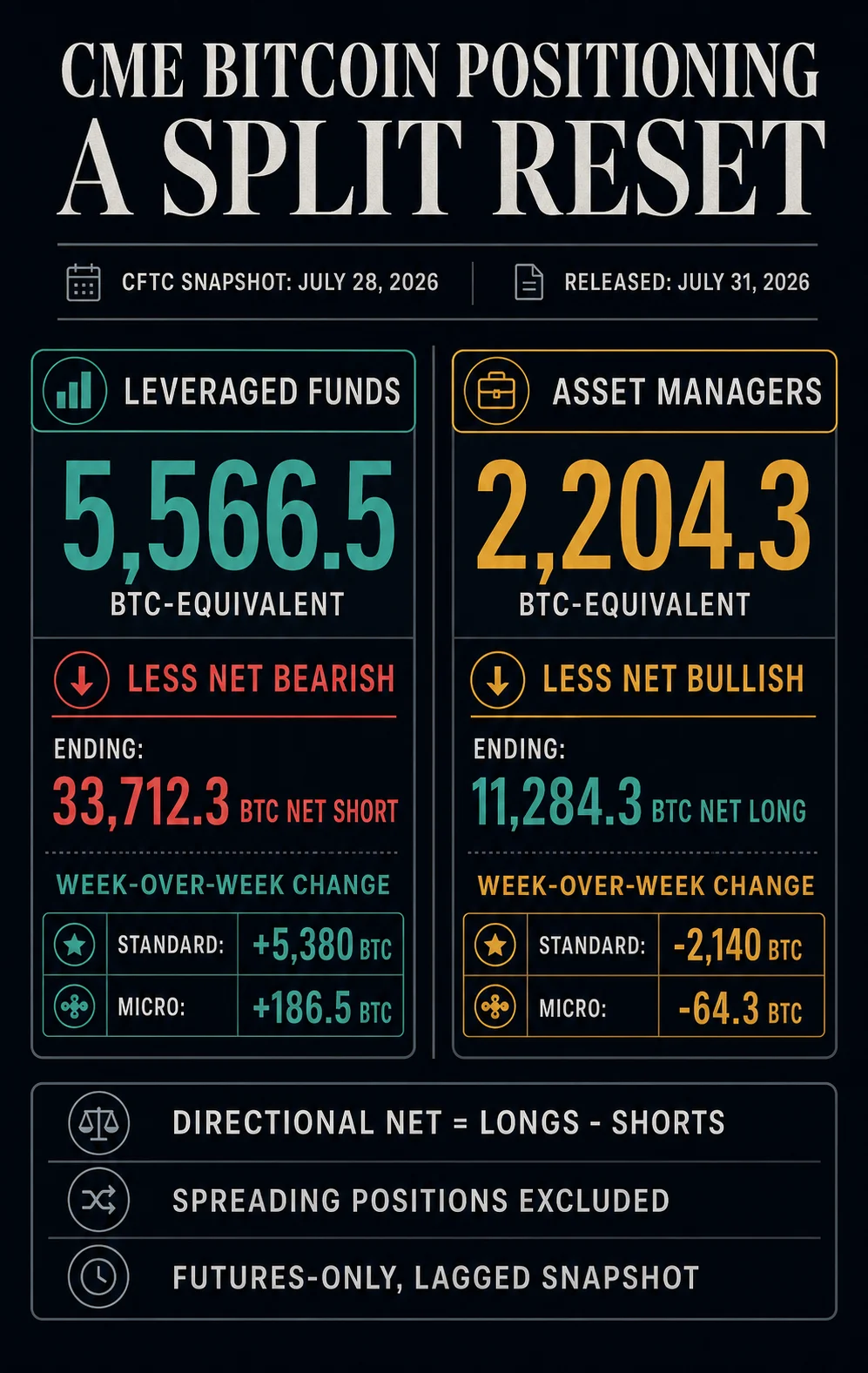
The latest snapshot of CME Bitcoin futures positioning, as of Tuesday, July 28, has revealed a complex and somewhat contradictory picture for market participants. While leveraged funds significantly reduced their net bearish exposure, a simultaneous pullback by asset managers has left the market without the clear bullish confirmation many had anticipated. The data, compiled by the Commodity Futures Trading Commission (CFTC) and released on Friday, July 31, indicates a nuanced market dynamic where a reduction in short-selling pressure did not automatically translate into a widespread bullish sentiment.
Leveraged Funds Reduce Bearish Bets Amidst Shifting Market Dynamics
Between Tuesday, July 21, and Tuesday, July 28, leveraged funds collectively decreased their net bearish position in CME’s standard and micro Bitcoin futures contracts by an equivalent of 5,566.5 Bitcoin. This reduction in bearish sentiment among a key segment of futures traders was a notable development, suggesting a potential shift in their outlook or a tactical repositioning in anticipation of market movements. The CFTC’s Commitment of Traders (COT) report, a weekly publication that details the positions held by different categories of traders, provides crucial insights into the underlying sentiment and potential future price action of Bitcoin.
Specifically, the report indicated that leveraged funds saw their net short position in standard Bitcoin futures contracts improve by 1,076 contracts, equating to approximately 5,380 BTC. This improvement in their directional net exposure suggests that either they closed out existing short positions or initiated new long positions. Concurrently, their net position in Micro Bitcoin futures contracts also saw a positive shift, with an improvement of 1,865 contracts, representing an additional 186.5 BTC. This segment of the market, often characterized by its responsiveness to short-term price fluctuations and its higher leverage, plays a significant role in driving volatility.
The CFTC report categorizes traders based on their primary business activities, with "leveraged funds" typically encompassing entities such as hedge funds, commodity trading advisors (CTAs), and other professional traders who utilize futures markets for speculative purposes. Their actions can often signal shifts in short-to-medium term market sentiment. A decrease in their net short positions can be interpreted as a signal that these sophisticated market participants are becoming less bearish, potentially anticipating price appreciation or reducing their risk exposure to downside movements.
Asset Managers Exhibit Countervailing Trend
However, the narrative of a purely bullish turn is complicated by the simultaneous actions of asset managers. Over the same July 21-28 period, asset managers, who are generally perceived as holding longer-term investment horizons and often represent institutional capital, saw their combined directional net weaken by 2,204.3 BTC-equivalent. This indicates that asset managers were either reducing their net long positions or increasing their net short positions, a move that counteracted the deleveraging observed among leveraged funds.
The data shows that on July 28, leveraged funds maintained a net short position of 33,712.3 BTC-equivalent, while asset managers held a net long position of 11,284.3 BTC-equivalent. This divergence in positioning highlights a split in market sentiment between these two influential trader groups. The weakening net long position of asset managers suggests a degree of caution or a reduction in their bullish conviction, even as leveraged funds were shedding their bearish bets.

The CFTC’s methodology for classifying traders is based on their reported primary business purpose on Form 40. It is important to note that the commission does not disclose the specific rationale behind each trader’s position. A leveraged fund’s short position, for instance, could be an outright bearish bet, a hedge against other positions, or part of a more complex strategy like a cash-and-carry trade. Similarly, the actions of asset managers could be driven by a variety of factors, including rebalancing portfolios, taking profits, or responding to macroeconomic signals.
Contextualizing the Futures Data: A Broader Market Picture
To fully understand the implications of these futures market movements, it is crucial to consider them within the broader context of Bitcoin’s performance and other market indicators. The period in question, late July 2026, was characterized by a complex interplay of factors affecting Bitcoin’s price.
Timeline of Key Events:
- July 21-28: The period captured by the CFTC report, showing shifts in leveraged fund and asset manager positions.
- July 28: The specific date for which the directional net figures were recorded.
- July 29: A CryptoSlate analysis, referencing Glassnode data, highlighted softer perpetual market buying and long funding rates. This analysis also noted that the four trading sessions leading up to July 28 saw approximately $526.5 million in outflows from spot Bitcoin Exchange-Traded Funds (ETFs).
- July 30: CME released its daily bulletin, detailing futures contract settlements and open interest changes. Standard Bitcoin futures for July settled at $64,775, August at $65,085, and September at $65,335. The bulletin showed a decrease in open interest for July contracts, with increases in August and September, which could indicate contract rollovers or basis activity.
- July 31: The CFTC released its Commitment of Traders report, providing the detailed positioning data analyzed in this article.
- July 29 (subsequent report): A separate flow report indicated a $32.1 million inflow into Bitcoin ETFs on this date, offering a contrasting signal to the earlier outflow data.
The data on spot Bitcoin ETF flows, in particular, provides a crucial counterpoint to the futures market analysis. Significant outflows from ETFs in the days leading up to the CFTC report suggested a cooling of institutional demand or profit-taking activity from the spot market. While the subsequent inflow on July 29 offered a glimmer of renewed interest, the overall trend during that specific week indicated a cautious sentiment among some institutional investors who directly invest in Bitcoin via ETFs.
Furthermore, analysis of the perpetual futures market, which often reflects the sentiment of retail traders and is a key indicator of short-term speculative interest, suggested that buying pressure and funding rates were not exhibiting strong bullish momentum. This, coupled with the ETF outflows, painted a picture of a market that was not experiencing overwhelming bullish conviction, despite the reduction in leveraged shorts.
Analysis of CME Futures Data
The CME Bitcoin futures market is a critical barometer for institutional sentiment and hedging activity. The standard Bitcoin futures contract is valued at 5 BTC, while the Micro Bitcoin futures contract is valued at 0.1 BTC. The significant reduction in net bearish positions by leveraged funds implies a decrease in their overall bearish exposure. This could be interpreted as a sign that these traders are either anticipating a price recovery or are hedging their existing long positions by reducing their short exposure.

For asset managers, a weakening directional net over the same period suggests a more cautious stance. This could be due to various factors, including portfolio rebalancing, concerns about macroeconomic headwinds, or a belief that current price levels are not sustainable for further significant upside without additional catalysts.
The CFTC’s report methodology is important to understand. It classifies traders by their predominant business purpose, which can include hedgers, speculators, and other market participants. The "leveraged funds" category often includes highly active traders who may adjust their positions frequently based on market signals. The "asset managers" category typically includes entities with longer investment horizons, such as pension funds, mutual funds, and insurance companies. Their positions are often seen as more indicative of longer-term institutional sentiment.
The CME’s July 30 bulletin, detailing futures settlement prices and open interest, provides further context. The settlement prices for July, August, and September contracts indicated a slight contango, where later-dated contracts trade at higher prices than near-dated ones. This structure can sometimes reflect expectations of future price appreciation, but it can also be influenced by factors such as storage costs or financing rates. The changes in open interest, with a decrease in July contracts and increases in August and September, are consistent with traders rolling over their positions to later expiry dates, a common practice as a contract approaches its expiration. However, this data was released after the CFTC snapshot and cannot directly explain the trader-class shifts observed in the COT report.
Implications for Bitcoin’s Price Trajectory
The reduction in leveraged shorts by a significant margin is, in isolation, a positive signal for Bitcoin. It suggests that a layer of selling pressure that was weighing on the market has potentially eased. However, the simultaneous cautiousness or reduction in bullish sentiment among asset managers, coupled with recent spot ETF outflows, tempers the bullish interpretation.
The key takeaway from this snapshot is that the market is not exhibiting a clear, unified bullish trend. While leveraged traders are reducing their bearish bets, institutional investors, as represented by asset managers and ETF flows, are not providing strong confirmation of a sustained upward trajectory. This suggests that Bitcoin’s price may remain in a period of consolidation or exhibit choppy price action until a clearer consensus emerges among different market participants.
The absence of a strong bullish confirmation means that traders and investors should remain vigilant. The reduction in leveraged shorts could lead to a short-term price bounce if the market interprets it as a sign of improving sentiment. However, the underlying demand from institutional investors, particularly as reflected in ETF flows and asset manager positioning, will be critical for sustaining any upward momentum in the medium to long term.
Further analysis of subsequent CFTC reports, ETF flow data, and on-chain metrics will be essential to determine whether the reduction in leveraged shorts was a precursor to a more significant bullish move or simply a tactical adjustment by speculative traders. The market remains in a state of flux, with conflicting signals from different segments of the trading community, underscoring the complexity and inherent uncertainty of the cryptocurrency market. The July 28 snapshot, therefore, serves as a reminder that while technical indicators and positioning data offer valuable insights, they must be interpreted within the broader economic and market context.








