admin
admin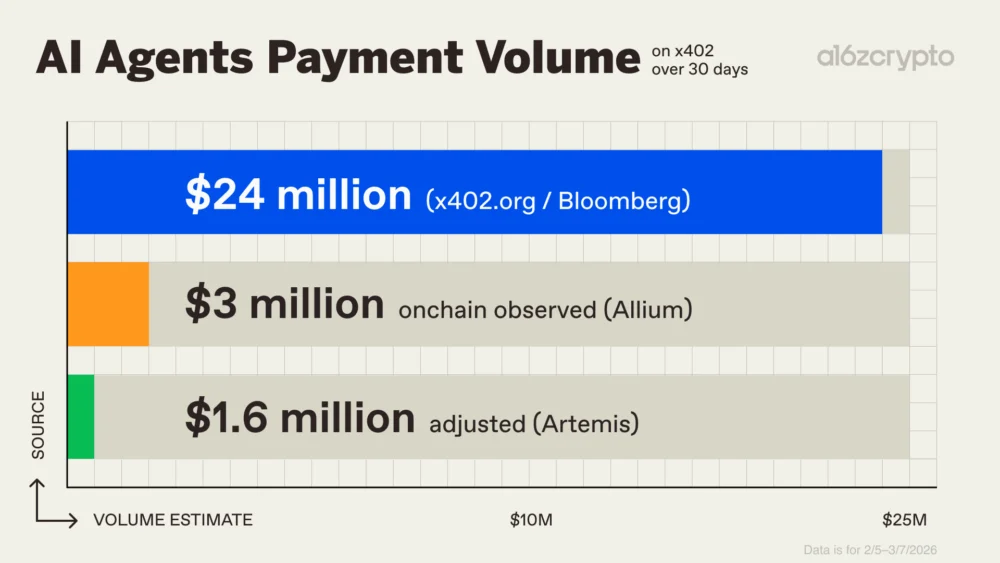
The burgeoning landscape of autonomous artificial intelligence agents is currently navigating a significant disconnect between market enthusiasm and on-chain reality, as recent data suggests that actual payment volumes are more than 90% lower than initial reports indicated. Despite this discrepancy, the world’s largest financial and technology institutions are aggressively deploying capital and engineering resources to build the rails for a future "machine-to-machine" economy. This development comes as Noah Levine, a partner at the venture capital firm Andreessen Horowitz (a16z), highlighted a stark contrast between reported transaction figures and verified on-chain activity, suggesting that while the "agentic" economy is in its infancy, the infrastructure to support it is reaching a critical mass of adoption.
The controversy over data accuracy began following a Bloomberg report published on Saturday, which cited data from x402.org indicating that AI agents had processed approximately $24 million in payments over a rolling 30-day period. However, subsequent analysis by Allium Labs and a16z has challenged these figures. According to Levine, more granular data suggests that the total volume of AI agent transactions over the same period was closer to $3 million. Furthermore, when filtering out "wash trades"—transactions where the same entity trades with itself to create the illusion of volume—the actual economic activity drops to roughly $1.6 million. This 93% gap between the headlines and the reality underscores the challenges of measuring a financial ecosystem that is still evolving its fundamental reporting standards.
The Measurement Gap and the State of Agentic Commerce
The discrepancy in transaction data is not merely a matter of accounting but a reflection of the "early-stage" nature of the measurement infrastructure itself. As Noah Levine noted in a public statement on Wednesday, the difficulty in tracking these payments stems from the way AI agents interact with blockchain protocols and traditional APIs. The $1.6 million in monthly volume, while modest compared to global payment networks, represents a specific subset of activity primarily centered around developer tools and specialized AI services.
Current AI payment activity is concentrated in a few key areas that facilitate the "agentic" workflow. Platforms like Firecrawl, which converts websites into data formats readable by large language models (LLMs), offer web scraping services for as little as one cent per query. Similarly, Browserbase provides AI-centric web browser sessions, and Freepik facilitates automated image generation. While these companies maintain traditional credit card payment gateways, they have begun integrating the x402 protocol to allow developers and autonomous agents to purchase services on a per-use basis. This "pay-as-you-go" model is essential for agents that may need to perform thousands of micro-transactions without the friction of maintaining dozens of separate monthly subscriptions.
The x402 Protocol and the Evolution of Machine-to-Machine Payments
At the heart of this infrastructure is x402, a payment standard developed by Coinbase designed to facilitate crypto payments over HTTP. The protocol is intended to serve as a bridge between the traditional internet and decentralized finance, allowing AI agents to navigate the web and pay for resources—such as API access, data, or compute power—using digital assets. Unlike human-centric payment systems that require multi-factor authentication and manual approval, x402 enables a programmatic approach to commerce.
The significance of x402 lies in its ability to handle the high frequency and low value of machine transactions. Traditional credit card networks often struggle with transactions valued at fractions of a cent due to fixed processing fees. By utilizing stablecoins like USDC and layer-2 blockchain networks, the x402 protocol aims to make micro-payments economically viable. This technology is being positioned as the "financial nervous system" for autonomous agents that operate without human intervention, requiring a medium of exchange that is as programmable as the code that governs them.
A Chronology of Recent Developments in the AI Payment Sector
The timeline of the past week illustrates the rapid pace of development and the high-level interest in the sector:
- Saturday, March 7: Bloomberg publishes an article highlighting the growth of stablecoin-based AI agent payments, citing a $24 million monthly volume. This report sparks widespread discussion about the readiness of the AI economy.
- Monday, March 9: Coinbase CEO Brian Armstrong publicly asserts that the number of AI agents making transactions will soon surpass the number of human transactors. He emphasizes the need for specialized payment rails that can accommodate machine logic.
- Wednesday, March 11: Noah Levine of a16z releases a counter-analysis, revealing that after filtering for wash trades and verifying with Allium Labs, the real economic volume is $1.6 million. He clarifies that the focus should be on the quality of the infrastructure rather than the current volume.
- Thursday, March 12: Coinbase announces that its x402 Facilitator has officially added support for Polygon, an Ethereum layer-2 network. This expansion allows developers to accept USDC payments across three major ecosystems: Polygon, Base, and Solana.
The expansion to Polygon is a strategic move intended to provide the "quick settlement and minimal fees" necessary for machine-to-machine transactions. By diversifying the supported networks, Coinbase is positioning x402 as a cross-chain standard capable of handling the diverse needs of different AI applications.

Institutional Betting on a Post-Human Economy
While the current $1.6 million monthly volume might seem insignificant to a multi-billion dollar industry, the list of companies integrating these protocols suggests a long-term strategic bet. Major payment and internet infrastructure giants, including Stripe, Cloudflare, and Vercel, have already integrated x402. Even more notably, Google has embedded the system into its own agent payments protocol.
The involvement of these "Big Tech" and "Big Fintech" players indicates a consensus that the future of the internet involves autonomous agents acting as the "default buyer." In this projected future, humans will no longer manually browse for every service or piece of data they require. Instead, they will deploy agents—such as Claude Code or the OpenClaw personal AI assistant—to perform tasks on their behalf. These agents will negotiate prices, verify service level agreements, and execute payments autonomously.
Levine’s analysis suggests that the current $1.6 million in volume is a "proof of concept" phase. The companies building the infrastructure are not betting on the current market size; they are betting on the total addressable market of an economy where billions of agents operate 24/7. This "agentic economy" would require a level of liquidity and transaction throughput that traditional banking systems are currently unequipped to provide.
Technical Requirements for Machine Commerce
The shift toward AI-driven commerce necessitates a fundamental change in how financial networks are structured. For a machine-to-machine payment to be viable, several criteria must be met:
- Low Latency: Agents often operate in real-time environments where a delay in payment confirmation could halt a complex workflow.
- Near-Zero Fees: When a transaction is worth one cent, a five-cent transaction fee is prohibitive. Layer-2 solutions like Base and Polygon, along with high-throughput chains like Solana, are designed to address this.
- Programmability: Payments must be conditional. An agent may be programmed to pay only if a specific data output is received and verified.
- Identity and Trust: In a world of anonymous agents, protocols must ensure that the "payer" and "receiver" are legitimate entities without requiring the heavy administrative burden of traditional KYC (Know Your Customer) for every micro-transaction.
The recent introduction of autonomous payment rails by companies like Alchemy on the Base network further illustrates this trend. Alchemy’s system allows agents to pay for blockchain data access directly using USDC, effectively removing the human from the loop of resource management.
Broader Implications and Future Outlook
The current discrepancy in data serves as a cautionary tale for investors and analysts regarding the "hype cycle" of AI and crypto integration. However, it does not diminish the underlying technological shift. The transition from human-led transactions to agentic transactions represents a shift from a "subscription-based" internet to a "utility-based" internet.
In the traditional SaaS (Software as a Service) model, a user might pay $20 a month for a tool they use twice. In the agentic model, an AI agent will pay exactly for what it consumes. This could lead to a more efficient allocation of resources but will require a massive overhaul of how digital services are priced and delivered.
The entry of Google and Stripe into the x402 ecosystem suggests that the lines between "crypto" and "traditional finance" are blurring in the context of AI. For these giants, the blockchain is not a speculative asset class but a superior database and settlement layer for automated commerce. As Coinbase CEO Brian Armstrong noted, the goal is to prepare for a world where "more AI agents than humans" are transacting. If this prediction holds true, the infrastructure currently being built—despite the low current volumes—will become the foundation of the global economy within the next decade.
As the industry moves forward, the focus will likely shift from basic payment protocols to more complex financial services for agents, including automated lending, insurance, and resource arbitrage. For now, the "gap" in the data serves as a reminder that the machine economy is still in its "dial-up" phase, waiting for the scale and maturity that only institutional-grade infrastructure can provide.