Reza Arap Oktovian
The Ethereum network is on the cusp of a monumental transition, often referred to as "The Merge," which will fundamentally alter its consensus mechanism from Proof-of-Work (PoW) to Proof-of-Stake (PoS). This intricate procedure, scheduled for later this year, is analogous to changing the engine of an airplane mid-flight, as Ethereum cannot cease block production under any circumstances. The success and security of this transition hinge critically on the diversity of client software that validators utilize to operate the network. Currently, a significant portion of the network’s staking power is concentrated on a single client, Prysm, raising concerns about the robustness and resilience of the upcoming Proof-of-Stake network.
The shift to Proof-of-Stake represents a paradigm change for Ethereum, aiming to drastically reduce its energy consumption and improve its scalability. Unlike many other blockchains, such as Bitcoin, which predominantly rely on a single client implementation, Ethereum’s development community, actively encouraged by the Ethereum Foundation and prominent figures, has championed the creation of multiple client software versions. These clients, often implemented in different programming languages by distinct development teams, are designed to provide redundancy and mitigate the risk of a single point of failure. This multi-client strategy is a cornerstone of Ethereum’s decentralized ethos, aiming to foster a more robust and secure network.
The Mechanics of The Merge: A Bifurcation of Duties
The Merge itself is not a simple amalgamation of two distinct chains. Instead, it’s a carefully orchestrated transition where existing Ethereum nodes, currently responsible for both transaction execution and validation under the PoW system, will see their roles bifurcated. A subset of these nodes will merge with the Beacon Chain, which has been operational since December 2020, serving as the foundation for the PoS consensus.
Post-Merge, two primary types of nodes will emerge:

-
Execution Nodes: These nodes will continue to interact with users and smart contracts, process transactions, and manage the Ethereum Virtual Machine (EVM). However, their validation duties will be offloaded. They will essentially function as transaction preparers, submitting them to validator nodes for final consensus. The core functionality of the EVM will remain largely intact, requiring only minor modifications to accommodate the new consensus layer.
-
Validator Nodes (on the Consensus Layer): These nodes, operating on the Beacon Chain, will be responsible for the critical task of validating transactions and proposing new blocks. They will derive their security from the staked Ether, effectively replacing the energy-intensive mining process of PoW.
This separation of duties is a key architectural enhancement, increasing the network’s robustness by distributing responsibilities across different logical layers. While execution clients share some code with their PoW predecessors, the validation aspect is entirely new, handled by the consensus layer clients.
The Peril of Client Centralization: A Critical Threshold
The fundamental rationale behind Ethereum’s multi-client approach is to safeguard against catastrophic network failures stemming from bugs or vulnerabilities within a single client. If a flaw is discovered in one client, the existence of other clients, built with different codebases and programming languages, ensures that the network as a whole can continue to operate. This contrasts with systems where a bug in the dominant client could potentially compromise the entire network.

The complexity of the Ethereum protocol, significantly greater than that of Bitcoin, necessitates this layered approach to security. Increased complexity inherently introduces a higher risk of vulnerabilities and expands the potential attack surface. Therefore, maintaining a healthy distribution of client usage is paramount.
The Ethereum community has established critical thresholds for client distribution to ensure network security:
-
Below 33% Staking Power: A bug in a client used by less than one-third of the network’s staking power would have minimal impact. The network would continue to operate smoothly, the bug would be identified and fixed, and normalcy would be restored.
-
Between 33% and 50% Staking Power: A bug in a client within this range would be more serious but would likely be managed by automated network mechanisms without significant user-facing disruptions.

-
Above 50% Staking Power: A critical bug in a client exceeding half of the network’s staking power would trigger a cascade of automated mechanisms. While intended to mend the situation, this scenario would inevitably lead to complications, network disturbances, and potential user impact.
-
Above 66% Staking Power (The Critical Threshold): This is the most precarious situation. If a bug affects a client used by more than two-thirds of the staking power, it essentially grants that client a super-majority. This could lead to a consensus failure, where the buggy chain finalizes, forcing non-buggy clients into an untenable position: either to permanently fork the chain, creating two separate Ethereums, or to join the compromised chain, accepting the consequences of the bug. The very principle of client diversity becomes nullified in such a scenario.
Prysm’s Dominance: A Cause for Concern
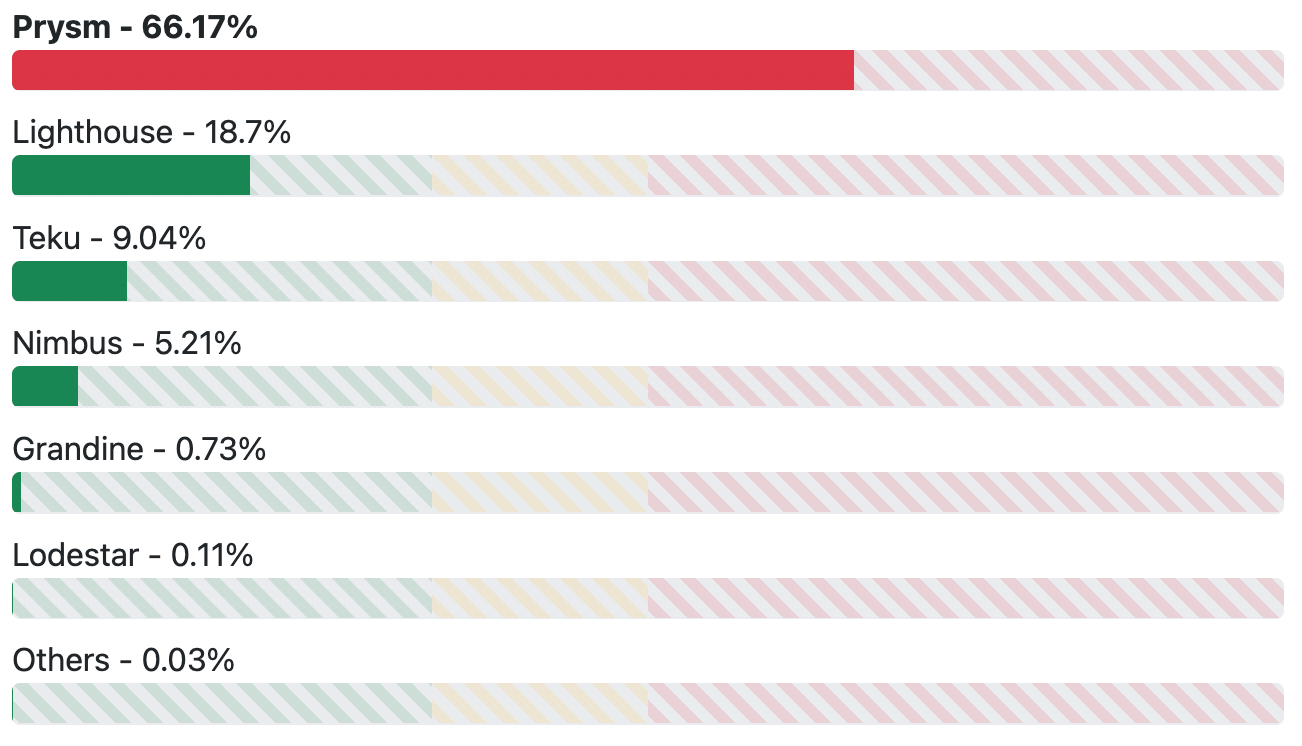
As of recent data, a striking statistic has emerged: approximately 66% of Ethereum’s staking power is currently running the Prysm client, developed by Prysmatic Labs. This level of concentration, while just shy of the critical 66% threshold for absolute consensus failure, is nonetheless a significant concern for network resilience. The potential for a consensus failure, though deemed unlikely by many, is a non-zero risk that cannot be ignored.
The competitive landscape of Ethereum consensus clients includes several other notable projects:
- Lighthouse: Developed by Sigma Prime.
- Teku: Developed by ConsenSys.
- Nimbus: Developed by Status.
- Grandine: A less prominent client with a very small market share.
- Loadstar: Another client with a minimal market presence.
It is worth noting that Grandine is reportedly published under a closed-source license, which can also raise concerns about transparency and community auditability.
The distribution of these consensus clients, as of early 2022, showed Prysm’s commanding lead. While Lighthouse and Teku hold substantial market shares, their combined presence, along with that of Nimbus, still falls considerably short of Prysm’s dominance. Resources such as clientdiversity.org aim to provide real-time data on this crucial metric.
Understanding Prysm’s Ascendancy
The question naturally arises: why has Prysm achieved such a dominant position in the Ethereum staking ecosystem? Ethereum core developer Marius van der Wijden, who works on the Geth (Go-Ethereum) Proof-of-Work client, offers insight into Prysm’s success:
"I think the big reasons for Prysm’s success are a first-mover advantage, tooling, and Golang," van der Wijden stated in an interview. "Prysm was the first prototype implementation of a beacon client. Thus, they could start optimizing their client early on and they had more time to create additional tooling (e.g., the Web UI) and good documentation."
He further elaborated on the significance of the programming language: "Another big advantage is the programming language used by Prysm – Golang – which is reasonably performant and very easy to read and develop in. Go-ethereum is also written in Golang, thus devs familiar with Geth could also easily understand and audit Prysm."
This familiarity with Golang among existing Ethereum developers facilitated quicker adoption and easier auditing of the Prysm client.
Execution Client Diversity: A Less Pressing, but Still Relevant, Issue
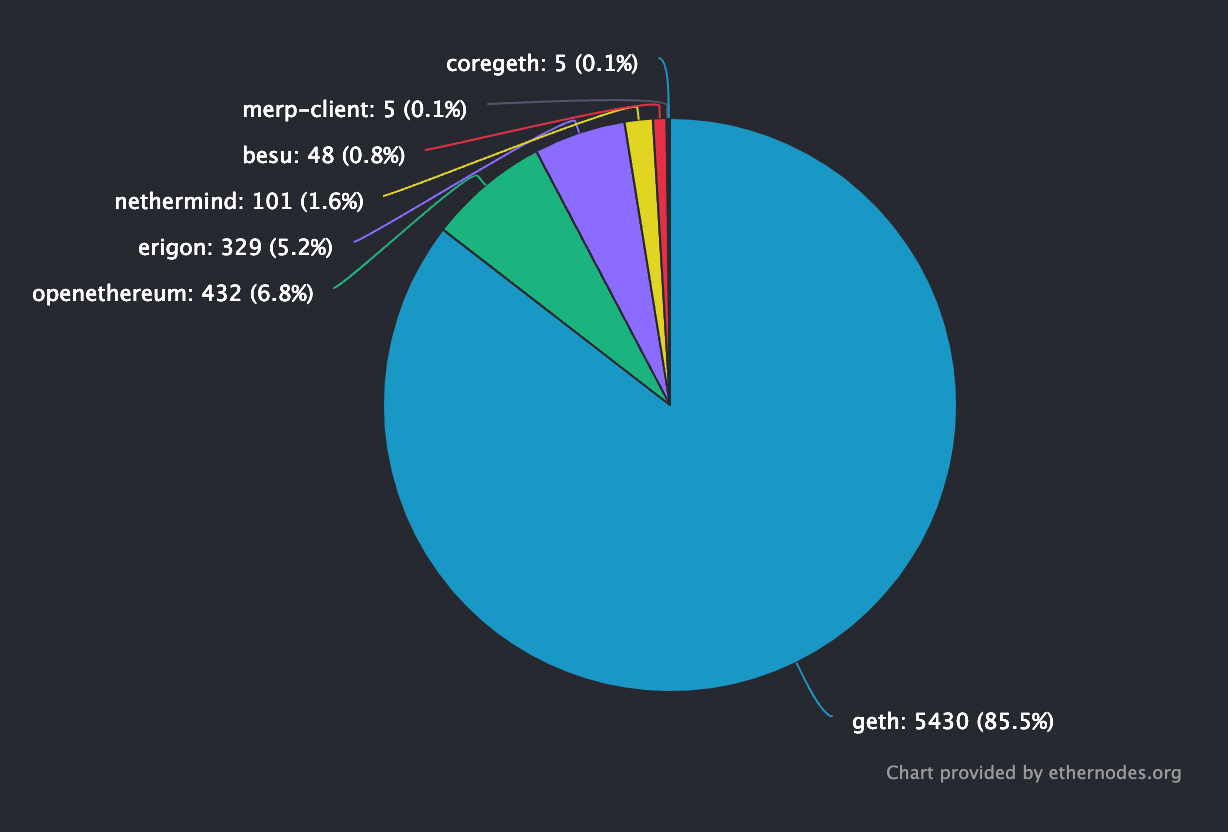
While the focus is heavily on consensus client diversity, the diversity of Proof-of-Work execution clients also warrants mention. Currently, Geth holds an overwhelming market share of over 85% in the PoW execution layer. However, this concentration is considered less critical in the post-Merge era.
"Go-ethereum currently has a supermajority of 85% on the execution layer. It will be a bit better post-merge since stakers can run multiple execution layer clients, with one beacon client, in order to always end up on the correct chain," explained van der Wijden. The primary role of execution nodes post-Merge will be transaction processing rather than network security, thus reducing the immediate risk associated with a single dominant execution client.
The Role of Major Exchanges in Prysm’s Dominance
A crucial factor contributing to Prysm’s high market share is the operational strategy of major cryptocurrency exchanges and staking services. These entities manage a significant portion of the total staked Ether, and their choice of client software has a disproportionate impact on overall client distribution.
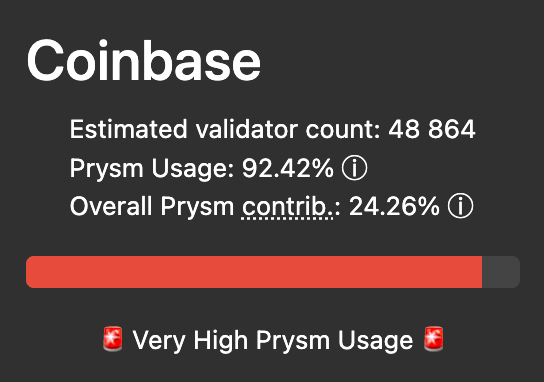
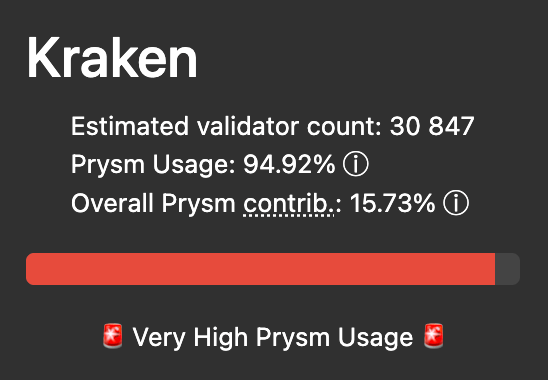
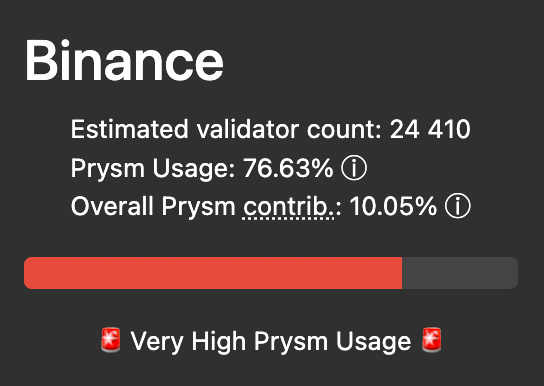
Several prominent staking services, including Coinbase, Kraken, and Binance, have been major contributors to Prysm’s dominance. For instance:
-
Coinbase: With a substantial number of validators, Coinbase reported that 92.4% of its validators were running the Prysm client. This alone accounted for a significant percentage of the network’s overall Prysm usage. In response to inquiries about client diversity, Coinbase Cloud emphasized security as the primary driver for selecting Prysm, citing its support for remote signers, a feature crucial for enhanced validator security by isolating private keys. While acknowledging support for Lighthouse, Coinbase’s initial reliance on Prysm stemmed from its perceived maturity and security features.
-
Kraken: Similarly, Kraken reported a high percentage of Prysm usage among its validators. However, Kraken has also indicated a proactive approach to diversifying its client base, initiating the rollout of new validators built on the Teku client and migrating some existing ones. This strategic shift aims to bolster client diversity and offer a more resilient staking service.
-
Binance: While Binance did not provide specific comments to CryptoSlate for this article, its validator setup also contributes to the overall Prysm dominance.
-
Lido: As a leading decentralized staking pool, Lido manages a substantial number of validators. While its Prysm usage is lower than that of some centralized exchanges, it still represents a significant contribution to Prysm’s overall market share.
These large-scale staking operations, driven by a confluence of factors including ease of use, existing infrastructure, and perceived security benefits, have inadvertently concentrated a substantial portion of staking power onto a single client.
Decentralized Alternatives and Emerging Trends
In contrast to the centralized behemoths, decentralized staking solutions like Rocket Pool exhibit significantly better client diversity. Rocket Pool, with a smaller but dedicated validator base, demonstrates a much lower reliance on Prysm, contributing minimally to the overall dominance issue. This highlights the potential for decentralized protocols to foster greater client distribution naturally.
The situation is not static, however. Discussions are actively underway between major staking services and the Ethereum Foundation regarding client diversity. According to Marius van der Wijden, the progress of these conversations is "good."
"Yes, there are talks about this, both internally and externally," van der Wijden confirmed. "I think big staking pools are working on switching parts of their infrastructure to other clients. They need to update their metrics and monitoring infrastructure for the new clients, so it might take longer for them to switch than home validators."
Switching client software is generally considered a straightforward process for individual node operators, with extensive testing and maintenance of all major implementations. However, larger staking services face more complex integration challenges due to their sophisticated infrastructure and API dependencies.
Assessing the Safety of The Merge
With The Merge approaching, the Ethereum community faces the reality of a less-than-ideal client distribution. The likelihood of Prysm’s dominance falling below the 33% threshold in the short term appears minimal. Despite this, the core Ethereum developers remain committed to pursuing The Merge.
"I think it’s safe to pursue," van der Wijden asserted. "The chances of a consensus failure happening are very small in my opinion. We have great testing and fuzzing infrastructure that runs permanently to find differences between clients. Even if a consensus failure occurs, we will be able to push out new releases and resolve forks quickly and easily."
Furthermore, he emphasized a crucial aspect of the community’s approach: "We also have strong consensus that we will not bail out stakers that run a majority client if their clients misbehave." This policy underscores the responsibility of node operators to maintain adequate client diversity and mitigate risks associated with over-reliance on a single client.
The Ethereum Foundation and its development partners are actively working to address the client diversity challenge. While the transition to Proof-of-Stake is an immense technical undertaking, the ongoing dialogue and the development of alternative clients provide a pathway towards a more decentralized and resilient Ethereum network in the long term. The success of The Merge, and indeed the future security of Ethereum, will partly depend on the community’s collective ability to foster and maintain robust client diversity.