Reza Arap Oktovian
Ethereum, the world’s second-largest blockchain by market capitalization and a cornerstone for hundreds of billions of dollars in digital assets, is poised for a monumental transition later this year. The network is set to move from its current Proof-of-Work (PoW) consensus mechanism to a more energy-efficient Proof-of-Stake (PoS) model. This undertaking, often likened to "changing the engine of an airplane while flying it," requires Ethereum to maintain continuous block production without interruption. Unlike many other prominent blockchains, such as Bitcoin, Ethereum’s development philosophy, actively encouraged by the Ethereum Foundation (EF) and key community figures, embraces the creation of multiple client software implementations. These distinct client versions, developed by various teams and often written in different programming languages, are designed to enhance the robustness and resilience of the PoS network, colloquially known as Ethereum 2.0.
The Merge: A Paradigm Shift in Network Operations
The upcoming transition, widely referred to as "The Merge," signifies a crucial integration. It will unite the existing Ethereum network nodes, among which a subset currently acts as miners, with the beacon chain, which has been operational since December 2020. A significant outcome of this merger will be the separation of node responsibilities. Currently, nodes perform both the execution and validation of transactions. Post-Merge, this dual role will be bifurcated.

Execution nodes will continue to interface with users and smart contracts through the Ethereum Virtual Machine (EVM), process transactions, and relay them to validator nodes for final validation. Essentially, their role will largely mirror their current function, with the critical difference being that the validation duty will be transferred to the validator nodes operating on the consensus layer. The consensus clients, on the other hand, will be responsible for proposing and attesting to new blocks, thus securing the network.
The development teams have engineered the system such that execution and consensus clients share some code, particularly when written in the same programming language. Execution clients have undergone minor adjustments to facilitate their integration into the new architecture. Core components of the execution client, such as the EVM, remain largely reusable with minimal modifications. Eventually, execution clients may shed the code segments responsible for validation on the current PoW chain.

The Merge, therefore, is not a simple amalgamation of two distinct chains into one. Instead, it represents a precise event at a predetermined block height where current nodes will cease their validation activities, handing over this critical function to validators. This architectural enhancement leverages the principle of separation of duties, distributing critical functions across different logical layers to bolster network robustness.
The Criticality of Client Diversity: A Single Point of Failure Risk
The rationale behind fostering multiple client implementations is rooted in a fundamental security principle: redundancy. If a fault, bug, or vulnerability emerges within one client software, it is intended that other clients, operating with independent codebases and potentially different programming languages, will remain unaffected. This diversification is a direct countermeasure against systemic failure.

The contrast with Bitcoin is notable. The Bitcoin protocol and its primary implementation are comparatively simpler. Ethereum, being a far more complex ecosystem—an order of magnitude more intricate than Bitcoin—inherently carries a higher risk of vulnerabilities and presents a broader attack surface. This complexity necessitates a robust strategy for managing potential failures, with client diversity being a key pillar.
However, the effectiveness of this strategy is contingent upon a balanced distribution of client usage. The underlying assumption is that no single client should command an overwhelming majority of the network’s staking power. Specifically, if one client is utilized by more than 33% of the total staking power, the principle of diversification begins to erode. The situation becomes critically precarious if a single client is adopted by over 66% of the staking power, as is currently the case, rendering the very concept of having disparate codebases largely moot in the face of a widespread vulnerability.

The implications of client distribution on network stability are profound. If a critical bug affects a client with less than one-third of the staking power, the network can typically absorb the shock. Other clients will continue to operate, and the affected client can be patched and brought back online with minimal disruption. Should a bug impact a client holding between one-third and one-half of the staking power, the network might experience some minor issues, but automated recovery mechanisms are generally expected to manage the situation without significant user-facing consequences.
The scenario becomes more serious when a bug affects a client with over 50% of the staking power. While automated protocols will likely initiate corrective actions, these can lead to network complications and disruptions for users. The most dire consequence arises if a bug affects a client used by more than two-thirds of the staking power. In such a scenario, the buggy client possesses a supermajority, granting it undue influence over network consensus. The compromised chain would likely finalize, leaving other clients with two unpalatable options: either permanently fork the chain, creating two separate Ethereum networks, or capitulate and join the buggy chain, accepting whatever adverse effects the bug has introduced.
Prysm’s Dominance: A Cause for Concern
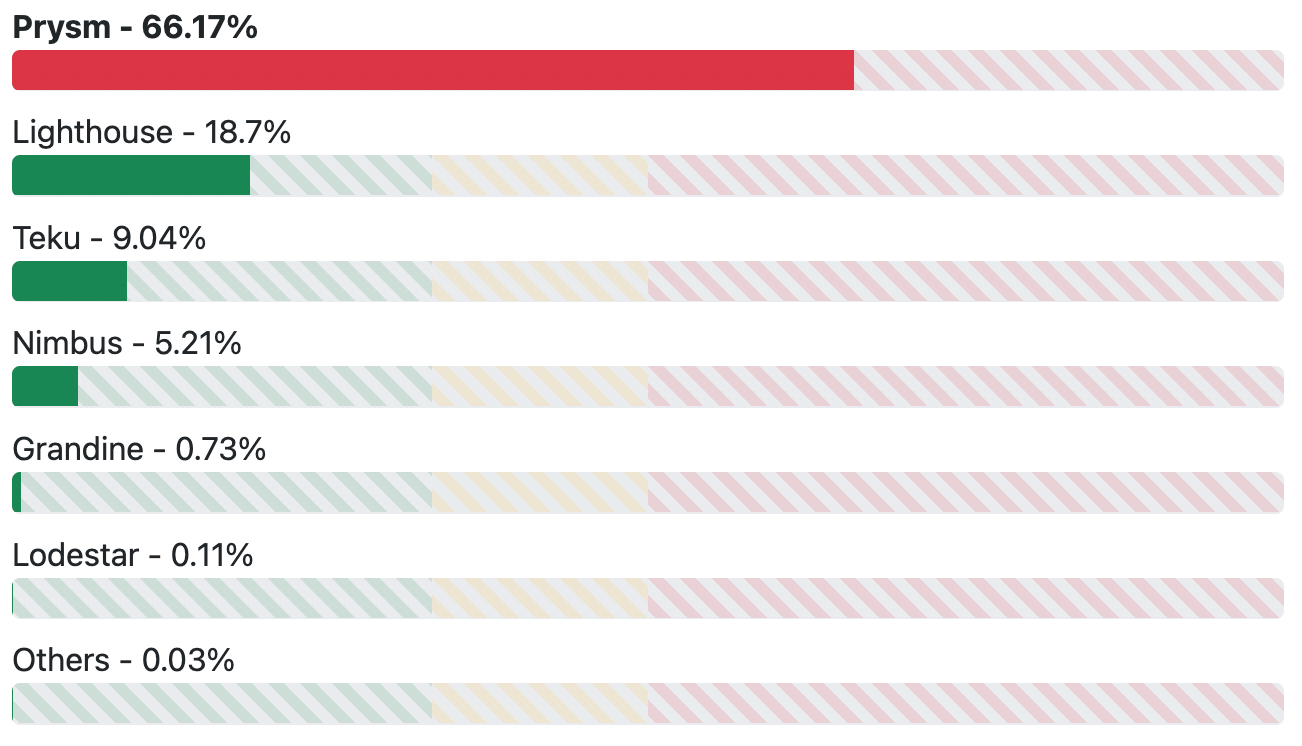
As of recent data, approximately 66% of Ethereum’s staking power is channeled through the Prysm client, developed by Prysmatic Labs. This concentration of power is far from ideal, particularly in the event of a critical bug within the Prysm client that could be exploited to trigger a network-wide consensus failure. While the likelihood of such a scenario is considered low, it remains a non-zero risk.
The Ethereum network utilizes several other consensus clients, including Lighthouse, Teku, and Nimbus. Two other clients, Grandine and Loadstar, possess very small market shares, each below 1%. Notably, Grandine is the only client operating under a closed-source license, which further limits transparency and potential community audit. The distribution of consensus clients, as depicted in available charts, shows Prysm’s overwhelming dominance, hovering just below the critical two-thirds threshold. Resources like clientdiversity.org aim to provide real-time data and insights into this distribution.
The question of why Prysm has achieved such significant adoption is pertinent. Multiple factors contribute to its leading position. Ethereum core developer Marius van der Wijden, who works on the Geth (Golang Ethereum) Proof-of-Work client, attributes Prysm’s success to several key advantages:
- First-Mover Advantage: Prysm was among the earliest prototype implementations of a beacon chain client. This early start allowed the team to begin optimization and development ahead of competitors, accumulating valuable experience and refining their codebase.
- Comprehensive Tooling and Documentation: The Prysm team has invested in developing robust tooling, including a user-friendly Web UI, and has produced comprehensive documentation, which significantly lowers the barrier to entry for users and developers.
- Golang Programming Language: Prysm is written in Golang, a language known for its performance, ease of development, and readability. This choice is significant because the widely used Go-ethereum (Geth) execution client is also written in Golang. Developers familiar with Geth’s architecture can more readily understand, audit, and contribute to Prysm.
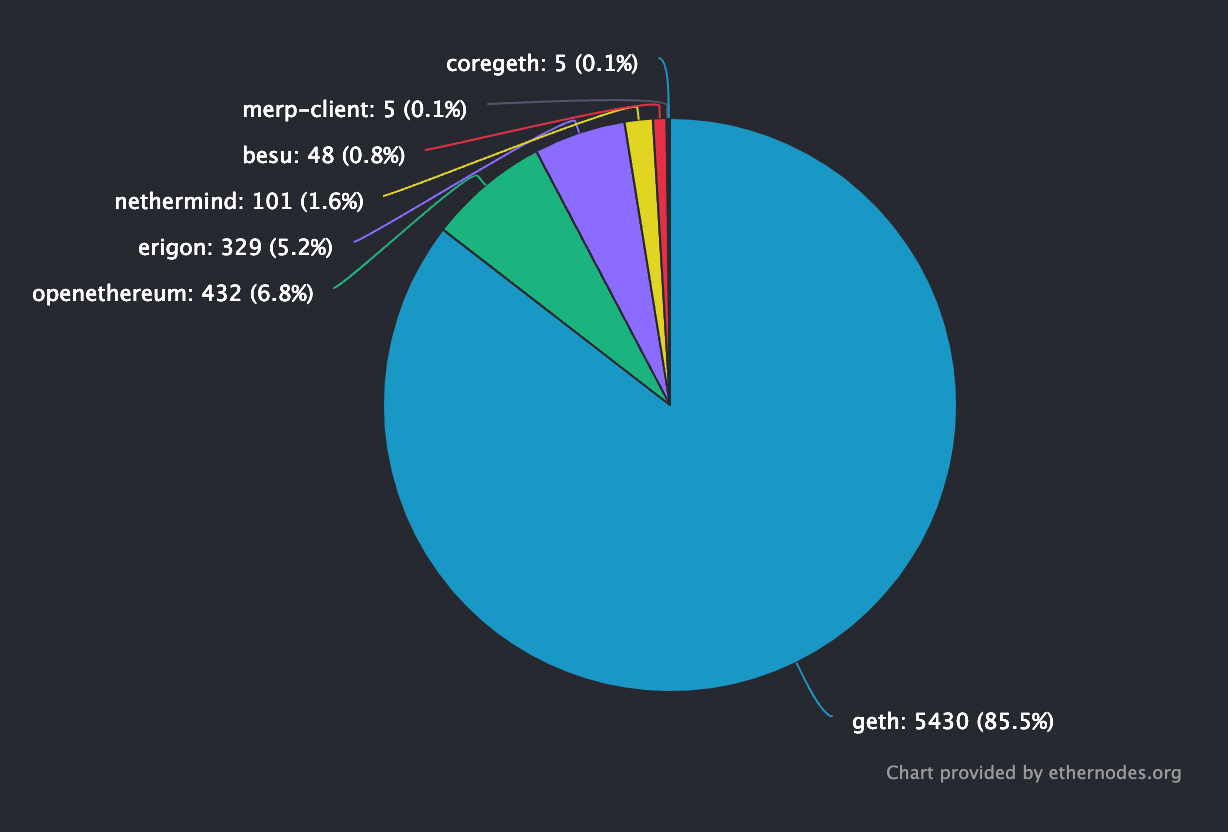
While the dominance of Geth in the execution layer is even more pronounced, exceeding 85% of the market share, this is considered less of a concern post-Merge. Execution nodes primarily handle transaction processing, whereas consensus clients are directly responsible for network security and validation. After the Merge, stakers will have the flexibility to run multiple execution layer clients alongside a single beacon client to ensure they remain on the correct chain.
Major Exchanges Fuel Prysm’s Dominance
The issue of client diversity is exacerbated by the operational choices of major staking services and pools. These entities, which aggregate significant amounts of staked Ether, often on behalf of numerous users, are substantial contributors to Prysm’s high utilization rate. Their decision to predominantly run Prysm amplifies the concentration of staking power.
Prominent among these are exchanges like Coinbase, Kraken, and Binance. Coinbase, operating a substantial number of validator nodes, has shown a particularly high reliance on Prysm. As of recent data, Coinbase runs a significant portion of its validators on Prysm, contributing a considerable percentage to the overall Prysm dominance.
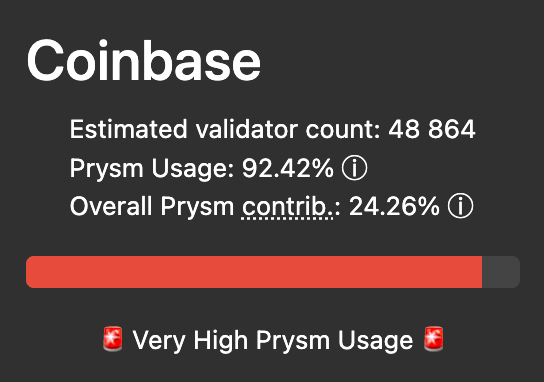
When queried about the client diversity issue and their role in it, Coinbase pointed to a statement from Coinbase Cloud. The company emphasized that its primary motivation for choosing Prysm was security. Specifically, Prysm was the initial viable client supporting "remote signers," a feature that allows validator keys to be generated and stored in isolated environments, separate from the validator itself. This separation significantly enhances the security of ETH2 validators by minimizing the risk of key compromise. Furthermore, remote signers enable Coinbase Cloud to offer double-signing protection through specialized software, safeguarding validators against issues within client signing modules. Coinbase Cloud also noted its support for Lighthouse and efforts to integrate remote signer capabilities into it.
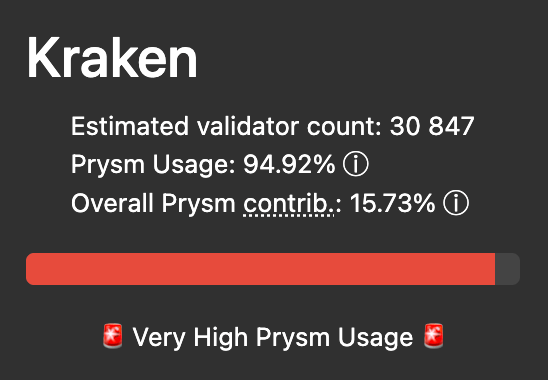
Kraken, another major exchange, also acknowledged its initial reliance on Prysm due to its perceived maturity and stability. However, Kraken has since begun deploying new validators on the Teku client and migrating some existing ones, a proactive step to enhance client diversity and offer a more resilient staking service.
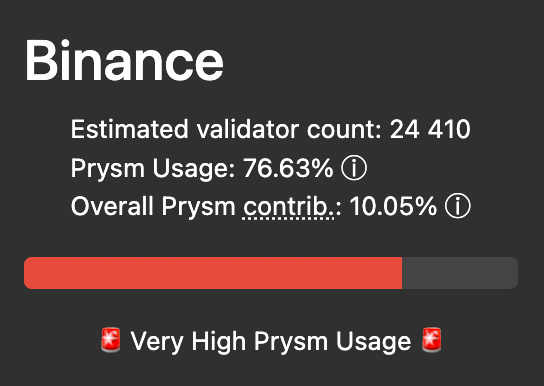
Binance, while not providing a direct comment to inquiries, also exhibits a significant Prysm usage rate among its validators.
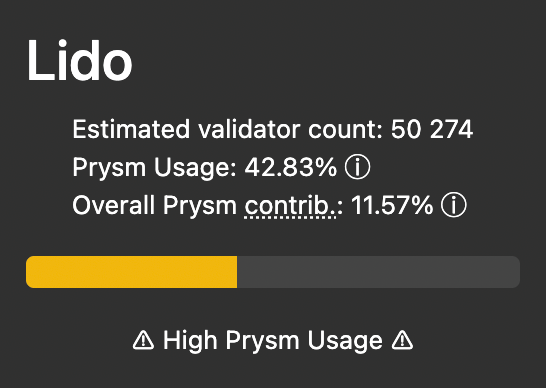
Lido, a prominent liquid staking solution, while having a larger validator count than Binance, also contributes significantly to Prysm’s dominance, though its Prysm usage rate is lower than some of the exchanges.
In contrast, decentralized staking pools like Rocket Pool demonstrate a much more favorable client distribution. Rocket Pool has a considerably lower percentage of its validators running Prysm, making its contribution to the overall Prysm dominance minimal.
Collaborative Efforts and Future Outlook
The concentration of staking power on Prysm is a recognized challenge within the Ethereum community. Discussions are actively underway among major staking services, and between these services and the Ethereum Foundation, to address this imbalance. According to Marius van der Wijden, these discussions are progressing positively. He indicated that large staking pools are actively working on migrating portions of their infrastructure to alternative clients. This transition, while not inherently risky or complex for individual node operators, requires significant effort for larger entities to update their monitoring and metrics infrastructure for new clients.
The Ethereum community faces a near-term reality where Prysm’s dominance is unlikely to fall below the critical 33% threshold in the immediate period leading up to The Merge. Despite this less-than-ideal client distribution, core developers remain committed to proceeding with The Merge. Van der Wijden expressed confidence in the safety of pursuing the transition, citing the robustness of Ethereum’s testing and fuzzing infrastructure, which continuously seeks out discrepancies between clients. He asserted that even in the event of a consensus failure, the community possesses the capability to quickly deploy new releases and resolve any resulting forks.
Crucially, the Ethereum core development team has established a strong consensus that they will not provide bailouts for stakers who operate a majority client if that client misbehaves. This stance reinforces the importance of individual stakers actively participating in maintaining client diversity for the overall health and security of the Ethereum network. The success of The Merge and the long-term security of Ethereum hinge on a collaborative effort to foster a more balanced and decentralized client ecosystem.